
Thymosin Alpha 1 Benefits & Dosage | PeptideIQ
Thymosin Alpha 1 Benefits: Immune Support, Longevity, and How to Track Results
Thymosin Alpha 1 doesn't have the TikTok virality of BPC-157 or the skincare marketing budget behind GHK-Cu. What it has is four decades of clinical use, prescription approval in more than 35 countries, and a growing body of longevity researchers who treat it as one of the most evidence-backed immune peptides available. This guide covers the real thymosin alpha 1 benefits — immune activation, inflammation control, and the open questions that remain — plus how to actually know if it's working for you.
Key Takeaways
- Thymosin Alpha 1 is an immune-modulating peptide that activates T-cell production and reduces inflammatory markers, making it a foundation compound in many longevity and immune-support protocols.
- Research supports its role in immune resilience, cellular regeneration signaling, and stress recovery, with a favorable side-effect profile at standard doses.
- Typical longevity protocols run 4–12 weeks using 1–2mg subcutaneously, dosed daily or 3–5 times weekly, and most users tolerate it well as a solo peptide or within a stack.
- It pairs commonly with GHK-Cu, LL-37, MOTS-c, and NAD+ — each addressing a different layer of cellular and immune health.
- Tracking cortisol, CRP, and white blood cell trends alongside self-reported energy is the only reliable way to confirm a protocol is actually working.
Contents
- What Is Thymosin Alpha 1 and How Does It Support Immune Health?
- What Are the Key Thymosin Alpha 1 Benefits for Longevity?
- What Does the Clinical Research Say About Thymosin Alpha 1 Benefits?
- How Does Thymosin Alpha 1 Compare to LL-37 for Immune Support?
- What Peptides Stack Well With Thymosin Alpha 1 for Longevity?
- What's a Typical Thymosin Alpha 1 Dosage and Protocol for Longevity Users?
- How Can You Track Thymosin Alpha 1 Results Effectively?
- Is Thymosin Alpha 1 Safe and Well-Tolerated Long-Term?
What Is Thymosin Alpha 1 and How Does It Support Immune Health?
Thymosin Alpha 1 is a synthetic version of a peptide the thymus gland produces naturally, where it governs T-cell maturation and immune signaling. It's sold under the brand name Zadaxin in dozens of countries as a prescription immune therapy for hepatitis B and C, though it has never received FDA approval in the United States. Its defining trait is dual-action regulation — it can wake up an underperforming immune response and calm an overactive one, rather than pushing immunity in a single fixed direction.
That matters because the thymus gland shrinks with age — a process called thymic involution that begins in adolescence and accelerates after 40. By midlife, most people are producing a fraction of the naive T-cells they had at 20. Thymosin Alpha 1 doesn't reverse thymic shrinkage, but it mimics the signal the thymus would normally send, which is why it shows up so often in longevity and immune system peptide discussions.
What Are the Key Thymosin Alpha 1 Benefits for Longevity?
The core thymosin alpha 1 benefits are T-cell activation, reduced systemic inflammation, improved antiviral defense, and a low side-effect burden compared to many immunomodulators, with effects documented across decades of clinical use in real patient populations, not just longevity forum anecdotes. This evidence comes from hepatitis treatment, cancer adjunct therapy, and vaccine response studies.
The benefits people cite most often include:
- T-cell production and maturation — supports the adaptive immune system's ability to recognize and respond to new threats
- Lower inflammatory markers — CRP and other inflammation indicators trend down in several clinical populations
- Better vaccine and infection response — used clinically as an immune adjuvant in immunocompromised patients
- Reduced fatigue and improved recovery — commonly self-reported, though this is subjective and harder to measure than lab markers
 Falling inflammatory markers are the most measurable signal that an immune peptide protocol is working.
Reality check: The evidence for immune modulation is strong. The evidence that thymosin alpha 1 reverses biological aging is not — that claim is extrapolated from immune-aging research, not proven in dedicated longevity trials.
What Does the Clinical Research Say About Thymosin Alpha 1 Benefits?
Thymosin Alpha 1's clinical record centers on hepatitis B and C treatment, sepsis and severe infection support, and use as a cancer treatment adjuvant — areas where it has decades of peer-reviewed data and approval in more than 35 countries. Studies consistently show increased T-cell counts and improved immune markers in treated patient populations.
Where the evidence thins out is longevity-specific application. There is no large randomized trial testing thymosin alpha 1 purely as an anti-aging intervention in healthy adults. What exists is a reasonable mechanistic argument — immune decline drives much of age-related disease risk, and thymosin alpha 1 measurably counters immune decline — but that's an inference, not a longevity trial result. The long-term effects of peptides generally are still an active research area, and thymosin alpha 1 is no exception.
Worth knowing: Its dual immune-modulating action — sometimes called "immune rheostat" behavior — is also why it's studied for autoimmune-adjacent conditions, not just immune deficiency.
How Does Thymosin Alpha 1 Compare to LL-37 for Immune Support?
Thymosin Alpha 1 and LL-37 both support immune function, but through different arms of the immune system — thymosin alpha 1 works on adaptive immunity through T-cell maturation, while LL-37 is an antimicrobial peptide acting on innate, first-line defense against pathogens. They're often confused because both get grouped under "immune peptides," but their mechanisms and typical use cases barely overlap.
| Attribute | Thymosin Alpha 1 | LL-37 |
|---|---|---|
| Primary mechanism | T-cell maturation, adaptive immune modulation | Direct antimicrobial action, innate immune signaling |
| Best known for | Hepatitis therapy, immune resilience with age | Antimicrobial defense, wound and gut barrier support |
| Typical dose | 1–2mg subcutaneous, 3–5x weekly | Varies widely by protocol and formulation |
| Evidence level | Strong clinical evidence (non-US approved use) | Early human evidence, mostly preclinical/animal data |
| Regulatory status | Approved abroad, not FDA-approved | Not approved as a drug anywhere |
For a full breakdown of dosing and safety, the LL-37 peptide guide covers what the antimicrobial side of immune support looks like in practice.
What Peptides Stack Well With Thymosin Alpha 1 for Longevity?
Thymosin Alpha 1 stacks most commonly with GHK-Cu for cellular regeneration, LL-37 for antimicrobial coverage, and MOTS-c or NAD+ for mitochondrial energy support — each targets a distinct layer of the aging process rather than duplicating thymosin alpha 1's immune effect. Longevity users rarely run it alone once they've established baseline tolerance across a first cycle.
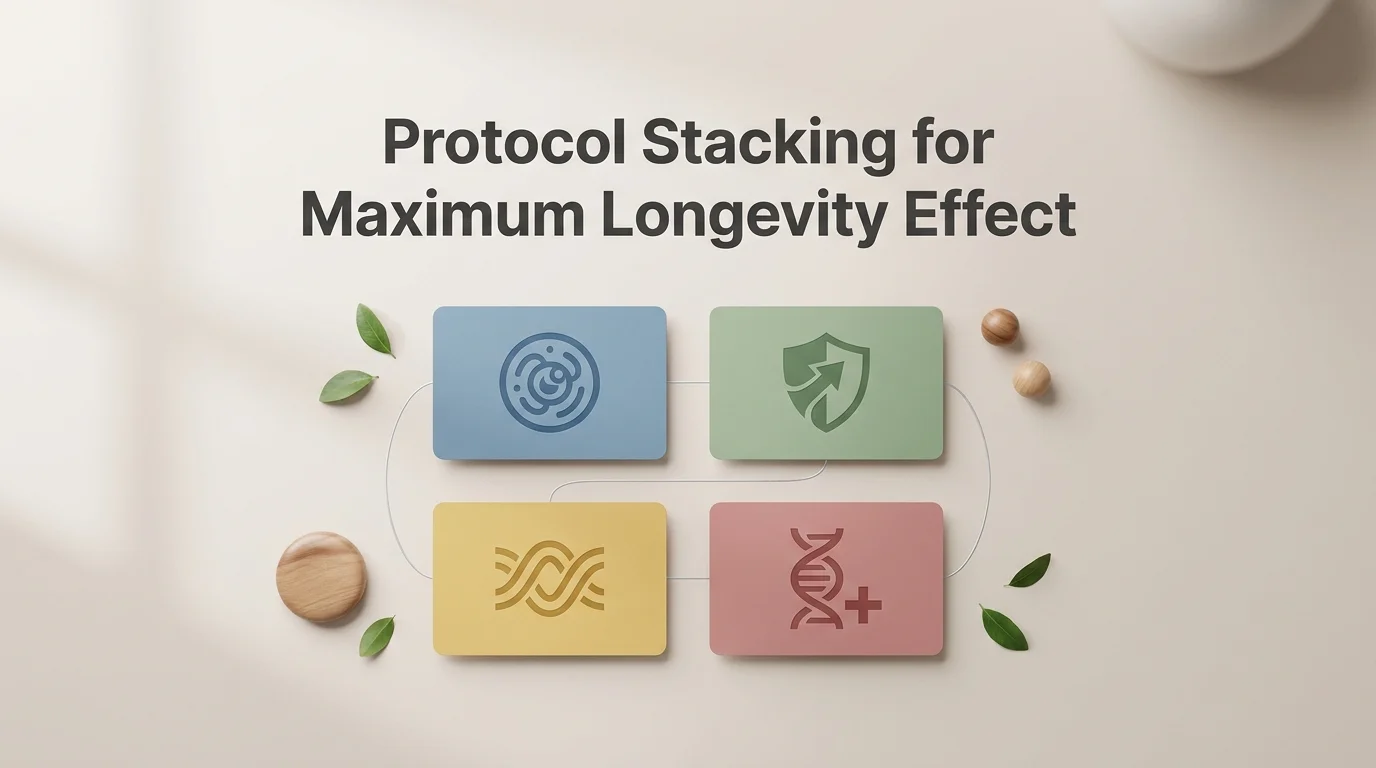 Each peptide in a longevity stack should address a different mechanism — immune, structural, antimicrobial, or metabolic.
Common longevity stack logic:
- GHK-Cu for cellular regeneration covers collagen synthesis and tissue repair, an area thymosin alpha 1 doesn't touch
- LL-37 adds gut and mucosal barrier support alongside thymosin alpha 1's systemic immune work
- MOTS-c as a complementary longevity peptide targets mitochondrial function and metabolic efficiency
- Growth hormone peptides like those covered in the CJC-1295 weight loss guide sometimes appear in advanced multi-protocol stacks, though the goals differ from pure immune support
Users running several peptides simultaneously face a real organizational problem — the BPC-157 and TB-500 stacking guide covers the same multi-protocol management challenge from the healing and recovery side of the peptide world.
What's a Typical Thymosin Alpha 1 Dosage and Protocol for Longevity Users?
A typical thymosin alpha 1 dosage for longevity purposes runs 1–2mg administered subcutaneously, either daily or 3–5 times weekly, over a 4–12 week cycle, with the exact length depending on the user's specific goal and starting immune markers. Protocol length varies — shorter cycles for a general immune tune-up, longer for chronic inflammation.
Most longevity protocols follow this rough shape:
- Weeks 1–2: Lower-end dosing to establish tolerance and monitor for injection site reactions
- Weeks 3–8: Maintenance dosing at the target amount, 3–5x weekly
- Weeks 9–12 (if extended): Continued maintenance or taper, depending on how markers are trending
- Rest period: Most users cycle off for several weeks before repeating, rather than running it continuously indefinitely
Pro tip: Dose timing matters less than consistency. Missed or irregular doses blunt the cumulative immune signaling effect more than a slightly off injection schedule.
How Can You Track Thymosin Alpha 1 Results Effectively?
Effective tracking combines subjective wellness metrics — energy, sleep, illness frequency — with objective bloodwork: CRP, white blood cell count, cortisol, and IGF-1, measured before starting and again every few weeks throughout the cycle to confirm the protocol is actually changing something measurable. Neither signal alone tells the full story.
 Tracking biomarkers alongside dose adherence turns "I think it's working" into a measurable trend line.
This is the part most peptide guides skip entirely, and it's where most self-guided protocols fail — not because the peptide doesn't work, but because there's no system connecting doses to outcomes. PeptideIQ's Bloodwork Tracker addresses this directly: it logs 15-plus longevity biomarkers, including IGF-1, cortisol, homocysteine, and CRP, and plots them against your actual dose adherence across a cycle. Instead of guessing whether week six felt different from week one, you can see your inflammation markers and immune indicators trending in the same view as your injection log — which is the only way to separate a working protocol from a placebo effect.
Practical tracking checklist:
- Pull baseline bloodwork before day one — CRP, WBC, cortisol, IGF-1 at minimum
- Re-test at the midpoint and end of the cycle, not just at the end
- Log energy, sleep quality, and illness frequency weekly, even briefly
- Compare adherence rate against marker movement — sporadic dosing muddies every result
Is Thymosin Alpha 1 Safe and Well-Tolerated Long-Term?
Thymosin Alpha 1 is generally well-tolerated, with mild injection site reactions being the most commonly reported issue and serious adverse events being rare across its decades-long clinical history in hepatitis and immune therapy use worldwide. That said, "safe in clinical hepatitis treatment" and "safe for indefinite longevity use" are not the same claim.
People with autoimmune conditions, or anyone on immunosuppressant therapy, should be cautious — a peptide that activates T-cell production can complicate a condition where the immune system is already overactive. The broader question of peptides' long-term effects applies here too: most safety data comes from defined treatment courses of months, not years of continuous use, which is exactly why measuring your own markers over time matters more than trusting a general safety claim.
Get Started with PeptideIQ
Reading about thymosin alpha 1 benefits is one thing — knowing whether your specific protocol is producing them is another. PeptideIQ's Bloodwork Tracker and AI co-pilot connect your dose history to your actual biomarker trends, so you're not left guessing between lab draws.
FAQ
How long does it take for thymosin alpha 1 to work?
Most users report subjective changes like improved energy within 2–4 weeks, while measurable shifts in bloodwork markers such as CRP or white blood cell counts typically take 4–8 weeks to show a clear trend. Individual response varies based on baseline immune status and dose consistency.
Who should not take thymosin alpha 1?
People with autoimmune conditions, those on immunosuppressant medications, and anyone with an active organ transplant should avoid thymosin alpha 1 without direct physician oversight. Because it activates immune response, it can theoretically worsen conditions where the immune system is already overactive.
What are the most common side effects of thymosin alpha 1?
The most frequently reported side effects are mild injection site redness or irritation, occasional headache, and short-term fatigue during the first week of a new cycle. Serious adverse events are uncommon in its clinical history, though long-term longevity-specific safety data remains limited.
Can thymosin alpha 1 help with hair growth?
There's no strong clinical evidence that thymosin alpha 1 directly promotes hair growth. Some anecdotal reports link improved hair quality to reduced systemic inflammation during a protocol, but this is an indirect effect at best, not a documented primary benefit.
What's a typical thymosin alpha 1 dosage for longevity protocols?
Longevity users typically dose 1–2mg subcutaneously, either daily or 3–5 times per week, over a 4–12 week cycle. Dosing usually starts conservatively for the first one to two weeks before moving to a maintenance schedule.
Is thymosin alpha 1 legal to use in the United States?
Thymosin alpha 1 is not FDA-approved as a drug in the US, but it is legally available through compounding pharmacies with a prescription in many states. Its legal status has shifted with recent peptide compounding policy changes, so availability can vary by state and provider.