

GLP-1 Side Effects: Timeline & What's Normal
GLP-1 Side Effects: What to Expect and How Long They Last
Nausea hits around day three. Fatigue feels heavier than expected in week one. Both usually fade out by week four, part of a fairly predictable timeline that holds across semaglutide, tirzepatide, and their branded versions — Ozempic, Wegovy, Zepbound, and Mounjaro.
GLP-1 side effects follow this arc closely enough to plan around, and up to half of users report nausea at some point during treatment — the single most common reaction across the entire drug class.
What Are the Most Common GLP-1 Side Effects?
The most common GLP-1 side effects are gastrointestinal — nausea, constipation, diarrhea, and stomach discomfort — followed by fatigue, dizziness, and appetite suppression. These symptoms trace back to the same mechanism that drives weight loss: GLP-1 receptor agonists slow gastric emptying and blunt hunger signals, and the digestive system needs time to adjust.
Reported rates vary by drug and dose, but the pattern holds across semaglutide, tirzepatide, and their branded versions:
- Nausea — the most frequently reported symptom, especially in weeks 1-3 of a new dose
- Constipation or diarrhea — often alternating, tied to slower gut motility
- Fatigue — usually mild, most noticeable in the first week at each new dose
- Reduced appetite — the intended effect, though it can tip into feeling under-fed if meals aren't adjusted
- Injection site soreness or redness — minor, typically gone within a day
- Dizziness — frequently linked to reduced fluid intake rather than the drug itself
Ozempic and semaglutide are the same compound, so the Ozempic side effects profile overlaps almost completely with what's described here. Brand differences mostly come down to dose scheduling, not the underlying symptoms.
Key Takeaways
- Most GLP-1 users (semaglutide, tirzepatide, Wegovy, Ozempic) experience at least one side effect in the first 2-3 weeks, with nausea and appetite changes being most common.
- Side effect severity typically peaks around week 2-3, then gradually improves; most users report roughly 80% improvement by week 6-8 as their body adapts.
- The timeline is predictable when tracked consistently — logging when symptoms appear, their severity, and when they resolve lets you separate normal adaptation from a genuine problem.
- Hair loss and muscle loss are delayed side effects (weeks 4-12+), less common than early nausea but requiring a longer tracking window to catch.
- Taking these side effects seriously and monitoring them isn't weakness — it's the difference between staying on a protocol that works and abandoning one that could have worked with better management.
When Do GLP-1 Side Effects Start and Peak?
GLP-1 side effects typically begin within the first one to three days of a new dose and peak between week two and week three. Every dose increase resets this cycle to some degree — a smaller version of the same adjustment period repeats each time you titrate up, which is why standard protocols raise dose gradually instead of all at once.
This staggered pattern is exactly why titration schedules exist in the first place. Jumping straight to a maintenance dose produces a much rougher first month than the standard four-week step-up most prescribers use.
Two things trip people up early on: telling normal adaptation apart from a symptom that's genuinely getting worse, and remembering what "worse than last week" actually felt like without a record. Semaglutide side effects follow this same start-and-peak arc almost exactly, since semaglutide is the active ingredient behind both Ozempic and Wegovy.
The GLP-1 Side Effect Timeline: Onset, Peak, and Resolution
Symptom timing follows a consistent enough pattern that it's worth mapping directly rather than describing in prose.
| Side Effect | Typical Onset | Peak Severity | Typical Resolution |
|---|---|---|---|
| Nausea | Days 1-3 | Week 2-3 | Week 4-6 |
| Fatigue | Days 1-7 | Week 1-2 | Week 3-4 |
| Constipation / diarrhea | Week 1-2 | Week 2-3 | Week 4-6 |
| Appetite suppression | Day 1 | Weeks 2-4 | Ongoing at a mild level (intended effect) |
| Hair thinning | Week 8-12 | Week 12-16 | 3-6 months after weight stabilizes or stopping |
| Muscle loss (without protein/resistance training) | Week 4+ | Progressive if unaddressed | Reversible with dietary and training changes |
Worth knowing: The two delayed effects — hair thinning and muscle loss — don't run on the same clock as the early GI symptoms, which is exactly why they get missed. Stop paying attention after week 4 because the nausea passed, and it's easy to miss the pattern that matters most.
Which GLP-1 Side Effects Fade vs. Persist
Early GI symptoms — nausea, fatigue, digestive changes — are adaptation responses. They show up because your body is adjusting to a new mechanism, and they reliably fade within four to six weeks of a stable dose.
Delayed effects work differently. Hair thinning stems from rapid weight loss triggering a shift in the hair growth cycle (telogen effluvium), not the drug directly — the same pattern shows up after any fast weight loss, surgical or pharmaceutical. It typically resolves once weight stabilizes. Muscle loss persists and compounds if you don't actively counter it, since GLP-1s reduce overall caloric intake without distinguishing between fat and lean tissue.
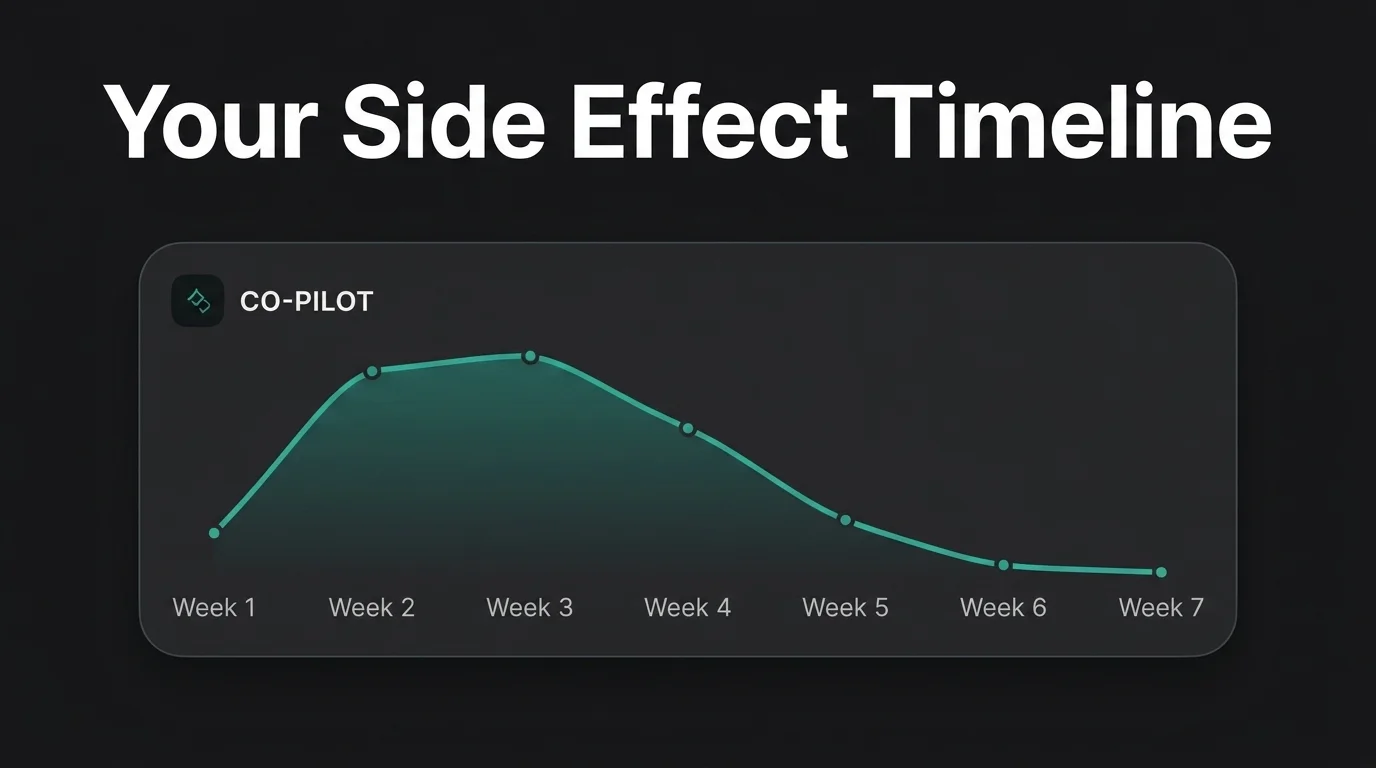 PeptideIQ's co-pilot turns a week of scattered symptom logs into a single trend line.
Why Does PeptideIQ Track Every Side Effect?
PeptideIQ tracks every side effect through a 15-symptom grid built into the dose logging flow — one tap records fatigue, nausea, headache, and eleven other symptoms alongside a severity rating each time you log a dose. That structure exists because the data only means something in context: a symptom logged once tells you little, but a symptom logged with a timestamp, a severity level, and a dose history behind it becomes a pattern you can act on.
Most people trying to answer "is this normal?" are working from memory — a fuzzy sense of feeling worse this week than last. The dose logging step-4 grid replaces that guesswork with a record: exactly which symptoms appeared, exactly how severe, and exactly which day of your protocol. Over a few weeks, that turns into a real trendline instead of an impression.
Track your progress with an app built around exactly this problem, and the pattern becomes visible well before it becomes something worth calling a doctor about.
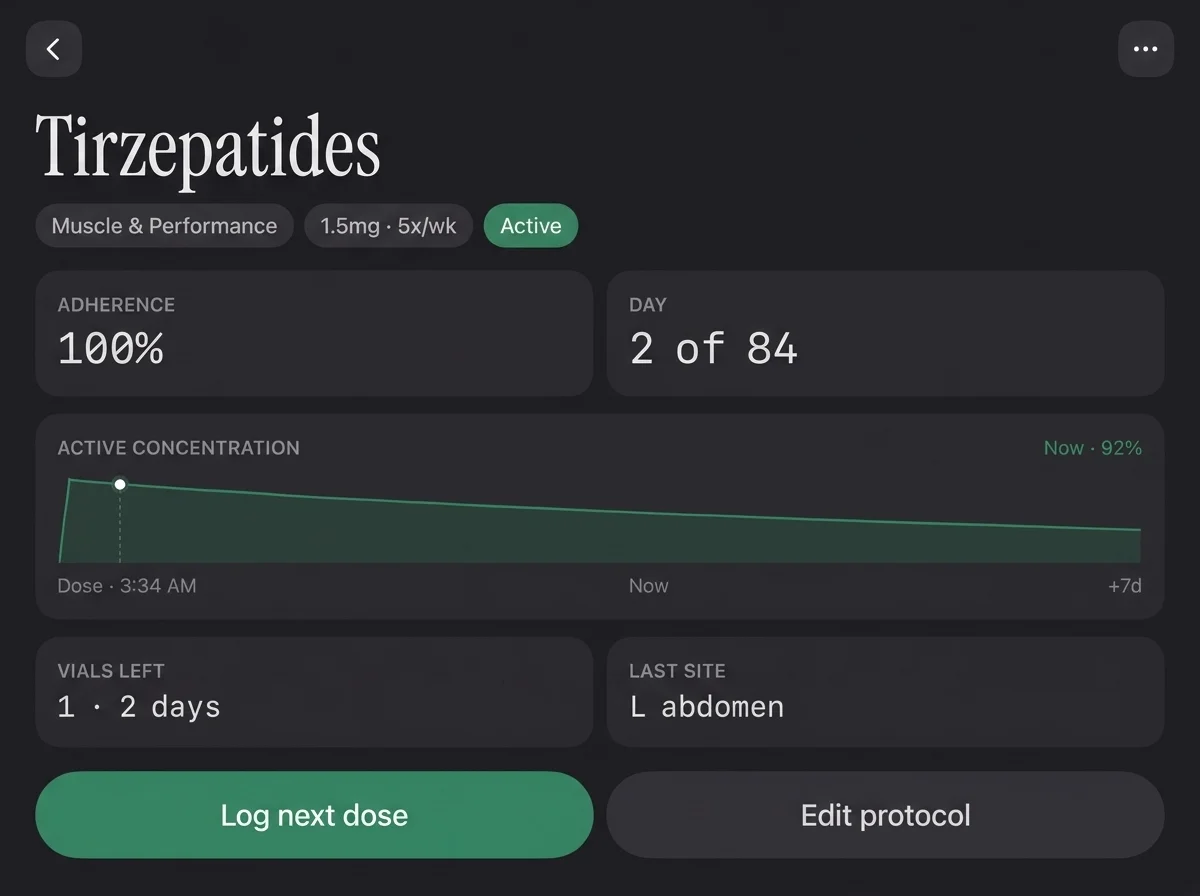 Consistent dose logging — like PeptideIQ's adherence tracking — is what makes a side-effect pattern visible in the first place.
Managing GLP-1 Side Effects Without Guesswork
Managing early GLP-1 side effects comes down to three levers: hydration, meal timing, and dose pacing. Small, protein-forward meals reduce nausea more reliably than skipping meals outright. Water intake matters more than most people expect — GLP-1s blunt the thirst signal itself, so dehydration often shows up as fatigue or dizziness rather than thirst.
- Eat smaller meals, more often, prioritizing protein and fiber over fat
- Front-load hydration earlier in the day rather than catching up at night
- Ask your prescriber about slowing your titration schedule if a dose increase hits hard
- Add resistance training two to three times a week starting in month one, before muscle loss becomes measurable
- Log symptoms consistently enough to notice a pattern, not just a bad day
Pro tip: If a symptom that had resolved comes back at the same severity without a dose change, that's the signal worth flagging to your prescriber — not the symptom itself showing up in week 1.
Are GLP-1 Side Effects Dangerous?
Most GLP-1 side effects are uncomfortable rather than dangerous, but a small subset require immediate medical attention: signs of pancreatitis (severe abdominal pain radiating to the back), gallbladder issues (sharp right-upper-abdomen pain), or severe dehydration from persistent vomiting. These are uncommon, but they don't follow the gradual peak-and-fade pattern ordinary side effects do.
The distinction that matters: normal side effects trend toward improvement week over week. Anything that suddenly worsens, doesn't fit the expected timeline, or arrives with severe pain is worth a call to your prescriber, regardless of how far into your protocol you are.
Get Started with PeptideIQ
Side effects that follow a known timeline are manageable. Side effects you can't place on a timeline just feel like something going wrong. PeptideIQ's dose logging and AI co-pilot exist to close that gap — turning scattered symptoms into a pattern you and your prescriber can actually read.
Join the PeptideIQ Waitlist — track every dose and side effect with an AI co-pilot that knows your specific cycle.
Not ready yet? Learn how PeptideIQ works — free access to the peptide library and AI co-pilot at launch.
Frequently Asked Questions
Does a higher GLP-1 dose mean worse side effects?
Not always. Higher doses tend to bring a short return of early symptoms like nausea during the first week of each increase, but severity doesn't scale linearly with dose. Gradual titration schedules exist specifically to prevent the harsher reaction a jump straight to a high dose would cause.
What GLP-1 side effects should prompt a call to your doctor?
Severe abdominal pain, especially radiating to your back, persistent vomiting that prevents fluid intake, and sharp pain under your right ribs all warrant an immediate call. These patterns don't match the gradual peak-and-fade timeline typical side effects follow, which is the key distinguishing signal.
Do GLP-1 side effects come back every time you increase your dose?
A milder version often does. Each dose increase can trigger a short return of nausea or fatigue lasting a few days to a week — smaller than the initial adjustment period. This is a normal, expected part of titration rather than a sign something has gone wrong.
Is nausea a sign that a GLP-1 medication is working?
Nausea reflects the drug slowing gastric emptying, the same mechanism behind appetite suppression — but it isn't a required signal of effectiveness. Plenty of people lose weight steadily with minimal nausea, and its absence doesn't mean the medication isn't working as intended.