
AOD 9604 Peptide: What the Human Trials Actually Showed
AOD 9604 Peptide: What the Human Trials Actually Showed
General education, not medical advice. AOD-9604 is not an FDA-approved weight-loss drug, and nothing here is a recommendation to use it or a dosing guide.
Search for the AOD 9604 peptide and the top results split into two camps. One is a 2013 safety paper written by people tied to the company that made the compound. The other is a run of vendor pages calling it a precise fat burner.
Neither is a neutral read, so this page checks what was really measured. If peptides are new to you, start with what a peptide is.
Key Takeaways
- AOD-9604 is a 16-amino-acid fragment modeled on the fat-metabolism end of human growth hormone. It is not an FDA-approved weight-loss drug.
- The human trials we can verify were funded by the sponsor and mostly tested safety. The one efficacy headline we found was a company announcement, and the larger follow-up is reported to have missed its goal.
- Reported side effects in trials were mostly mild, but the studies were short and used oral or IV dosing, not vials from a research-chemical seller.
- Purity of unregulated vials is unverified, so where it comes from matters as much as what it is.
- Whether any peptide is working for you is a question about your own logged trend, not a trial headline.
What the AOD 9604 Peptide Is, and How It Differs From Growth Hormone
AOD-9604 is a 16-amino-acid peptide built from a short stretch at the tail end of human growth hormone (hGH). It was developed to test whether that fragment could affect fat metabolism without the full hormone's wider effects, and the sponsor's data reported no meaningful change in IGF-1.
That IGF-1 point is the whole pitch. Full growth hormone raises IGF-1, which drives growth and affects blood sugar. A fragment that skips that step would, in theory, be a cleaner tool.
The 2013 safety paper by Stier, Vos and Kenley (Journal of Endocrinology and Metabolism) reports no significant IGF-1 change in its larger trials. Theory and a flat IGF-1 line are not the same as proof of fat loss, though. For the broader frame on how peptides act, see what peptides do to your body.
Six Trials, One Sponsor
That paper is the backbone of the safety picture. It summarizes six trials of AOD-9604, all funded by Metabolic Pharmaceuticals, and several of its authors declare ties to the company.
The trials escalated in size:
- Phase I and IIa: 15 healthy men, then small groups of obese men (17 to 36 people), using single IV doses, single oral doses, and a 7-day oral course.
- Phase IIb, 12 weeks: 300 obese adults, split across six groups of 50, taking daily oral doses.
- Phase IIb, 24 weeks: 502 randomized obese adults taking daily oral tablets.
Notice what was tested: tablets and IV infusions. Nobody in these trials was injecting reconstituted vials under the skin.
What Did the Human Trials Actually Measure?
The 2013 paper measured safety and tolerability: adverse events, IGF-1, fasting glucose, glucose tolerance, and antibody formation. It does not report the weight-loss results, so it cannot be used to claim AOD-9604 works for fat loss.
 A flat-looking line is what small effects often look like on a chart.
Across the trials, the authors report mostly mild adverse events and no antibodies against the compound. In the 24-week trial, 18 people (3.6%) had serious adverse events at similar rates across groups. In the 12-week trial, five serious events included skin cancers, a breast cancer and a lipoma, and the investigators judged none related to the drug.
Reality check: "Judged unrelated" by sponsor-linked investigators in a 12-week study cannot rule anything in or out about cancer risk. The follow-up was simply too short.
Did AOD-9604 Produce Weight Loss in Human Studies?
The only efficacy number we could trace was a 2004 company announcement: in a 12-week, 300-person study, the 1 mg group lost about 2.8 kg, reported as more than triple placebo. A later 24-week, roughly 500-person trial is reported by secondary sources to have missed significance, and development stopped.
Take that in two steps. First, the 2004 figure came from a press release, not a peer-reviewed paper, and a different source gives the 1 mg result as 2.6 kg. Even taken at face value, under 3 kg in 12 weeks is a modest effect.
Second, the larger trial is the one that should carry more weight. The secondary sources describing its failure are not primary documents, so treat that as likely rather than settled.
What we can say plainly: we found no independent, peer-reviewed human trial showing clinically meaningful fat loss. The announcement itself is archived by News-Medical if you want to read the original wording.
That is also why "aod-9604 weight loss" claims on seller pages deserve suspicion. They usually cite rodent data or the 2004 headline without the follow-up.
Reported AOD 9604 Peptide Side Effects
Reported side effects in the human trials were mostly mild: headache was the most common, and the highest oral doses brought more diarrhea and gas. One IV participant had severe chest tightness judged possibly related. Long-term effects are unknown because no trial ran longer than 24 weeks.
Here is what the 2013 summary lists for AOD 9604 side effects:
- Headache across IV and oral dosing
- Diarrhea and flatulence at the highest oral dose in the 7-day study
- One severe chest-tightness event after an IV dose
- One serious diarrhea event possibly related to a high oral dose
Two caveats matter more than the list. These are tablet and IV findings, and none of them describes a vial of unknown purity. For evidence-quality thinking about any peptide, our guide to the safest peptides, ranked by evidence covers how to weigh this kind of data.
Worth knowing: Research-grade vials are not inspected the way a pharmacy product is. Contamination, wrong strength and mislabeling are risks that no trial in this section measured.
Is AOD-9604 FDA-Approved, and Is It Legal to Use?
No. AOD-9604 is not FDA-approved as a drug. A GRAS (generally recognized as safe) opinion for food use came from a panel the sponsor describes in its own paper, which is not an FDA approval. Legal status varies by country and by how a product is sold.
The FDA reviewed AOD-9604 in a November 2024 evaluation for the 503A compounding list. Secondary sources report that the advisory committee voted against adding it, so pharmacy access is restricted. We could not verify every later classification against an FDA page, so check the agency's current compounding lists directly.
Sport is stricter.
Several sources report that the World Anti-Doping Agency prohibits it, and anyone in tested competition should confirm that on the current list. Readers in the UK, Canada and Australia face their own regulators, with different rules and different enforcement. Our guide on whether peptides are legal goes through the wider picture.
Questions to Bring to a Clinician Before Considering AOD-9604
Ask what outcome would count as success, whether an approved option fits your goal better, what the source and purity of the product are, and what you would watch for. A clinician who knows your conditions and medications can say whether any of this applies to you.
Bring specifics rather than a general worry:
- What weight change over what period would make this worth continuing, and what would make us stop?
- Is there an approved weight-management option with stronger trial data?
- How do my current medications and conditions change the risk?
- Where is the product from, and is there a certificate of analysis I can verify?
If you are already weighing the decision, those four questions do more than any forum thread. We would not suggest the peptide to anyone who hasn't already decided on their own to look into it.
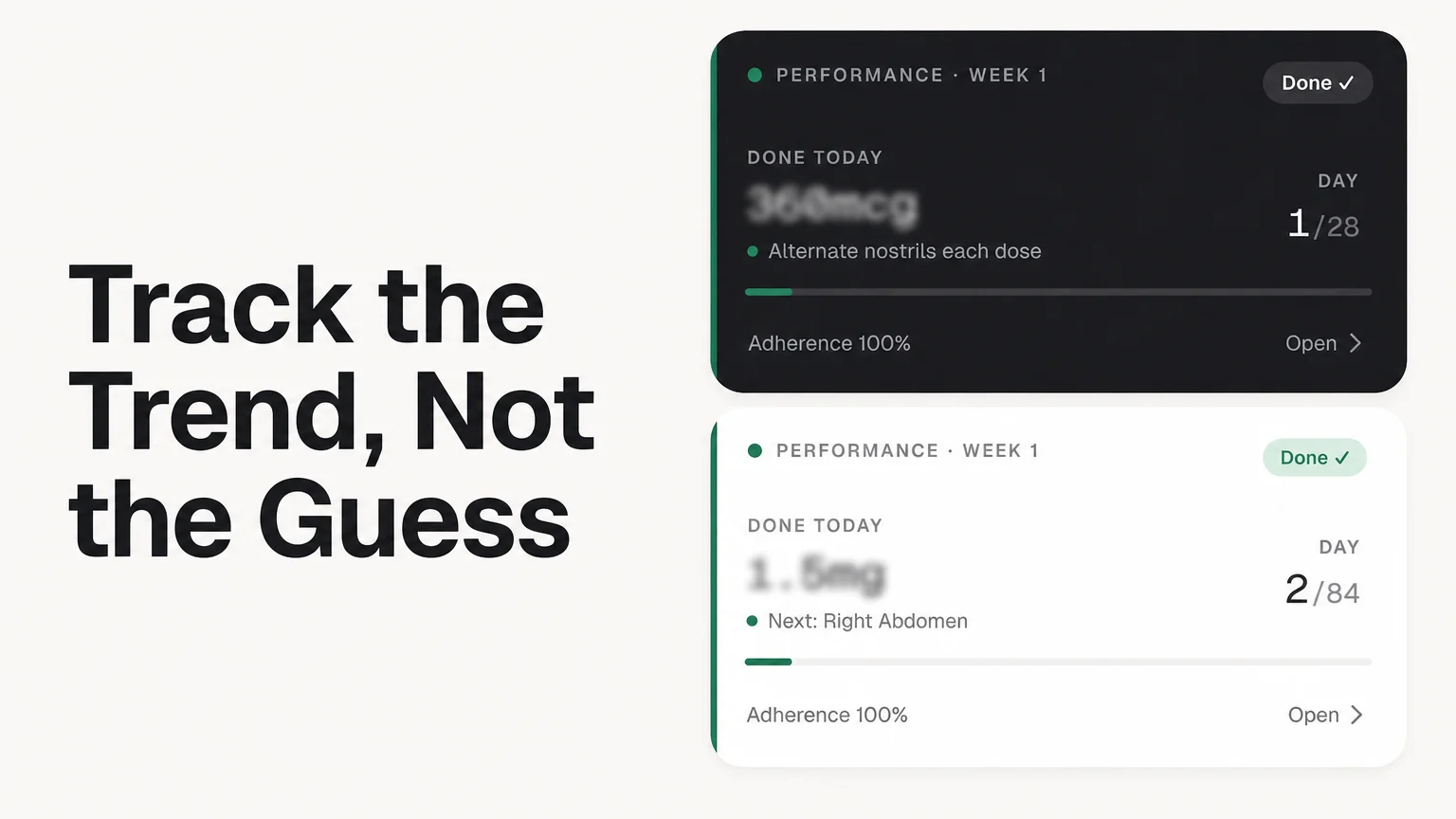 The Today screen: one card per protocol, with adherence tracked alongside each one.
How Would You Know If AOD-9604 Is Actually Working?
You would know by comparing a logged trend to your own baseline: weight over several weeks, how consistently you took each dose, and any side effects with dates. Memory is a poor judge, because a hopeful week feels like progress and a missed week disappears.
This is the honest answer to the question the headlines skip. A trial averages hundreds of people to find a small effect, and you are one person. The only way to see your own effect is a record that does not depend on mood.
Here is what a useful log holds:
- A weight reading on a consistent schedule, not only on days you feel good
- Each dose logged as taken or missed, so adherence is a number
- Side effects with the date and a severity note
- Marked events, such as a changed routine or a pause
PeptideIQ is built around exactly that loop.
Its Progress screen charts your goal metric, such as weight, against your protocol timeline and annotates it with events like "Started cycle" or "Missed 2 doses here". A Monday insight card summarizes that week's logged doses, weight movement and flagged side effects.
AOD-9604 is in the app's Peptide Library, and the Today screen above shows the adherence rows that make a trend readable. The app is pre-launch with a waitlist open, and it is not a medical device or a source for what to take.
A log will not prove the peptide caused anything. It will show whether the line moved, and whether it moved more than your adherence and routine would explain.
Get Started With PeptideIQ
If you decide to follow any peptide with a clinician, a clear record beats memory. PeptideIQ keeps your doses, adherence, weight trend and side effects in one place, so you can judge what you see.
Quick Recap
Quick recap
- AOD-9604 is a hGH fragment that is not FDA-approved for weight loss.
- Verified human data is mainly sponsor-funded safety work on tablets and IV doses.
- The one efficacy headline we found was a 2004 company announcement of about 2.8 kg in 12 weeks, and the larger trial is reported to have missed.
- Source and purity of unregulated vials are unverified.
- Your own logged trend is the only evidence about your own results.
FAQ
Does AOD-9604 work for weight loss?
Human evidence is weak. A 2004 company announcement reported about 2.8 kg lost over 12 weeks at the top dose, and a larger 24-week trial is reported to have missed significance. We found no independent peer-reviewed trial showing clinically meaningful fat loss.
Is AOD-9604 a steroid or a growth hormone?
It is neither. AOD-9604 is a short peptide fragment modeled on part of human growth hormone, not the full hormone and not an anabolic steroid. In the sponsor's trials it did not significantly change IGF-1, the main marker raised by growth hormone itself.
Is AOD-9604 FDA-approved?
No. The FDA has not approved AOD-9604 as a drug. It was reviewed for the 503A compounding list in 2024, and secondary reports say the advisory committee voted against adding it, while the sponsor's GRAS opinion is not FDA approval.
What are the side effects of AOD-9604?
Trials reported mostly mild effects, with headache the most common and diarrhea and gas at the highest oral doses. One IV participant had severe chest tightness. The studies lasted at most 24 weeks, so long-term effects remain unknown.
How can I track whether a peptide is working?
Log a weight reading on a regular schedule, mark every dose as taken or missed, and record side effects with dates. Then compare the trend against your baseline rather than relying on memory. PeptideIQ is designed for this kind of record.