
Safest Peptides: Ranked by Evidence | PeptideIQ
The Safest Peptides to Start With, Ranked by Evidence
The safest peptides are the ones with the most human safety data behind them — semaglutide and tirzepatide (FDA-approved), BPC-157 (a long anecdotal track record among peptide users), and CJC-1295 paired with ipamorelin (strong animal evidence, minimal reported adverse effects in user communities). None of that erases risk entirely. It just means the risk is better mapped than it is for a compound nobody has logged data on yet.
FDA testing has found that up to 40% of online peptide products carry incorrect dosages or undeclared ingredients — which means where you source a peptide often matters more than which one you pick.
Which Are the Safest Peptides to Start With?
The peptides with the strongest safety track records are FDA-approved options (semaglutide, tirzepatide), peptides with years of widespread anecdotal use (BPC-157), and growth-hormone secretagogues that peptide-user communities report tolerating well (CJC-1295, ipamorelin). Each sits in a different evidence tier, and that tier is the single best predictor of how well-understood the risk actually is.
Three tiers, roughly:
- FDA-approved: semaglutide, tirzepatide. Prescribed to millions, dosing studied in large clinical trials, side effects well-documented (nausea, GI upset, injection site reactions).
- Widely used with strong anecdotal or animal evidence: BPC-157, CJC-1295, ipamorelin. No FDA approval, but years of community-reported use with few serious adverse events logged.
- Early research or anecdotal-only: GHK-Cu, Epitalon, Semax, TB-500. Promising early signals, thinner human data — worth more caution, not automatic avoidance.
Beginners are usually best served picking from the first two tiers and giving the app-store version of "wait and see" a real chance: log the first two to three weeks before adding anything else.
Key Takeaways
- Evidence tier — not marketing claims — is the strongest predictor of a peptide's real-world safety profile.
- FDA-approved peptides (semaglutide, tirzepatide) have the deepest clinical safety data; BPC-157 and CJC-1295/ipamorelin have strong community track records without formal approval.
- Up to 40% of online peptide products tested by the FDA contained incorrect dosages or undeclared ingredients — sourcing is a bigger risk lever than most people assume.
- The most common real-world safety failure isn't the molecule; it's mixing, storage, and injection technique done wrong.
- Legal status varies by peptide and location — semaglutide and tirzepatide are FDA-approved, while BPC-157 and most others sit in gray-market or research-compound territory.
What Makes a Peptide Safe or Unsafe?
A peptide's safety comes down to three things: how much human evidence exists for it, how clean and accurately dosed the source product is, and how correctly the user handles reconstitution, storage, and injection. Get any one of those wrong and the peptide itself becomes almost irrelevant to the outcome.
Evidence level is the first filter. PeptideIQ's peptide library classifies every entry honestly as FDA-Approved, Strong Animal Evidence, Early Human Trials, or Anecdotal Only — a distinction most comparison sites blur together under a single "is this safe?" verdict.
Source quality is the second filter, and it's the one most people skip. Gray-market peptide imports hit $328 million in 2025, arriving with no prescription and no lab verification.
Worth knowing: On February 27, 2026, the U.S. Health Secretary announced on a podcast that 14 previously restricted peptides would return to legal compounding status — a reminder that "legal" and "safe" are two separate questions that shift over time, not a fixed list you memorize once.
User error is the third filter, and it's the one within your control regardless of which peptide you choose. Incorrect BAC water ratios, wrong syringe units, skipped fasting windows for peptides like ipamorelin, or storing a reconstituted vial at room temperature all turn a well-studied peptide into a risky one. For a deeper look at where things actually go wrong, our breakdown of peptide downsides covers the full picture beyond just the safest-peptide shortlist.
How Do Safety Profiles Compare Across Common Peptides?
Here's how the most-searched peptides stack up once you separate evidence level from legal status and typical reported side effects:
| Peptide | Evidence Level | Legal Status | Most-Reported Side Effects |
|---|---|---|---|
| Semaglutide | FDA-Approved | Prescription | Nausea, GI upset, fatigue |
| Tirzepatide | FDA-Approved | Prescription | Nausea, appetite suppression, fatigue |
| BPC-157 | Anecdotal, widely used | Gray-market/research compound | Mild injection site soreness |
| CJC-1295 + Ipamorelin | Strong animal evidence | Gray-market/research compound | Water retention, flushing |
| GHK-Cu | Early human trials | Gray-market/research compound | Mild skin/injection site reaction |
| TB-500 | Early human trials | Gray-market/research compound | Fatigue, headache (less common) |
This is the comparison most competitor roundups skip — they'll tell you a peptide is "generally safe under medical supervision" without ever separating evidence level from legal status, which are genuinely different questions. Our general peptide safety deep dive goes further into how that distinction plays out for people considering peptide therapy specifically, and our foundational safety piece covers the broader evidence base this table is drawn from.
The Safest Peptides by Real-World User Data
The peptides users report tolerating best in practice are usually the ones logged consistently, not just the ones with the cleanest research paper. Real-world tolerance data — captured while someone is actually mid-protocol — tells a different story than a lab study run under controlled conditions.
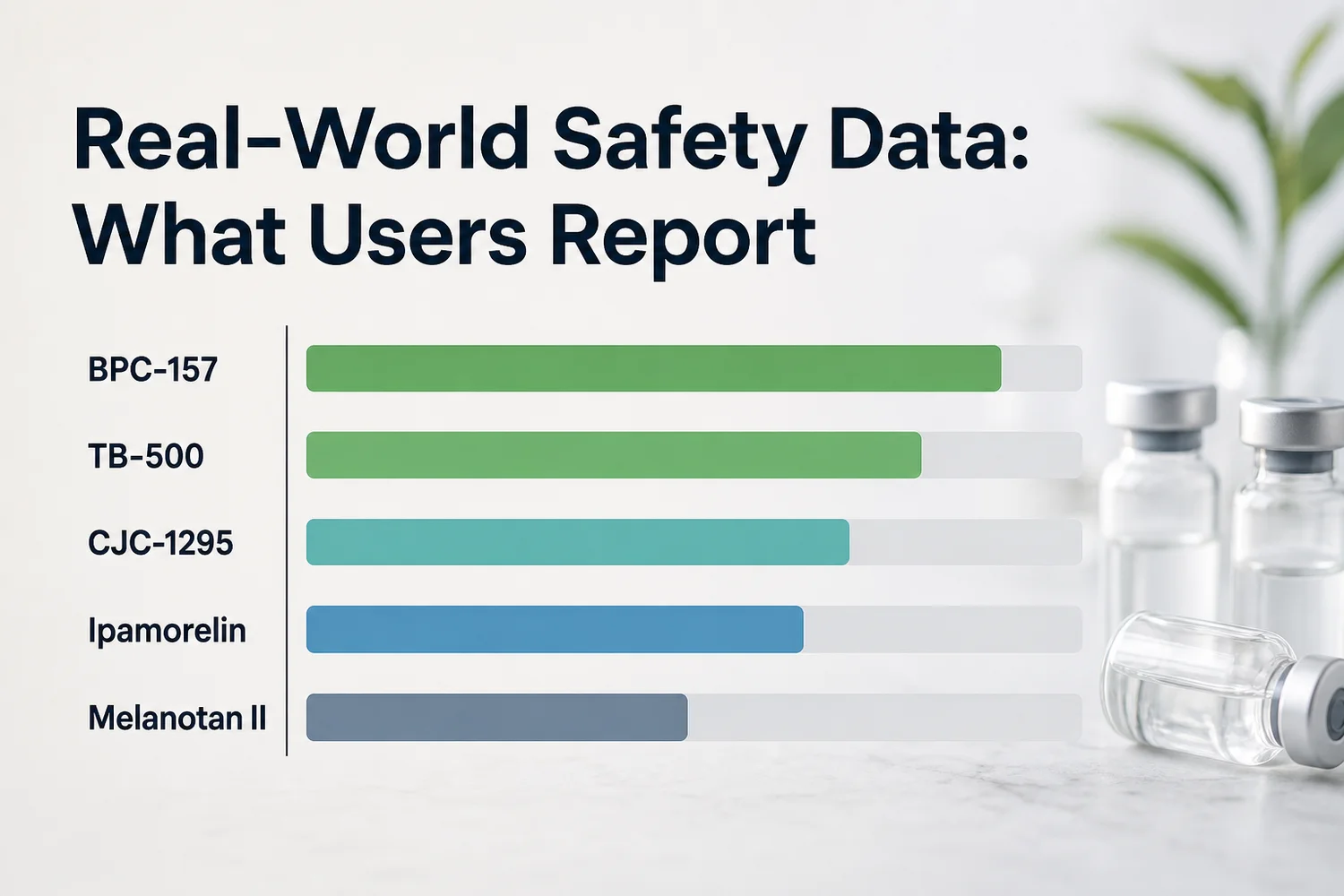 Tolerance ratings shift with the data. That's the point of logging your own response instead of relying on a fixed list.
This is where self-reported tracking earns its keep. PeptideIQ logs side effects the moment they happen — tagged Mild, Moderate, or Severe across a 15-symptom grid covering everything from fatigue and nausea to injection site soreness and mood changes. Patterns emerge from that data that a forum thread or a single case study can't produce: which peptides, at which doses, correlate with more logged side effects, and which ones show a clean run for most people who stick with them.
By the numbers: Gray-market peptide imports hit $328 million in 2025, while FDA testing flagged incorrect dosing or undeclared ingredients in up to 40% of online products — the biggest safety lever most people can pull isn't peptide choice, it's sourcing and adherence.
That's also why "safest peptide" is really a moving target per person. Your energy, sleep, and side-effect pattern in week one predicts more about your specific risk than any general ranking — including this one.
Why PeptideIQ Matters for Safe Peptide Use
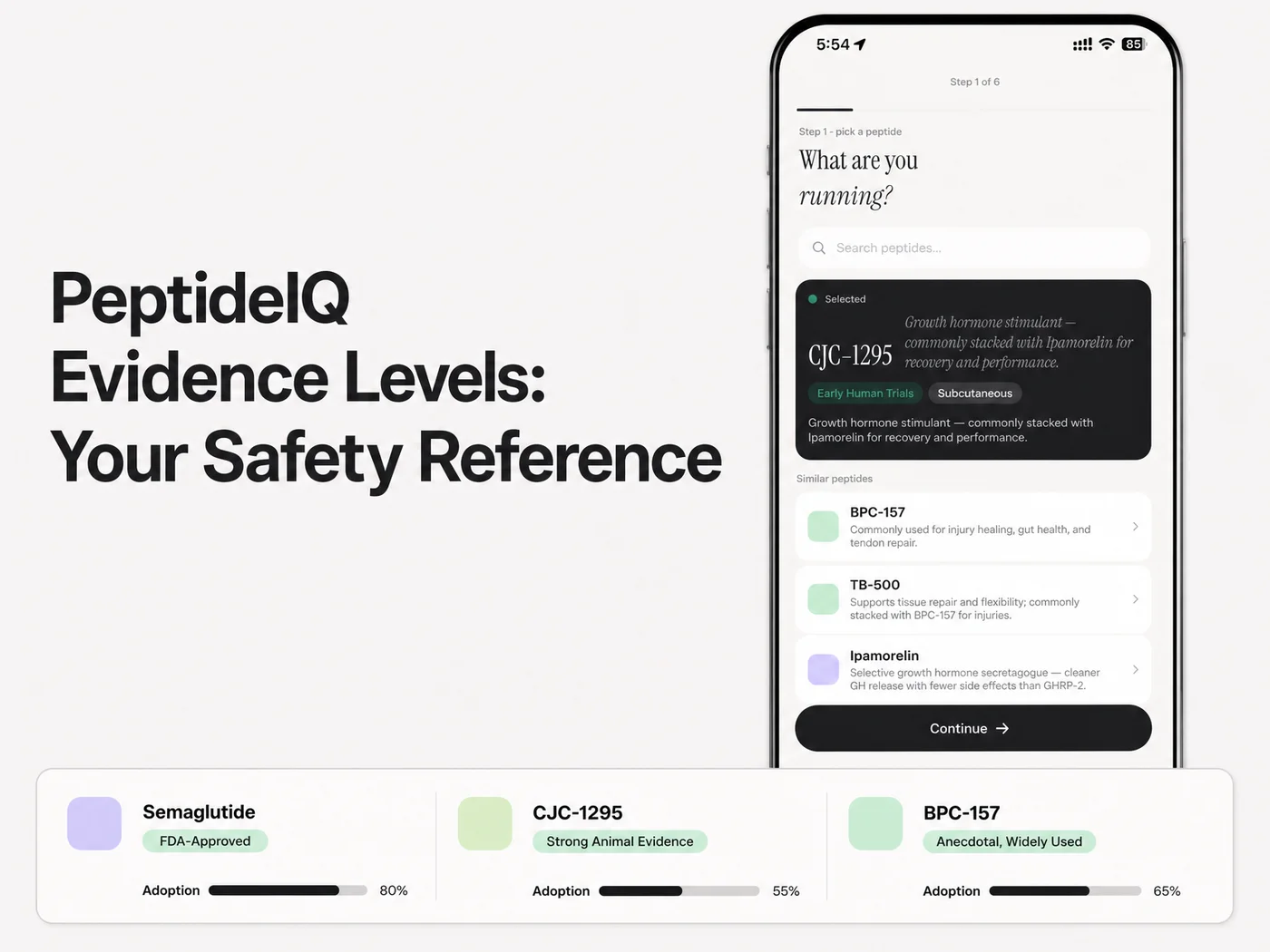 PeptideIQ tags each peptide with its actual evidence tier — Early Human Trials, Strong Animal Evidence, or Anecdotal — right where you choose it.
Choosing a peptide from the safer tiers only solves part of the problem. Most safety failures happen after that decision — during mixing, dosing, and the first few weeks of adjusting to how your body responds, which is exactly where guessing becomes dangerous.
PeptideIQ replaces the guesswork with a guided system: reconstitution math done for you, injection site rotation, and side-effect logging that turns "is this normal?" into an answer grounded in your actual data instead of a stranger's forum post. Join the PeptideIQ Waitlist and get the tracking system in place before your first dose, not after something feels off.
FAQ
Which peptides are considered the safest for beginners?
Semaglutide and tirzepatide (FDA-approved), BPC-157 (long anecdotal history), and CJC-1295 with ipamorelin (strong animal evidence, low reported side effects) are typically considered the safest starting points. Evidence level, not popularity, should drive the choice — and logging your own response in the first weeks matters more than any general ranking.
Are FDA-approved peptides safer than compounded options?
FDA-approved peptides like semaglutide have deeper clinical safety data and regulated manufacturing, making them the most predictable option. Compounded peptides like BPC-157 aren't automatically unsafe, but they carry more sourcing variability — up to 40% of tested online products had dosing or ingredient issues.
What's the real safety risk with most peptides people use?
The biggest risk usually isn't the peptide itself — it's user error: incorrect reconstitution ratios, wrong syringe units, poor storage temperature, or skipping fasting windows certain peptides require. A well-studied peptide handled incorrectly is riskier than a lesser-known one handled correctly.
Are peptides safer than anabolic steroids?
Most researched peptides carry a different, generally milder side-effect profile than anabolic steroids, particularly around hormonal suppression and cardiovascular strain. The comparison isn't one-size-fits-all, though — our full head-to-head on peptides versus steroids breaks down where that holds true and where it doesn't.