
Are Peptides Safe? What Science Says | PeptideIQ
Are Peptides Safe? What the Research Actually Shows
Most people searching "are peptides safe" have already found a supplier. The real question is: safe how — and under what conditions?
Key Takeaways
- Peptides can be safe when sourced from reputable suppliers and administered with proper protocols
- FDA-approved peptides (semaglutide, tirzepatide) have undergone rigorous safety testing; research peptides require careful independent vetting
- Common side effects are mild and manageable; serious adverse events are rare when dosing and injection technique are correct
- FDA testing found up to 40% of online peptide products contained incorrect dosages or undeclared ingredients — sourcing quality is the #1 safety variable
- Proper storage, sterile technique, and systematic tracking significantly reduce the risks associated with peptide use
Contents
- Are Peptides Safe? What Does the Research Show?
- What Are the Main Risks of Using Peptides?
- How Do You Safely Inject and Administer Peptides?
- Are Peptides Legal and FDA-Approved?
- What Side Effects Should You Monitor When Using Peptides?
- How Do You Know If a Peptide Source Is Safe?
- Do Peptides Work as Advertised, and Are They Worth the Risk?
- Frequently Asked Questions: Are Peptides Safe?
Are Peptides Safe? What Does the Research Show?
Peptides are among the most studied compounds in modern pharmacology — over 11% of all FDA-approved drugs from 2016 to 2024 were synthetic peptides. At the FDA-approved end of the spectrum (semaglutide, tirzepatide), safety data is extensive. At the gray-market research end, evidence is thinner and product quality is the defining variable.
Peptides are short chains of amino acids — the same building blocks that make up proteins. Because they occur naturally in the body, they are generally well-tolerated compared to synthetic small-molecule drugs. The immune system is already familiar with peptide structures.
 The safety profile of a peptide depends heavily on its approval status, source quality, and how it's administered.
The answer to "are peptides safe" is not a flat yes or no — it's a spectrum. FDA-approved peptides are backed by phase III trials with thousands of participants. Research peptides like BPC-157 and CJC-1295 have animal studies and community safety data, but lack the same regulatory track record. Both can be used responsibly with the right protocols.
Key insight: The single biggest driver of peptide safety is not the compound itself — it's the quality of what you actually received. Source verification is the non-negotiable first step.
What Are the Main Risks of Using Peptides?
The main risks of peptide use fall into three categories: product quality (contamination, misdosing), administration errors (infection from poor sterile technique), and compound-specific side effects. The good news: all three are manageable with the right information.
Product Quality Risks
FDA testing found that up to 40% of online peptide products contained incorrect dosages or undeclared ingredients. A mislabeled vial means you may be injecting more — or less — than you intend. Both scenarios carry real consequences: overdosing can amplify side effects; underdosing wastes money and produces no benefit.
Administration Risks
Any injectable carries infection risk if sterile preparation is skipped. Using a shared needle, not swabbing the injection site, or working with non-sterile reconstitution water are the most common mistakes. These are avoidable.
Compound-Specific Risks
Immunogenicity — an adverse immune response — can occur with some synthetic peptides, though it's more commonly reported with therapeutic biologics than with the peptides typically used in personal wellness protocols. Monitoring for unexpected inflammation or allergic response after starting any new compound is good practice.
Peptide safety comparison — FDA-approved vs research peptides:
| Factor | FDA-Approved (e.g. Semaglutide) | Research Peptides (e.g. BPC-157) |
|---|---|---|
| Human trial data | Extensive phase II/III | Limited; mostly animal studies |
| Dosage accuracy | Pharmaceutical-grade | Varies by supplier (40% failure rate) |
| Side effect profile | Well-documented | Community-reported, less systematic |
| Legal status | Prescription or compounded | Gray market (US); varies globally |
| Quality assurance | Regulatory oversight | Buyer-dependent — COA required |
| Common use | Weight loss, metabolic | Injury recovery, healing, GH stimulation |
By the numbers: Over 11% of FDA-approved drugs from 2016 to 2024 were synthetic peptides — making this one of the most active therapeutic drug classes, not an experimental fringe.
How Do You Safely Inject and Administer Peptides?
Safe peptide injection comes down to five consistent habits: sterile preparation, correct reconstitution, proper site rotation, accurate dose calculation, and refrigerated storage. Miss any of these and you introduce risk that has nothing to do with the peptide compound itself.
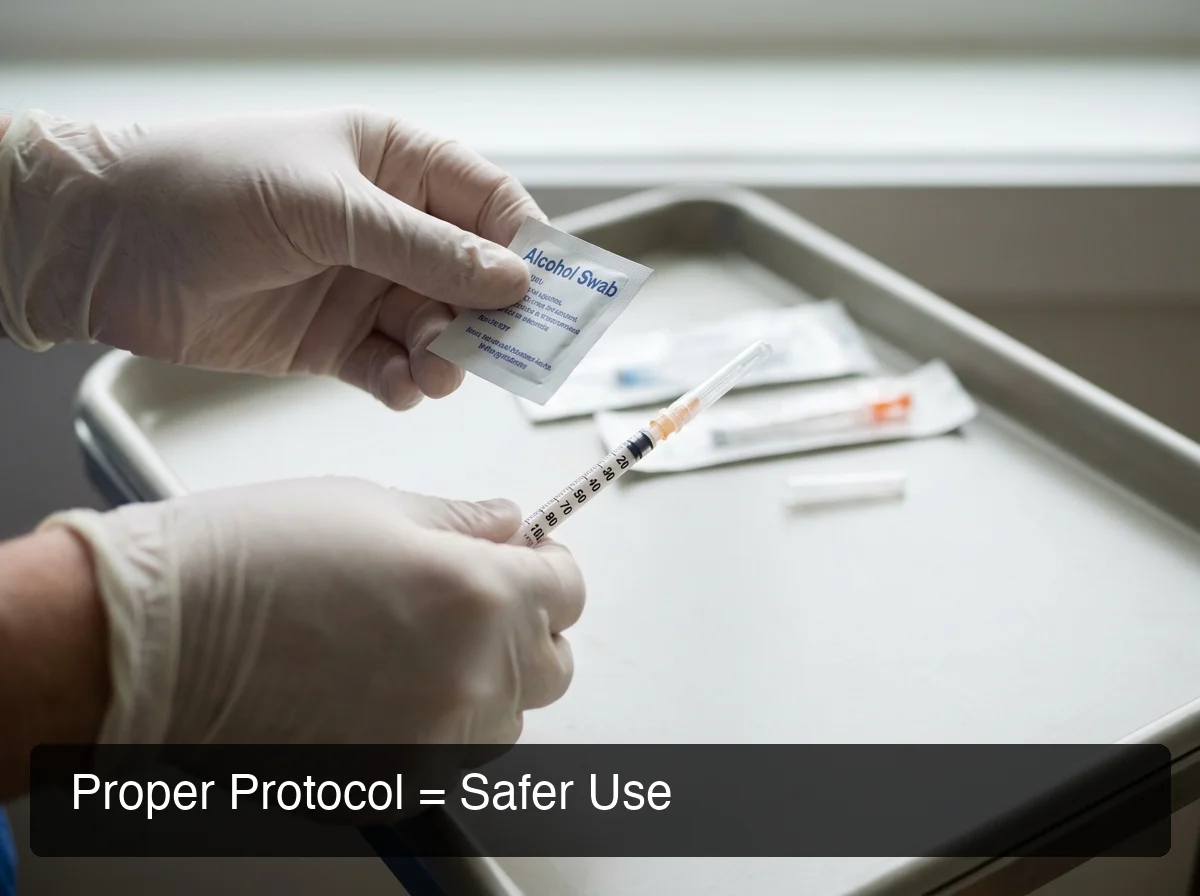 Sterile technique is the single most preventable source of peptide-related adverse events.
Reconstitution and Storage
Most peptides arrive as lyophilized (freeze-dried) powder. You reconstitute with bacteriostatic (BAC) water before injecting. Use only pharmaceutical-grade BAC water — not regular saline or tap water.
Once reconstituted, most peptides are stable for 28–90 days refrigerated, depending on the compound.
Sterile Injection Protocol
- Use a new insulin syringe for every injection
- Swab the vial septum and injection site with 70% isopropyl alcohol and let it dry
- Rotate injection sites — abdomen (2 inches from navel), outer thigh, upper outer glute
- Never inject into bruised, inflamed, or scarred tissue
- Dispose of used needles in a sharps container
For a full visual guide, see our complete guide to where to inject peptides — covering subcutaneous and intramuscular approaches with body diagram references.
Bottom line: Infection from poor sterile technique is the most common peptide adverse event reported in community forums — and the most preventable. Clean prep takes 90 seconds.
Are Peptides Legal and FDA-Approved?
Peptides occupy a complex legal landscape. A small number are FDA-approved prescription drugs. A larger group are legal for "research use" only.
A third category — previously restricted compounded peptides — recently saw a significant US policy reversal that expanded supervised therapeutic access.
FDA-Approved Peptides
Semaglutide (Ozempic, Wegovy), tirzepatide (Mounjaro, Zepbound), and approximately 80 other peptides hold FDA approval for specific indications. These require prescriptions in the US. For a comprehensive breakdown, see our list of FDA-approved peptides — it covers approvals by category, indication, and current availability.
Research Peptides and the Legal Gray Area
BPC-157, CJC-1295, Ipamorelin, TB-500, and others are sold legally as "research chemicals" in most US states. This means they can be sold but not for human consumption. In practice, millions of people use them — the legal framework has lagged the reality of use.
The 2026 US Policy Shift
On February 27, 2026, the US Health Secretary announced that 14 previously restricted peptides would return to legal compounding status. This significantly expanded access to supervised therapeutic use. The regulatory environment for peptides is actively shifting in the direction of greater access, not restriction.
Are Peptides Safer Than Steroids?
Peptides and anabolic steroids work through fundamentally different mechanisms. Steroids suppress natural hormone production, carry liver toxicity risks, and disrupt the hormonal axis.
Most peptides stimulate the body's own production — GH secretagogues prompt the pituitary naturally. The side effect profile is substantially cleaner. That said, "safer than steroids" is not the same as "without risk."
What Side Effects Should You Monitor When Using Peptides?
Side effects from peptides are generally mild and dose-dependent. The most commonly reported are injection site reactions (redness, minor bruising), nausea in the first weeks on GLP-1s, and temporary fatigue or water retention with growth hormone secretagogues. Serious adverse events are rare when dosing protocols are followed.
Common Side Effects by Peptide Category
GLP-1s (semaglutide, tirzepatide): Nausea and appetite suppression (weeks 1–4, typically resolves), constipation or loose stools during titration, fatigue in early weeks.
GH secretagogues (CJC-1295, Ipamorelin, Sermorelin): Transient water retention, mild joint discomfort at higher doses, vivid dreams more common with GHRP-6.
Healing peptides (BPC-157, TB-500): Generally very well-tolerated. Injection site soreness; occasional temporary energy shifts in early days.
When to Stop and Seek Medical Input
Stop use and consult a healthcare provider if you experience: severe injection site swelling that doesn't resolve in 48 hours, systemic symptoms (fever, chills, rash beyond injection site), or persistent cardiovascular symptoms (racing heart, chest tightness). These are uncommon but real warning signs.
For timeline-specific expectations on healing peptides — including when side effects typically peak and resolve — our article on how long BPC-157 takes to work provides week-by-week benchmarks that help distinguish normal adjustment from something worth monitoring.
Key insight: Most peptide side effects are time-limited and dose-dependent. Keeping a detailed log — energy, mood, symptoms by day — makes it far easier to distinguish a compound adjustment response from a reaction worth acting on.
How Do You Know If a Peptide Source Is Safe?
A reputable peptide source provides a Certificate of Analysis (COA) from a third-party laboratory confirming purity, identity, and concentration for every batch. Legitimate suppliers test independently and make these COAs publicly available on request. If a supplier won't share a COA, don't buy from them.
 Third-party COA testing is the minimum bar for any peptide source you trust with your health.
What to Look for in a COA
- Identity test: Confirms the compound is what it claims to be (HPLC or mass spectrometry)
- Purity percentage: 98%+ is pharmaceutical grade; below 95% is a red flag
- Date of analysis: COA should be recent (within 12 months) and batch-specific
- Third-party lab: The testing lab should be independent of the seller
Red Flags to Avoid
- No COA available or only seller-generated "in-house" testing
- Prices significantly below market rate (often indicates lower purity or misdosed product)
- No clear batch number on packaging
- Claims that sound too good to be true ("100% pure, guaranteed results")
Tracking Your Response Over Time
Even with verified source quality, individual responses vary. Systematic tracking — logging doses, wellness metrics, side effects, and outcomes day by day — is the only way to know if your specific protocol is working or causing problems. This is precisely the gap PeptideIQ was built to fill: a guided tracking system that monitors your protocol in real time and flags patterns that warrant attention.
Download PeptideIQ on the App Store to use a tracker designed around your cycle, data, and side effect history.
Not ready yet? Learn more about PeptideIQ — explore how the tracking system works before you commit.
Do Peptides Work as Advertised, and Are They Worth the Risk?
FDA-approved GLP-1 peptides have among the strongest efficacy data in modern medicine — semaglutide and tirzepatide produced 15–22% body weight loss in phase III trials. Research peptides have more variable evidence. Most have animal studies showing meaningful effects; human trial data is limited but accumulating.
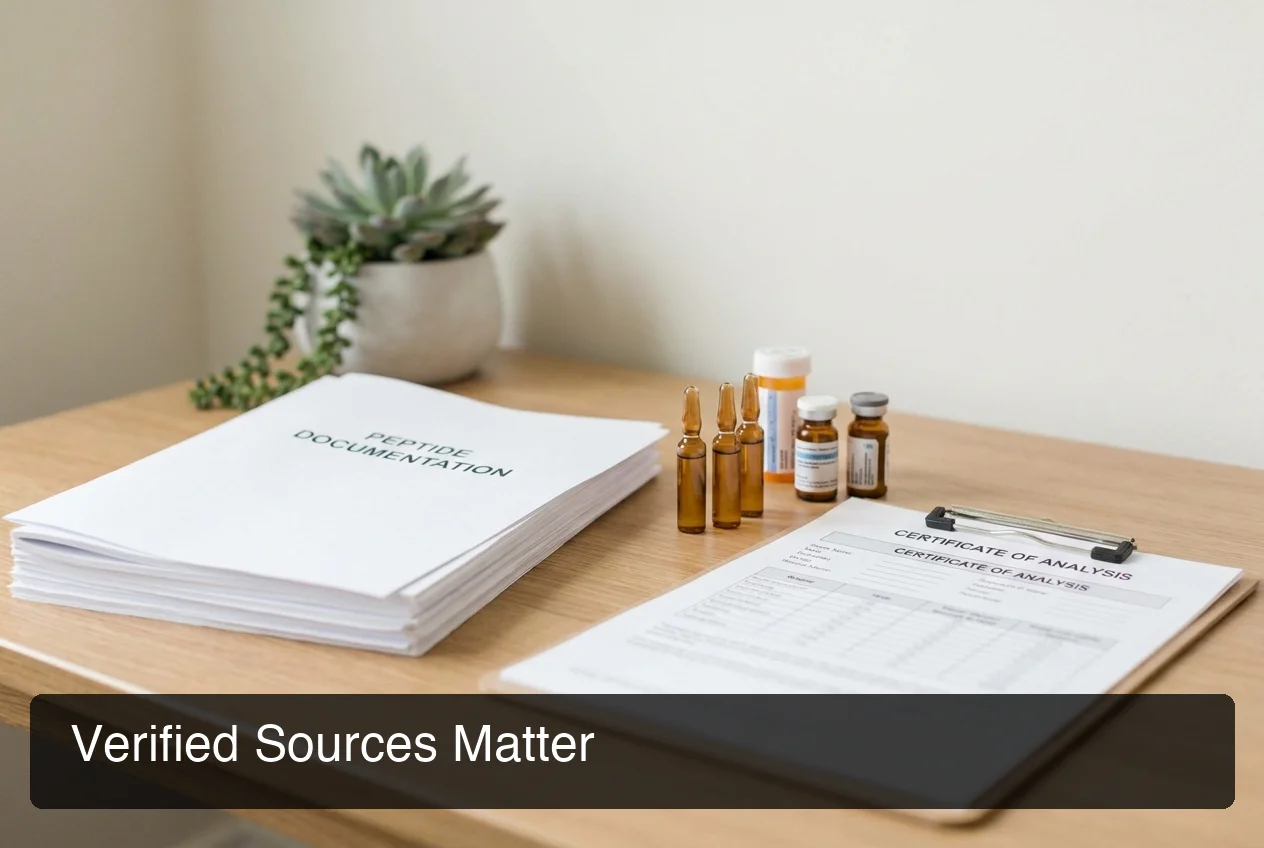 Protocol discipline — consistent dosing, proper storage, and systematic tracking — determines whether peptides deliver their potential.
Evidence Quality by Peptide Category
Strongest evidence (FDA-approved): Semaglutide, tirzepatide, PT-141, thymosin alpha-1. Clinical trial data confirms efficacy and a clear safety profile.
Moderate evidence: BPC-157, CJC-1295/Ipamorelin, GHK-Cu, TB-500. Community evidence is substantial; formal human trials are ongoing.
Emerging or anecdotal: Epithalon, MOTS-c, LL-37. Strong animal-model results; limited human safety data to date.
Is the Risk-Benefit Worth It?
For FDA-approved peptides with medical supervision, the risk-benefit calculus is well-established. For research peptides, the equation is individually determined — it depends on sourcing rigor, preparation quality, and systematic self-monitoring.
The worst outcomes share a common thread: unverified sources, skipped sterile technique, and no tracking system to catch early warning signs. Protocol discipline — not the compound — is what separates a good outcome from a bad one.
Get Started with PeptideIQ
If you're using peptides — or planning to — having a system that tracks every dose, flags unusual symptom patterns, and gives you an AI co-pilot that knows your exact cycle is the difference between guessing and knowing.
PeptideIQ is the first guided AI system built specifically for peptide users. Download PeptideIQ on the App Store to start tracking today.
Not ready to try it yet? Learn more about how PeptideIQ works — no commitment required.
Frequently Asked Questions: Are Peptides Safe?
What is the risk of taking peptides?
The main risks are product quality (incorrect dosage or contamination in up to 40% of online products), injection site infection from poor sterile technique, and compound-specific side effects. All three risks are substantially reduced by sourcing from verified suppliers with third-party COAs, using proper sterile protocol, and following evidence-based dosing.
Why don't doctors use peptides more often?
Most peptides sit outside FDA approval, which limits what physicians can prescribe or recommend within standard-of-care guidelines. The February 2026 US policy change restoring 14 peptides to legal compounding status is beginning to shift this. Many functional medicine and integrative health practitioners already work with peptide protocols for their patients.
Are peptides safer than steroids?
Generally, yes — the mechanisms differ fundamentally. Most peptides stimulate the body's own hormone production rather than suppressing it; anabolic steroids suppress endogenous testosterone, carry liver toxicity risks, and disrupt the HPGA axis. The side effect profiles are substantially different, though neither is entirely risk-free.
Are peptides safe for weight loss?
FDA-approved GLP-1 peptides (semaglutide, tirzepatide) have the most extensive safety and efficacy data of any weight-loss drug class in history — phase III trials showed 15–22% body weight reduction with a well-documented safety profile. Compounded versions carry more quality variability, requiring careful supplier vetting.
How do I know if the peptide I bought is legitimate?
Request a Certificate of Analysis (COA) from an independent third-party laboratory confirming identity and purity (98%+ minimum). Prices significantly below market rate often signal compromised quality or mislabeled product. Never buy from a supplier who can't provide batch-specific COA documentation on request.
Do peptides affect hormones long-term?
GH secretagogues (CJC-1295, Ipamorelin, Sermorelin) stimulate the pituitary to release growth hormone naturally — they don't suppress the system, and endogenous production returns to baseline post-cycle. GLP-1 peptides affect metabolic hormones during use; most markers normalize after stopping. Periodic bloodwork tracking IGF-1 and relevant hormones is recommended for extended protocols.
Are research peptides safe for beginners?
Research peptides are manageable for beginners who follow verified sourcing, proper sterile technique, and evidence-based starter protocols. The biggest mistakes beginners make are sourcing from unverified suppliers, skipping reconstitution calculations, and having no tracking system in place. Starting with a single well-studied peptide like BPC-157 at conservative doses is the most risk-appropriate approach for first-time users.