
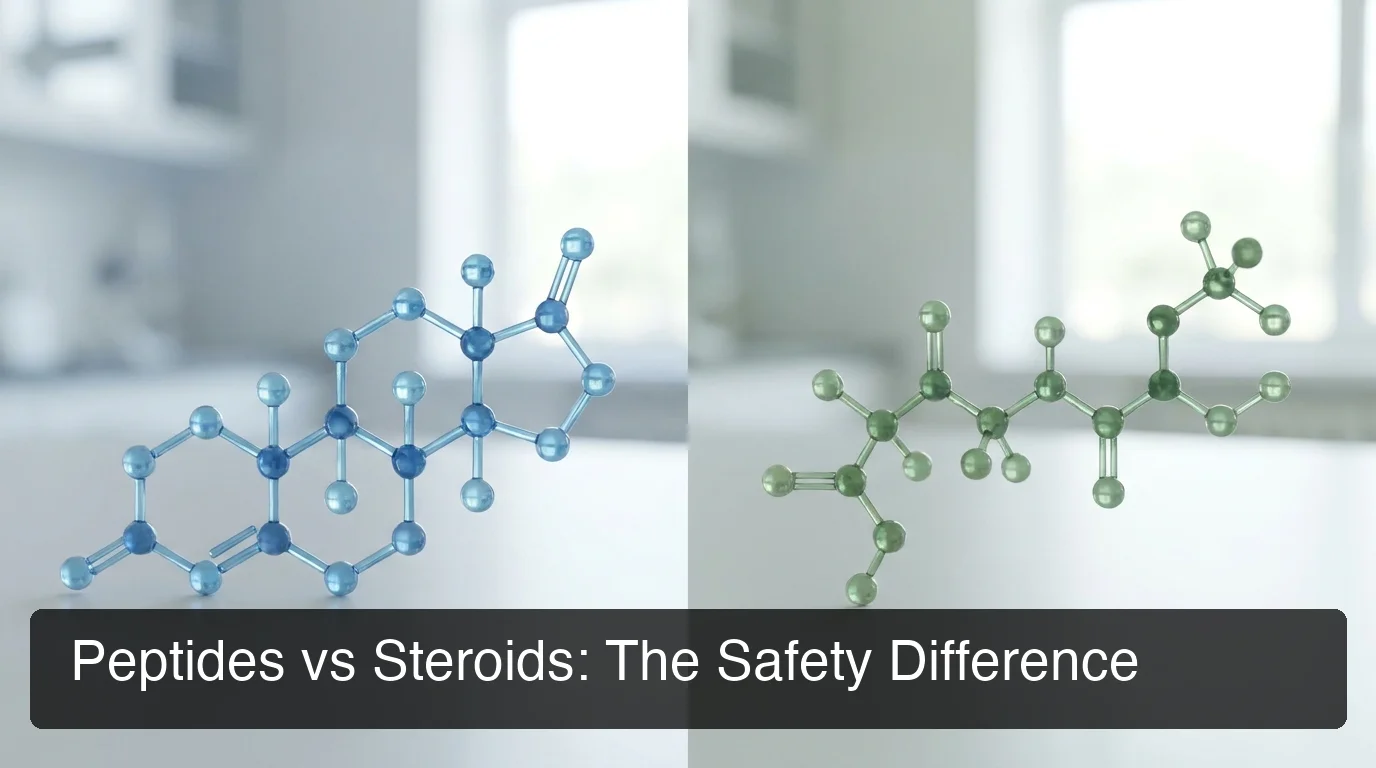
Are Peptides Safer Than Steroids? | PeptideIQ
Are Peptides Safer Than Steroids? What the Evidence Actually Shows
Ask ten peptide users whether their compound is safer than steroids and you'll get ten confident answers — few of them the same. Are peptides safer than steroids? The honest answer is more useful than a flat yes or no: it depends on which peptide, which steroid, and whether anyone involved actually knows what they're doing.
Key Takeaways
- Peptides and steroids are fundamentally different molecular classes — peptides are amino acid chains, steroids are synthetic hormones — so comparing them requires understanding their distinct mechanisms.
- Peptides are generally better tolerated than steroids and carry lower cardiovascular risk, but they are not zero-risk — safety depends on proper dosing, timing, and source quality.
- The biggest safety risk with peptides isn't the compounds themselves — it's inconsistent dosing and a lack of guidance. FDA testing found 40% of online peptide products contained incorrect dosages or undeclared ingredients.
- Structured protocol management — validated dosing, injection site rotation, side-effect tracking, and medical guidance — turns peptide use from a guessing game into a controlled system.
- PeptideIQ's guided protocol system is built specifically to close the gap that causes most peptide safety failures: no structure, no feedback, no way to catch a mistake before it becomes a problem.
Contents
- What Is the Difference Between Peptides and Steroids?
- Are Peptides Safer Than Steroids?
- What Are the Side Effects of Peptides vs Steroids?
- How Do Peptides and Steroids Differ in How Your Body Processes Them?
- Why Guidance and Protocol Structure Matter More Than the Peptide Itself
- Are Peptides Safer Than Steroids for Long-Term Use?
- Are Peptides Legal When Steroids Are Controlled Substances?
What Is the Difference Between Peptides and Steroids?
Peptides are short chains of amino acids that signal your body to do something it already knows how to do — release growth hormone, repair tissue, regulate appetite. Steroids are synthetic versions of testosterone or cortisol that directly replace or amplify a hormone your body produces. That's the core distinction: one nudges existing biology, the other overrides it.
Anabolic-androgenic steroids (AAS) bind to androgen receptors and drive muscle protein synthesis directly. They're potent, fast-acting, and heavily studied — decades of clinical and black-market use have documented their effects in detail.
Peptides work differently depending on the compound. Growth hormone secretagogues like CJC-1295 and Ipamorelin stimulate your pituitary gland to release more of your own GH. Healing peptides like BPC-157 support tissue repair pathways. GLP-1 peptides like semaglutide regulate appetite and blood sugar. None of them replace a hormone system wholesale — they work with the systems already running.
For a full side-by-side breakdown of specific compounds, the peptides vs steroids comparison guide covers individual pairings in more depth than this article's safety focus allows.
Worth knowing: "Peptide" isn't one category with one risk profile — GLP-1s, healing peptides, and growth hormone secretagogues behave completely differently in the body.
Are Peptides Safer Than Steroids?
In general, yes — most peptides carry a lower risk profile than anabolic steroids, primarily because they don't force the same degree of hormonal override. But "safer" isn't the same as "safe," and the comparison only holds when peptides are dosed correctly from a legitimate source. Anabolic steroids have well-documented risks: liver strain from oral compounds, suppressed natural testosterone production, and cardiovascular strain from shifted cholesterol ratios.
Peptides sidestep most of that. They don't typically suppress your natural hormone production the way exogenous testosterone does, and non-hormonal peptides like BPC-157 don't touch the endocrine system at all. That's a real safety advantage.
Here's what gets left out of most comparisons: the safety advantage assumes the product in the vial is what the label says. Gray-market peptide manufacturing has none of the quality control that pharmaceutical-grade anabolic steroids get, even the illegal ones. A cleaner mechanism doesn't help if the dose is wrong or the vial contains something else entirely.
For a broader look at how peptide safety holds up across the full class of compounds, our foundational safety guide walks through evidence levels compound by compound.
What Are the Side Effects of Peptides vs Steroids?
Peptide side effects tend to be mild and localized — injection site irritation, temporary water retention, or nausea with GLP-1 compounds. Steroid side effects tend to be systemic — liver strain, blood pressure changes, and hormonal suppression that can persist after the cycle ends. The severity gap is real, but it isn't universal across every peptide or every steroid.
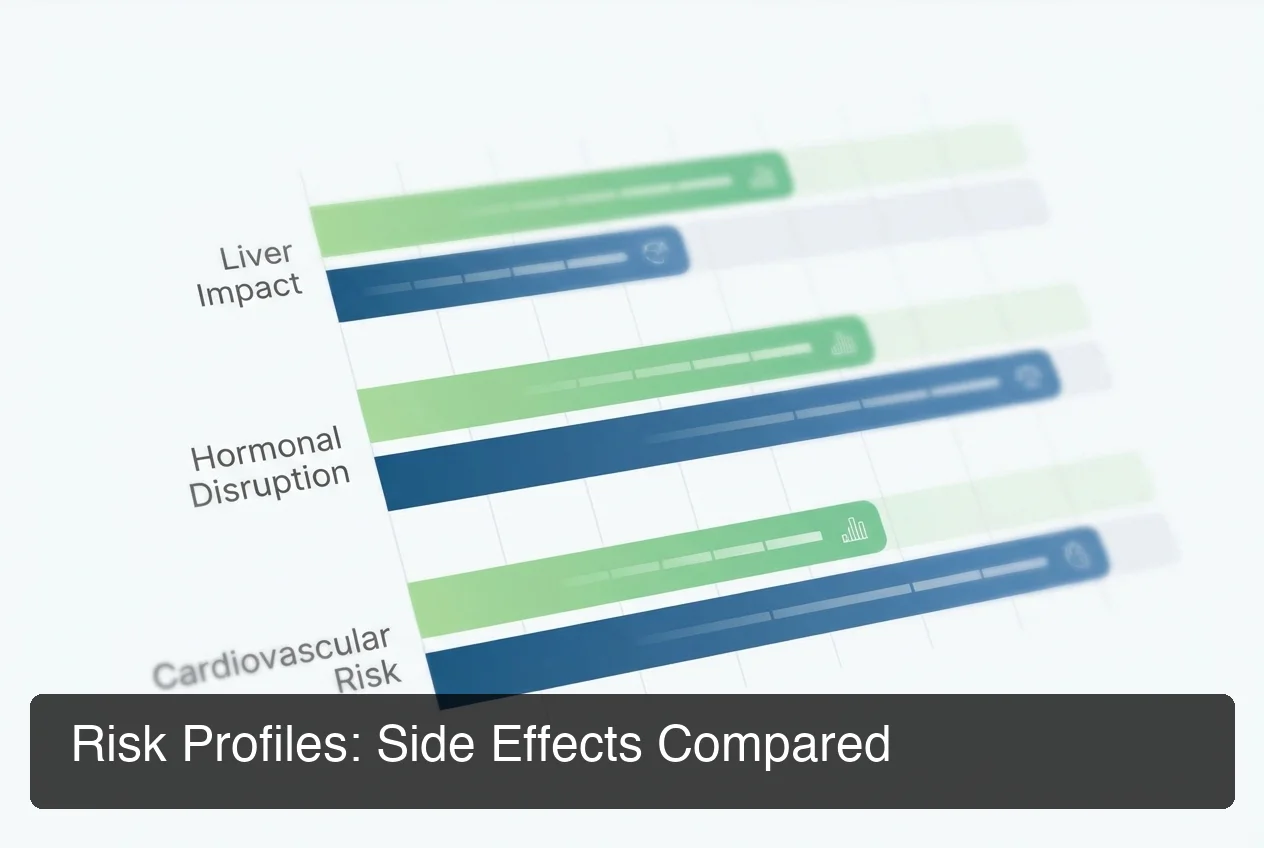 Side effect severity clusters differently for peptides and steroids — the risk categories themselves aren't identical.
| Risk Factor | Anabolic Steroids | Peptides (most compounds) |
|---|---|---|
| Liver toxicity | High with oral (17-alpha alkylated) compounds | Minimal — not hepatotoxic |
| Cardiovascular strain | Elevated LDL, reduced HDL, blood pressure spikes | Generally neutral; GLP-1s often improve markers |
| Hormonal suppression | Significant HPTA suppression, can persist post-cycle | Minimal to none for non-hormonal peptides |
| Water retention / gyno | Common with aromatizing compounds | Rare |
| Dosing error risk | Lower — pharma-grade, typically prescribed | Higher — up to 40% of tested products mislabeled |
That last row is the one competitor articles skip entirely. A cleaner molecular profile means nothing if the actual dose in the syringe doesn't match the label. For a deeper look at realistic downsides beyond the steroid comparison, see our companion piece on the actual downsides of peptides.
Common peptide side effects by category:
- GLP-1 peptides (semaglutide, tirzepatide): nausea, fatigue, appetite suppression
- Healing peptides (BPC-157, TB-500): injection site soreness, rare headaches
- GH secretagogues (CJC-1295, Ipamorelin): water retention, tingling, hunger spikes
How Do Peptides and Steroids Differ in How Your Body Processes Them?
Steroids are lipid-soluble and pass through cell membranes directly, binding androgen receptors inside the cell and altering gene expression for muscle growth. Peptides are water-soluble chains that bind receptors on the cell surface, triggering a signal cascade rather than entering the cell itself. That structural difference explains a lot about why peptides get broken down faster and why oral peptide products barely work at all.
 Peptides bind at the cell surface and get metabolized quickly — a mechanism with a different risk curve than a steroid altering gene expression directly.
Peptides have short half-lives — often minutes to hours — which is part of why dosing timing matters so much. Miss a window and the effect is gone, not accumulating dangerously. Steroids build up in tissue over weeks, which is part of why their side effects compound the longer a cycle runs.
This is also why oral peptides mostly don't work: stomach acid destroys the amino acid chain before it reaches the bloodstream. Injectable administration bypasses that entirely, which is why nearly every legitimate peptide protocol is injection-based rather than oral. If you're weighing peptides against a different performance compound entirely, our peptides vs HGH breakdown covers how growth hormone secretagogues compare to direct HGH administration on this same absorption question.
Why Guidance and Protocol Structure Matter More Than the Peptide Itself
The FDA testing that found 40% of online peptide products carrying incorrect dosages or undeclared ingredients isn't a peptide safety problem — it's a guidance problem. Most steroid users, even ones sourcing from the gray market, at least know their compound's rough half-life and typical dosing window from decades of shared community data. Most peptide users are working from a Reddit thread and a guess.
 Structured tracking — not the compound itself — is what closes the gap between a risky guess and a controlled protocol.
PeptideIQ was built around this exact gap. The injection site rotation system tracks which sites were used in the last 48 hours and recommends the next one automatically, preventing the tissue irritation that comes from repeatedly hitting the same spot. Automated dose validation checks the math on every logged dose against vial concentration, catching the unit-conversion errors — mg versus mcg versus IU — that cause most reported dosing mistakes. Side-effect tracking logs symptoms against dose and timing, so a pattern like "nausea every time I inject before eating" becomes visible instead of anecdotal.
None of that changes what's in the vial. It changes whether the person using it is flying blind or working from a system.
What this means for you: the safety comparison between peptides and steroids only holds if the peptide dose is correct and consistent — which is exactly what unstructured self-administration fails to guarantee.
Are Peptides Safer Than Steroids for Long-Term Use?
Over the long term, most peptides remain a lower-risk choice than continuous anabolic steroid use, largely because they don't carry the cumulative liver and cardiovascular burden that steroids do. But long-term peptide safety data is thinner than long-term steroid data — steroids have 70+ years of clinical observation behind them, peptides have a fraction of that. This is the honest caveat most promotional content skips.
Long-term steroid use tracks predictable risk accumulation: cardiovascular strain rises with cumulative dose, natural testosterone production may not fully recover, and liver markers worsen with oral compound duration. Long-term peptide risk is less mapped, particularly for the newer or gray-market compounds without FDA-approval status.
That evidence gap cuts both ways. It means peptides aren't proven dangerous long-term — but it also means "safer" is a probability based on mechanism, not a guarantee based on decades of surveillance data. Evaluating whether a specific protocol is legitimate versus risky self-experimentation is a different question than asking whether the compound class is inherently safer, and it's one worth separating clearly before committing to a long cycle.
- Track duration and cumulative dose across cycles, not just the current one
- Log bloodwork over time if you're running any hormone-adjacent peptide long-term
- Reassess protocol structure every cycle, not just at the start
Are Peptides Legal When Steroids Are Controlled Substances?
Anabolic steroids are Schedule III controlled substances in the US — possession without a prescription is a federal offense. Most peptides exist in a legal gray zone: not scheduled as controlled substances, but also not FDA-approved for the uses most people buy them for, which puts them in "research use only" territory that vendors exploit. GLP-1 peptides like semaglutide are the exception — FDA-approved and prescribable.
That legal distinction matters for safety in an indirect way: prescribed steroids at least pass through pharmacy quality control. Gray-market peptides, legal or not, often don't. For the full regulatory picture, including the 2026 compounding policy changes affecting specific peptides, see our detailed legal status guide.
Get Started with PeptideIQ
Whether peptides end up safer than steroids for you personally comes down to execution, not the molecule. PeptideIQ's guided protocol system validates every dose, rotates injection sites automatically, and logs side effects against your actual cycle — turning the safety advantage peptides can offer into one you can actually rely on.
Download PeptideIQ on the App Store
FAQ
Are peptides safer than steroids overall? Generally yes — most peptides carry lower liver, cardiovascular, and hormonal risk than anabolic steroids. But the advantage depends entirely on correct dosing and legitimate sourcing; a mislabeled or contaminated peptide product can erase that safety margin quickly.
Are peptides safer than testosterone specifically? Non-hormonal peptides like BPC-157 don't interact with testosterone production, making them lower-risk for hormonal suppression than exogenous testosterone. GH-releasing peptides carry more overlap with hormonal systems but still avoid testosterone's direct suppression effect.
What are the biggest negatives of taking peptides? Inconsistent product quality is the top concern — FDA testing found 40% of online peptide products had incorrect dosages or undeclared ingredients. Beyond that, thinner long-term safety data and injection-site irritation are the most common real drawbacks.
Which is better for muscle growth, peptides or steroids? Steroids produce faster, more dramatic muscle gains through direct hormonal override. Peptides like CJC-1295 and Ipamorelin work more gradually by boosting natural growth hormone release, offering a slower but generally lower-risk path to recovery and lean mass gains.
Are peptides 100% safe? No compound is 100% safe, and peptides are no exception. Even non-hormonal peptides carry risks from incorrect dosing, contaminated sourcing, and individual reactions — safety depends on protocol structure, not just the compound's inherent profile.
Are peptides legal to buy and use? It depends on the specific peptide. FDA-approved compounds like semaglutide are legal with a prescription. Most research peptides exist in a legal gray zone — not scheduled, but not approved for personal use either, which is different from a steroid's clear controlled-substance status.
Have you actually confirmed your peptide dose is accurate, or are you trusting the vendor's label? That's the question that determines whether the "peptides are safer" argument applies to your protocol specifically.