

Sermorelin Side Effects: What the Published Data Shows
Sermorelin Side Effects: What the Published Data Shows
General education, not medical advice. Sermorelin acetate (Geref) is no longer marketed as an FDA-approved product, and compounded or gray-market versions vary. Any decision to use it belongs with a clinician.
One in six. That is the figure the sermorelin label gives for its most common problem, a local reaction at the injection site. Most sermorelin side effects sit in that mild, local category, and the data behind them is smaller and older than the confident blog posts suggest.
Key Takeaways
- The label reports injection-site pain, swelling or redness in about 1 in 6 patients; 3 of 350 trial patients stopped because of it.
- Headache, flushing, dizziness, trouble swallowing, hyperactivity, sleepiness and hives each occurred in under 1% of patients.
- Hives, trouble breathing, or swelling of the face, mouth, lips or tongue means stop and get medical help right away.
- Fasted dosing is a protocol convention, not a label requirement, so the label's own advice is a once-daily dose at bedtime.
What Are the Most Common Sermorelin Side Effects?
The most common sermorelin side effect is a local injection reaction: pain, swelling or redness where the needle went in. Less often, people report headache, flushing, dizziness, trouble swallowing, hyperactivity, sleepiness, hives, or a changed sense of taste.
Here is how the primary label data lays out. Figures come from the RxList copy of the sermorelin acetate label (FDA revision dated 2001); the page does not break results down by age.
| Effect | Reported frequency | Source note |
|---|---|---|
| Injection-site pain, swelling or redness | About 1 in 6 patients | Label, clinical trials |
| Discontinued due to injection reaction | 3 of 350 patients | Label, clinical trials |
| Headache | Under 1% | Label |
| Flushing | Under 1% | Label |
| Dysphagia (trouble swallowing) | Under 1% | Label |
| Dizziness | Under 1% | Label |
| Hyperactivity, somnolence | Under 1% each | Label |
| Urticaria (hives) | Under 1% | Label |
| Hypothyroidism during therapy | 6.5% | Label, largest study |
The hypothyroidism row deserves a second look. In the largest study, 8 of 110 enrolled patients were already on thyroid replacement before starting, and 5 more were after starting. The label advises thyroid tests before and during therapy, because untreated hypothyroidism can blunt the response.
How Often Do Sermorelin Side Effects Show Up in the Published Data?
In the label's clinical trials, roughly 1 in 6 patients had an injection-site reaction, and every other individual side effect occurred in under 1%. Only 3 of 350 exposed patients discontinued because of those reactions.
That is reassuring on its face. It is also worth saying what the numbers cannot tell you.
- No population breakdown. The label does not split adverse events by age or sex.
- A narrow dose. The labeled regimen is a once-daily subcutaneous dose at bedtime. Compounded products and off-label adult regimens differ.
- Old trials. The label dates to 2001. Modern adult wellness use was not what was studied.
- Antibodies. The label says a large proportion of patients develop anti-GRF antibodies at least once during treatment, without giving a percentage. It adds that they do not appear to affect growth or relate to a specific adverse reaction profile, and that no generalized allergic reactions have been reported.
Reality check: "Under 1%" describes a few hundred trial patients on a labeled product. It is not a safety guarantee for a compounded vial, a different dose, or a different person.
Are Sermorelin Side Effects Serious, or Mostly Mild?
Mostly mild, going by the label: local reactions and brief systemic effects like flushing or headache. The serious category is allergic. The label notes local or systemic allergic reactions may occur, and says patients should seek prompt medical attention if they do.
The label also says sermorelin is very unlikely to be associated with abuse or dependence. It lists a contraindication for known sensitivity to sermorelin or its excipients. Patients with an intracranial lesion were not studied, and the label does not recommend treating them.
It also notes that concurrent glucocorticoid therapy may inhibit the response. Phosphorus, alkaline phosphatase, GH and IGF-1 may rise on lab work.
Pregnancy sits in Category C: rat and rabbit studies at 0.5 mg/kg/day produced minor fetal variations.
Which Sermorelin Side Effects Mean You Should Stop and Call a Doctor?
Stop and get medical help right away for hives, rash, difficulty breathing, or swelling of the face, mouth, lips or tongue. These are signs of an allergic reaction. Also call a clinician for a reaction at the injection site that is spreading, worsening, or not settling.
The label's own list pairs those allergic signs with "get medical help right away." Everything below that threshold is a conversation, not an emergency.
 Keep the vial stored properly, and keep a written record you can hand to a clinician.
Use this split as a working rule:
- Expected adjustment: brief redness or tenderness at the site, mild flushing, a passing headache. Note it, rotate sites, and watch whether it fades.
- Call a clinician: symptoms that persist, repeat after each dose, or keep you from sleeping, working or eating.
- Stop and seek care now: hives, breathing trouble, facial or throat swelling.
Same logic applies to the sibling peptides. Our BPC-157 side effects guide on what's normal and when to stop uses the same normal-versus-stop framing, and the CJC-1295 side effects page covers the other growth-hormone secretagogue most often paired with sermorelin discussions.
Why Does Sermorelin Need Fasted Dosing?
In most peptide protocols, sermorelin is injected fasted because food, especially carbohydrate, is generally thought to blunt the growth hormone response to a secretagogue. That is a protocol convention. The label itself says once daily at bedtime and makes no fasting statement.
This is the gap between sources. The label gives bedtime timing. Many protocol guides add a fasting window, usually a couple of hours after the last meal, so the dose lands when the pituitary response is least likely to be dulled.
For side effects, the practical point is consistency. If doses land at random times relative to meals and sleep, a headache or a rough night cannot be tied to anything. A fixed, fasted window makes each dose comparable.
PeptideIQ builds that into setup. When a cycle includes sermorelin, the fasting window timer is switched on automatically, and it warns you if you try to log a dose before the window opens. You can override it.
Pro tip: If you eat late, move the whole routine later rather than shortening the fast. Changing timing and fasting at the same time muddies any symptom you log.
 Same window, every dose, so one variable stays fixed.
What Don't We Know About Sermorelin Side Effects Yet?
Long-term safety at modern adult wellness doses is not well documented in the sources reviewed here. The label data is old, the adverse-event table has no age split, and compounded product quality is outside what any label covers.
Be wary of any page that gives precise side-effect percentages for "sermorelin injections" in adults without a citation. If a number has no trial attached, treat it as opinion.
Gaps worth naming:
- Rates in healthy adults using it off-label.
- Dose-by-dose side-effect curves.
- Reliability of compounded or gray-market vial contents.
- Direct, head-to-head safety data against other secretagogues.
For the comparison people most often want, see our ipamorelin vs sermorelin data-driven comparison.
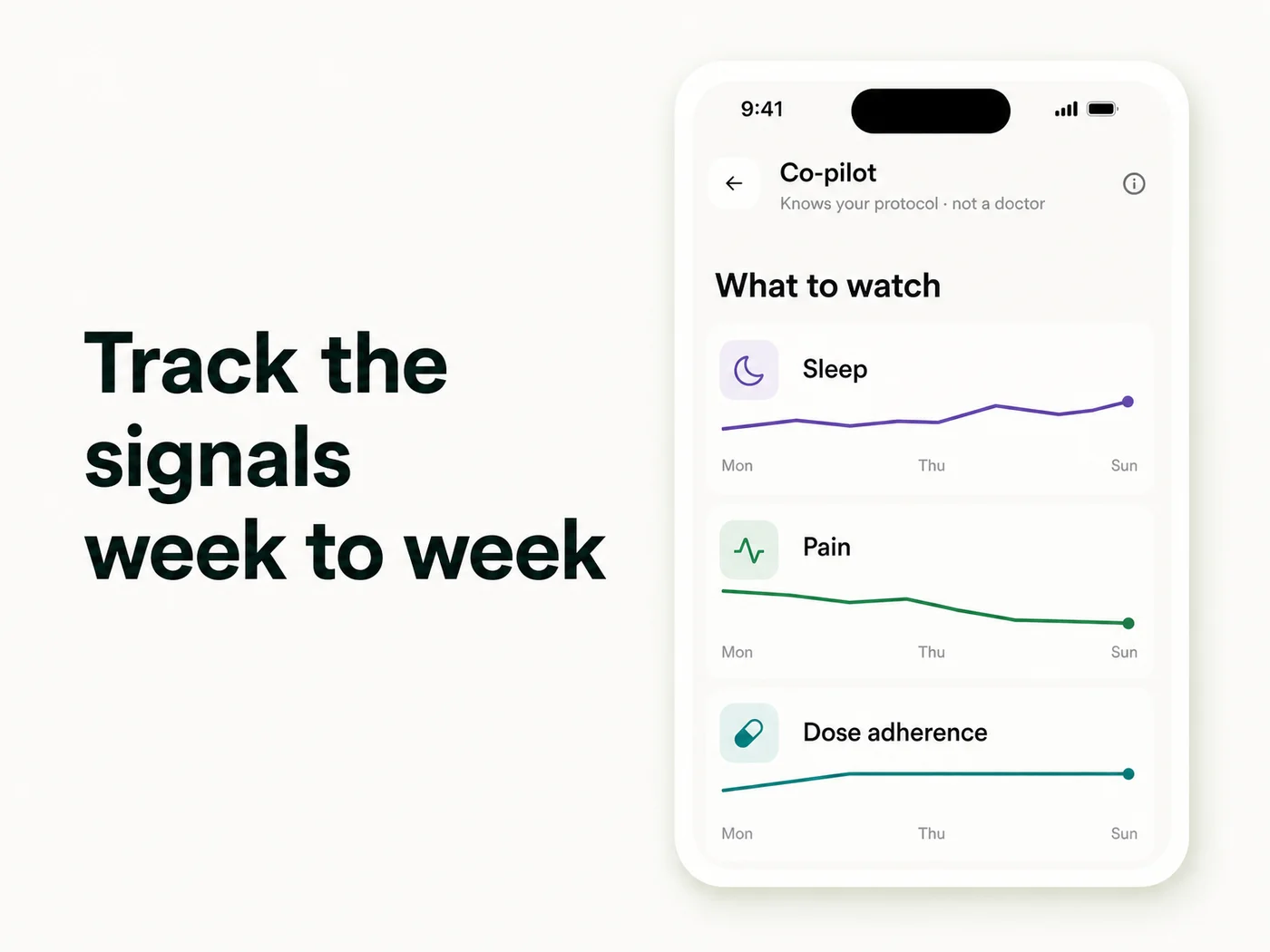 Illustration of the weekly trend view. The lines are examples, not data.
How Do You Track a Sermorelin Cycle Without Guessing?
Log the same things every dose: date, time, dose, hours fasted, injection site, and a quick note on sleep and symptoms. After two or three weeks you have a dated record that shows whether a symptom follows the dose or just happens.
PeptideIQ is built for exactly this record. It logs doses and adherence, adds four quick wellness sliders (energy, mood, sleep quality and a goal metric), and shows week-over-week trends so you can see patterns instead of relying on memory.
It does not detect or diagnose side effects, and it is not a doctor. What it gives you is a clean timeline to bring to one.
A useful weekly review takes five minutes:
- Scan the sleep and energy trend for a dip that follows dose changes.
- Check which injection sites were used when a local reaction showed up.
- Count missed or late doses.
- Write down anything new, with the date.
PeptideIQ is pre-launch and iOS-first, and waitlist signup is free.
How Do Sermorelin Side Effects Compare With Ipamorelin?
The two are not interchangeable. Sermorelin is a GHRH analog with the label data above. Ipamorelin is a ghrelin-receptor agonist without a comparable labeled adverse-event table, so frequencies cannot be compared like for like.
That asymmetry is the honest takeaway: one has a label with percentages, the other mostly has protocol-level reporting. Our full ipamorelin vs sermorelin breakdown goes through the mechanism, timing and protocol differences side by side.
FAQ
What is the most common side effect of sermorelin?
A local injection reaction: pain, swelling or redness at the site. The label reports it in about 1 in 6 patients. Three of 350 trial patients discontinued because of it. Rotating injection sites is the label's own advice.
Is sermorelin safe?
In its labeled trials, most side effects were mild and individually under 1%, apart from injection-site reactions. Safety for long-term adult use or compounded products is less well documented. A clinician who knows your history is the right judge.
Does sermorelin cause hives or allergic reactions?
Urticaria occurred in under 1% of trial patients, and the label says local or systemic allergic reactions may occur. Hives, breathing trouble or facial swelling means stop and get medical help right away.
Does sermorelin cause hypothyroidism?
The label reports hypothyroidism during therapy at 6.5% in its data, and recommends thyroid tests before and during treatment. Untreated hypothyroidism can also weaken the response to sermorelin.
Does sermorelin have to be taken fasted?
The label says once daily at bedtime and does not mention fasting. Many protocols add a fasted window because food may blunt growth hormone release. PeptideIQ turns on a fasting timer automatically for sermorelin cycles.
Bottom Line
Sermorelin's side-effect profile, as far as the label goes, is mostly local and mild, with allergic reactions as the real stop sign. Beyond that, the evidence is thin, so keep a dated log, keep timing consistent, and take it to a clinician.