

CJC-1295 Side Effects: What's Normal & How to Manage
CJC-1295 Side Effects: What's Normal, What's Rare, and How to Manage Them
CJC-1295 is one of the most widely used growth hormone peptides — and the side effect list sends many first-time users looking for reassurance before they ever inject. Here's the honest picture: most CJC-1295 side effects are mild, dose-dependent, and temporary.
Key Takeaways
- CJC-1295 side effects are mild, dose-dependent, and typically subside within 1–2 weeks
- Most users experience only minor water retention or temporary joint pain; serious adverse reactions are rare
- Proper dosing (0.5–1 mg per dose) combined with adequate injection spacing minimizes risk significantly
- Starting low and titrating gradually gives your body time to adapt and identify your side effect threshold
- PeptideIQ's dosing calculator and tracking tools help users monitor protocols and catch issues early
Contents
- What Are the Side Effects of CJC-1295?
- How Common Are CJC-1295 Side Effects?
- What Makes CJC-1295 Side Effects Temporary and Manageable?
- How Does CJC-1295 Compare to Other Growth Hormone Peptides in Terms of Side Effects?
- How to Minimize CJC-1295 Side Effects?
- What Should You Do If You Experience CJC-1295 Side Effects?
- Are CJC-1295 Side Effects Reversible?
- Download PeptideIQ
- Frequently Asked Questions About CJC-1295 Side Effects
What Are the Side Effects of CJC-1295?
CJC-1295 side effects most commonly include water retention, injection site reactions (redness, mild swelling, or soreness), headaches, flushing, and temporary joint discomfort. These are the same effects produced by any growth hormone-releasing peptide — your pituitary gland is doing more work, and your body is adapting to elevated GH and IGF-1 levels.
 Understanding which CJC-1295 side effects are normal — and which require attention — is the first step toward a confident protocol.
The most reported CJC-1295 adverse effects, organized by frequency:
Common (affects most users at some point):
- Water retention, particularly in the first 1–2 weeks
- Injection site redness or mild swelling
- Temporary fatigue or drowsiness post-injection
- Increased hunger, especially with fasted dosing
Occasional (occurs in some users, often dose-related):
- Headaches, typically mild and short-lived
- Skin flushing
- Joint or muscle aches linked to fluid changes
- Temporary mood changes or irritability
Rare (documented but not commonly reported):
- Elevated heart rate (particularly at higher doses)
- Flu-like symptoms in the first week
- Vertigo or lightheadedness
Serious adverse reactions to CJC-1295 are uncommon in the published literature. A 2006 clinical trial published in the Journal of Clinical Endocrinology & Metabolism reported no serious adverse events across multiple dose cohorts.
Key insight: The most common CJC-1295 side effect — water retention — is not a danger sign. It's a predictable physiological response to increased GH and IGF-1, and it resolves within the first 1–2 weeks for the vast majority of users.
How Common Are CJC-1295 Side Effects?
In clinical research, no serious adverse reactions were reported across CJC-1295 dose groups ranging from 30 to 60 mcg/kg. Most adverse effects were mild and transient. Community experience mirrors this: side effects typically appear in the first week, peak around days 3–7, then resolve as the body adapts to elevated growth hormone output.
 Knowing which side effects are common versus rare helps you assess your own response accurately — and avoid quitting a protocol prematurely.
The distinction that matters most is whether you're using CJC-1295 with or without the DAC (Drug Affinity Complex) modification. CJC-1295 with DAC has a significantly longer half-life (6–8 days versus roughly 30 minutes for MOD GRF 1-29). This changes the side effect profile slightly — DAC formulations produce more sustained GH elevation and are more associated with lasting water retention and joint aching, while MOD GRF 1-29 tends to cause sharper but shorter-lived flushing and tingling.
| Side Effect | Frequency | Duration | Severity |
|---|---|---|---|
| Water retention | Common | Days 1–14 | Mild–Moderate |
| Injection site reaction | Common | 24–48 hours | Mild |
| Post-injection fatigue | Common | 2–4 hours | Mild |
| Increased hunger | Common | Ongoing | Mild |
| Headaches | Occasional | Hours | Mild |
| Skin flushing | Occasional | Minutes–Hours | Mild |
| Joint aching | Occasional | Days 1–21 | Mild–Moderate |
| Elevated heart rate | Rare | Minutes | Mild |
| Flu-like symptoms | Rare | Days 1–7 | Mild |
For a broader look at how growth hormone peptides and other compounds compare across the safety spectrum, the real downsides of peptides article covers general risk profiles across different compound categories.
What Makes CJC-1295 Side Effects Temporary and Manageable?
CJC-1295 side effects are dose-dependent — they scale with how much you inject, not with time on protocol. This is the key insight separating informed users from first-timers who quit early: your body is not becoming less tolerant, it is becoming more adapted. The adaptation window for most users is 7–14 days, after which side effects typically fade while beneficial effects continue to develop.
The mechanism is straightforward. CJC-1295 stimulates the pituitary gland to release more growth hormone. In the early days, GH and IGF-1 levels rise rapidly — this surge drives water retention and the joint discomfort some users notice.
Once your body establishes a new equilibrium, these effects resolve. The beneficial effects — recovery, sleep quality, body composition — then continue to build uninterrupted.
Why the First Two Weeks Are the Hardest
During the adaptation window, your body is adjusting to three simultaneous changes:
- Elevated GH and IGF-1 levels above your prior baseline
- Increased sodium retention (the primary driver of water retention)
- Altered sleep architecture (GH is primarily released during deep sleep)
After this window, most users report side effects have significantly decreased or disappeared entirely — while recovery quality, sleep depth, and body composition changes continue to build.
By the numbers: Clinical data found that CJC-1295 produced sustained GH increases of 2–10 fold with no serious adverse events. Community experience with standard doses (0.5–1 mg per dose) consistently reports mild, self-resolving side effects across the 7–14 day adaptation window.
If side effects persist beyond three weeks, the most likely cause is dose, not the compound itself. The outcomes that motivate users to work through the adaptation window — improved recovery, fat loss, sleep quality — are covered in detail in the CJC-1295 for weight loss results article.
How Does CJC-1295 Compare to Other Growth Hormone Peptides in Terms of Side Effects?
CJC-1295 has a substantially more favorable side effect profile than exogenous synthetic HGH. It works within your body's natural feedback loop — the pituitary still regulates total GH output — preventing the runaway IGF-1 levels and serious complications (carpal tunnel syndrome, edema, acromegaly risk) that come with bypassing that system entirely. Compared to other growth hormone-releasing peptides, CJC-1295 side effects are broadly similar.
| Compound | Side Effect Severity | Mechanism | Key Risk Difference |
|---|---|---|---|
| Exogenous HGH | High | Bypasses pituitary feedback | IGF-1 runaway; carpal tunnel; joint pain; acromegaly risk |
| CJC-1295 | Mild | Pituitary stimulation; feedback preserved | Water retention; transient flushing |
| Sermorelin | Mild | Pituitary stimulation; shorter half-life | Injection site reactions; flushing |
| Ipamorelin | Mild | GHRP; selective GH release | Minimal; slight hunger increase |
| MK-677 | Mild–Moderate | Oral GHSR agonist | More water retention; cortisol elevation at higher doses |
When CJC-1295 is stacked with Ipamorelin — the most common combination protocol — the side effect picture remains mild. Ipamorelin's selectivity for GH release (without spiking cortisol or prolactin like GHRP-2 and GHRP-6) makes it the preferred pairing for users who want maximum benefit with minimal added risk.
Compared to growth hormone-releasing peptides like GHK-Cu, CJC-1295 operates through an entirely different mechanism. CJC-1295 triggers pituitary GH pulses; copper peptides work through cellular regeneration pathways. The mod grf side effects profile reflects a pituitary-mediated pathway — fundamentally different from signaling peptides that act directly at the tissue level.
Other peptide stack combinations carry their own distinct profiles — any stacking decision should account for the additive side effect picture, not just each compound in isolation.
How to Minimize CJC-1295 Side Effects?
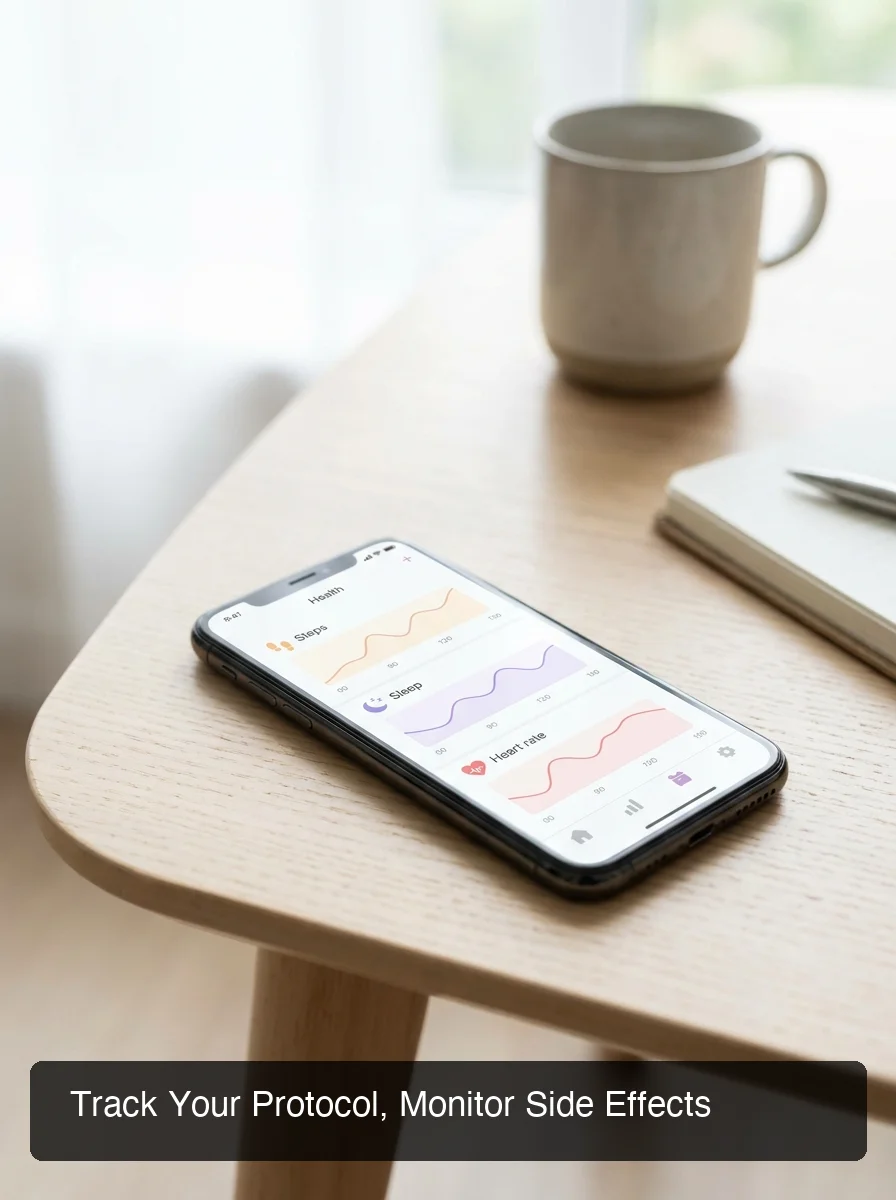 PeptideIQ's side effect logging grid tracks every symptom against dose timing — making it easy to spot threshold patterns before they compound.
The most effective way to minimize CJC-1295 side effects is to start at the lowest effective dose, space injections correctly, and log your body's response from day one. Dose escalation without tracking is the leading cause of preventable side effects — users overshoot their personal tolerance threshold without realizing it until symptoms are already significant.
Practical protocol guidelines that reduce risk from the first injection:
- Start at 0.5 mg per dose, not 1 mg. Most adverse effects at standard doses occur when users begin at the top of the dosing range.
- Space injections appropriately. MOD GRF 1-29 (no DAC): 2–3x per week is standard. CJC-1295 with DAC: once weekly is sufficient given the 6–8 day half-life — stacking doses too closely drives compounding side effects.
- Dose fasted. CJC-1295 is most effective in a fasted state — elevated insulin blunts GH release. For first-time injection technique and reconstitution setup, the peptide guide for beginners covers every step.
- Hydrate consistently. Water retention is partly driven by inadequate intake — your body retains fluid when it perceives a deficit. Staying ahead of hydration blunts this effect.
- Log every symptom. Side effects that seem random often follow clear patterns: they peak post-injection, correlate with sleep quality, or spike when doses are timed too closely.
PeptideIQ's dosing calculator takes your vial concentration, desired dose, and syringe type to output the exact units to draw — eliminating the math errors that lead to accidental overdose and its corresponding side effects. The side effect logging grid in the app (one tap per symptom per session) creates a visible record so you can identify threshold problems before they escalate into a reason to stop.
Bottom line: The single most effective strategy for managing CJC-1295 adverse effects is tracking your response with precision from day one. Guessing at whether a symptom is dose-related or coincidental is the fastest way to either quit unnecessarily or push past your threshold without realizing it.
Accurate Dosing Practices Prevent Most Problems
The math involved in peptide dosing — converting vial milligrams to syringe units based on BAC water volume — is where most errors happen. Precise dosing practices matter across all injectable peptides. A 2x dose error on CJC-1295 amplifies every side effect on the list significantly.
 Exact measurement is not optional with growth hormone peptides — small deviations at the dose level have outsized effects on side effect severity.
What Should You Do If You Experience CJC-1295 Side Effects?
When CJC-1295 side effects appear, your first response should be assessment — not panic, and not dismissal. Categorize what you're experiencing: is it injection-site local (normal and expected), systemic and mild (monitor and reduce dose if persistent), or systemic and severe (stop the protocol and seek medical guidance)?
Response Tiers
Local injection site reaction (redness, swelling, mild pain): Rotate injection sites, verify your technique is correct, and continue. This resolves within 24–48 hours in most cases. If redness spreads or the site worsens over 48 hours, inspect your vial for contamination.
Mild systemic effects (water retention, post-injection fatigue, headaches): Give the protocol 7–14 days. These are adaptation-phase effects with clear physiological explanations. If they persist beyond two weeks, reduce dose by 25% and reassess.
Moderate symptoms (noticeable joint pain, persistent headaches, pronounced flushing): Pause for 3–5 days. Your current dose is likely above your personal tolerance threshold. Restart at a lower dose and titrate up more gradually.
Severe symptoms (difficulty breathing, significant swelling, chest discomfort, severe dizziness): Stop immediately and seek medical attention. These are not standard CJC-1295 side effects and suggest an allergic reaction, a contaminated product, or a pre-existing condition being affected.
Are CJC-1295 Side Effects Reversible?
Yes — CJC-1295 side effects are fully reversible. Because CJC-1295 stimulates your pituitary gland rather than replacing a hormone, your body's natural production system remains intact throughout. When you stop, GH levels return to baseline and all side effects resolve — there is no evidence of permanent hormonal suppression at standard doses.
This is one of CJC-1295's most significant advantages over exogenous synthetic HGH. Direct HGH injection suppresses your pituitary's natural GH production over time — a feedback loop disruption that can take months to normalize after stopping. CJC-1295 does not trigger this suppression because it works through your existing pituitary signaling, not around it.
Water retention clears within days of stopping. Joint aching resolves as IGF-1 levels normalize (typically within 1–2 weeks). Mood changes and sleep disruption normalize within the first week off-protocol.
Key insight: CJC-1295's within-feedback mechanism is the primary reason its CJC-1295 safety profile is so much milder than exogenous HGH — and why its effects are fully reversible. No other growth hormone approach preserves the natural pituitary feedback loop this effectively at comparable performance outcomes.
Download PeptideIQ
Understanding your CJC-1295 side effects is one thing. Tracking them systematically — so you can catch threshold issues early, adjust doses precisely, and build confidence across the full cycle — is the difference between guessing and knowing.
Download PeptideIQ on the App Store
Frequently Asked Questions About CJC-1295 Side Effects
Is CJC-1295 safe to take?
CJC-1295 is considered safe at standard doses (0.5–1 mg per dose) based on clinical research and community data — no serious adverse events were reported in published human trials. Like all injectable peptides, it should be used with awareness of your personal health baseline, especially with cardiovascular or endocrine conditions. Consulting a healthcare professional before starting is appropriate.
Does CJC-1295 affect testosterone?
CJC-1295 does not directly affect testosterone production. It stimulates growth hormone and IGF-1, which operate on a separate axis from the hypothalamic-pituitary-gonadal (HPG) system that controls testosterone. Some users report improved recovery and energy that may indirectly support hormonal health, but CJC-1295 does not suppress or stimulate testosterone directly at standard doses.
What are the negative side effects of growth hormone peptides generally?
Growth hormone peptide side effects vary by compound. GHRH/GHRP peptides like CJC-1295 cause water retention, injection site reactions, and transient flushing. Healing peptides like BPC-157 are generally well-tolerated; GLP-1 peptides (semaglutide, tirzepatide) have a distinct profile driven by GI effects rather than GH elevation.
What side effects does CJC-1295 have in women?
Women report broadly similar side effects to men — water retention, injection site reactions, and initial fatigue. Water retention may be more pronounced due to differences in baseline fluid regulation, and mood-related effects may track with the menstrual cycle. The CJC-1295 safety profile in women is not significantly different from men; start at the lower end of the dosing range (0.5 mg).
Can CJC-1295 side effects be prevented entirely?
Prevention is not the realistic goal — management is. Starting at 0.5 mg, spacing injections correctly, hydrating consistently, and logging symptoms from day one eliminates most severe or prolonged side effects. The 7–14 day adaptation window produces some degree of side effects for most users; what you control is how quickly you identify and respond to your personal threshold.
What is the difference between CJC-1295 with DAC and MOD GRF 1-29 side effects?
MOD GRF 1-29 is CJC-1295 without the DAC modification — half-life of ~30 minutes versus 6–8 days. MOD GRF 1-29 produces pulsatile GH release with more acute flushing and tingling but shorter water retention; CJC-1295 with DAC produces sustained GH elevation with longer-lasting water retention but less acute post-injection effects. Users sensitive to immediate injection side effects often prefer MOD GRF 1-29.