
Peptide Guide for Beginners: Setup, Dosing & Safety
Peptide Guide for Beginners: Setup, Dosing & Your First Cycle
This peptide guide is built for first-time users who already have a vial and no idea what to do next. Most resources assume you know the basics — this one starts from zero.
Key Takeaways
- Peptides are short amino acid chains targeting specific outcomes — muscle, recovery, healing, or longevity — with beginner-friendly options including CJC-1295, TB-500, and BPC-157.
- A complete beginner setup costs under $200 and includes peptide vials, bacteriostatic water, U-100 insulin syringes, alcohol swabs, and a sharps container.
- Safe starter doses range from 0.5–1 mg daily injected subcutaneously at rotating sites, with 4–8 week cycles standard for first-time users to assess tolerance.
- Consistent daily logging of doses, injection sites, and how you feel is the single habit that separates successful cycles from chaotic ones — most beginners underestimate this.
- Source only from verified suppliers with third-party testing certificates — FDA testing found up to 40% of online peptide products contained incorrect dosages or undeclared ingredients.
Contents
- What Is a Peptide Guide and Why Do Beginners Need One?
- What Are the Best Peptides for Beginners?
- What Equipment Do You Need to Get Started With Peptides?
- How Do You Mix and Prepare Peptides as a Beginner?
- How Much Does a Beginner Peptide Cycle Cost?
- Are Peptides Safe for First-Time Users?
- How Should You Track Your Peptide Progress?
- What Results Can You Realistically Expect in Your First Month?
What Is a Peptide Guide and Why Do Beginners Need One?
A peptide guide gives first-time users the structured process to go from "vial in fridge, no idea" to a confident, repeatable protocol. Without a clear starting framework, most beginners either underdose and see no benefit, improvise inconsistently and can't interpret results, or abandon their cycle before it has a chance to work. This guide covers all five startup essentials: which peptides to start with, what equipment to buy, how to mix, what it costs, and how to track.
Peptides are short chains of amino acids — the molecular building blocks of proteins — that signal specific biological processes when introduced into the body. Unlike oral supplements, most peptides are injected subcutaneously, which means the barrier to getting started is genuinely higher. You need equipment, a mixing process, and a tracking plan.
If you're still weighing whether peptides are right for you, start with the Beginner's Complete Guide to What a Peptide Is before diving in here.
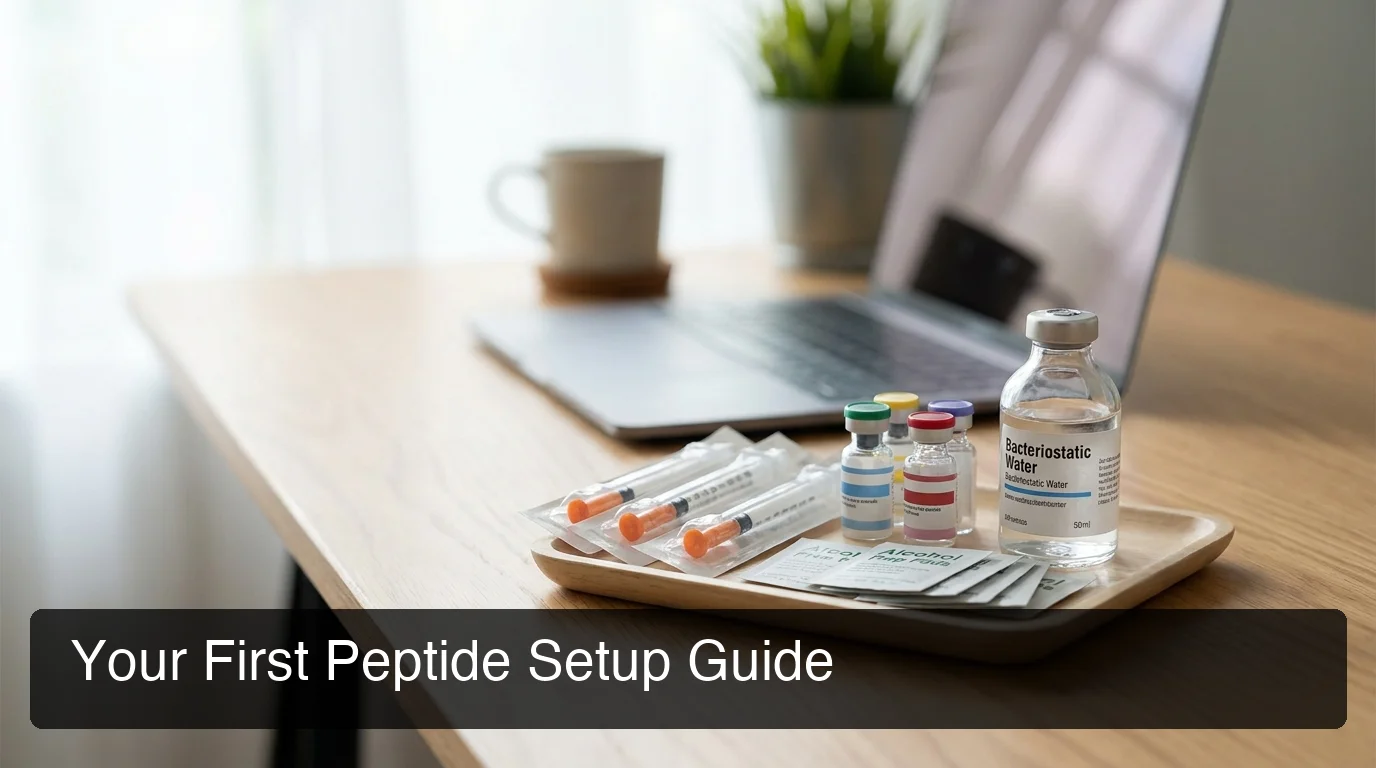 An organized, dedicated workspace reduces errors and builds the consistency habit that makes peptide protocols actually work.
Key insight: The biggest beginner mistake isn't a bad injection technique — it's starting without a system. A system means knowing your dose, your schedule, your rotation plan, and exactly how you'll measure progress before you draw your first dose.
What Are the Best Peptides for Beginners?
The best peptides for beginners are well-tolerated, have clear goal alignment, and work as standalone protocols: BPC-157 for injury recovery and gut healing, TB-500 for systemic tissue repair and mobility, and CJC-1295 with Ipamorelin for growth hormone stimulation and recovery. The first rule of beginner protocol design is to start with one peptide — not a stack — so you can isolate what's working.
| Peptide | Primary Use | Evidence Level | Beginner Dose | Cycle Length |
|---|---|---|---|---|
| BPC-157 | Injury recovery, gut healing | Strong animal / early human | 250–500 mcg/day | 4–8 weeks |
| TB-500 | Tissue repair, mobility | Moderate animal | 2–5 mg/week | 4–8 weeks |
| CJC-1295 | GH stimulation, recovery | Human clinical data | 1–2 mg/week | 8–12 weeks |
| Ipamorelin | GH pulse, sleep quality | Human clinical data | 200–300 mcg/dose | 8–12 weeks |
Why Start With One Peptide?
Running a single peptide makes cause-and-effect clear. If your knee heals faster, that's BPC-157 working. If your sleep improves, that's CJC-1295 doing its job.
Stack two peptides from Day 1 and you lose the signal — you cannot attribute any change to either compound with confidence.
Complete one solo cycle first, then add a second peptide with that baseline already established.
What Equipment Do You Need to Get Started With Peptides?
The complete beginner peptide kit requires five items: the lyophilized peptide vial, bacteriostatic water (not regular sterile water), U-100 insulin syringes, 70% isopropyl alcohol prep pads, and a sharps container. Every item serves a specific function — substituting or skipping any one of them introduces contamination or dosing risk.
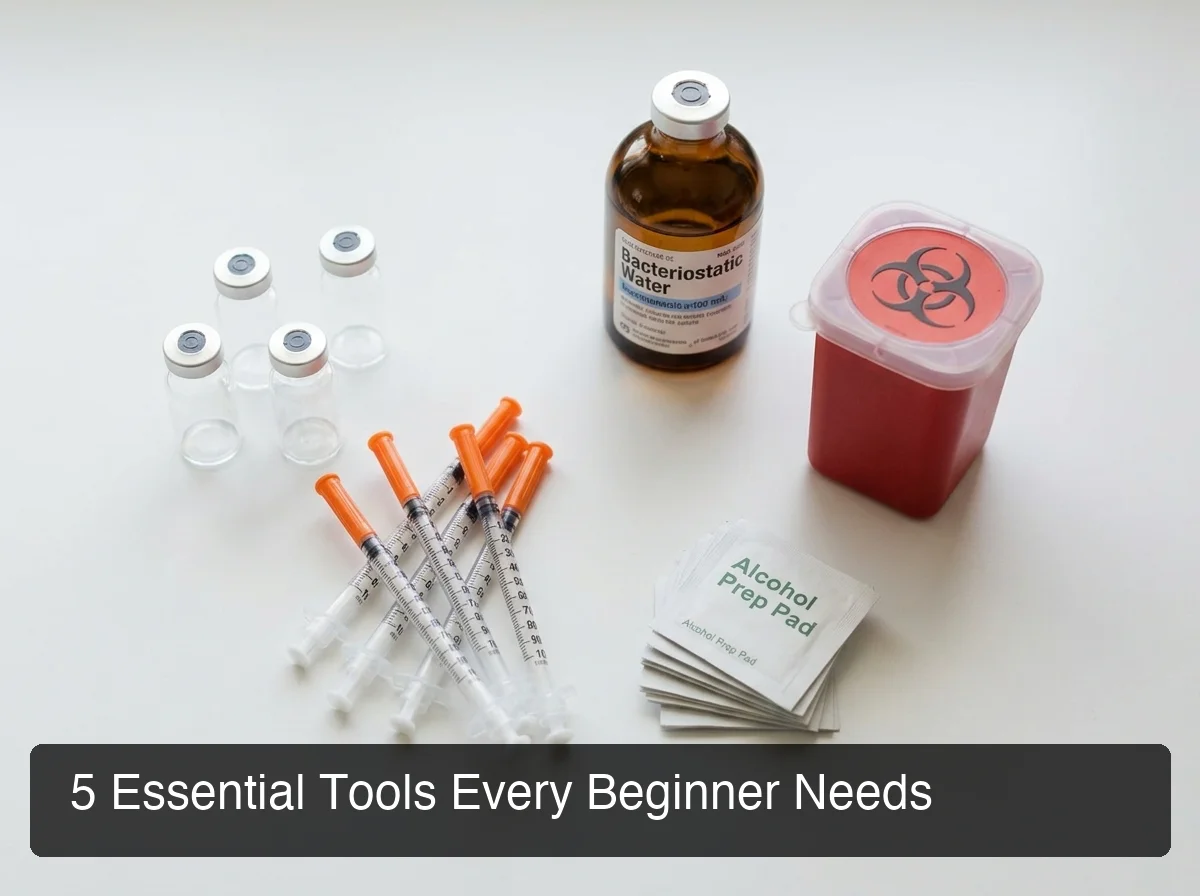 All five items are available without a prescription. Budget $40–$60 for the equipment portion of your beginner kit.
Equipment Breakdown
- Bacteriostatic water (BAC water): Sterile water with 0.9% benzyl alcohol to prevent bacterial growth after opening. Shelf life once opened: 28–30 days. Do NOT substitute with regular sterile water — it contains no preservative and will spoil quickly in a multi-dose vial.
- U-100 insulin syringes: The standard for subcutaneous peptide injections. U-100 means 100 units per mL. A 1 mL syringe with a 29–31 gauge, 6 mm needle is ideal — the short length reduces discomfort at subcutaneous depth.
- Alcohol prep pads (70% isopropyl): Wipe the rubber stopper of every vial before drawing, and the injection site before and after each dose. Let the site air dry before inserting the needle.
- Sharps container: Required for safe disposal of used needles. A 1-quart sharps container costs under $5 at any pharmacy. Never recap a used needle or discard in household trash.
When you're ready to go deeper on diluents, an upcoming guide on bacteriostatic water for peptides will cover why BAC water is non-negotiable, how to verify quality, and how to extend its effective shelf life.
By the numbers: Insulin syringes ($12), bacteriostatic water ($10), alcohol swabs ($6), sharps container ($4) — your equipment kit totals under $35. Combined with peptide vials, most beginners spend $150–$200 for a complete first cycle.
How Do You Mix and Prepare Peptides as a Beginner?
Reconstitution is the process of mixing lyophilized (freeze-dried) peptide powder with bacteriostatic water before injection. The most common beginner error is adding the wrong amount of BAC water, which throws off the concentration and makes every dose calculation wrong from that point forward. The math is simple: a 5 mg vial with 2 mL of BAC water gives a concentration of 2,500 mcg/mL.
Step-by-Step Reconstitution Process
- Wipe the rubber stopper of both the peptide vial and the BAC water vial with an alcohol pad. Let both dry completely.
- Draw your target BAC water volume (typically 1–2 mL) into the syringe.
- Insert the syringe at an angle and let the water run slowly down the inside wall of the peptide vial — do not squirt directly onto the powder.
- Swirl gently to mix. Never shake — shaking degrades the peptide chain.
- Allow 60–90 seconds for full dissolution. The solution should be clear and colorless.
- Refrigerate immediately. Label the vial with the reconstitution date.
Calculating Your Draw
With a U-100 syringe, 1 unit = 0.01 mL. At a concentration of 2,500 mcg/mL (5 mg vial + 2 mL BAC water), a 250 mcg dose = 10 units drawn on the syringe.
For detailed guidance on injection technique, needle angle, and site rotation, the Peptide Injection Site Beginner's Guide covers each subcutaneous location with step-by-step instructions.
A full step-by-step peptide mixing protocol guide is coming for users who need the deeper dive on ratio variations, reverse calculations, and multi-vial management.
How Much Does a Beginner Peptide Cycle Cost?
A standard 8-week beginner peptide cycle costs $120–$300 total depending on which peptide, dosage, and supplier you choose. Healing peptides (BPC-157, TB-500) run on the lower end; growth hormone peptides (CJC-1295, Ipamorelin) cost more per cycle. The premium for verified third-party testing is mandatory — cheap, unverified peptides are not a bargain.
| Item | Estimated Cost |
|---|---|
| Peptide vials (1–2 for 8 weeks) | $60–$200 |
| Bacteriostatic water (2 vials) | $8–$15 |
| Insulin syringes (box of 100) | $10–$15 |
| Alcohol swabs (box of 100) | $5–$8 |
| Sharps container | $3–$6 |
| Total | $86–$244 |
What to Look for in a Supplier
Request a Certificate of Analysis (COA) from an independent third-party lab. The COA should confirm purity at 99%+ and be dated within the past 12 months. Any supplier unwilling to share one should be avoided — this is the single most effective contamination-prevention step available to a beginner.
Are Peptides Safe for First-Time Users?
Peptides are not uniformly safe or unsafe — safety is peptide-specific, dose-dependent, and sourcing-dependent. FDA-approved peptides (semaglutide, tirzepatide) have well-established profiles; gray-market peptides (BPC-157, CJC-1295) carry strong animal evidence but limited long-term human data.
Responsible first use means starting at the low end of standard doses, tracking your response from Day 1, and knowing what side effects to watch for.
Common side effects by peptide type:
- Healing peptides (BPC-157, TB-500): Mild injection site soreness, occasional nausea in the first week. Typically resolves by Day 10.
- GH peptides (CJC-1295, Ipamorelin): Water retention, tingling in extremities, increased appetite, morning grogginess. Usually subside by week 3 as the body adapts.
- GLP-1 peptides (semaglutide): Nausea, reduced appetite, possible hair loss at higher doses. Well-documented and manageable with the titration schedules designed for this class.
For the full clinical evidence breakdown and risk mitigation framework, read Are Peptides Safe? What the Research Actually Shows.
Bottom line: The two primary safety risks for first-time users are contaminated product and dosing errors. Both are solved by sourcing from verified suppliers with COAs and logging every dose from Day 1.
How Should You Track Your Peptide Progress?
Consistent tracking is the difference between a cycle that teaches you something and one that leaves you guessing. Most beginners underestimate this: they dose inconsistently, skip logging, and three weeks in they genuinely cannot tell whether their protocol is working. The data you collect in the first two weeks becomes the baseline every later measurement gets compared against.
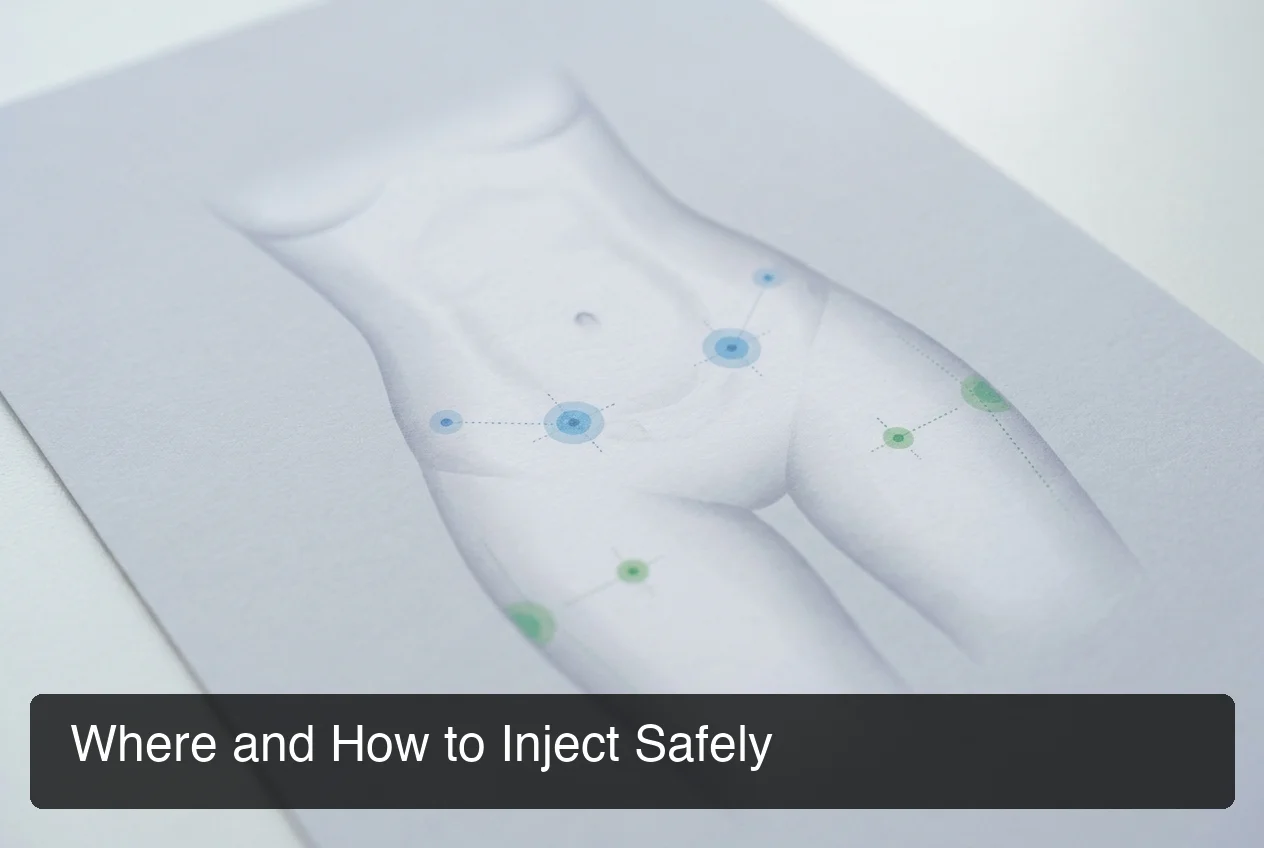 Rotating injection sites prevents scar tissue buildup. Logging each site ensures you never reuse the same location within 48 hours.
What to Log With Every Dose
- Injection site used (rotate to prevent tissue buildup)
- Dose amount drawn in syringe units
- Date and time of injection
- Energy level (1–10 scale)
- Primary goal metric: pain score for recovery, body weight for GLP-1, recovery rating for performance
- Any side effects noticed — even mild ones
This takes under two minutes per dose. The compounding value of that data over 8 weeks is enormous.
Why an App Beats a Spreadsheet
Spreadsheet tracking fails because it requires too many steps. Within two weeks most people stop logging, and when you stop logging you lose the signal entirely.
PeptideIQ is purpose-built for this workflow — 60-second dose logging with injection site rotation diagrams, wellness sliders, reconstitution math, and an AI co-pilot that knows your full cycle history. Weekly AI insight cards surface automatically based on your actual logged data.
What Results Can You Realistically Expect in Your First Month?
Peptide results in the first month are real but modest — this is a timeline-driven process, not an overnight transformation. BPC-157 users typically notice reduced pain by weeks 2–4, GH peptide users see improved sleep in weeks 1–2 with body composition visible at weeks 6–8, and GLP-1 users see the most measurable early results with weight change often by week 2.
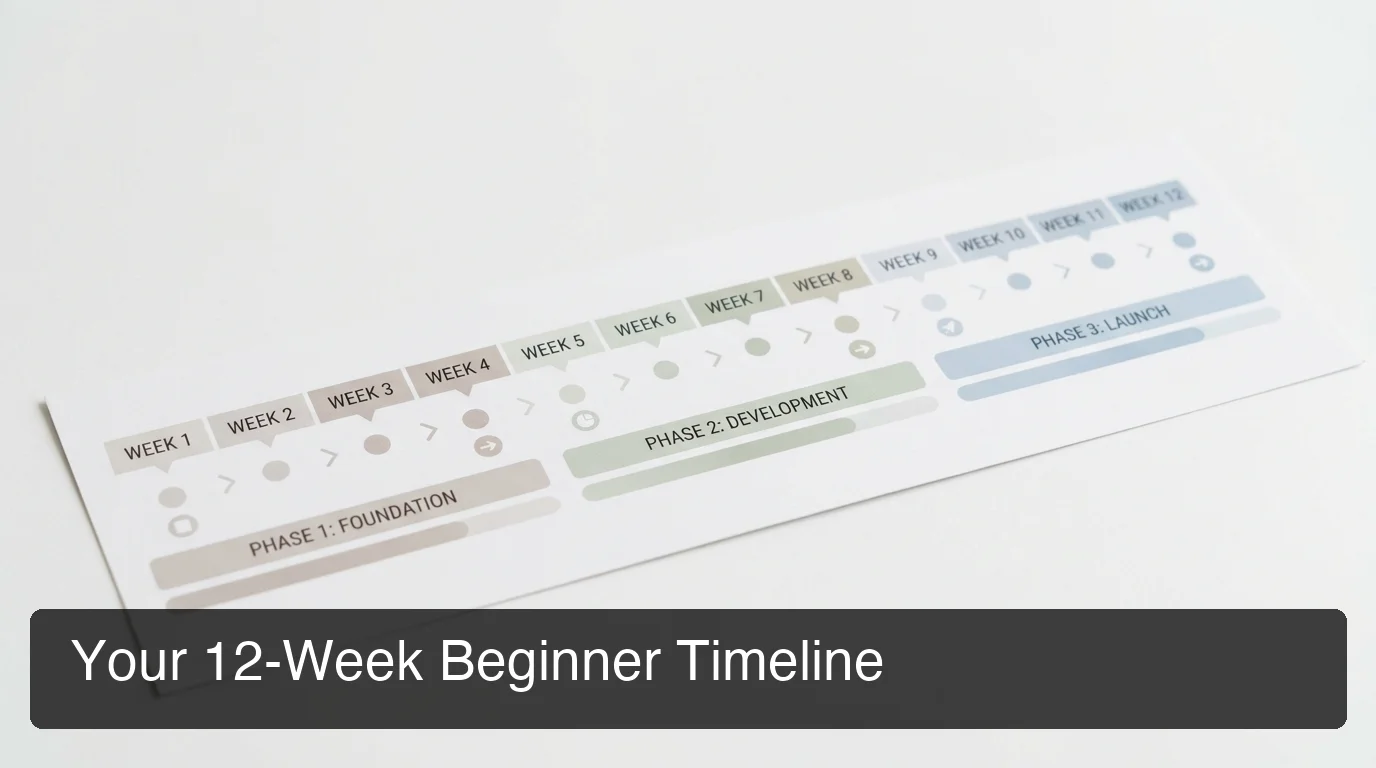 A 12-week beginner cycle: weeks 1–4 establish baseline response and tolerance, weeks 5–8 deliver peak benefit, weeks 9–12 consolidate or evaluate continuation.
Week-by-Week Expectations
Weeks 1–2: Establish your routine and baseline. Some users experience mild side effects (injection site soreness, nausea) — these typically resolve by Day 10. Log every dose. Record your baseline energy, pain, and goal metrics now.
Weeks 3–4: Primary signal window. BPC-157 healing effects peak here. GH peptides begin showing sleep quality improvements. GLP-1 nausea usually subsides as the body adapts to the dose.
Weeks 5–8: Results consolidation. Energy, recovery, or weight metrics should show a clear directional trend if dosing has been consistent. This is where the tracking data you built in weeks 1–4 pays off — you have a real baseline to compare against.
For a deeper look at outcomes across longer peptide protocols and the clinical research behind them, Is Peptide Therapy Safe? What Clinical Evidence Actually Shows provides the research context.
Get Started with PeptideIQ
The most common reason beginner peptide cycles fail is not sourcing or technique — it's inconsistent tracking. You cannot optimize what you don't measure.
PeptideIQ is the AI-powered guided system built for exactly this: protocol setup, dose logging with injection site rotation, automatic reconstitution math, vial inventory tracking, and weekly AI insight cards that know your cycle, your data, and your goals. Download PeptideIQ on the App Store
Peptide Guide FAQ: Common Beginner Questions
What is a peptide guide for beginners?
A beginner peptide guide covers the complete startup process: which peptides to start with, the equipment required to reconstitute and inject safely, how to calculate doses, what a first cycle costs, and how to track results week by week. It bridges the gap between research and Day 1 execution confidence.
How do you mix peptides as a beginner?
Add bacteriostatic water to your peptide vial by letting it run slowly down the inside wall — never squirt directly onto the powder. Swirl gently until fully dissolved (60–90 seconds), then refrigerate. With 2 mL of BAC water in a 5 mg vial, concentration is 2,500 mcg/mL. A 250 mcg dose draws to 10 units on a U-100 syringe.
What insulin syringe should beginners use for peptides?
Use a U-100 insulin syringe with a 29–31 gauge needle and 6 mm length for subcutaneous peptide injections. U-100 means 100 units per mL, which aligns precisely with standard peptide dose calculations. The 1 mL size gives enough precision at beginner doses (typically 10–50 units per draw) without wasting reconstituted product.
How do you store peptides properly?
Unreconstituted (lyophilized) peptides store at room temperature in a cool, dark location for months or refrigerated for up to 2 years. Once reconstituted with bacteriostatic water, refrigerate and use within 28–30 days. Never freeze reconstituted peptides — freeze-thaw cycles degrade the compound. Building a proper peptide storage routine extends effective shelf life and protects your investment.
What is bacteriostatic water and why do peptides need it?
Bacteriostatic water (BAC water) is sterile water containing 0.9% benzyl alcohol to prevent bacterial growth. It is the correct diluent for peptide reconstitution because it keeps your solution stable and sterile for up to 30 days after opening. Regular sterile water contains no preservative and spoils quickly — never use it as a substitute for a multi-dose vial.
How long does a beginner peptide cycle last?
Standard beginner cycles run 4–8 weeks for healing peptides (BPC-157, TB-500) and 8–12 weeks for growth hormone peptides (CJC-1295, Ipamorelin). After each active cycle, take an equal-length rest period before starting again. First cycles should always start at the minimum effective dose to establish your individual tolerance baseline before increasing.
How do you know if your peptide protocol is working?
Track your primary goal metric daily — pain level, recovery score, energy, or body weight — and compare week-over-week trends. If you logged consistently from Day 1, you'll have a clear signal by week 3–4. Without tracking, most beginners who "didn't feel anything" simply lost the signal in their own inconsistency.