
Peptide Injection Site Guide for Beginners | PeptideIQ
Peptide Injection Site: The Beginner's Complete Guide
You have the vial. You have the syringe. Now the question every first-timer asks: where exactly do I inject this? Choosing the right peptide injection site affects comfort, absorption, and long-term tissue health — and the wrong approach leads to lumpy tissue, inconsistent dosing, and wasted protocol weeks.
Key Takeaways
- The four most reliable peptide injection sites are the abdomen, outer thigh, deltoid, and glutes — each with distinct advantages depending on peptide type and experience level.
- Site rotation prevents lipohypertrophy (fatty lumps under the skin) and maintains consistent absorption over weeks of protocol use.
- Subcutaneous (SubQ) injections target the fat layer just under the skin — the preferred method for most peptides and all beginners.
- Abdomen absorbs fastest; glutes tolerate the largest volume; thigh is easiest to self-inject.
- A 25–27G needle, alcohol prep pad, and four-zone rotation plan are all you need for a safe home injection routine.
Contents
- What Are the Best Peptide Injection Sites for Beginners?
- Where Can You Safely Inject Peptides? Complete Site Guide
- Which Injection Site Works Best for Your Specific Peptide?
- How Do You Prevent Lipohypertrophy When Rotating Peptide Injection Sites?
- Can You Inject Peptides in the Same Site Multiple Times?
- What's the Safest Way to Rotate Between Peptide Injection Sites?
- How Does PeptideIQ Help You Track Peptide Injection Sites?
- Get Started with PeptideIQ
- Frequently Asked Questions
What Are the Best Peptide Injection Sites for Beginners?
The four best peptide injection sites for beginners are the abdomen, outer thigh, deltoid, and glutes. These locations offer accessible subcutaneous fat tissue, predictable absorption, and enough surface area to rotate across multiple zones without returning to the same spot for at least four days.
For most beginners, the abdomen is the go-to starting point. It has abundant fat tissue, is easy to pinch and visualize, and provides the fastest absorption rate of any common site. The outer thigh is a strong second choice — easy to see and reach for self-injection.
Deltoid and glutes expand your rotation pool significantly once you're comfortable. A four-site rotation from day one is non-negotiable for preventing lipohypertrophy during any cycle longer than two weeks.
 The four primary peptide injection sites — abdomen, thigh, deltoid, and glutes — form the foundation of any beginner rotation plan.
Key insight: Most beginners inject abdomen-only for their entire first cycle. This is the #1 mistake leading to lipohypertrophy. Build a four-site rotation from day one, even if the abdomen feels most comfortable.
Where Can You Safely Inject Peptides? Complete Site Guide
Every standard peptide injection site targets the subcutaneous fat layer using a 25–27G needle at a 45° angle. Each site has specific anatomical landmarks that separate safe injection zones from nerve and vessel-rich areas to avoid.
Abdomen — Fastest Absorption, Easiest Self-Injection
Stay at least 2 inches (5 cm) from your navel in all directions. Target the soft fat on both sides, spreading outward toward each hip — this gives 8–12 distinct rotation spots. Pinch 1–2 inches of skin, insert at 45°, inject slowly.
Best for: BPC-157, semaglutide, tirzepatide, ipamorelin, CJC-1295, GHK-Cu. Volume up to 1ml.
Outer Thigh — Best for Self-Administration
Target the middle third of your outer thigh between knee and hip. You can see and reach this site clearly with both hands. Avoid the inner thigh — it has thinner tissue and more nerve endings.
Best for: BPC-157, TB-500, Epitalon, any peptide when abdomen zones need rest. Volume up to 1.5ml.
Deltoid — Upper Outer Arm
Two finger-widths below the shoulder bone on the outer arm. Less fat here means smaller volumes only (under 0.5ml). Useful as your third rotation site when abdomen and thigh are fatigued.
Best for: Small-volume doses (0.5ml or less) for any SubQ peptide.
Glutes — Highest Volume Tolerance
The upper outer quadrant of each buttock holds the most subcutaneous fat of any common site. Most comfortable for larger volumes and least prone to immediate post-injection soreness. Self-injection is harder — a mirror helps.
Best for: Larger volumes (1–2ml), intramuscular peptides like TB-500, extended cycles needing additional rotation zones.
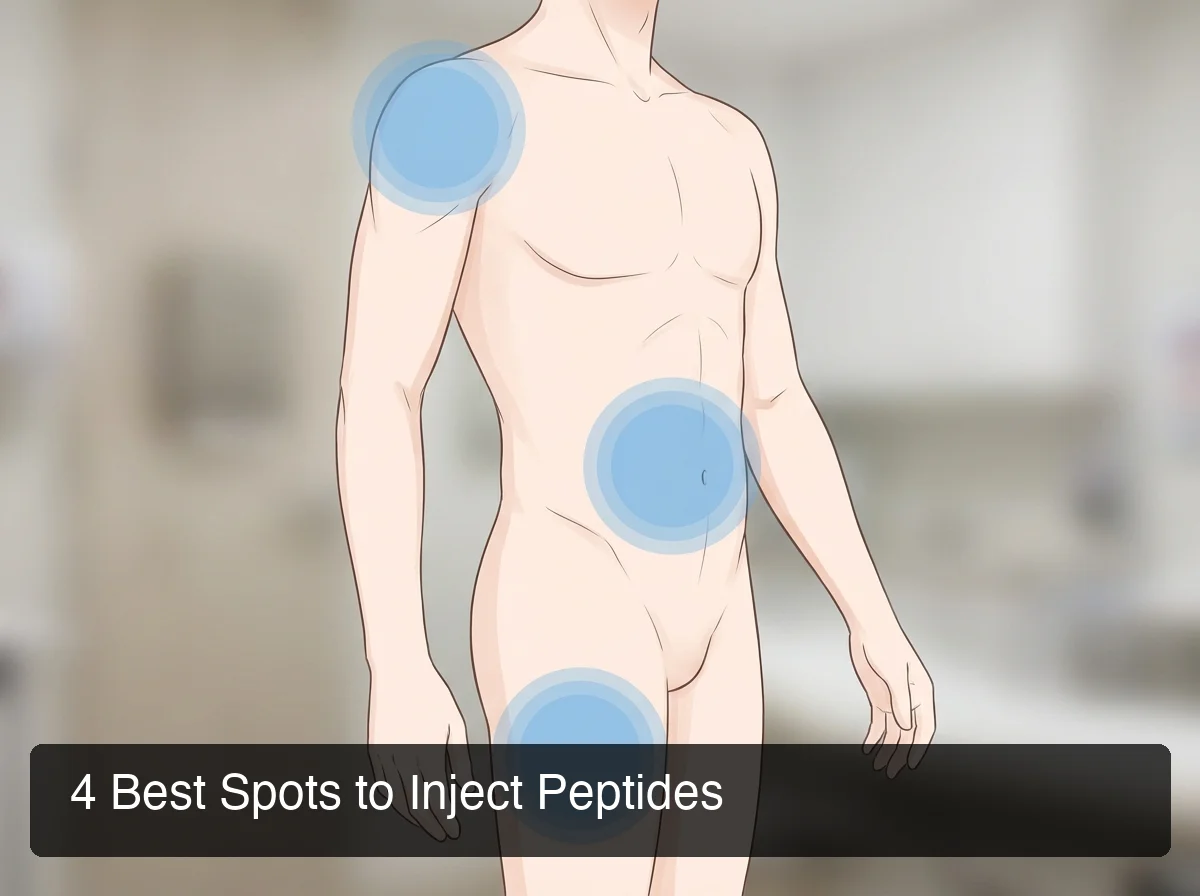 Anatomical overview of the four primary peptide injection zones — each site offers reliable subcutaneous fat access for consistent absorption.
Injection Site Comparison
| Site | Method | Absorption | Self-Inject Ease | Max Volume |
|---|---|---|---|---|
| Abdomen | SubQ | Fast | Very Easy | 1ml |
| Outer Thigh | SubQ | Moderate | Easy | 1.5ml |
| Deltoid | SubQ | Moderate | Moderate | 0.5ml |
| Glutes | SubQ or IM | Moderate | Hard | 2ml |
For complete step-by-step needle technique — angle, depth, and plunger speed — see our subcutaneous injection guide.
Which Injection Site Works Best for Your Specific Peptide?
Most peptides are subcutaneous by design, making the abdomen or outer thigh the default for nearly every beginner stack. A small subset benefit from intramuscular (IM) delivery — into deltoid or glutes — when faster systemic uptake matters more than comfort.
For beginners, SubQ into the abdomen covers every peptide on a typical starting stack. The practical absorption difference between sites is measurable in clinical studies but unlikely to change daily outcomes.
Site-to-Peptide Reference
| Peptide | Recommended Site | Method | Key Note |
|---|---|---|---|
| BPC-157 | Abdomen (near injury site) | SubQ | Inject proximal to injury when possible |
| Semaglutide / Tirzepatide | Abdomen or thigh | SubQ | Rotate weekly, not daily |
| CJC-1295 with DAC | Abdomen or thigh | SubQ | Long half-life — weekly dosing |
| Ipamorelin | Abdomen | SubQ | Must be fasted before injection |
| GHK-Cu | Abdomen or thigh | SubQ | Excellent site tolerance |
| TB-500 | Abdomen or thigh | SubQ or IM | IM for broader systemic effect |
| Sermorelin | Abdomen or deltoid | SubQ | Typically administered at bedtime |
| Epitalon | Abdomen or thigh | SubQ | Keep volume small — 0.5ml max |
By the numbers: BPC-157 protocols consistently recommend injecting as close to the injury site as practical (while staying subcutaneous). Knee injury: outer thigh. Shoulder injury: deltoid. The proximity may reduce the systemic distance the peptide needs to travel.
Once you've chosen your injection site for your specific peptide, proper injection technique is equally important — our complete injection technique guide covers every step from angle of insertion to post-injection care.
How Do You Prevent Lipohypertrophy When Rotating Peptide Injection Sites?
Lipohypertrophy — fatty tissue accumulation beneath the skin at a repeatedly injected site — develops when injections stimulate fat cell proliferation in the same small zone. Prevention requires never returning to the same spot within four days, spread across a minimum of three distinct anatomical sites.
Lipohypertrophy is painless but damaging to your protocol. The affected tissue absorbs peptides inconsistently, making your dose unreliable even when your reconstitution math is perfect. Semaglutide users are especially vulnerable because weekly dosing at a single site rapidly exhausts rotation capacity.
Recognizing Lipohypertrophy Early
- Firm, raised, or rubbery lump under the skin at a frequent injection site
- Injections in that area feel different — less resistance or sensation
- Visible asymmetry versus the same zone on the opposite side of the body
If you notice these signs, rest that site for 4–8 weeks. Tissue typically resolves without intervention; severe cases may take longer.
Bottom line: Lipohypertrophy is fully preventable. A four-zone rotation — abdomen left, abdomen right, thigh left, thigh right — gives you eight distinct spots with a minimum eight-day rest between any single position.
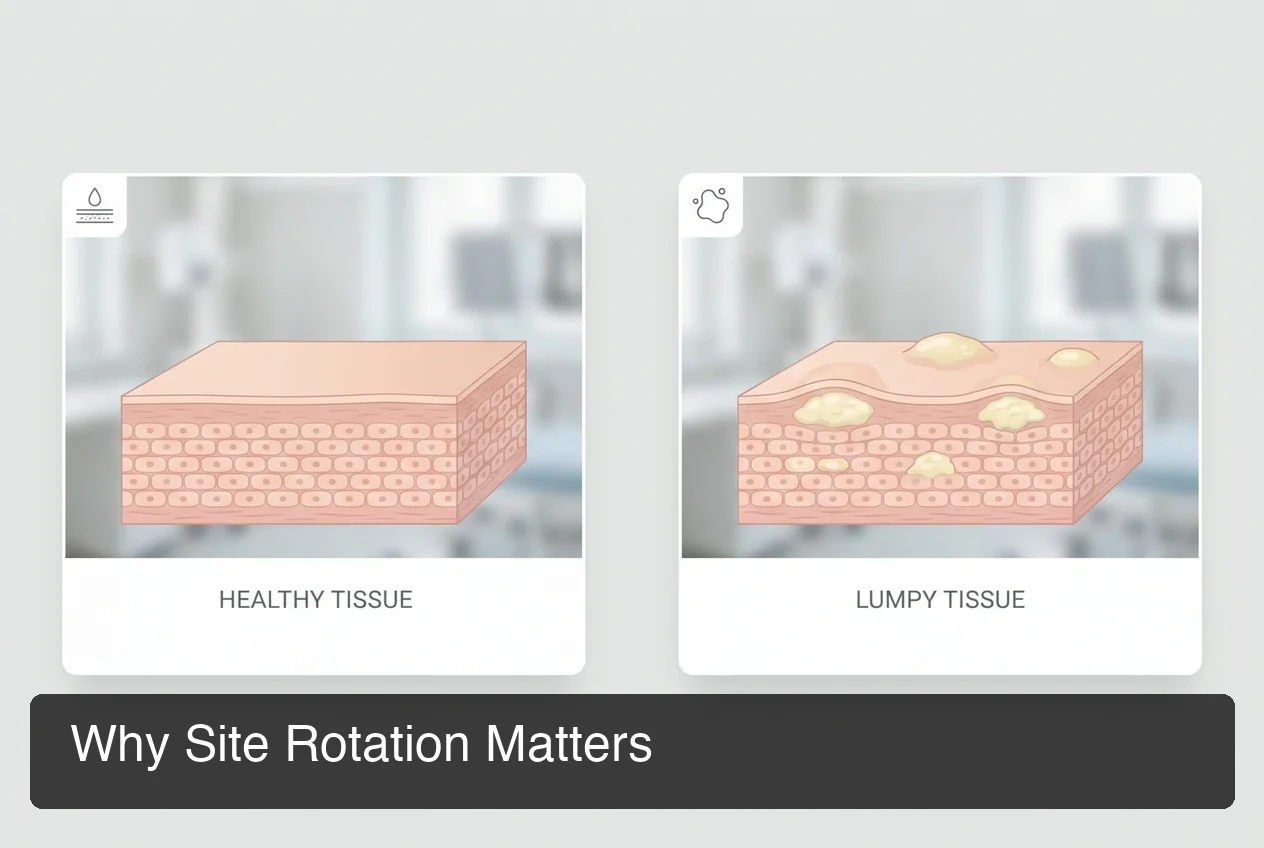 Consistent site rotation is the only reliable prevention for lipohypertrophy — healthy tissue maintains predictable absorption throughout a full cycle.
Can You Inject Peptides in the Same Site Multiple Times?
You can use the same anatomical zone (e.g., the abdomen) repeatedly — but you must vary the exact injection spot within that zone with every dose. The same skin surface should not receive an injection more than once every four days. Returning to the same millimeter-level point causes tissue irritation and, over time, lipohypertrophy.
Think of your abdomen as a clock face — Monday at 9 o'clock, Wednesday at 3 o'clock, Friday at 12 o'clock. Each position sits 1–2 inches from the last. This system keeps you in the abdomen while naturally rotating the actual puncture points.
The safety concern is not about using the same general region — it is about reusing the exact same small zone without rest. If you are evaluating the broader safety profile of peptide use, our article on peptide safety and what the research shows offers a grounded overview.
What's the Safest Way to Rotate Between Peptide Injection Sites?
The safest rotation follows the "four-day rule": no site receives a second injection within four days. A practical system for daily-dosing beginners uses four quadrants — left abdomen, right abdomen, left thigh, right thigh — advancing one position per dose and cycling back only after all four are used.
After site selection, mixing your reconstituted peptide correctly ensures accurate dosing at injection time — covered in our peptide mixing guide.
Beginner Rotation Schedule (Daily Dosing)
| Day | Injection Zone |
|---|---|
| Day 1 | Left abdomen |
| Day 2 | Right abdomen |
| Day 3 | Left outer thigh |
| Day 4 | Right outer thigh |
| Day 5 | Back to left abdomen |
For cycles beyond four weeks, expand the rotation to include deltoid and glutes. This gives each site 6+ days of rest between injections.
Safe Home Injection Checklist
- Wash hands thoroughly (20 seconds, soap and water)
- Prep site with alcohol pad; air dry 10 seconds before inserting
- Use a fresh sterile needle for every injection — never reuse
- Confirm dose calculation before drawing
- Pinch skin lightly before insertion; release after needle is in
- Inject slowly — 10 seconds per 0.5ml to minimize stinging
- Apply light pressure with cotton ball after withdrawal; do not rub
- Dispose of needles immediately in a sharps container
Protecting injection site health means also protecting your peptide supply through proper storage — consistent refrigeration and sterile reconstitution directly affect how your compound performs at the injection site.
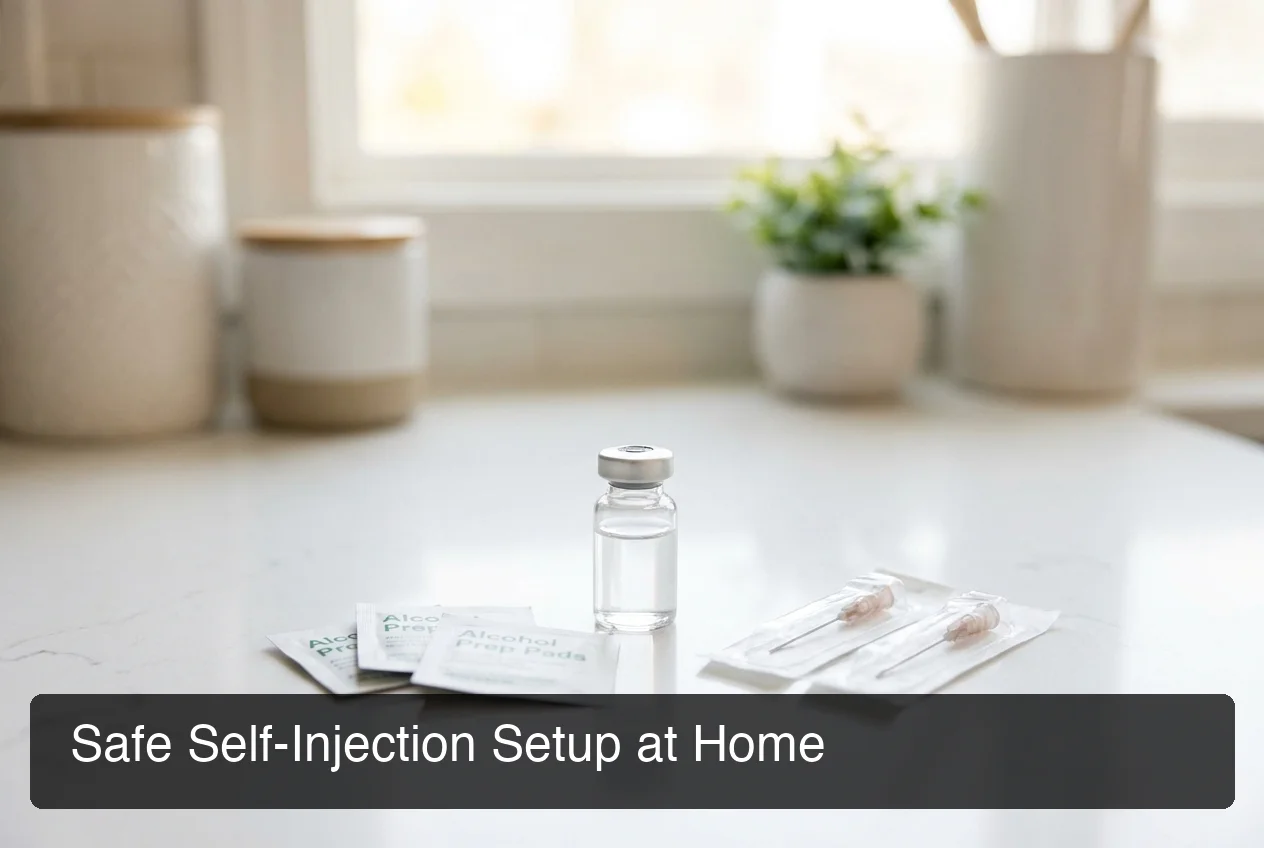 A well-organized home injection setup: alcohol swabs, fresh sterile needles, and a properly reconstituted peptide vial — the essentials for safe self-administration.
How Does PeptideIQ Help You Track Peptide Injection Sites?
Tracking which injection zone you used three days ago — and which sites are resting — becomes genuinely difficult across a 56-day cycle. PeptideIQ solves this with a built-in injection site rotation tracker: a color-coded front/back body diagram that shows your next recommended site after every logged dose.
Green means ready, yellow means used in the last 48 hours, red means used today. For first-timers, PeptideIQ labels the exact anatomical landmark: "Left abdomen — 2 inches from navel." The rotation management is automatic — you just follow the system.
PeptideIQ's AI co-pilot also knows your protocol specifics — cycle day, dose history, wellness logs — so when injection site soreness shows up on Day 6 of BPC-157, it responds with context, not a generic disclaimer.
Get Started with PeptideIQ
Site selection is the foundation. Managing it — rotation history, dose timing, cycle phase, side effect tracking — is where most users run into problems without a system. PeptideIQ handles all of it, so you can focus on the protocol instead of the logistics.
Download PeptideIQ on the App Store
Frequently Asked Questions
Where is the best place to give a peptide shot?
The abdomen is the best starting site for most beginners — it has abundant subcutaneous fat, absorbs peptides quickly, and is easy to self-inject without assistance. Stay at least 2 inches from your navel and rotate across 8–12 spots on both sides. Never return to the exact same point for at least four days.
Does it really matter where you inject peptides?
Yes — injection site affects absorption speed and long-term tissue health. Abdomen absorbs fastest; glutes tolerate the most volume. More critically, injecting the same spot repeatedly causes lipohypertrophy — fatty tissue that makes absorption inconsistent and keeps your doses unpredictable across the entire protocol cycle.
Do I inject peptides into fat or muscle?
Most peptides are injected subcutaneously — into the fat layer just under the skin, not into muscle — using a short ½-inch, 29–31G needle at a 45° angle. Intramuscular injection applies only to a small subset of peptides (TB-500, some GHRPs) and is not recommended for beginners. Default to subcutaneous for your entire first cycle.
What needle gauge should I use for peptide injections?
A 25–27G, ½-inch needle is the standard for subcutaneous peptide injections; for very small volumes (0.5ml or less), a 29–31G insulin syringe causes even less discomfort. Avoid needles shorter than ⅜ inch in the deltoid, where fat tissue is thinner. Needle gauge does not affect absorption — only comfort during insertion.
How do I know if my injection site is infected?
Watch for spreading redness beyond the injection point, increasing warmth, swelling, discharge (yellow or green), or fever. Mild redness or a small raised bump immediately post-injection is normal and typically resolves in 30 minutes. If redness spreads or any symptom persists beyond 24 hours, consult a healthcare provider.
How often should I rotate peptide injection sites?
Each site should rest a minimum of four days before receiving another injection. A four-zone rotation — left abdomen, right abdomen, left thigh, right thigh — gives every site at least four days off per cycle. For long protocols (8+ weeks), add deltoid and glutes to extend rest intervals further and protect all zones from overuse.
Can I inject two different peptides in the same site on the same day?
It is generally safe to inject two peptides at the same anatomical site using separate syringes, with different puncture points spaced a few inches apart. Some users prefer different sites per peptide to track any site-specific reactions independently. If you are running a multi-peptide stack, a tracking system that logs which peptide was injected where simplifies this significantly.