
How to Store Peptides: Temperature, Containers & Shelf Life
How to Store Peptides Safely: Temperature, Containers & Shelf Life
Most people obsess over peptide dosing. Almost nobody thinks about how to store peptides — until the vial in their fridge turns cloudy and smells off. Improper storage is the #1 cause of lost peptide potency, and it's entirely preventable.
Key Takeaways
- Most peptides require refrigeration at 2–8°C to maintain stability and potency for months to years.
- Amber glass vials with desiccant packs protect peptides from light and moisture, the two biggest stability threats.
- Room temperature storage (up to 25°C) is safe for short periods (hours to days) but degrades potency faster; always return to cold storage.
- Traveling with peptides requires insulated cooler cases and ice packs; TSA rules allow peptides in carry-on if they remain properly sealed.
- Proper labeling with reconstitution dates and storage temperature is critical for tracking expiration and maintaining safety.
Contents
- How to Store Peptides at Home?
- Do Peptides Need to Be Refrigerated?
- How to Store Peptides Long-Term?
- How Long Can Peptides Stay at Room Temperature?
- What Containers Are Safe for Storing Peptides?
- How Do Temperature and Light Affect Peptide Stability?
- How PeptideIQ Helps You Track Storage Conditions
- Can You Travel With Peptides? Storage Tips for On-the-Go
- FAQ: Peptide Storage Questions
How to Store Peptides at Home?
Store lyophilized (dry powder) peptides at 2–8°C in a sealed amber glass vial with a desiccant pack. Reconstituted peptides mixed with bacteriostatic water need the same refrigerated range and typically last 28–90 days depending on the peptide type. Both forms require protection from light, heat, and moisture.
The format of your peptide determines the exact protocol. Dry lyophilized peptides arrive as a white powder — stable, easy to store, forgiving of short delays. Reconstituted peptides are biologically active solutions that degrade much faster.
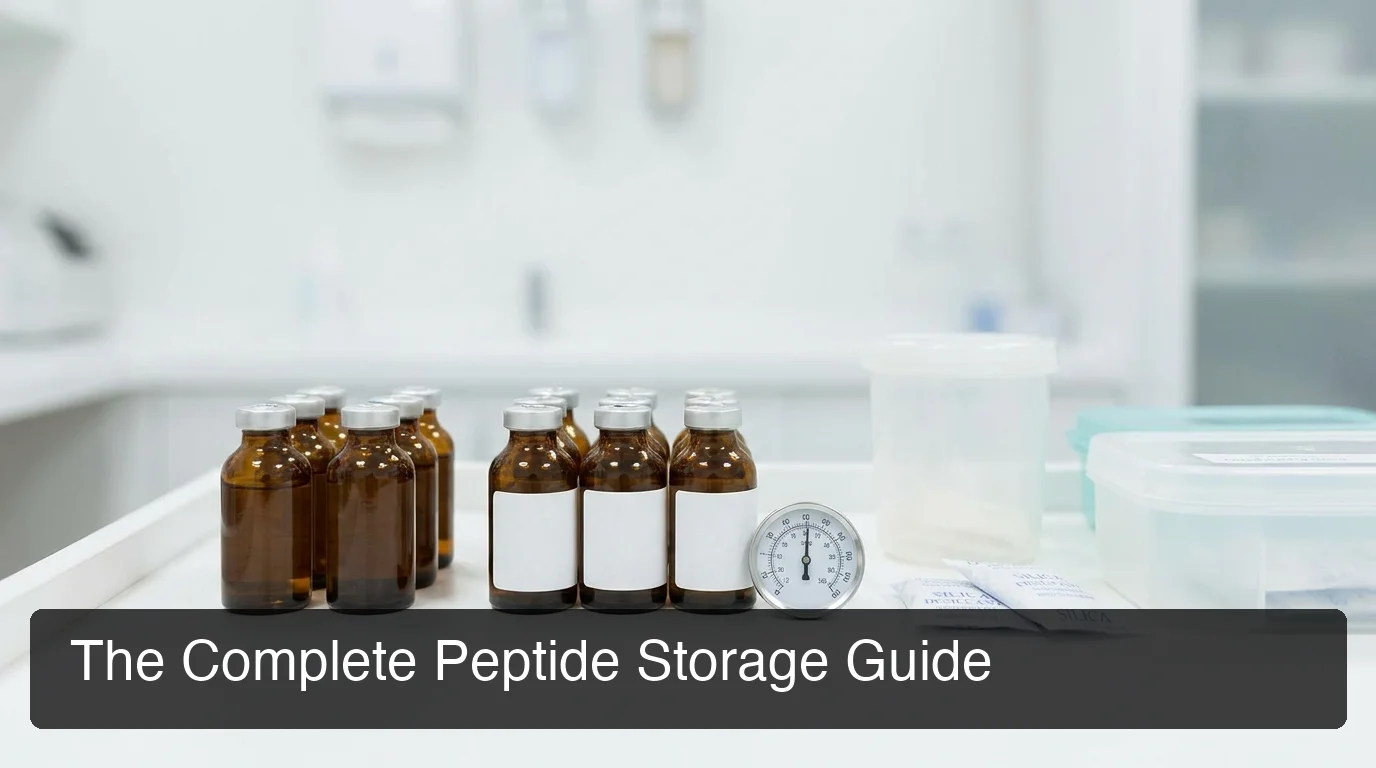
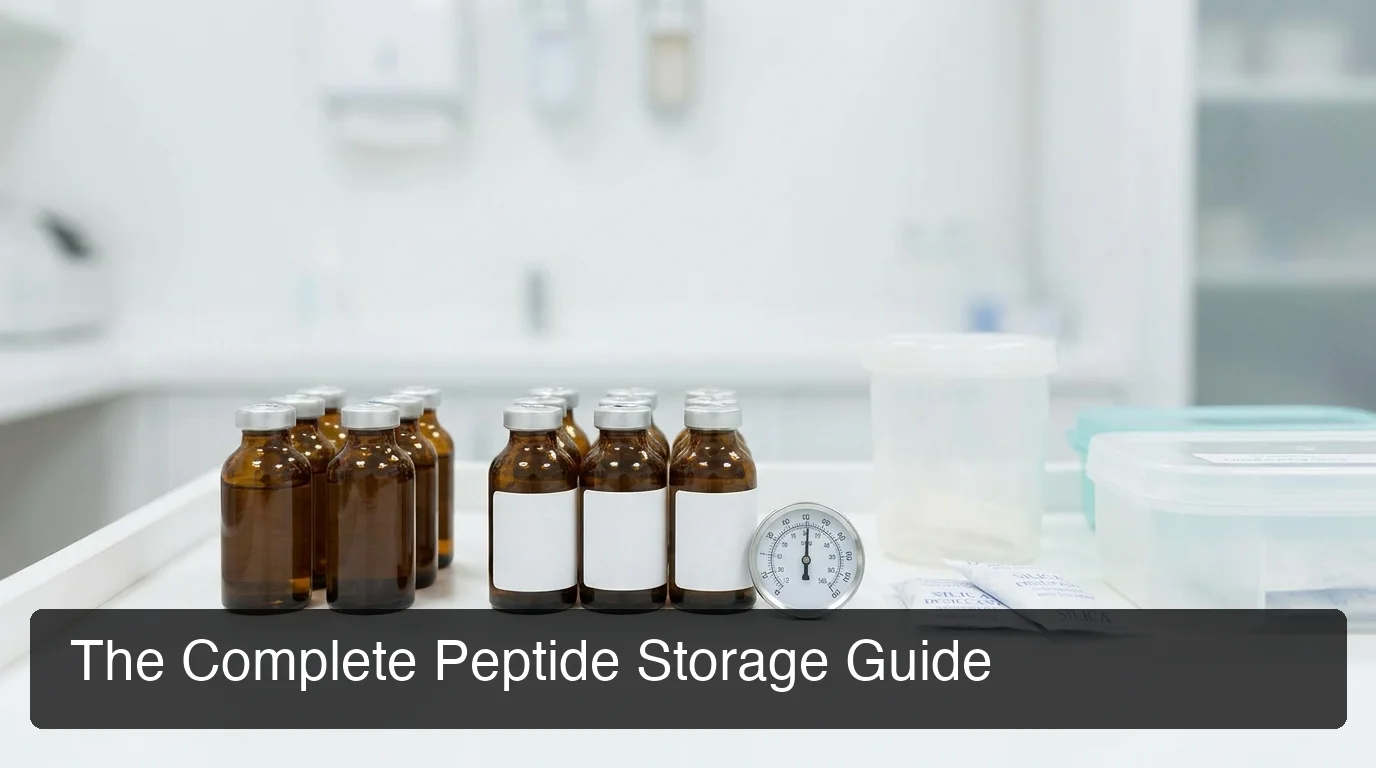 A proper home peptide storage setup: labeled amber vials, desiccant, and a dedicated refrigerator shelf.
Lyophilized vs. Reconstituted Storage at a Glance
| Format | Storage Temp | Shelf Life | Key Rule |
|---|---|---|---|
| Lyophilized (dry powder) | 2–8°C (fridge) or −20°C (freezer) | 12–36 months | Freeze only this form |
| Reconstituted (in BAC water) | 2–8°C (fridge only) | 28–90 days | Never freeze after mixing |
| Opened multi-dose vial | 2–8°C (fridge) | Peptide-dependent | BPC-157: 30 days; GLP-1s: up to 90 days |
If you're new to peptides and haven't started a protocol yet, the beginner's complete guide to what peptides are is the right first stop before getting into storage details.
Do Peptides Need to Be Refrigerated?
Yes — nearly all peptides require refrigeration once reconstituted. Lyophilized peptides are more forgiving but still benefit from cold storage to maximize shelf life. The only exception is brief handling: room temperature exposure during injection preparation is safe for short periods.
Peptides are short-chain amino acid sequences. Like proteins, heat disrupts the bonds that give them biological activity. Room temperature storage accelerates this degradation — not dramatically in a single afternoon, but significantly over days and weeks.
Temperature Quick Reference
- −20°C (freezer): Lyophilized peptides only. Extends shelf life to 2+ years. Do NOT freeze reconstituted peptides — ice crystals destroy molecular structure.
- 2–8°C (fridge): The daily working range for both forms. Optimal for reconstituted peptides.
- Up to 25°C (room temp): Safe for a few hours during prep. Not safe for storage.
- Above 25°C: Active degradation zone. Never leave peptides in a hot car or near a window.
Key insight: The rule is simple — if you're not injecting it in the next 30 minutes, it should be cold.
How to Store Peptides Long-Term?
For long-term peptide storage, keep lyophilized peptides frozen at −20°C in sealed amber glass vials with silica desiccant packs. Under these conditions, most peptides remain stable for 2–3 years. Do not reconstitute until you're ready to start — once mixed with bacteriostatic water, the clock starts immediately.
Long-term planning matters if you've purchased a bulk supply or are bridging between protocols. The freeze-dry state is nature's pause button for peptides.
Long-Term Storage Best Practices
- Keep in the original sealed vial until you're ready to use it
- Use a dedicated section of your freezer — avoid the door where temperatures fluctuate
- Minimize freeze-thaw cycles: each one degrades potency incrementally
- If splitting into smaller aliquots, use sterile amber glass vials only
- Always include a silica desiccant packet in the storage container
Bottom line: Every unnecessary freeze-thaw cycle costs potency. Reconstitute only what you plan to use in the coming weeks, and leave the rest frozen.
How Long Can Peptides Stay at Room Temperature?
Lyophilized peptides can tolerate room temperature (up to 25°C) for days to a few weeks without significant degradation. Reconstituted peptides in solution should never exceed 4–8 hours at room temperature. The warmer the environment above 25°C, the faster degradation accelerates.
Room temperature is transit territory — not storage. Getting your shipment on a normal summer delivery day is fine. Leaving it on your kitchen counter for two weeks is not.
Room Temperature Degradation Timeline
- Lyophilized at room temp: 2–4 weeks without major potency loss (still refrigerate as soon as possible)
- Reconstituted below 25°C: Up to 8 hours safely
- Reconstituted above 30°C: Active breakdown begins within hours
- Reconstituted above 40°C (e.g., a parked car): Significant degradation within 30–60 minutes
If a reconstituted vial has been at room temperature for more than 8 hours, treat it as compromised. Injecting degraded peptides creates unpredictable biological activity. For a broader view of what makes peptide use risky or safe, see what the research actually shows on peptide safety.
What Containers Are Safe for Storing Peptides?
Use amber glass vials with rubber stoppers and silica desiccant packs. Amber glass blocks the UV wavelengths that cause photo-oxidation — clear glass and plastic provide no such protection. Never store peptide solutions in plastic syringes long-term; the material is porous and can leach compounds into solution.
Container choice directly impacts shelf life. The goal is a dry, light-free, low-oxygen environment around your vials.
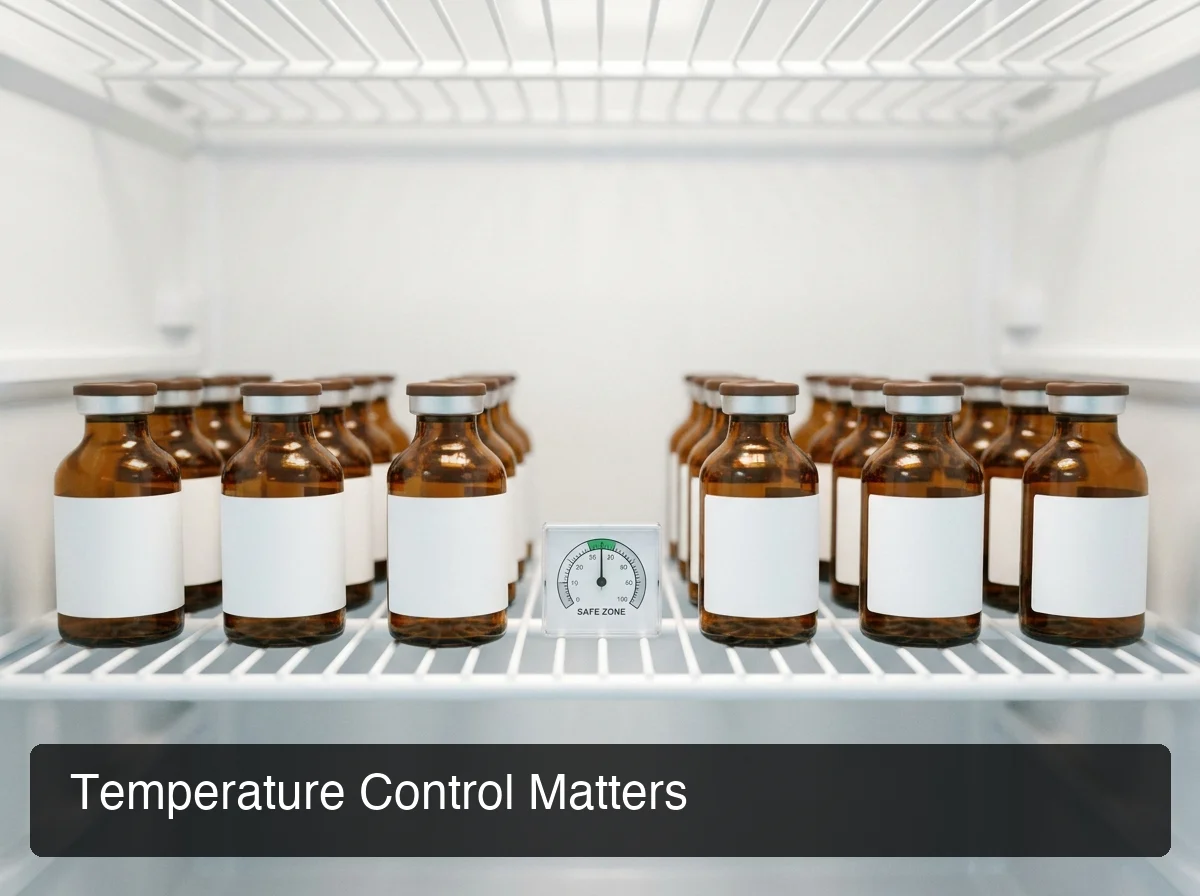 Labeled amber glass vials on an interior refrigerator shelf — the best practice setup for peptide storage containers.
What to Use vs. What to Avoid
Use:
- Amber glass vials (2–10ml depending on volume needs)
- Rubber or silicone stopper caps (compatible with multi-draw protocols)
- Silica gel desiccant packets — one per storage area
- Sealed foil pouches for long-term freezer storage
Avoid:
- Clear glass vials — zero UV protection
- Plastic vials — leaching risk, especially with thermal cycling
- Refrigerator door shelves — temperature variance is too high for consistent storage
- Metal containers — create temperature hot-spots and freeze-burn zones
By the numbers: Amber glass blocks 95%+ of UV and visible light below 450nm — the primary wavelength range responsible for peptide photo-oxidation damage.
How Do Temperature and Light Affect Peptide Stability?
Temperature and light are the two primary drivers of peptide degradation. Heat breaks the hydrogen bonds maintaining peptide structure and accelerates oxidation; UV light causes direct photo-oxidative cleavage of peptide bonds. Together, they can reduce a 6-month effective supply to 2 months of degraded peptide with unpredictable activity.
The chemistry is direct: peptide bonds are not indestructible. Heat adds kinetic energy to the molecules, increasing the rate of unwanted reactions. UV exposure generates free radicals that attack the amino acid sequence directly.
Stability by Peptide Type
Most peptides fall into predictable stability categories based on their molecular structure:
- Most stable: GLP-1 peptides (semaglutide, tirzepatide) — robust structure, up to 90 days refrigerated after reconstitution
- Moderately stable: BPC-157, TB-500 — 28–42 days refrigerated after reconstitution
- Least stable: Short-chain peptides (Selank, Semax) — 14–28 days after reconstitution; higher sensitivity to temperature variance
Moisture is the third threat. Water molecules catalyze hydrolysis reactions that cleave peptide bonds — this is exactly why desiccants matter and why you should never leave a vial cap off any longer than needed.
Key insight: Storage is a system, not a single decision. Temperature, containers, light exposure, and moisture all interact. Get one wrong and the others can't compensate.
How PeptideIQ Helps You Track Storage Conditions
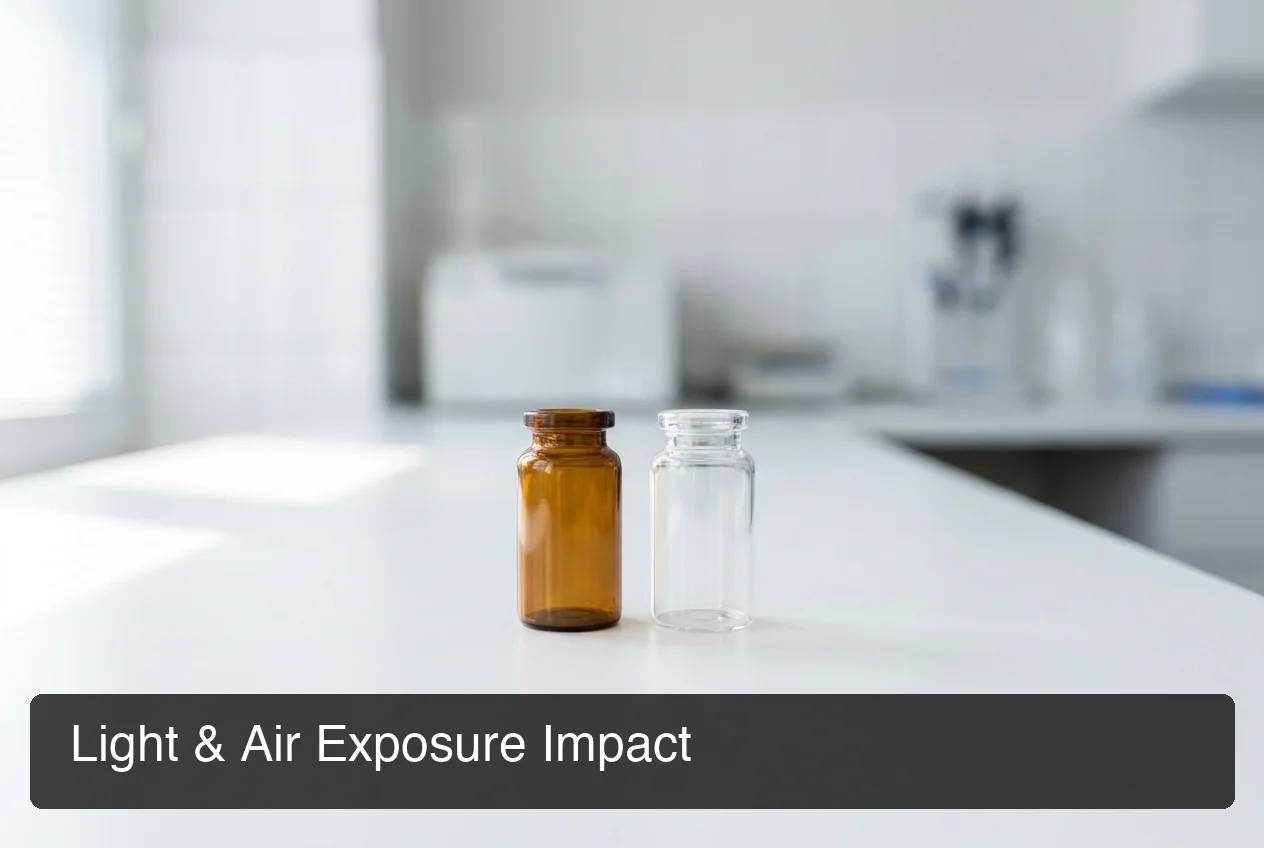 Amber vs. clear vial storage — PeptideIQ's Inventory Manager flags vials nearing expiry so you never inject degraded peptide.
Knowing the rules is one thing. Tracking them across multiple vials, multiple peptides, and multiple reconstitution dates is where most users lose track.
PeptideIQ's Inventory Manager automatically records each vial's reconstitution date, calculates the expiry date based on peptide type, and sends an alert 5 days before any vial expires — before you could accidentally inject degraded peptide.
BPC-157 logged as reconstituted gets a 30-day expiry automatically. GLP-1 vials get up to 90 days. You see remaining doses, expiry countdown, and vendor batch notes all in one place.
No more post-it notes on vials. No more guessing when you mixed this batch.
Download PeptideIQ on the App Store
Can You Travel With Peptides? Storage Tips for On-the-Go
**Traveling with peptides is manageable with the right kit. TSA allows peptides in carry-on if clearly labeled and sealed.
Use an insulated cooler case with gel ice packs to maintain 2–8°C during transit. Lyophilized peptides are the better travel option — more temperature-tolerant and simpler to pack than reconstituted solutions.**
Domestically in the US, peptides travel easily in carry-on with minimal friction. International travel requires more research — regulations vary significantly by destination country, and some nations restrict peptide imports entirely.
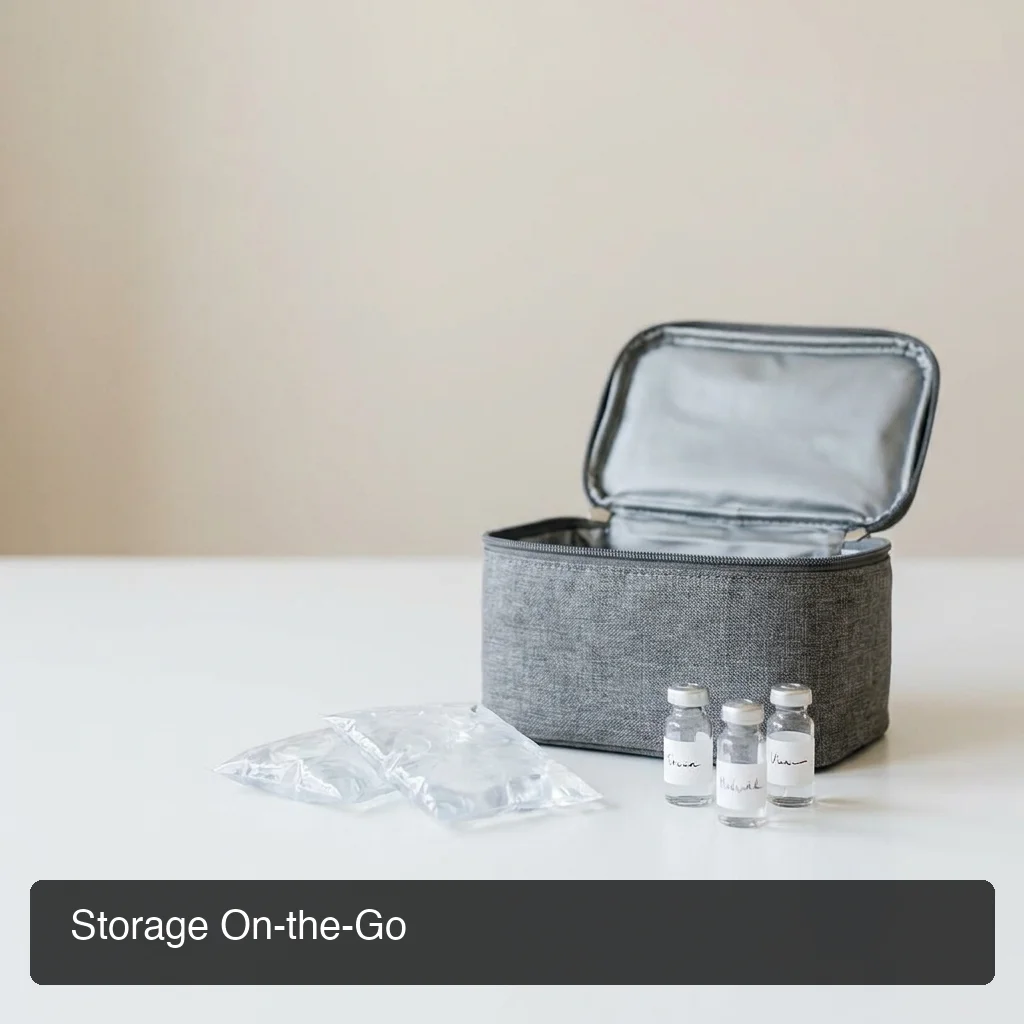 A compact travel peptide kit: insulated cooling case, labeled vials, gel ice packs — keep it minimal, keep it cold.
Travel Storage Checklist
- Carry-on only — checked baggage experiences uncontrolled temperature swings in cargo holds
- Insulated soft-sided mini cooler — TSA-friendly, with reusable gel ice packs
- Declare if traveling internationally — research destination country restrictions before departure
- Bring documentation for prescription peptides — if you use semaglutide or tirzepatide legitimately, carry a prescription copy
- Avoid dry ice in carry-on — TSA limits it to 2.5kg and requires disclosure
- Pack only what you need — minimum vials reduces risk exposure if security asks questions
If you're mixing peptides during travel, you'll need bacteriostatic water and proper reconstitution technique. The complete bacteriostatic water and reconstitution guide covers the mixing process step by step. After mixing, use the peptide reconstitution calculator to get concentrations and draw volumes exactly right before you store the reconstituted vial.
FAQ: Peptide Storage Questions
Do peptides go bad if not refrigerated?
Yes. Reconstituted (liquid) peptides begin degrading within hours at room temperature above 25°C. Lyophilized (dry powder) peptides are more stable and can tolerate room temperature for days to weeks without significant loss.
Refrigerate promptly after receiving — always on the same day your shipment arrives.
How long will my peptide last in the fridge?
Reconstituted peptides last 28–90 days refrigerated at 2–8°C: BPC-157 around 30 days, GLP-1 peptides like semaglutide up to 90 days. Lyophilized peptides stored in the fridge remain potent for 12–36 months. These timelines assume proper amber glass containers and consistent temperature throughout storage.
How should I store my peptides in the fridge?
Use amber glass vials on an interior fridge shelf — avoid the door where temperatures fluctuate. Keep with a silica desiccant pack inside a sealed container.
Label each vial with the reconstitution date, peptide name, and concentration. Set a reminder or use PeptideIQ's expiry tracking to stay ahead of degradation.
What peptides should not be frozen?
Never freeze reconstituted peptides in solution — ice crystals physically rupture the molecular structure and destroy bioactivity. Freeze only lyophilized (dry powder) peptides. Some advanced users store reconstituted aliquots at −20°C, but this requires precise equipment and is not recommended for typical home use.
What is peptide shelf life after reconstitution?
Shelf life after reconstitution varies by peptide: BPC-157 and TB-500 last approximately 28–42 days refrigerated; GLP-1 peptides (semaglutide, tirzepatide) last up to 90 days; short-chain peptides like Selank and Semax last 14–28 days. Concentration, excipients, and temperature consistency all affect actual stability — always check vendor-specific guidance.
Can I store peptides in plastic vials?
No. Plastic is porous and can leach compounds into peptide solutions over time, particularly with repeated temperature cycling. Plastic also provides no UV protection.
Use amber glass vials with rubber stoppers for all peptide storage. Drawing with a plastic insulin syringe is fine — that's brief contact, not storage.