
Bacteriostatic Water for Peptides: Mix, Store & Use
Bacteriostatic Water for Peptides: The Complete Reconstitution Guide
Using the wrong water to mix peptides is one of the most common — and most preventable — mistakes beginners make. Bacteriostatic water for peptides is the non-negotiable first step in any safe reconstitution process. This guide covers everything: what it is, why nothing else replaces it, how to use it, and how long it keeps your solutions stable.
Key Takeaways
- Bacteriostatic water is the only safe solvent for peptide reconstitution — sterile water lacks the antimicrobial preservative that prevents bacterial growth in your vials.
- Proper reconstitution extends peptide solution shelf life to 28+ days when refrigerated, but only if you use the correct water and sterile technique.
- The preservative (0.9% benzyl alcohol) in bacteriostatic water is what separates a 4-week-stable solution from a 48-hour ticking time bomb.
- A single contaminated solution can cost you weeks of progress — bacteriostatic water is the first critical step to ensuring your peptides stay pure and potent.
- Many beginners buy pharmaceutical-grade peptides, then immediately ruin them by mixing with the wrong water — bacteriostatic water prevents exactly that mistake.
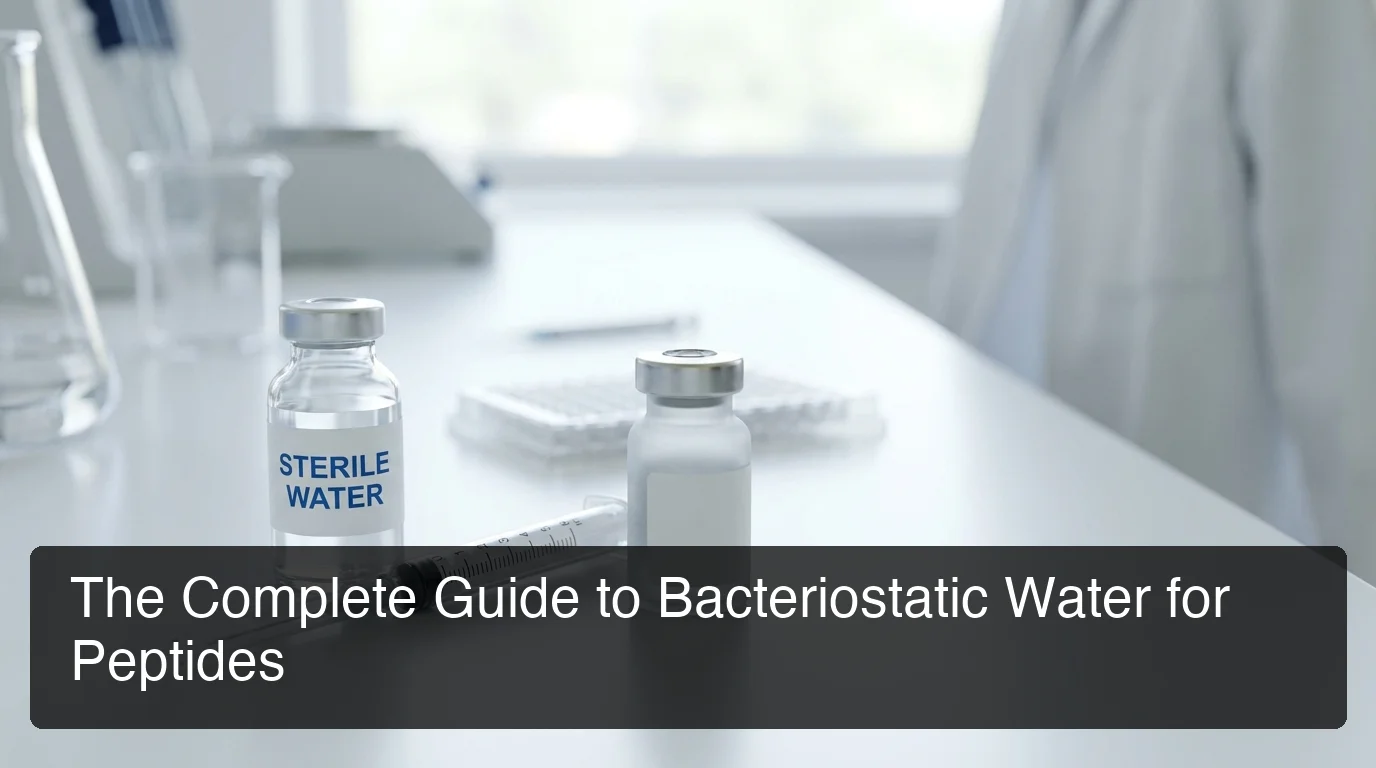 The three essentials of safe peptide reconstitution: bacteriostatic water, a peptide vial, and a calibrated insulin syringe.
Contents
- What Is Bacteriostatic Water for Peptides?
- Why Do Peptides Require Bacteriostatic Water?
- What's the Difference Between Bacteriostatic Water and Sterile Water?
- How Do You Use Bacteriostatic Water to Reconstitute Peptides Safely?
- How Much Bacteriostatic Water Do You Need for Peptide Reconstitution?
- How Long Does Bacteriostatic Water Keep Your Peptide Solutions Stable?
- Can You Use Regular Sterile Water Instead of Bacteriostatic Water?
- Where Can You Buy Bacteriostatic Water for Peptides?
- How PeptideIQ Eliminates Reconstitution Guesswork
- Frequently Asked Questions
What Is Bacteriostatic Water for Peptides?
Bacteriostatic water is sterile water for injection that contains 0.9% benzyl alcohol (9mg/mL) as an antimicrobial preservative. This additive prevents bacterial growth after the vial is punctured, making it safe to draw multiple doses from the same vial over days or weeks without contaminating your solution.
It's a pharmaceutical-grade product — not a specialty chemical — manufactured under sterile conditions and sold in sealed multi-dose glass vials (typically 10mL or 30mL). The benzyl alcohol concentration is low enough to be safe for subcutaneous injection but high enough to inhibit bacterial growth between uses.
If you're new to peptides and what they are, it's easy to assume any "sterile" water will work. It won't. The sterile designation only tells you the water was bacteria-free at the time of manufacturing — it says nothing about what happens after you open the vial.
What "Bacteriostatic" Actually Means
"Bacteriostatic" means the preservative stops bacteria from multiplying — it doesn't sterilize a solution that's already contaminated. It only works when paired with clean technique from the start.
Why Do Peptides Require Bacteriostatic Water?
Peptides require bacteriostatic water because they are reconstituted as multi-dose solutions — meaning you'll draw from the same vial 10, 20, or 30 times before it's empty. Each needle insertion is a potential contamination event. Without a bacteriostatic preservative, any bacteria that enters your vial can multiply unchecked and make the solution unsafe to inject.
Most peptides come as lyophilized (freeze-dried) powder in sealed vials with a shelf life of 12–24+ months refrigerated. Once you add water, the clock starts. The preservative in bacteriostatic water extends that window from 48 hours to 28+ days.
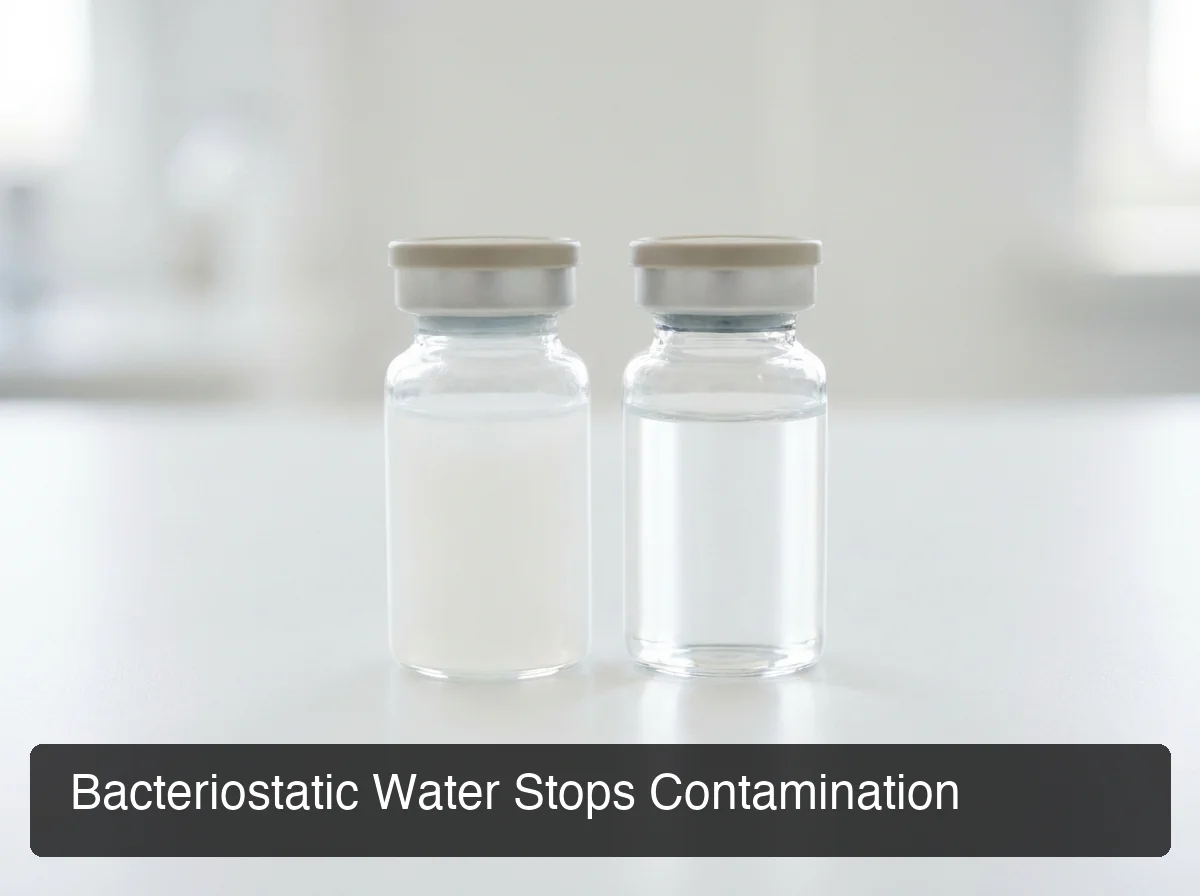 Left: turbid, contaminated peptide solution from using unpreserved sterile water. Right: crystal-clear, stable solution reconstituted with bacteriostatic water.
Key insight: A contaminated peptide solution won't necessarily look different. It may still appear perfectly clear. This is why technique and the right water are non-negotiable — you cannot rely on visual inspection to confirm safety.
Contamination from improper reconstitution is one of the most preventable risks in peptide use. If you're concerned about broader peptide safety, getting reconstitution right is where safety actually starts.
What's the Difference Between Bacteriostatic Water and Sterile Water?
Bacteriostatic water contains 0.9% benzyl alcohol to inhibit bacterial growth after the vial is opened. Sterile water contains no preservatives — it's a single-use solution that's safe for only one needle draw. Use sterile water in a multi-dose peptide vial and you're injecting from a vial that bacteria can colonize freely within 24-48 hours.
Here's the full comparison:
| Feature | Bacteriostatic Water | Sterile Water for Injection |
|---|---|---|
| Benzyl alcohol | 0.9% (9 mg/mL) | None |
| Multi-dose safe | Yes | No |
| Open vial shelf life (refrigerated) | 28–30 days | Use immediately (single draw only) |
| Bacterial growth inhibition | Yes | No |
| Recommended for peptide reconstitution | Yes | Only for single-use |
| Typical vial sizes | 10 mL, 30 mL | 1 mL, 10 mL |
| USP designation | Bacteriostatic Water for Injection, USP | Sterile Water for Injection, USP |
When Is Sterile Water Acceptable?
Sterile water is acceptable only if you're reconstituting a peptide you plan to draw in a single session — use the entire reconstituted volume immediately and discard. For any protocol requiring multiple doses over days or weeks (which is virtually every peptide cycle), sterile water is not a safe substitute.
Bottom line: For multi-dose peptide protocols, bacteriostatic water is not optional. Sterile water is a single-use emergency measure at best — not a cost-saving swap.
How Do You Use Bacteriostatic Water to Reconstitute Peptides Safely?
To reconstitute peptides safely with bacteriostatic water: wipe both vial tops with alcohol pads, draw the calculated volume of bacteriostatic water into an insulin syringe, inject it slowly down the inside wall of the peptide vial (not directly onto the powder), and swirl gently to dissolve. Never shake. The entire process takes under five minutes with clean hands and a clean workspace.
Step-by-Step Reconstitution
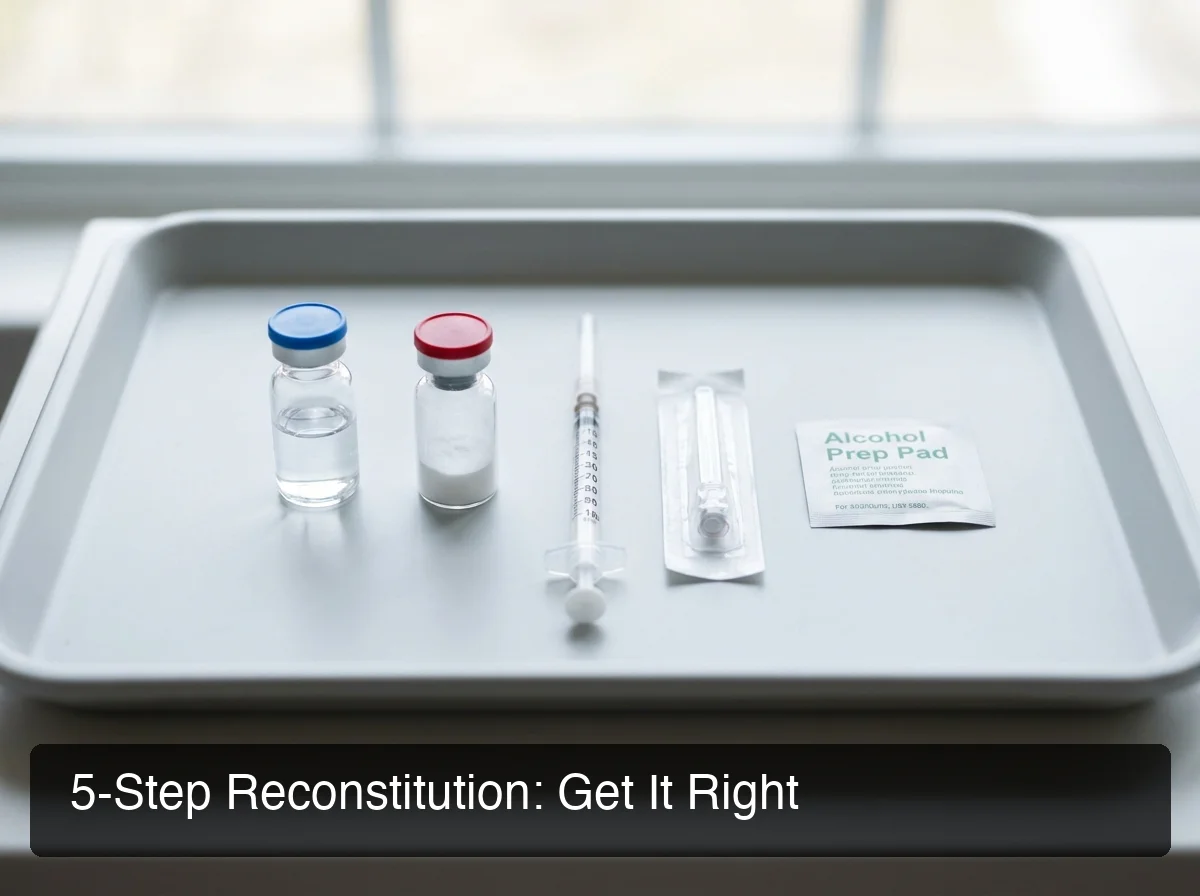
Step 1 — Gather supplies. You need: the peptide vial, bacteriostatic water vial, one or two U-100 insulin syringes, and two alcohol prep pads.
Step 2 — Clean both vial tops. Wipe the rubber stopper on each vial with a separate alcohol pad. Let each stopper air dry for 10–15 seconds. The stopper is the primary contamination entry point — don't rush this step.
Step 3 — Draw bacteriostatic water. Insert the syringe into the bacteriostatic water vial, invert it, and draw the calculated volume.
Step 4 — Inject slowly down the vial wall. Angle your syringe tip so the water runs down the inside glass wall of the peptide vial. Injecting directly onto lyophilized powder causes splashing and can mechanically stress the peptide. This is the step most beginners skip and shouldn't.
Step 5 — Swirl gently until dissolved. Roll the vial between your palms. Most peptides dissolve in 30–90 seconds. Never shake — shaking creates foam and can shear the peptide structure. Some peptides (GHK-Cu, certain GHRHs) may take 2–3 minutes of gentle agitation to fully dissolve.
For a peptide-specific protocol example, the BPC-157 reconstitution guide covers the same process with BPC-157-specific dose notes.
Pro tip: If the powder doesn't dissolve after 3 minutes of gentle swirling, refrigerate the vial for 30 minutes and try again. Peptide powders sometimes need temperature assistance — patience solves this, not force.
How Much Bacteriostatic Water Do You Need for Peptide Reconstitution?
The volume of bacteriostatic water you add directly sets your solution's concentration — which controls exactly how many syringe units you draw per dose. For a standard 5mg peptide vial, adding 1–2mL is the most common range, yielding concentrations of 2.5–5mg/mL. Your specific number should be calculated based on your vial size and target dose, not guessed.
The Concentration Math
Take a 5mg (5,000mcg) BPC-157 vial as an example:
| BAC Water Added | Concentration | 250mcg dose = |
|---|---|---|
| 1 mL | 5,000 mcg/mL | 5 units on U-100 |
| 2 mL | 2,500 mcg/mL | 10 units on U-100 |
| 2.5 mL | 2,000 mcg/mL | 12.5 units on U-100 |
Adding more water lowers concentration — making small doses easier to measure accurately with an insulin syringe. Adding less water increases concentration — giving you more doses per draw volume, but demanding more precision.
Use a Calculator, Not Estimation
This math is where most beginners make their first dosing error. The peptide reconstitution calculator handles the math for you: enter your vial size, BAC water volume, and target dose, and it outputs the exact syringe units to draw with a visual syringe illustration.
By the numbers: Adding 2mL of BAC water to a 5mg vial gives you 2,500mcg/mL. A 250mcg dose on a U-100 syringe is exactly 10 units. That's clean, measurable, and easy to verify.
How Long Does Bacteriostatic Water Keep Your Peptide Solutions Stable?
Peptide solutions reconstituted with bacteriostatic water remain stable for 28–30 days when refrigerated at 2–8°C (standard refrigerator temperature). GLP-1 compounds like semaglutide may remain stable up to 28–90 days depending on the specific product. Solutions made with regular sterile water must be used within 24–48 hours.
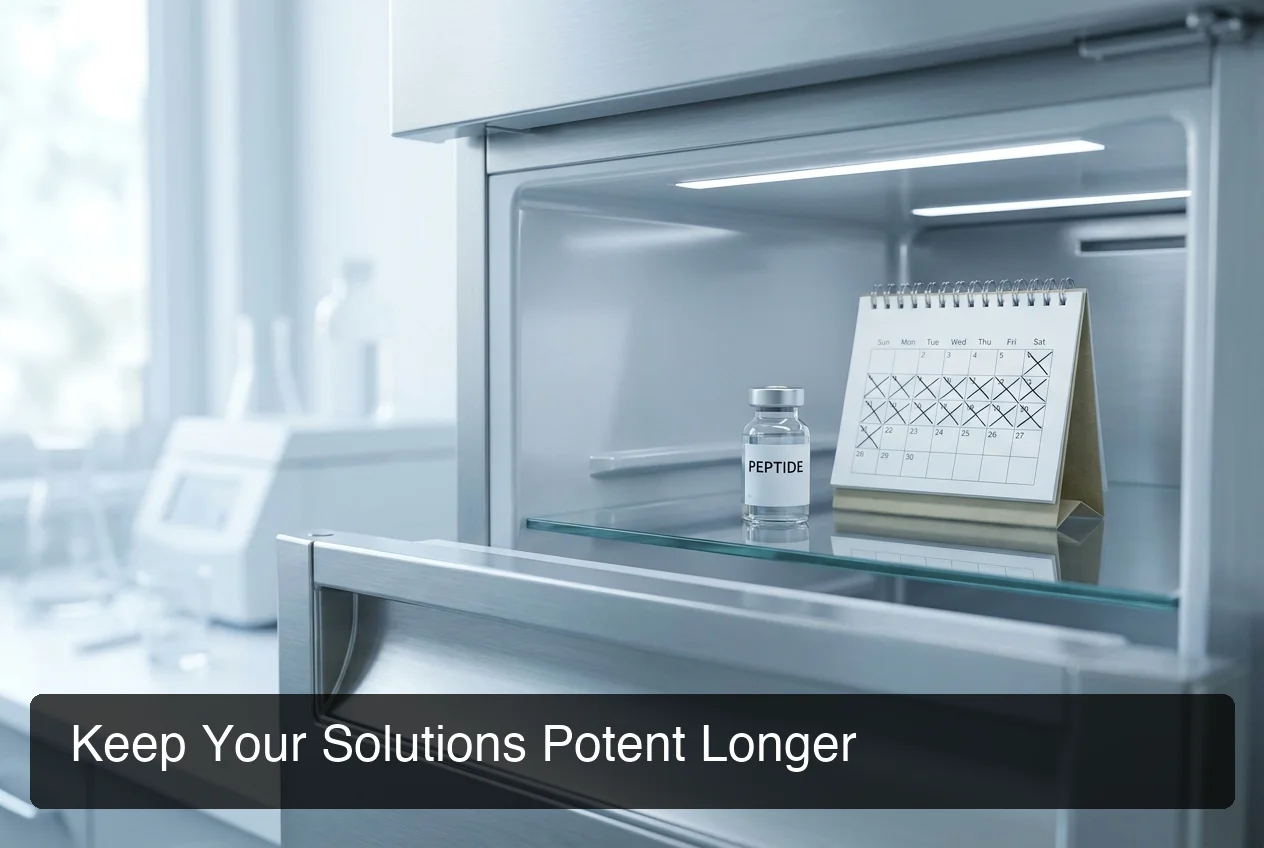 Peptide solution stability by reconstitution day — refrigerated with bacteriostatic water vs. unpreserved sterile water.
Storage Rules That Protect Your Solutions
- Temperature: Refrigerate at 2–8°C. Never freeze a reconstituted solution — ice crystal formation physically destroys peptide structure.
- Light protection: Store away from direct light. UV exposure degrades many peptides, especially BPC-157 and GHK-Cu.
- Vial labeling: Write the reconstitution date on each vial with a permanent marker. Never rely on memory.
- Minimize entries: Each needle insertion is a contamination risk. Don't enter the vial more than necessary.
Reference Stability Table
| Peptide | Reconstituted (BAC water, refrigerated) | Lyophilized powder (frozen) |
|---|---|---|
| BPC-157 | 28–30 days | 12–24 months |
| CJC-1295 | 28–30 days | 12–24 months |
| Ipamorelin | 28–30 days | 12–24 months |
| Semaglutide | 28–90 days | 12–24 months |
| GHK-Cu | 21–28 days | 12–24 months |
| TB-500 | 28–30 days | 12–24 months |
Key insight: The 28-day window is a maximum under ideal conditions — not a guarantee. Poor technique, inadequate refrigeration, or excessive vial punctures can shorten it significantly. Bacteriostatic water buys you time only if clean technique earns it.
Can You Use Regular Sterile Water Instead of Bacteriostatic Water?
You can use sterile water only for single-use reconstitution — draw the full vial in one session and discard the remainder. For any multi-dose protocol, which covers virtually every peptide cycle, regular sterile water is not a safe substitute. Without benzyl alcohol, bacteria from repeated needle entries can colonize your vial within 24–48 hours.
Multiple adverse events linked to peptide injections have been traced to preparation errors, not the peptides themselves. Bacteriostatic water is the simplest, cheapest insurance against contamination.
What About Acetic Acid Solution?
Some peptides — particularly CJC-1295, Sermorelin, and certain GHRH analogues — reconstitute better in 0.6% acetic acid solution because of their pH-dependent solubility. This is a specialized reconstitution solvent for specific peptides, not a general bacteriostatic water replacement. For the vast majority of peptides, bacteriostatic water is the correct and recommended default.
If you're ever unsure which solvent applies to your specific peptide, consult the peptide's certificate of analysis (COA) or the supplier's product documentation.
Where Can You Buy Bacteriostatic Water for Peptides?
Bacteriostatic water is available without a prescription from peptide suppliers, compounding pharmacies, medical supply vendors, and online retailers. It typically costs $5–20 per vial. Look specifically for vials labeled "Bacteriostatic Water for Injection, USP" — this confirms pharmaceutical-grade manufacturing standards.
Reliable Sources
- Compounding pharmacies — Most reliable for pharmaceutical-grade product. Some require a prescription; many sell it over the counter.
- Online peptide suppliers — Typically carry BAC water alongside their peptide products. Quality varies — always confirm USP labeling.
- Amazon — Available from multiple vendors. Look for name-brand pharmaceutical products (Hospira, Pfizer) over unbranded alternatives.
- Retail pharmacies (CVS, Walgreens) — Availability is inconsistent; ask the pharmacy counter directly rather than searching the shelf.
What to avoid: Any product without a USP label — it's your only public confirmation of standardized benzyl alcohol concentration and sterile manufacturing.
How PeptideIQ Eliminates Reconstitution Guesswork
 PeptideIQ's reconstitution calculator — enter your vial size and target dose, get the exact syringe units with a visual draw guide.
Getting bacteriostatic water right is step one. Getting the dose math right every single time is step two — and that's where most beginners make their second mistake.
PeptideIQ is an AI-powered iOS app built specifically for peptide users. Its built-in reconstitution calculator handles the volume math automatically: input your vial size, BAC water volume, and target dose, and it outputs the precise syringe units to draw — with a visual syringe illustration showing exactly where to fill. No conversion errors, no guessing.
Beyond reconstitution, PeptideIQ tracks every dose, manages your full protocol, monitors your progress over each cycle, and gives you an AI co-pilot that knows your specific data — not generic peptide information. It's the system built for the moment you have a vial in your hand and need to know exactly what to do next.
Download PeptideIQ on the App Store
Not ready to start a cycle yet? Bookmark this guide — and check back when PeptideIQ launches to track your protocol from day one.
Frequently Asked Questions
What is bacteriostatic water and why is it used for peptides?
Bacteriostatic water is sterile injectable water containing 0.9% benzyl alcohol as an antimicrobial preservative. It's used for peptide reconstitution because most peptide protocols require drawing multiple doses from the same vial over days or weeks. The benzyl alcohol prevents bacterial growth between draws, keeping the solution safe for the full 28–30 day window after reconstitution.
Can I use regular sterile water instead of bacteriostatic water for peptides?
Regular sterile water is only safe if you draw the entire reconstituted vial in a single session and discard the rest immediately. For multi-dose protocols — which covers virtually every peptide cycle — sterile water is not a safe substitute. Without benzyl alcohol, bacteria can colonize the vial within 24–48 hours of the first needle entry, making bacteriostatic water the only correct choice.
How much bacteriostatic water do I add to a peptide vial?
The volume depends on your target dose and desired concentration. For a 5mg vial, adding 1mL gives 5,000mcg/mL; adding 2mL gives 2,500mcg/mL. More water lowers concentration, making small doses easier to measure — use a peptide reconstitution calculator to determine the exact volume and syringe units for your setup.
How long does bacteriostatic water keep peptide solutions stable?
Peptide solutions reconstituted with bacteriostatic water remain stable for 28–30 days refrigerated at 2–8°C; GLP-1 compounds can extend to 90 days. Solutions made with regular sterile water must be used within 24–48 hours. Always label vials with the reconstitution date and store away from light and temperature swings.
Where can I buy bacteriostatic water for peptides?
Bacteriostatic water is available from online peptide suppliers, compounding pharmacies, medical supply vendors, and Amazon. Look for vials labeled "Bacteriostatic Water for Injection, USP" to confirm pharmaceutical-grade quality. Expect to pay $5–20 per 10–30mL vial; Hospira (now Pfizer) is the most widely recognized name-brand source.
What type of bacteriostatic water is best for peptides?
Any USP-grade bacteriostatic water for injection containing 0.9% benzyl alcohol is appropriate for peptide reconstitution. There is no meaningful performance difference between brands meeting the same specification. Prioritize the USP label over brand name — it confirms standardized benzyl alcohol concentration and sterile manufacturing conditions.
Is bacteriostatic water safe to inject?
Yes — bacteriostatic water is a pharmaceutical-grade injectable solution used in clinical and hospital settings for decades. The 0.9% benzyl alcohol concentration is the established standard for multi-dose injectable preparations. Do not confuse it with undiluted benzyl alcohol, which is a completely different compound at much higher concentrations.