
Peptide Reconstitution Calculator Guide | PeptideIQ
Peptide Reconstitution Calculator: Mix It Right Every Time
Reconstituting a lyophilized peptide vial sounds technical — because it is. Before you draw a single dose, you need to know exactly how much bacteriostatic water to add and precisely where to fill your syringe. A peptide reconstitution calculator does that math instantly and error-free.
Key Takeaways
- Peptide reconstitution calculators automate the precision math needed to mix lyophilized peptides with bacteriostatic water, eliminating manual arithmetic errors that cause underdosing or waste.
- The core formula — (desired mcg ÷ vial mg × 1,000) ÷ (total volume in units) = units to draw — is identical across all peptides; only the inputs change.
- Most beginner mistakes happen at the reconstitution stage, before any injection — getting this one calculation right prevents cascading errors throughout your entire protocol.
- Pre-made calculators save 5–10 minutes per reconstitution cycle and reduce human error to near zero, which is critical for expensive peptides like GHK-Cu or stacked protocols like CJC-1295/Ipamorelin.
- The PeptideIQ reconstitution calculator integrates with your peptide inventory, saves your protocols, and shows a visual syringe illustration so you know exactly where to draw every time.
Contents
- What Is a Peptide Reconstitution Calculator?
- Why Do You Need a Peptide Reconstitution Calculator?
- How Does a Peptide Reconstitution Calculator Work?
- What Information Do You Need to Use a Reconstitution Calculator?
- Why Do Beginners Often Fail at Manual Reconstitution Math?
- What's the Difference Between a Reconstitution and a Dosage Calculator?
- How Accurate Are Peptide Reconstitution Calculators?
- Why the PeptideIQ Calculator Eliminates Guesswork
- Get Started with PeptideIQ
- Frequently Asked Questions
What Is a Peptide Reconstitution Calculator?
A peptide reconstitution calculator is a tool that takes three inputs — vial strength in mg, bacteriostatic water volume in ml, and your target dose in mcg — and outputs the exact number of syringe units to draw. It automates the single calculation that most beginners get wrong before their very first injection.
Lyophilized peptides arrive as a white, freeze-dried powder. Before injecting, you must mix that powder with bacteriostatic (BAC) water to create a liquid solution. The resulting concentration depends entirely on how much water you add — and that concentration determines how many syringe units equal your target dose.
Without a calculator, you're converting between milligrams, micrograms, and syringe units under pressure. That's where errors creep in.
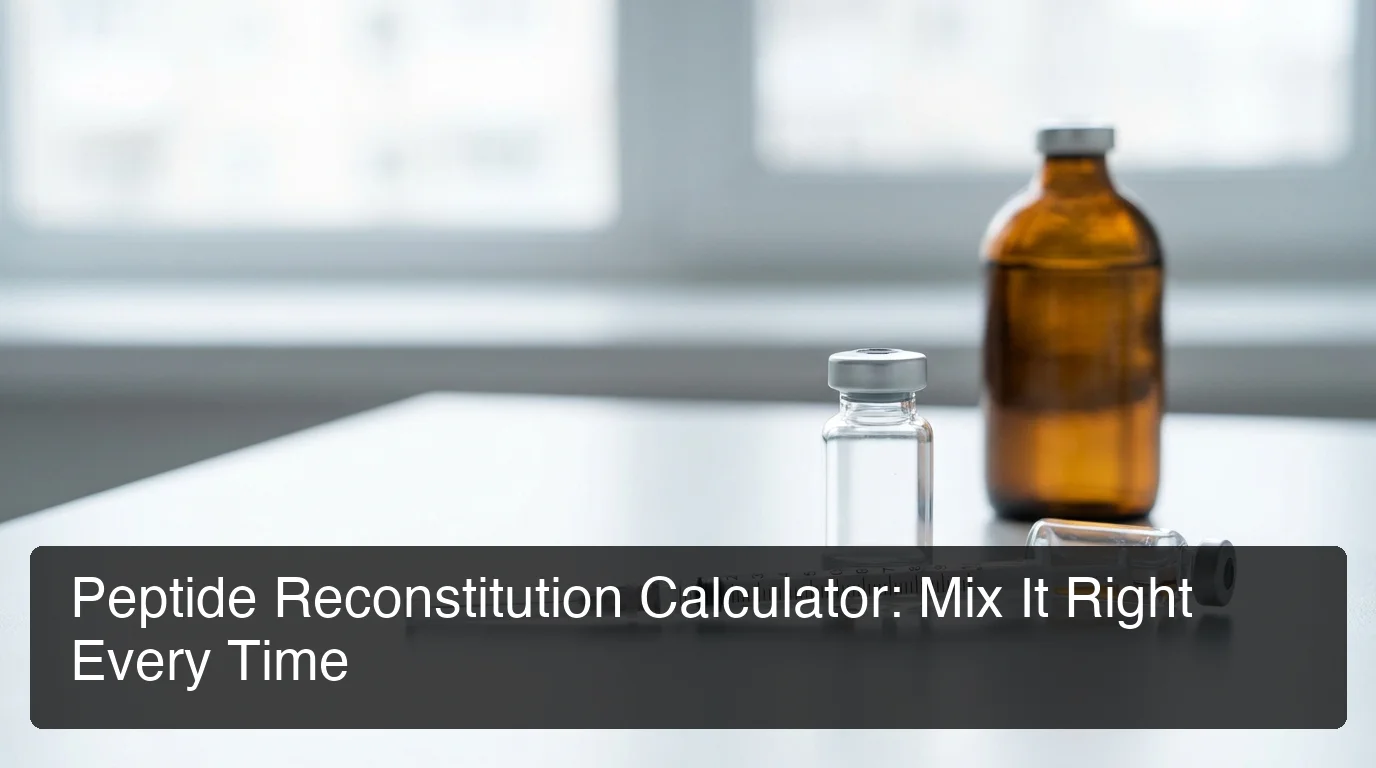 A complete reconstitution setup: vial, bacteriostatic water, and a calibrated insulin syringe — the three inputs every calculator needs.
Why Do You Need a Peptide Reconstitution Calculator?
You need a peptide reconstitution calculator because it connects three different unit systems — milligrams, micrograms, and syringe units — that have no intuitive relationship. A small input error compounds across every dose in your vial, turning an affordable peptide protocol into an expensive guessing game.
The financial stakes are real. A 5mg BPC-157 vial runs $30–$80 depending on source. A 10mg GHK-Cu vial can cost $100 or more.
Miscalculate your reconstitution and you're either overdosing your way through an expensive vial in days or underdosing for weeks with no results.
If you're completely new to this, start with our peptide guide for beginners — reconstitution math makes far more sense once you understand how peptides are structured and why concentration matters so much.
Three Reconstitution Mistakes a Calculator Prevents
- Wrong water volume — Adding 1ml to a 5mg vial gives 5mg/ml; adding 2ml gives 2.5mg/ml. Same vial, completely different dosing math for every injection that follows.
- Unit confusion — Your dose is in mcg. Your vial is in mg. 1mg equals 1,000mcg. Reversing that conversion creates a thousand-fold error in either direction.
- Syringe type mismatch — A U-100 syringe and a U-50 syringe show the same unit markings but hold different volumes per unit. The calculator adjusts draw amounts automatically when you select syringe type.
Key insight: Most peptide protocol failures aren't caused by the wrong peptide — they're caused by systematic dosing errors that started at reconstitution and were never corrected.
How Does a Peptide Reconstitution Calculator Work?
A peptide reconstitution calculator applies the formula: (desired dose in mcg ÷ concentration in mcg/unit) = units to draw. Concentration is derived from your vial strength and water volume. Every input changes the output proportionally, which is why the calculator beats mental math every time.
Here's a worked example. You have a 5mg BPC-157 vial and you add 2ml of bacteriostatic water.
Step-by-Step Calculation
- Convert vial strength to mcg: 5mg × 1,000 = 5,000mcg total peptide content
- Calculate concentration per ml: 5,000mcg ÷ 2ml = 2,500mcg per ml
- Convert to concentration per unit (U-100): 2,500mcg ÷ 100 units = 25mcg per unit
- Divide target dose by mcg-per-unit: 250mcg ÷ 25mcg = 10 units
Result: draw to the 10-unit mark on your U-100 insulin syringe. That's it.
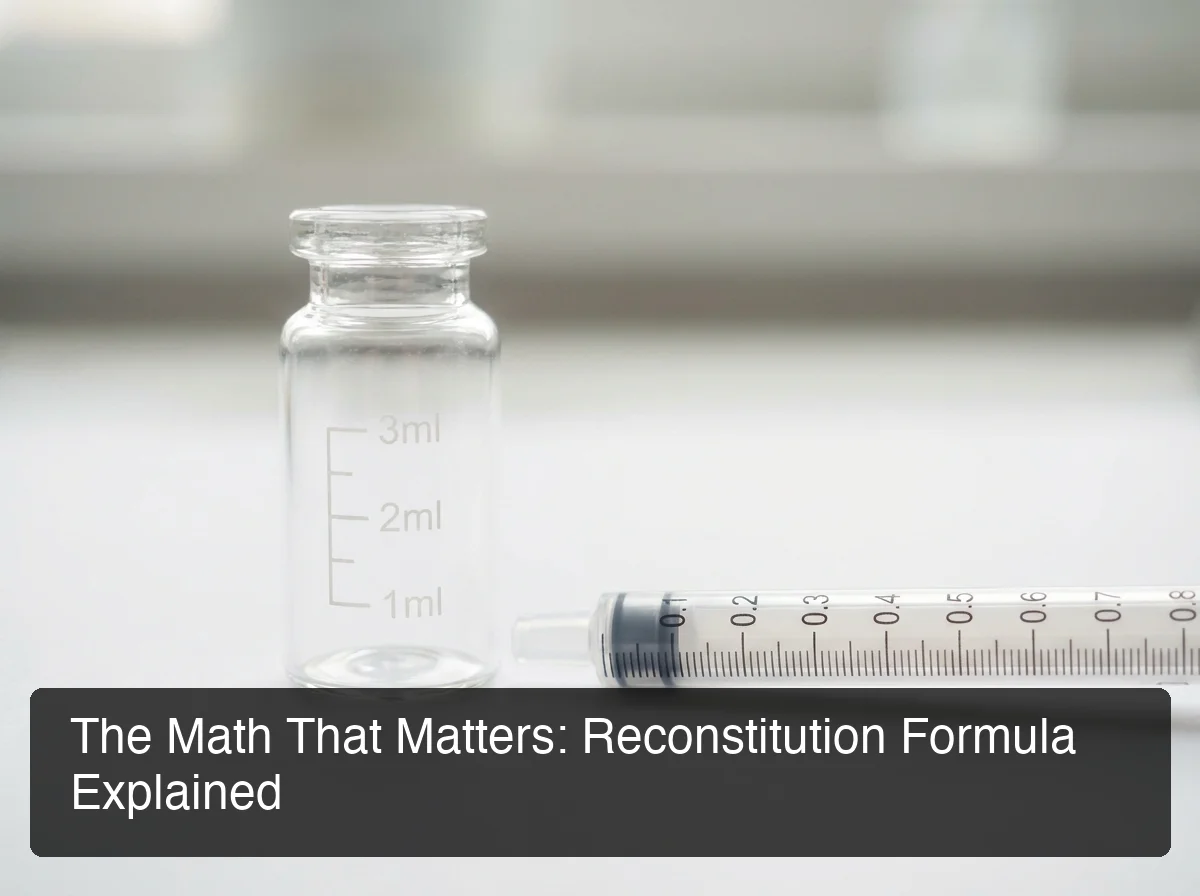 The reconstitution formula in visual form — vial strength, water volume, and target dose combine into one exact draw amount.
What Happens When You Change the Water Volume?
If you added 1ml instead of 2ml to the same 5mg vial, your concentration doubles to 5,000mcg/ml — and your draw halves to 5 units for the same 250mcg dose.
This is especially useful for fine-tuning. Very small draws (under 5 units) are hard to measure accurately.
Adding more water increases draw volume, making it easier to hit your target precisely. A calculator lets you experiment with water volumes instantly before you commit to mixing.
What Information Do You Need to Use a Reconstitution Calculator?
To use a peptide reconstitution calculator, you need four pieces of information: vial peptide amount in mg, bacteriostatic water volume in ml, your target dose in mcg, and your syringe type. Every output — concentration, units to draw — derives from these four numbers.
Here's what to gather before you start:
- Vial peptide amount — Read the label: "5mg," "10mg," "2mg." This is the total freeze-dried peptide content, not a concentration.
- BAC water volume — How much bacteriostatic water you plan to add. 1ml and 2ml are the most common starting points. 2ml tends to produce cleaner, easier-to-measure draw amounts for standard U-100 doses.
- Target dose in mcg — Your intended dose per injection. If you're unsure, most beginner BPC-157 protocols start at 250mcg twice daily. Your protocol or prescribing physician should specify this.
- Syringe type — U-100 insulin syringes are standard for most peptide users. U-50 and U-30 are occasionally used for very small doses where precision matters at the microliter level.
By the numbers: A standard U-100 insulin syringe holds exactly 1ml and has 100 unit graduations — each graduation is 0.01ml or 10 microliters. Understanding this is the foundation of every peptide draw calculation.
Why Do Beginners Often Fail at Manual Reconstitution Math?
Beginners fail at manual reconstitution math because the calculation requires three sequential unit conversions — mg to mcg, ml to units, and mcg-per-unit to draw amount — with no obvious checkpoint to catch an error mid-calculation. One wrong step invalidates every dose from that vial.
The most common failure is the mg-to-mcg conversion. Your vial says "5mg" but your protocol specifies "250mcg per dose." Mentally, many people divide 250 by 5 instead of 250 by 5,000 — a 1,000x error that produces a completely wrong draw amount and no obvious sign that anything is wrong.
The Compound Error Problem
Reconstitution errors are particularly dangerous because they replicate. If you mix a vial at the wrong concentration, every dose you draw from it will be off by the exact same factor. You won't know until your protocol ends with no results, or until you unexpectedly run out of vial.
Once your vial is correctly mixed, the next challenge is dialing in your per-dose amount across your protocol timeline. Our peptide dosing calculator guide covers body-weight dosing formulas and how to titrate doses over a multi-week cycle.
Bottom line: One accurate reconstitution calculation protects every subsequent dose from that vial. One error at this stage multiplies silently across your entire cycle.
What's the Difference Between a Reconstitution and a Dosage Calculator?
A reconstitution calculator answers the mixing question: "How much water do I add, and what do I draw?" A dosage calculator answers the protocol question: "How many mcg should I take per injection based on my goals and bodyweight?" Both are necessary — they solve distinct problems at different stages of your protocol.
| Feature | Reconstitution Calculator | Dosage Calculator |
|---|---|---|
| When used | When mixing a new vial | Per injection, per dose decision |
| Key inputs | Vial mg, water ml, syringe type | Bodyweight, peptide type, dose frequency |
| Key output | Units to draw on syringe | Mcg per dose |
| Error impact | Affects every dose from that vial | Affects that dose only |
| Frequency | Once per vial | Each protocol adjustment |
The two tools work in sequence. You use the reconstitution calculator once when mixing your vial to set the concentration. You use the dosage calculator to confirm your mcg target per injection and adjust it over time. Our peptide dose calculator article walks through the dosage side in full detail.
How Accurate Are Peptide Reconstitution Calculators?
Peptide reconstitution calculators are mathematically exact given correct inputs. The only source of error is human input — entering the wrong vial strength, measuring the wrong water volume, or selecting the wrong syringe type. The formula itself never introduces error.
This is why verifying your inputs before calculating matters more than which calculator you use. Three steps make your inputs bulletproof:
- Read the vial label directly — Don't estimate from memory. Vendors sell the same peptide in multiple strengths (5mg and 10mg are both common). Using the wrong one doubles or halves your dose.
- Measure BAC water with your syringe — Draw the water volume with your injection syringe and confirm the marking before injecting into the vial. Eyeballing in a vial or using an unmarked dropper introduces volume error.
- Confirm syringe type on the barrel — U-100 markings and U-50 markings look identical at a glance. The syringe type is always printed on the barrel. One mismatch here changes your draw amount by 2x.
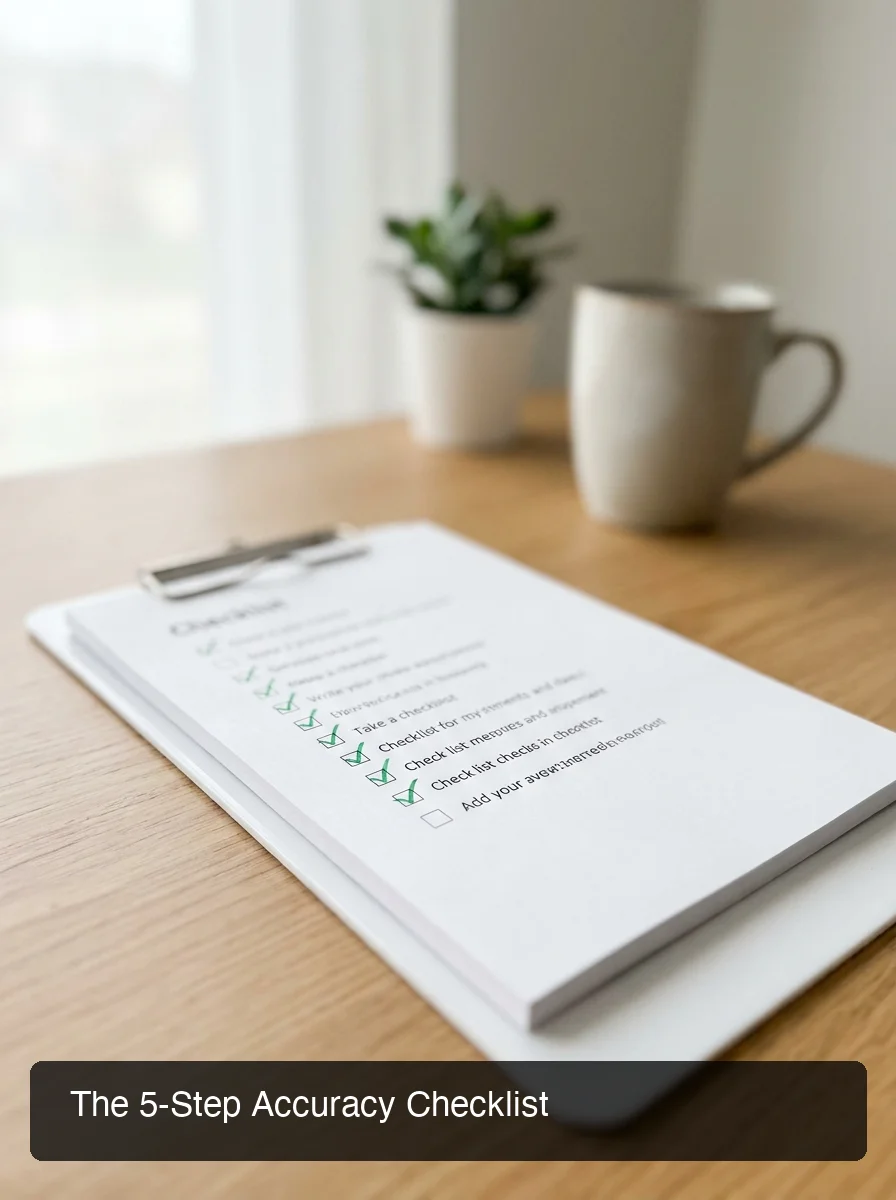 Five accuracy checks before drawing your dose — each one eliminates a common reconstitution error.
Pro tip: Record your reconstitution inputs the first time you mix each vial. If you mix a second vial of the same peptide later, you'll have your own verified reference without recalculating from scratch.
Why the PeptideIQ Calculator Eliminates Guesswork
 PeptideIQ's reconstitution calculator: enter your vial and water inputs, get the exact syringe units to draw — saved automatically to your inventory.
The PeptideIQ reconstitution calculator doesn't just output a number — it saves your results to the vial in your inventory, displays a visual syringe illustration with the exact draw line marked, and updates dynamically when you switch syringe types. You never recalculate the same vial twice.
Most standalone online calculators give you a number and nothing else. You do the math, write the result on a sticky note, and repeat the process next vial. PeptideIQ stores every reconstitution result attached to the specific vial it belongs to — alongside the reconstitution date, estimated expiry, and doses remaining.
What PeptideIQ's Reconstitution Calculator Includes
- Visual syringe display — Shows the exact draw line on an illustrated syringe, not just a unit number. For first-time users, this eliminates all ambiguity about which mark on the barrel to hit.
- Reverse calculator — Enter the syringe units you want to draw and the app tells you how much BAC water to add. This is one of the most-requested features in the peptide community.
- Syringe type toggle — Switch between U-100, U-50, and U-30. Draw amounts update instantly. No recalculating.
- Auto-save to inventory — Reconstitution data attaches to the vial record: concentration, date mixed, expiry estimate, and remaining doses that decrement automatically with each logged injection.
Get Started with PeptideIQ
Getting your peptide reconstitution math right is the foundation of every successful protocol. PeptideIQ's built-in reconstitution calculator handles the math — and saves it to your inventory so you never have to repeat it.
Download PeptideIQ on the App Store
Not ready to try it yet? Explore the peptide dosing calculator guide to see how PeptideIQ manages the next step: calculating your per-dose amounts once your vial is mixed.
Frequently Asked Questions
How much water should I add to reconstitute a peptide?
The standard starting point is 1–2ml of bacteriostatic water per vial, regardless of vial strength. Adding 2ml to a 5mg vial gives 2.5mg/ml — a concentration that produces manageable draw amounts on U-100 syringes. Use a reconstitution calculator to preview the resulting draw amount before committing to a water volume.
How do I calculate how much peptide I need to draw?
Use the formula: desired mcg ÷ (vial mcg ÷ total volume in units) = units to draw. Convert vial mg to mcg first by multiplying by 1,000. For a 250mcg dose from a 5mg vial with 2ml BAC water: 250 ÷ (5,000 ÷ 200) = 250 ÷ 25 = 10 units on a U-100 syringe.
What is bacteriostatic water and why is it used for peptide reconstitution?
Bacteriostatic water is sterile water containing 0.9% benzyl alcohol, which inhibits bacterial growth. It's used instead of plain sterile water because reconstituted peptide solutions are multi-use — you draw from the same vial across multiple injection sessions. The benzyl alcohol preservative keeps the solution safe for 28–30 days refrigerated.
What's the difference between mcg and mg in peptide dosing?
Milligrams (mg) describes the total peptide content in the vial. Micrograms (mcg) describes individual injection doses. 1mg equals 1,000mcg exactly.
Vials are labeled in mg because the total content is relatively large; doses are expressed in mcg because individual injections are tiny fractions of that total — typically 100–500mcg per injection.
Can I use a regular syringe instead of an insulin syringe for reconstitution?
Standard 3ml or 5ml syringes are too imprecise for the small draw volumes that peptide dosing requires. Insulin syringes — specifically U-100 — are calibrated in 1-unit (0.01ml) increments, which is the precision level needed for doses of 10–30 units. They're available at any pharmacy without a prescription.
How long does a reconstituted peptide vial last?
Most reconstituted peptides remain stable for 28–30 days when refrigerated at 2–8°C. GLP-1 peptides such as semaglutide and tirzepatide are stable up to 90 days. Unreconstituted (lyophilized) peptides typically last 12–24 months when stored correctly.
PeptideIQ's inventory manager tracks reconstitution dates and sends an expiry warning 5 days before your vial expires.
Does PeptideIQ have a built-in peptide reconstitution calculator?
Yes. PeptideIQ includes a reconstitution calculator that accepts vial strength, BAC water volume, and target dose as inputs — and outputs the exact syringe units to draw. It includes a visual syringe illustration, a reverse calculator, and syringe type toggle.
All results auto-save to your vial inventory. The calculator works fully offline.