
How Much Water to Mix With Peptides (With Examples)
How Much Water to Mix With Peptides: The Math Behind the Choice
General education, not medical advice. Follow your prescriber's instructions or the product label for the water volume and dose. This page explains the arithmetic; it does not tell you what to take.
Take a 10 mg freeze-dried vial. Add 1 mL of water and one dose is 5 syringe units. Add 2 mL and the same dose is 10 units.
Nothing about the peptide changed, only your water choice.
That is the whole question behind how much water to mix with peptides. The volume you add decides the concentration, and the concentration decides what you draw.
Key Takeaways
- The water volume you add to a freeze-dried peptide vial sets the concentration, and the concentration sets how many syringe units make one dose.
- Concentration = total mcg ÷ mL of water. Doubling the water halves the concentration and doubles the units you draw for the same dose.
- Total peptide in the vial never changes, so the number of doses stays the same whichever volume you pick.
- Check the vial mg, water volume and target dose before every draw. PeptideIQ's reconstitution calculator also runs the reverse calculation: target units in, water to add out.
Contents
- How Much Water to Mix With Peptides: How Much Bacteriostatic Water Per Vial?
- Does the Amount of Water Change How Strong Each Dose Is?
- How Much Water to Mix With Peptides in a 5 mg or 10 mg Vial?
- What Happens If You Add Too Little or Too Much Water?
- Can an App Calculate the Water Volume for You?
- How Do You Check the Math Before You Draw a Dose?
- FAQ
How Much Water to Mix With Peptides: How Much Bacteriostatic Water Per Vial?
There is no single correct volume. Any amount that fully dissolves the powder and fits the vial can work, because the volume only changes concentration, not the total peptide inside. The right figure for your vial is the one your label or prescriber gives, or one you choose so the dose lands on a readable syringe mark.
Search results on this topic repeat a rule of "1:1 or 1:2." Ignore it. Milligrams and millilitres are different units, so a ratio between them means nothing until you convert it into a concentration.
What does work is a two-step habit. Convert the vial to micrograms, then divide by the water you plan to add. Everything else on this page builds on that.
Water here means bacteriostatic water, the standard diluent for multi-dose peptide vials. Which diluent a specific product calls for is a label question, not a math one.
Reality check: If a page tells you "the" amount of water for a peptide without asking your vial size and your dose, it is guessing.
Does the Amount of Water Change How Strong Each Dose Is?
No. The dose in micrograms stays the same whatever volume you use. What changes is the strength of each millilitre: more water means a weaker solution, so you draw a larger volume to get the identical dose, and less water means a stronger solution and a smaller draw.
The rule is two lines of arithmetic:
- Concentration (mcg/mL) = total mcg in the vial ÷ mL of water added
- Units to draw (U-100) = dose in mcg ÷ concentration × 100
On a U-100 insulin syringe, 100 units equal 1 mL, so each unit is 0.01 mL. If you need the dose itself worked out from the vial first, how to calculate how much peptide you need covers that step.
A worked example with a 10 mg vial
Ten milligrams is 10,000 mcg. Say the dose is 500 mcg.
- 2 mL of water: 10,000 ÷ 2 = 5,000 mcg/mL. A 500 mcg dose is 0.10 mL, or 10 units.
- 1 mL of water: 10,000 ÷ 1 = 10,000 mcg/mL. The same 500 mcg dose is 0.05 mL, or 5 units.
Same peptide, same dose, half the draw. The 500 mcg figure is only there to show the arithmetic. It is not a suggested dose for any peptide.
By the numbers: Moving from 1 mL to 2 mL of water doubles the draw from 5 to 10 units, while the vial still holds the same 20 doses of 500 mcg.
How Much Water to Mix With Peptides in a 5 mg or 10 mg Vial?
Pick the volume that makes your dose a whole, easy-to-read number of syringe units and keeps the total draw comfortably inside the syringe. Work backwards: decide the units you want to see on the barrel, then calculate the water that produces them.
A 5 mg vial is 5,000 mcg, and the same formula applies. For a 250 mcg dose, 1 mL gives 5,000 mcg/mL and a 5-unit draw. With 2 mL you get 2,500 mcg/mL and a 10-unit draw.
Here is the 10 mg vial across four water volumes, still with the 500 mcg example dose:
| Water added | Concentration | Volume per 500 mcg | Units (U-100) | Doses in vial |
|---|---|---|---|---|
| 1 mL | 10,000 mcg/mL | 0.05 mL | 5 | 20 |
| 2 mL | 5,000 mcg/mL | 0.10 mL | 10 | 20 |
| 2.5 mL | 4,000 mcg/mL | 0.125 mL | 12.5 | 20 |
| 4 mL | 2,500 mcg/mL | 0.20 mL | 20 | 20 |
The last column never moves. Water volume does not create or remove doses.
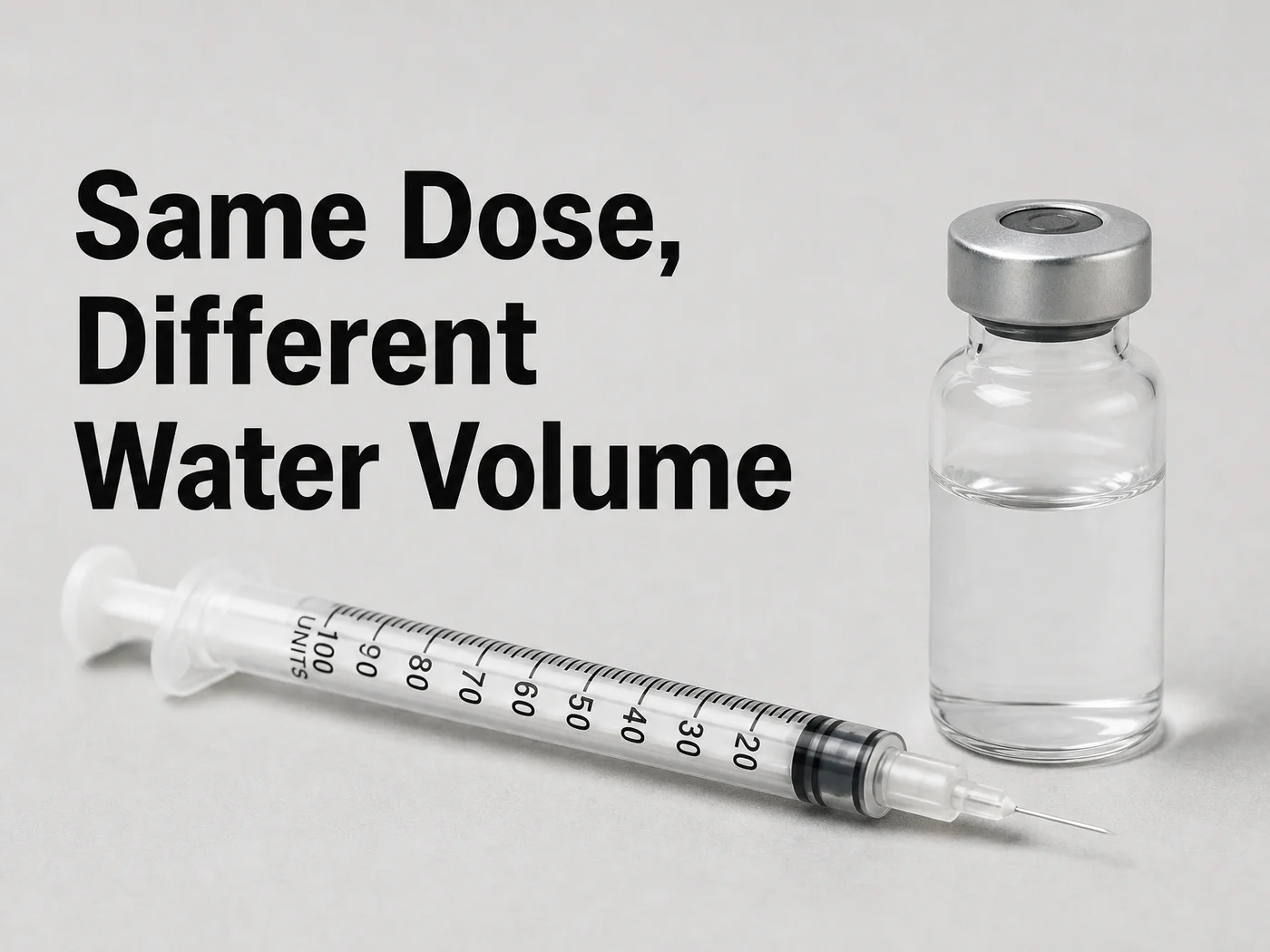 A U-100 syringe is marked in units; the water you add decides how many of those units one dose takes.
Look at the 2.5 mL row. A 12.5-unit draw means reading a half mark, which is easy to get wrong. Choosing 2 mL (10 units) or 4 mL (20 units) puts the dose on a clean line.
Once the volume is chosen, the step-by-step mixing guide walks through adding the water to the vial itself.
Work it backwards
Say you want a 10-unit draw for a 500 mcg dose from a 10 mg vial. Ten units is 0.1 mL, so you need 500 ÷ 0.1 = 5,000 mcg/mL. Then 10,000 mcg ÷ 5,000 mcg/mL = 2 mL of water.
That reverse order is how most people actually want to plan it.
What Happens If You Add Too Little or Too Much Water?
Too little water gives a very concentrated solution and a tiny draw, so a one-unit reading error becomes a large share of your dose. Too much gives a weak solution and a draw that may not fit the syringe, or the vial. Neither is dangerous by itself if the math is right; the risk is miscalculating.
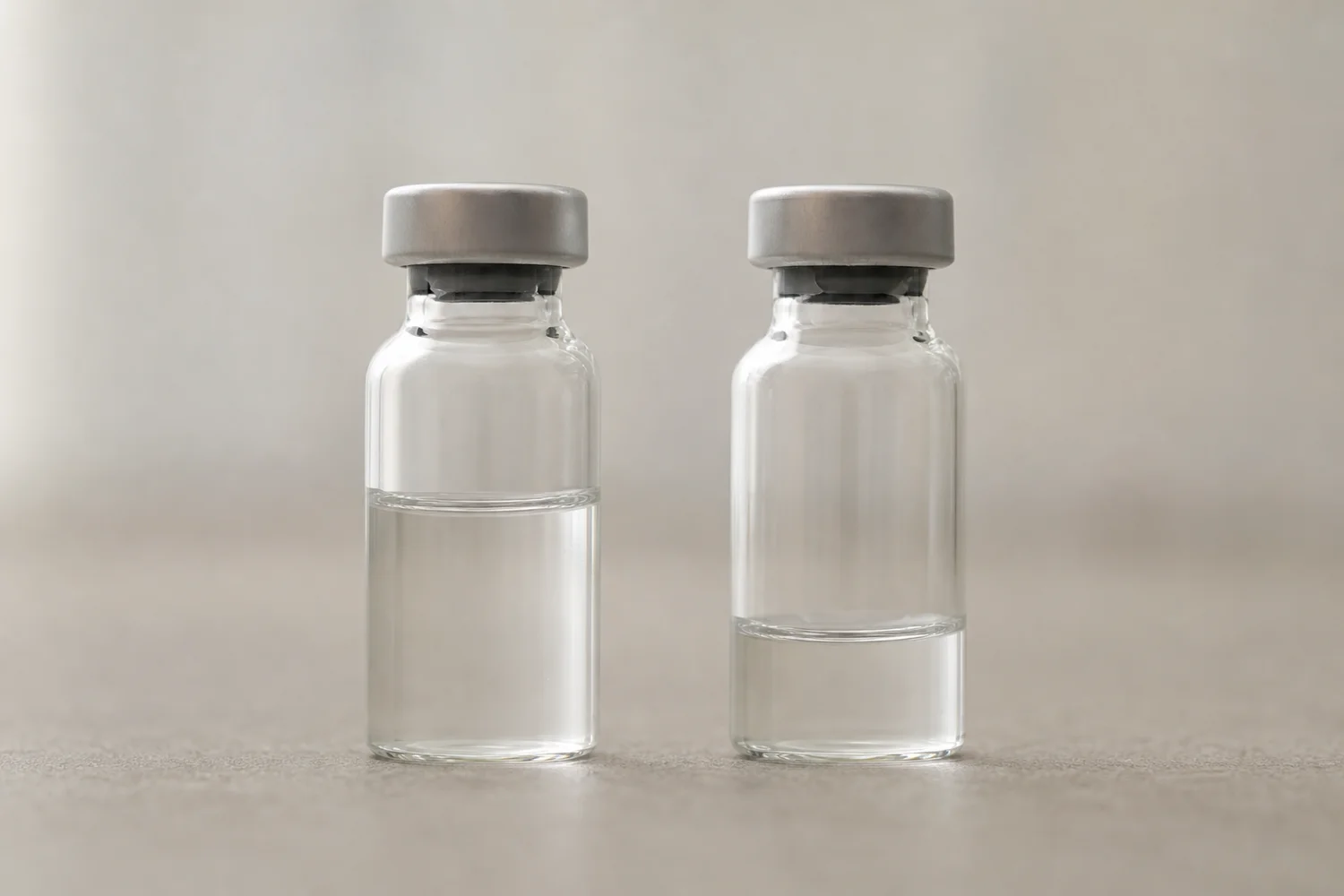 Two vials can hold the same peptide amount with very different concentrations.
At the small end, picture a 3-unit draw. Overshooting by one unit means a 33% error. At 10 units, the same one-unit slip is 10%.
At the large end, a U-100 syringe holds 100 units (1 mL). If your dose works out to more than the syringe holds, you would need more than one draw, and the extra volume is a bigger injection.
- Too little water: small, hard-to-read draws; larger percentage error per unit
- Too much water: large draws, possible multiple pulls, a fuller vial
- Wrong arithmetic for either: the actual problem, and the reason to check twice
Common mistake: Mixing up the water volume you added with the volume you draw. Write the water volume on the vial label the moment you add it, because it is easy to forget by next week.
A different, quieter error is changing the water volume between vials and keeping last week's unit count. Each new vial needs the calculation run again with its own numbers.
Can an App Calculate the Water Volume for You?
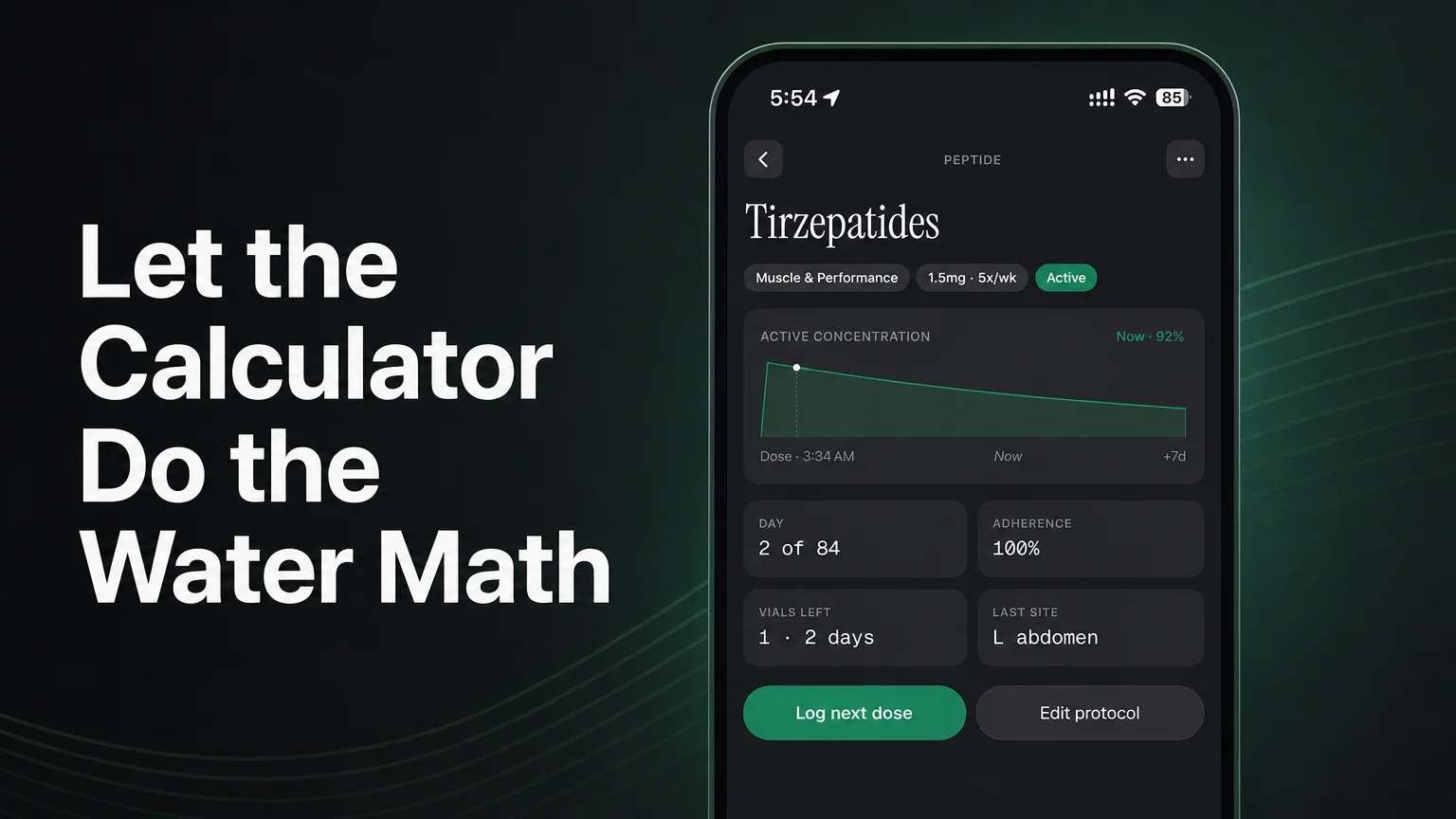 The peptide detail screen in the PeptideIQ app, where the vial and dose you logged are kept on file.
Yes. The PeptideIQ reconstitution calculator takes the vial amount in mg, the BAC water volume in mL and the dose in mcg, and returns the concentration plus the exact syringe units to draw, with the line marked on a syringe illustration.
It also runs in reverse, and that is the part most relevant here. Enter the syringe units you want to see for a dose, and it tells you how much BAC water to add. Syringe type toggles between U-100, U-50 and U-30, and the draw changes to match.
Each calculation saves to that vial in the inventory, with the concentration and the water added, so next week's dose does not depend on memory. The calculator works offline, since it is a core feature.
The app is iPhone-only and currently on a waitlist.
The calculator is a math tool: you supply the vial, water and dose, and it shows what they mean. Whether a given dose is right for you stays a decision for you and your prescriber. For the full walkthrough, see the peptide reconstitution calculator.
How Do You Check the Math Before You Draw a Dose?
Re-run the numbers from the vial in your hand before every draw: vial mg to mcg, divide by the water added, divide your dose by that concentration, multiply by 100. If the answer matches what you planned and the syringe mark, draw. If it does not, stop and recheck.
A short checklist:
- Read the vial. Confirm the mg printed on the label.
- Read your note. What water volume did you add to this vial?
- Run the concentration. mcg ÷ mL.
- Run the units. Dose ÷ concentration × 100.
- Sanity check. Does the draw fit the syringe and land on a clear mark?
For a second pass on the dose itself, the peptide dose calculator page works through that side. A quick sanity test: if halving the water did not halve your units, something is off.
Injection speed is a separate question from water volume, and this page leaves it out.
Get Started with PeptideIQ
If you would rather not redo this by hand with every vial, the PeptideIQ app keeps each vial's water volume, concentration and dose on file. It is built for people who already have a vial and want the math handled.
Join the PeptideIQ iPhone waitlist
FAQ
How much water do I add to a 10 mg peptide vial?
It depends on your dose and the syringe marks you want. Using a 500 mcg dose as an example, 2 mL gives 5,000 mcg/mL and a 10-unit draw on U-100, while 1 mL gives a 5-unit draw. Follow your label or prescriber for the actual volume.
How much BAC water do I add to peptides in general?
There is no universal amount. Divide the vial's total mcg by the water volume to get concentration, then divide your dose by that concentration. A volume that makes your dose a whole number of units is usually the easiest to measure.
Does adding more water make the peptide weaker?
It makes each millilitre weaker, not the peptide itself. The vial still holds the same total mcg and the same number of doses. You just draw a larger volume, in more syringe units, to get the same dose.
How many units is 0.1 mL on an insulin syringe?
On a U-100 insulin syringe, 100 units equal 1 mL, so 0.1 mL is 10 units and 0.05 mL is 5 units. Other syringe types can be marked differently, so read the barrel and confirm before drawing.
Can I add more water after mixing?
Changing the volume after mixing changes the concentration, so every unit calculation changes with it. If you do, redo the math and note the new total water on the vial. Check your product label before altering anything, since some products specify their own instructions.
Does the water volume change how many doses are in a vial?
No. A vial holds a fixed amount of peptide, so a 10 mg vial gives twenty 500 mcg doses with 1 mL, 2 mL or 4 mL. Water volume only changes how many syringe units each dose takes.