
How to Prepare Peptides for Injection, Step by Step
How to Prepare Peptides for Injection: Step-by-Step Guide
Learning how to prepare peptides for injection comes down to one process: dissolving the freeze-dried powder in your vial with bacteriostatic water, calculating your dose in syringe units, and drawing exactly that amount into an insulin syringe. The whole thing takes under 60 seconds once you've done it — but the first time, the math feels like a barrier nobody warned you about.
FDA testing has found incorrect dosages or undeclared ingredients in up to 40% of online peptide products — which makes precise reconstitution, not just "close enough," a real safety requirement.
How to Prepare Peptides for Injection: Which Supplies Will You Need?
Before you touch your peptide vial, gather everything first. You need the peptide vial (freeze-dried powder), bacteriostatic water, a U-100 or U-50 insulin syringe, alcohol swabs, and a clean flat surface. Having everything within arm's reach before you pierce anything is how you avoid contamination mid-process.
Bacteriostatic water (BAC water) — not regular sterile water — is the correct diluent. Multi-dose vials of BAC water stay sterile across multiple uses because of the 0.9% benzyl alcohol preservative. Regular sterile water for injection is single-use; it becomes a contamination risk the moment you open it.
The complete supply list:
- Peptide vial — sealed with freeze-dried (lyophilized) powder
- BAC water — 30ml multi-dose vial, available from compounding pharmacies and lab suppliers
- Insulin syringe — U-100 (100 units per ml) is standard; U-50 for very low-dose precision
- Alcohol swabs — one per vial top, one for your injection site
- Clean work surface — a small cloth or paper towel works; you're not operating sterile, you're minimizing exposure
If you're new to peptides and haven't determined which peptide fits your goal, the peptide guide for beginners covers core terminology before you start mixing.
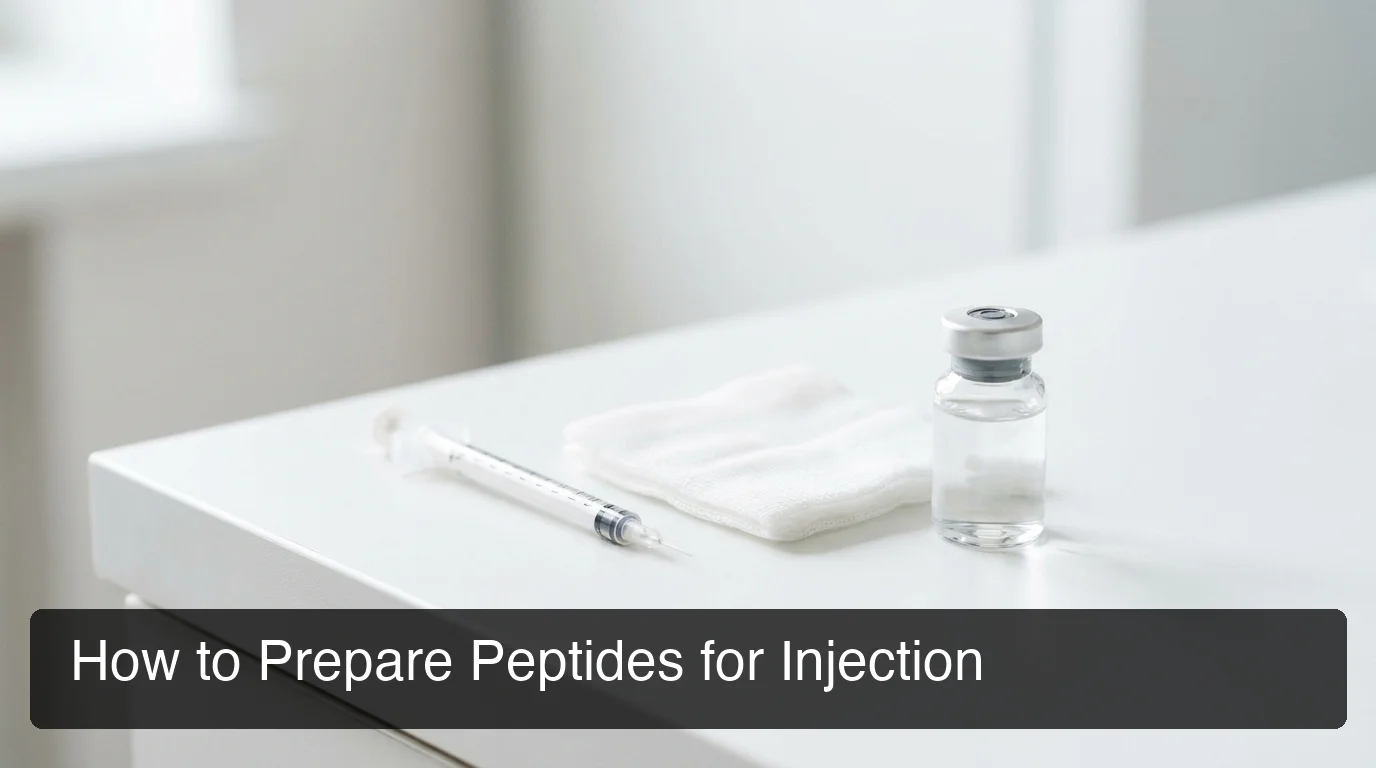 Everything in arm's reach before you start — the discipline that keeps your peptide vial sterile.
Key Takeaways
- Preparing a peptide for injection means dissolving freeze-dried powder in bacteriostatic water — the volume of BAC water you add determines every future dose's concentration.
- Use U-100 insulin syringes (or U-50 for doses under 10 units) with 29-31 gauge, half-inch needles for subcutaneous injections.
- Inject BAC water slowly along the inner vial wall — never directly onto the powder — and swirl gently to dissolve. Never shake.
- Reconstituted peptides are stable refrigerated for 20-30 days; label every vial with reconstitution date and BAC water volume added.
- Tracking preparation details in an app prevents dosing errors when you open a new vial or switch to a peptide with a different concentration.
Contents
- How to Prepare Peptides for Injection: Which Supplies Will You Need?
- How to Prepare Peptides for Injection Step by Step?
- How Much Bacteriostatic Water Should You Mix with Your Peptide Vial?
- What Syringe Size Is Right for Peptide Preparation?
- Can You Mix Multiple Doses Ahead of Time, or Should You Mix Fresh?
- Why PeptideIQ Tracks Preparation Accuracy
How to Prepare Peptides for Injection Step by Step?
The 5-step process: wipe both vial tops with alcohol swabs, draw your target volume of bacteriostatic water into a syringe, inject it slowly along the inner wall of the peptide vial, swirl gently to dissolve, then draw your dose in syringe units into a fresh syringe. Total prep time under 60 seconds once you've done it once.
Here's each step in detail:
Step 1 — Wipe both vial tops. Use a separate alcohol swab on the rubber septum of your peptide vial and another on your BAC water vial. Let them air-dry 20 seconds before piercing.
Step 2 — Draw BAC water. Insert a syringe needle into the BAC water vial and slowly pull back the plunger to draw your target volume. Pulling back fast creates bubbles that make the measurement harder to read.
Step 3 — Inject into the peptide vial along the wall. Angle the tip so water runs down the inner glass wall — not directly onto the freeze-dried powder. Direct pressure can cause clumping and partial degradation. Release the plunger slowly.
Step 4 — Dissolve without shaking. Swirl the vial gently between your fingers, or set it down and let the powder dissolve on its own. Full dissolution typically takes 30-60 seconds. The solution should run completely clear when it's ready.
Step 5 — Draw your dose. Using a fresh syringe, insert into the now-reconstituted vial and draw to the unit mark that matches your dose. Cap it and you're ready to inject.
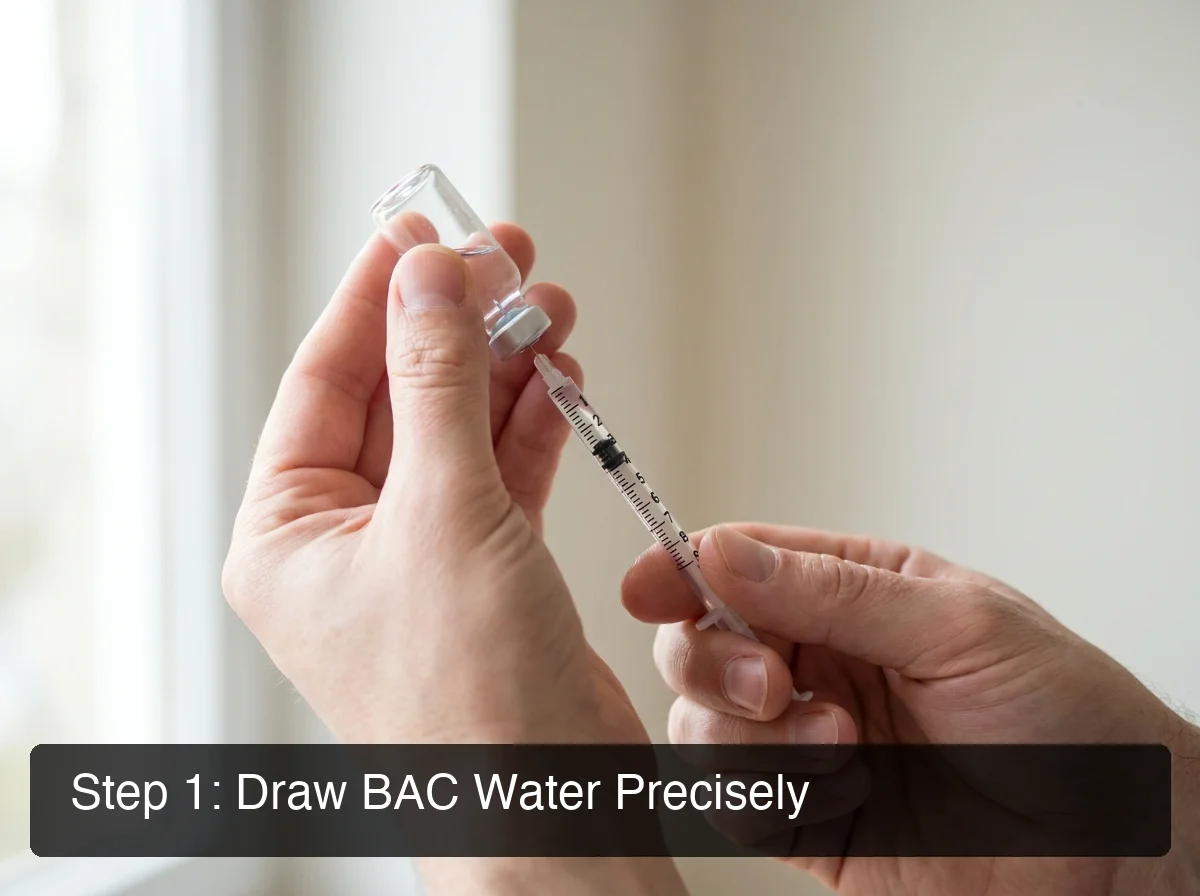 Draw BAC water precisely — the volume you add determines every dose's concentration going forward.
Worth knowing: Use a fresh syringe to draw your dose, separate from the one you used on the BAC water vial. A needle that has touched your skin should never re-enter a multi-dose vial. That's how sterile solutions go microbial.
How Much Bacteriostatic Water Should You Mix with Your Peptide Vial?
The BAC water volume you add sets the concentration of the entire vial. A 5mg vial plus 1ml of BAC water creates 5,000mcg/ml — a 250mcg dose requires 5 units on a U-100 syringe. Add 2ml instead: concentration halves to 2,500mcg/ml, and 250mcg now requires 10 units. Choose the water amount that puts your typical dose in a readable range on your syringe.
A quick reference table:
| Peptide vial | BAC water added | Resulting concentration | 250mcg dose = |
|---|---|---|---|
| 5mg (5,000mcg) | 1ml | 5,000mcg/ml | 5 units (U-100) |
| 5mg | 2ml | 2,500mcg/ml | 10 units (U-100) |
| 10mg | 2ml | 5,000mcg/ml | 5 units (U-100) |
| 2mg (2,000mcg) | 1ml | 2,000mcg/ml | 12.5 units (U-100) |
Most beginners prefer 2ml for a 5mg vial. The lower concentration puts common doses — 200-500mcg — in the 8-20 unit range, which is far easier to read accurately on an insulin syringe than single-digit marks.
For the math automatically: the peptide reconstitution calculator takes your vial size, BAC water volume, and target dose, then outputs the exact unit mark to draw. No conversion required.
What Syringe Size Is Right for Peptide Preparation?
For subcutaneous peptide injection, U-100 insulin syringes are standard. Switch to U-50 when your dose falls below 10 units on a U-100 — the wider barrel markings on a U-50 make small measurements more accurate. Needle gauge: 29, 30, or 31. Higher gauge = thinner needle. Most users find 30 or 31-gauge injections nearly painless at subcutaneous depth.
Syringe selection in practice:
- U-100 (100 units/ml): Best for doses of 10 units or more. Standard choice for most peptide protocols.
- U-50 (50 units per 0.5ml): Better precision at doses below 10 U-100 units. Useful for low-dose GLP-1 titration starts.
- Needle length: Half-inch (12.7mm) for most subcutaneous sites. 5/16-inch works for lean body compositions.
Once your syringe is loaded, site selection is the next variable. The complete guide to injection sites and technique covers abdomen rotation, thigh injection, and subcutaneous depth by body type.
Can You Mix Multiple Doses Ahead of Time, or Should You Mix Fresh?
You reconstitute the full vial once and draw individual doses from it over the following weeks — not a fresh mix before each injection. With bacteriostatic water, most peptides remain stable refrigerated for 20-30 days. Exception: discard any vial that appears cloudy, discolored, or shows visible particles after full dissolution.
Label every reconstituted vial with:
- Peptide name
- BAC water volume added
- Date reconstituted
- Calculated concentration
That last detail is critical when you open a new vial. If you used 2ml last time and add 1ml this time — concentration doubles, and your unit draw doubles for the same dose. Writing it down is not optional if you want consistent dosing across vials.
If you're mixing multiple peptides in one session, those labels become even more essential. Never rely on memory between vials.
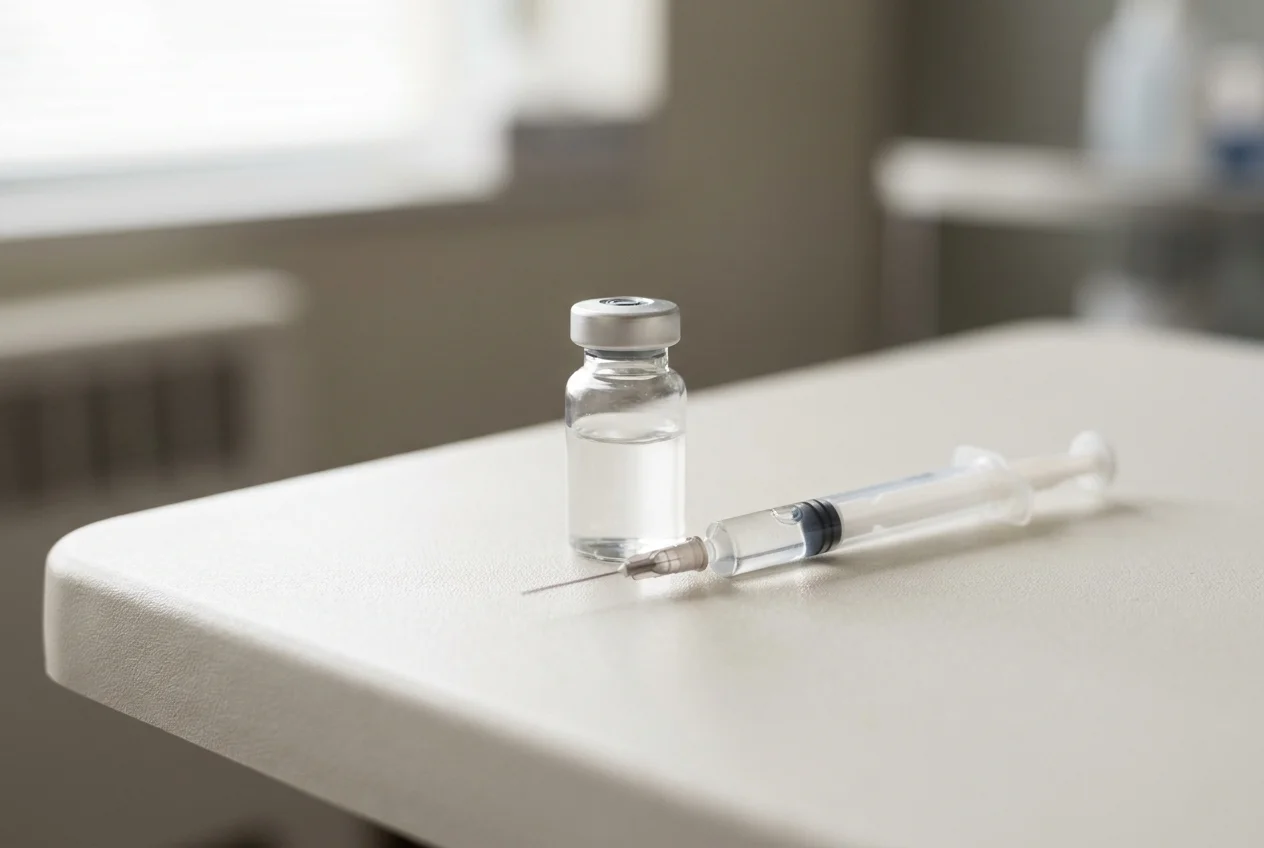 Label it, refrigerate it, log it — preparation details recorded now prevent dosing errors across every vial that follows.
Why PeptideIQ Tracks Preparation Accuracy
Reconstitution math is easy to do once. It's also easy to forget — especially when a new vial arrives and the concentration changes because you added a different BAC water amount.
PeptideIQ's Reconstitution Calculator saves every vial setup to your inventory automatically. When it's time to draw a dose, the app displays a visual syringe illustration with the exact unit line marked — calculated dynamically from that vial's saved concentration and your target dose, not generic math.
For first-time users, this step is mandatory during dose logging. For experienced users, it's a quick confirmation you can skip.
Every preparation logged becomes part of your dose history. When PeptideIQ's AI co-pilot answers a question about your cycle, it knows not just that you took 250mcg — it knows which vial, what concentration it was reconstituted at, and when that vial was opened.
Get Started with PeptideIQ
Preparation is the first step. Knowing every dose was drawn accurately — across vials, across peptides, across months of a protocol — is what a tracking system handles so you don't have to.
Download PeptideIQ on the App Store
Frequently Asked Questions
How do you reconstitute peptides for injection?
Draw your target volume of bacteriostatic water into a syringe, then inject it slowly down the inner wall of the peptide vial — not directly onto the powder. Swirl gently without shaking until the solution clears; this takes 30-60 seconds. Once fully dissolved, draw your calculated dose in syringe units into a separate, fresh syringe.
How much BAC water do I mix with my peptide?
For a 5mg vial, the standard is 1-2ml of bacteriostatic water. Adding 1ml yields 5,000mcg/ml (5mcg per U-100 unit); adding 2ml gives 2,500mcg/ml (2.5mcg per unit). Most beginners choose 2ml because it puts common doses like 250mcg in the 8-10 unit range — easier to read on an insulin syringe than single-digit marks.
Can you prepare multiple peptide doses at once, or should you mix fresh each time?
You mix the full vial once and draw individual doses over multiple injections — not a fresh reconstitution each time. Reconstituted peptides in bacteriostatic water are stable refrigerated for 20-30 days. Do not freeze a reconstituted solution; freeze-dried powder (before mixing) can be frozen, but the mixed solution cannot.
What safety precautions matter most when preparing peptides?
Use a fresh needle each time you pierce a vial septum, and never reinsert a needle that touched your skin. Wipe rubber vial tops with alcohol and let them dry before piercing. Direct BAC water along the vial wall rather than onto the powder, and discard any reconstituted solution that appears cloudy, discolored, or has visible particles — all signs of contamination or degradation.