
How Do I Calculate How Much Peptide I Need? Steps
How Do I Calculate How Much Peptide I Need? A Step-by-Step Method
The vial label says 10 mg. Your syringe is marked in units. The dose you want is 250 mcg. Three measurements, three different languages, and none of them tells you how far to pull the plunger. So how do I calculate how much peptide I need? With one formula and three conversions.
General education, not medical advice. Many peptides are not FDA-approved, and the examples below are illustrations of arithmetic, not dosing recommendations. Your dose comes from your prescriber or the protocol you have chosen to follow.
Key Takeaways
- Peptide dosing is a chain of three conversions: milligrams (what is in the vial), milliliters (the water you add), and micrograms or syringe units (what you actually draw).
- The core formula: desired dose in mcg ÷ concentration in mcg/mL = mL to draw. Multiply by 100 for units on a U-100 syringe.
- The reconstitution step, where you choose how much water to add, decides every number after it. Fix it first and write it down.
- A unit mix-up (mg read as mcg) is a 1,000x error. A decimal slip is 10x. Both are common and both are catchable with a two-minute check.
- PeptideIQ's reconstitution calculator does this chain for you, but knowing the math tells you when an answer looks wrong.
Contents
- What's the Difference Between mg, mcg, and Units in Peptide Dosing?
- How Do I Calculate How Much Peptide I Need When Mixing With BAC Water?
- What's the Standard Dosing Formula for BPC-157, CJC-1295, and Semaglutide?
- How Do You Convert Peptide Measurements Without a Calculator?
- Why Precision Dosing Matters for Your Results
- How Much Do Dosing Mistakes Affect Your Protocol?
- How Do I Calculate How Much Peptide I Need Without Math Errors?
- Get Started with PeptideIQ
- FAQ
What's the Difference Between mg, mcg, and Units in Peptide Dosing?
Milligrams (mg) and micrograms (mcg) measure weight: 1 mg equals 1,000 mcg. Milliliters (mL) measure liquid volume. "Units" are just the tick marks on an insulin syringe, where 100 units on a U-100 syringe equals exactly 1 mL. Units describe volume, never the amount of peptide.
Here is the vocabulary in one place:
- mg (milligram): the weight of peptide powder in the vial, e.g., 5 mg or 10 mg.
- mcg (microgram): one thousandth of a milligram. Most peptide doses are written in mcg, e.g., 250 mcg.
- mL (milliliter): the volume of bacteriostatic (BAC) water you add to the vial.
- Units: syringe markings. On a U-100 syringe, 100 units = 1 mL, so 1 unit = 0.01 mL.
Syringe type changes the unit math. A U-50 syringe holds 1 mL at 50 units, so each unit is 0.02 mL, twice the volume of a U-100 unit. If your syringe isn't U-100, stop and adjust every conversion below.
Common mistake: treating "units" as a dose. Two people can both draw 10 units and inject completely different amounts of peptide, because their vials were mixed with different amounts of water.
How Do I Calculate How Much Peptide I Need When Mixing With BAC Water?
Dose calculation takes three steps. First, find concentration: vial mg × 1,000 ÷ mL of BAC water gives mcg per mL. Second, find volume: desired dose in mcg ÷ concentration gives mL to draw. Third, convert to units: mL × 100 on a U-100 syringe.
Take a 10 mg vial and add 2 mL of BAC water. The peptide is spread across 2 mL, so the concentration is 10 mg ÷ 2 mL = 5 mg/mL, or 5,000 mcg/mL.
Now suppose you want a 250 mcg dose. Divide the dose by the concentration: 250 ÷ 5,000 = 0.05 mL. On a U-100 syringe, 0.05 mL × 100 = 5 units.
Written as a checklist you can repeat every time:
- Vial amount in mcg: mg × 1,000
- Concentration: vial mcg ÷ water mL
- Volume to draw: dose mcg ÷ concentration
- Units: volume × 100 (U-100)
- Reverse check: units ÷ 100 × concentration should return your dose
Step five is the one people skip, and it is the one that catches errors. If 5 units × 50 mcg per unit doesn't give you 250 mcg, something upstream is wrong.
Our peptide reconstitution calculator runs steps 1 and 2 for any vial and water combination, which is a useful way to confirm your hand arithmetic. More water means a weaker concentration and a larger draw, which is easier to measure precisely at low doses.
Related: How Much Water to Mix With Peptides (With Examples)
What's the Standard Dosing Formula for BPC-157, CJC-1295, and Semaglutide?
There is one formula for every peptide: dose (mcg) ÷ concentration (mcg/mL) = mL to draw. What differs between peptides is the dose and vial size, not the math. The three worked examples below use common vial sizes and illustrative doses, not recommendations.
Each example follows the same five steps. Only the inputs change.
| Peptide | Vial + water | Concentration | Example dose | Volume | U-100 units |
|---|---|---|---|---|---|
| BPC-157 | 10 mg + 2 mL | 5,000 mcg/mL | 250 mcg | 0.05 mL | 5 |
| BPC-157 | 10 mg + 1 mL | 10,000 mcg/mL | 250 mcg | 0.025 mL | 2.5 |
| CJC-1295 | 10 mg + 2 mL | 5,000 mcg/mL | 100 mcg | 0.02 mL | 2 |
| Semaglutide | 5 mg + 2 mL | 2,500 mcg/mL | 250 mcg (0.25 mg) | 0.1 mL | 10 |
Look at the first two rows. Same peptide, same vial, same 250 mcg dose, and the draw is 5 units in one case and 2.5 in the other. Half a unit is hard to read on a syringe barrel, so the more diluted mix is easier to dose accurately.
Worked example: semaglutide 5 mg vial
Semaglutide is the one in this table that is FDA-approved, and its dosing is set by a prescriber, so treat 0.25 mg here as arithmetic practice only. A 5 mg vial with 2 mL of water gives 5,000 ÷ 2 = 2,500 mcg/mL. A 0.25 mg dose is 250 mcg, so 250 ÷ 2,500 = 0.1 mL, which is 10 units.
Fix the concentration once and every future dose is a single division. For pre-worked numbers by peptide, see our peptide dosage cheat sheet.
How Do You Convert Peptide Measurements Without a Calculator?
Memorize two facts: 1 mg = 1,000 mcg, and on a U-100 syringe 1 unit = 0.01 mL. Then one shortcut handles everything: mcg per unit = concentration in mg/mL × 10. A 5 mg/mL mix delivers 50 mcg per unit, so 250 mcg is 5 units.
Use it like this:
- 2.5 mg/mL → 25 mcg per unit → a 250 mcg dose is 10 units
- 5 mg/mL → 50 mcg per unit → 250 mcg is 5 units; 100 mcg is 2 units
- 10 mg/mL → 100 mcg per unit → 250 mcg is 2.5 units
Once you know mcg per unit, dosing is dose ÷ mcg-per-unit. There is no mL step to forget.
A good habit: choose your water volume so mcg per unit is a round number, like 25, 50, or 100. If your result comes out as 7.3 units, pick a different water volume.
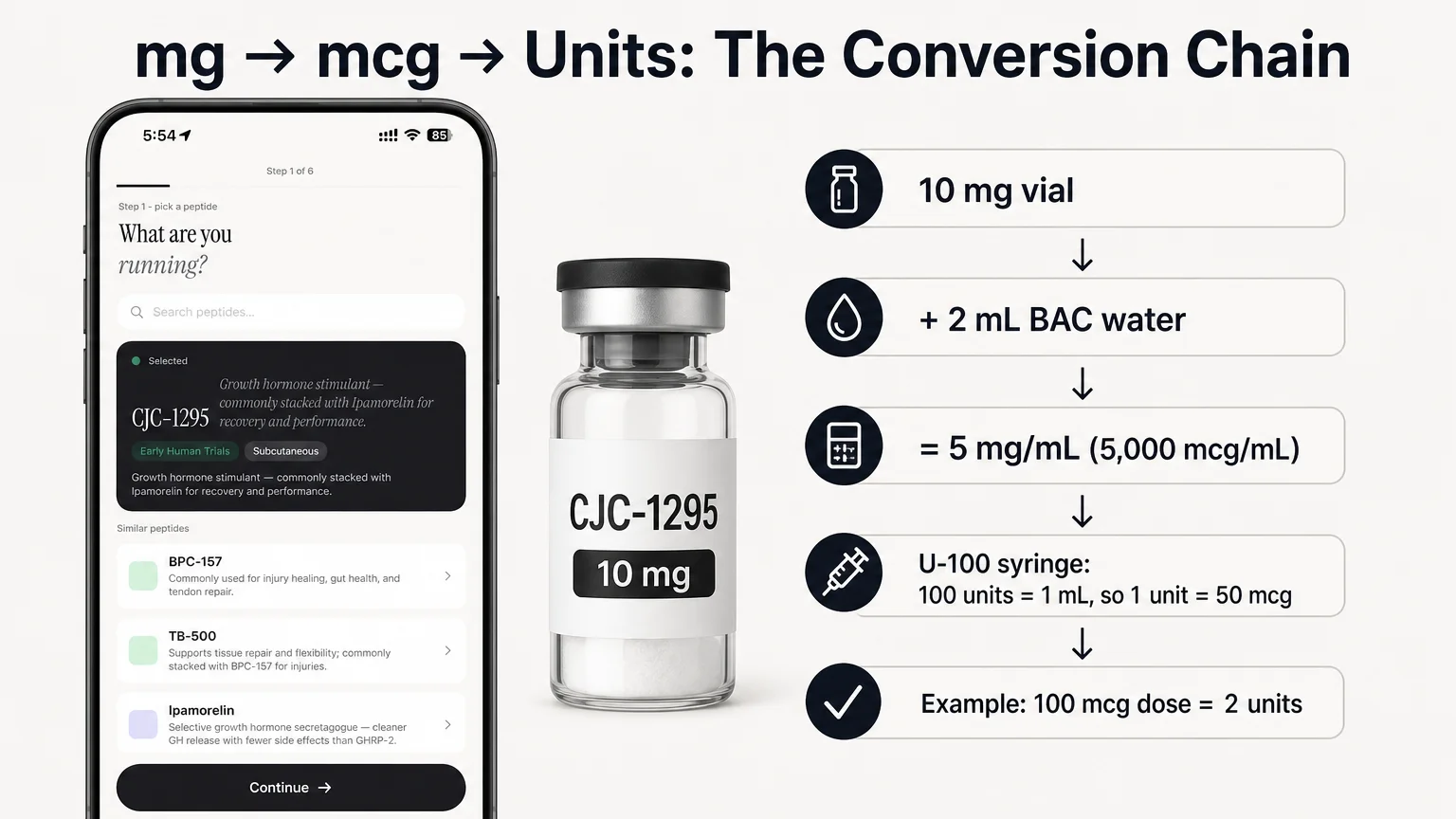 The conversion chain for a CJC-1295 10 mg vial, shown next to the PeptideIQ peptide picker where this math starts.
Why Precision Dosing Matters for Your Results
Dose calculation comes before the first injection because everything else in a protocol depends on it. You cannot judge whether 250 mcg of BPC-157 is working if you aren't sure you injected 250 mcg. Side effects, plateaus, and "it did nothing" conclusions all become unreadable when the dose was a guess.
Reconstitution is where this is won or lost. A wrong concentration doesn't produce one bad dose; it produces every dose from that vial wrong in the same direction, which can look like consistency.
This is the step PeptideIQ was built around. The reconstitution calculator takes three inputs, vial size in mg, BAC water in mL, and your desired dose in mcg, and returns the concentration and the exact syringe units to draw. It also has a reverse mode: enter the units you want to draw, and it tells you how much water to add. The syringe toggle covers U-100, U-50, and U-30, so the unit count changes with your syringe.
During dose logging, the app shows a syringe illustration with a line at the draw mark, such as "Draw to the 15 unit mark," calculated from the vial's saved concentration. These calculations work offline.
PeptideIQ is an iOS app in pre-launch with the waitlist open, so the manual method above is what you use today. If you're weighing tools in the meantime, our comparison of peptide calculator apps for beginners shows what to look for.
How Much Do Dosing Mistakes Affect Your Protocol?
Dosing errors scale with the mistake. A mg/mcg mix-up is off by 1,000x, a misplaced decimal by 10x, and a wrong water volume by whatever ratio you used versus what you calculated. Even a simple 2x error means half the intended effect or double the intended side effects.
Three traps account for most of the damage. Each is easy to avoid once you've seen it.
Trap 1: Mixing up mg and mcg
A dose of 0.25 mg is 250 mcg. Read the label wrong and you divide 250 by 5 instead of 5,000, as in the left notebook below. The answer, 50 mL, is obviously impossible.
Trap 2: Using the old concentration
You mixed one vial with 2 mL, then a second vial with 1 mL, and kept drawing "5 units" out of habit. The second vial is twice as strong, so you're now injecting double. Label every vial with its concentration and the date you mixed it.
Trap 3: Reading units as mL
On a U-100 syringe, "5" on the barrel is 5 units, which is 0.05 mL. It is not 5 mL.
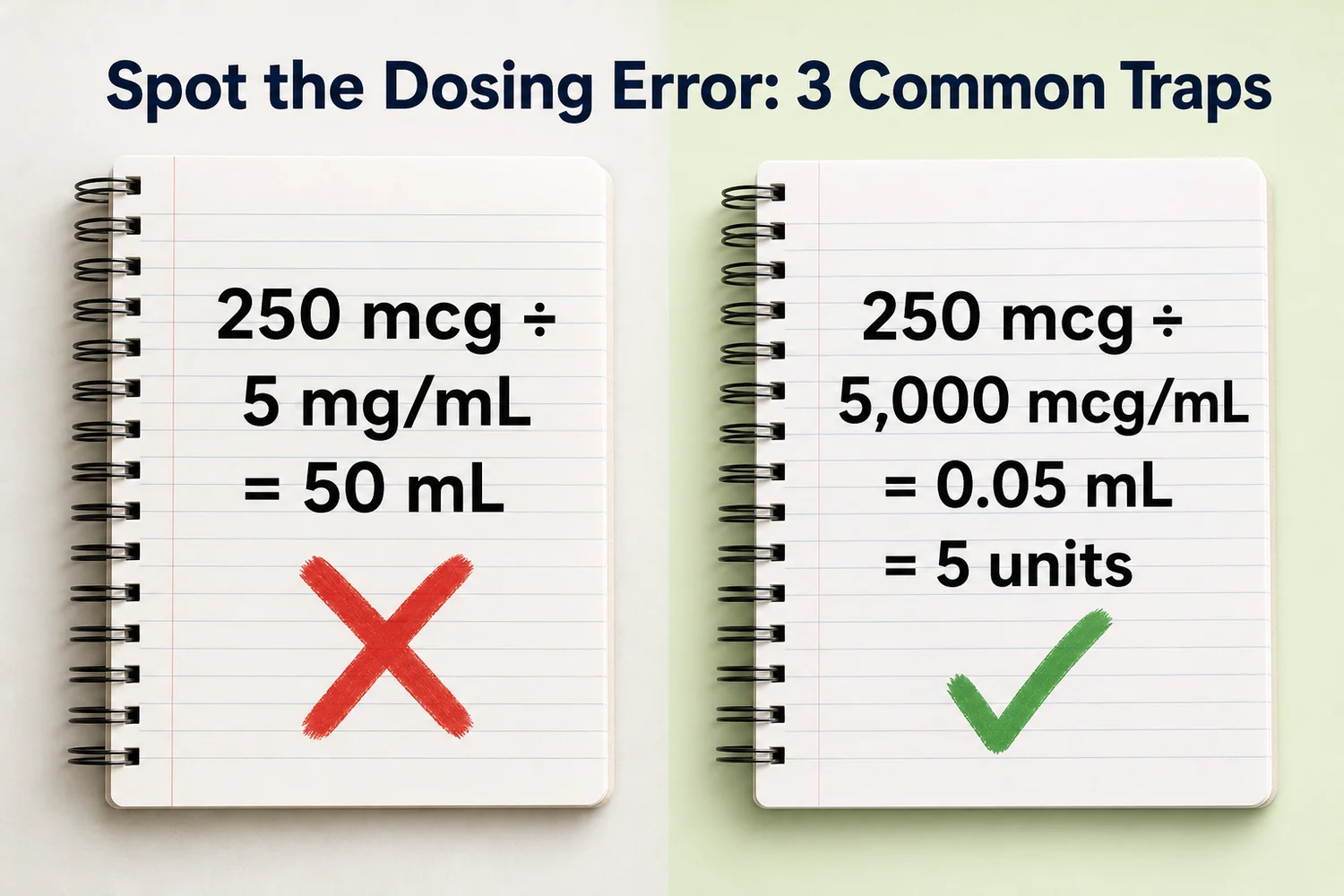 Same inputs, one unit conversion skipped: the left page is the classic mg-versus-mcg slip.
Reality check: the dangerous errors are the ones that produce believable results. Always sanity-check: a 250 mcg dose should be a small fraction of a milliliter, not a full syringe.
How Do I Calculate How Much Peptide I Need Without Math Errors?
Use the same five-step routine every time: write the vial mg and water mL, compute concentration and mcg per unit, calculate your draw, reverse-check it, then confirm with a second tool. Run the whole thing on paper before the needle is anywhere near the vial.
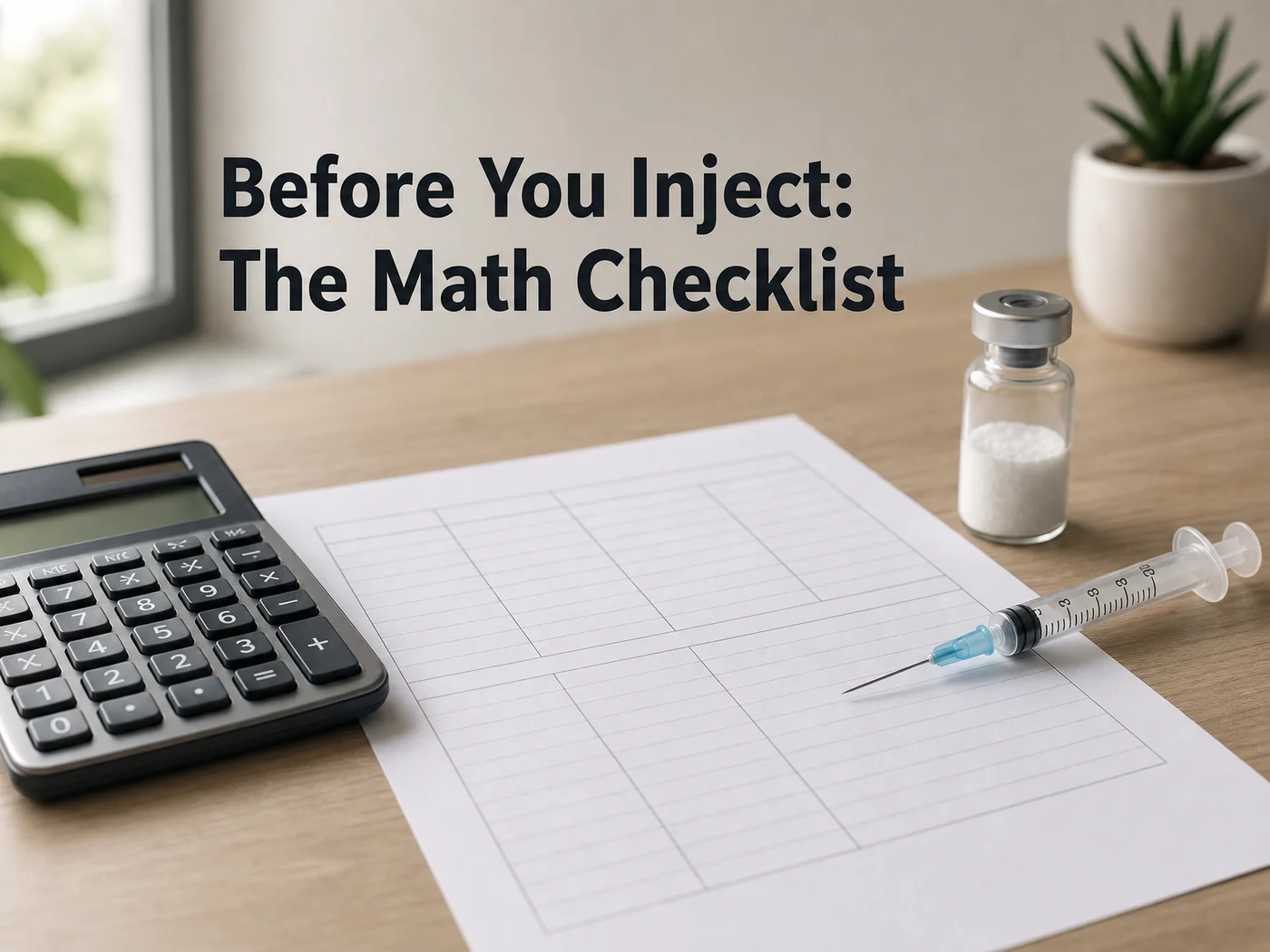 A paper worksheet and a second tool: the cheapest safeguards against a bad draw.
Your pre-injection checklist
- Vial size in mg matches the label (not a different batch).
- Water volume added is written on the vial.
- Concentration in mcg/mL calculated and recorded.
- mcg per unit worked out for your syringe type (U-100, U-50, or U-30).
- Draw amount reverse-checked: units × mcg per unit = intended dose.
- Result compared against a calculator, such as our peptide dose calculator or peptide dosing calculator.
- If the two answers disagree, you don't inject until you know why.
That last line is the real safeguard: two independent methods that disagree mean one has an error you haven't found yet.
Get Started with PeptideIQ
Doing the math by hand once builds the instinct to catch a wrong answer. After that, let a tool carry the arithmetic: PeptideIQ stores each vial's concentration and draws the line on a syringe illustration at dose time. It's an iOS app in pre-launch, and the waitlist is open.
FAQ
How do I calculate how much peptide I need per injection?
Divide your desired dose in mcg by the vial's concentration in mcg/mL to get the volume to draw. For a 5,000 mcg/mL mix and a 250 mcg dose, that is 0.05 mL, or 5 units on a U-100 syringe. Your dose itself comes from your prescriber or protocol.
How much peptide is 250 mcg?
250 mcg is 0.25 mg. How much liquid that is depends on concentration: at 5 mg/mL it is 0.05 mL (5 units on a U-100 syringe); at 2.5 mg/mL it is 0.1 mL (10 units). The weight stays fixed, only the volume changes.
How many mcg are in 1 mg of peptide?
1 mg equals 1,000 mcg. So a 5 mg vial contains 5,000 mcg and a 10 mg vial contains 10,000 mcg. Always convert the vial's mg to mcg before dividing by water volume, so your dose and concentration use the same unit.
How many units is 0.1 mL on an insulin syringe?
On a U-100 syringe, 0.1 mL is 10 units, because 100 units equal 1 mL. On a U-50 syringe, 0.1 mL is 5 units. Check the syringe's label before converting, since the same mL reading means different unit counts on different syringes.
How much BAC water should I add to a peptide vial?
There is no single correct volume. More water gives a weaker concentration and a larger draw that is easier to measure; less water gives a stronger mix and a tiny draw. Pick a volume that makes your dose a round number of units, then record it.
Does PeptideIQ calculate peptide doses automatically?
PeptideIQ's reconstitution calculator takes vial size in mg, BAC water in mL, and your desired dose in mcg, then returns the concentration and syringe units to draw. It supports U-100, U-50, and U-30 syringes. The app is an iOS pre-launch product with a waitlist at peptideiq.io.