
Peptide Dosing Calculator: Precision Dosing Guide
Peptide Dosing Calculator: Precision Dosing for Every Protocol
Most peptide mistakes happen before the injection — at the calculator stage. If your numbers are wrong when you draw the syringe, no technique in the world fixes it.
Key Takeaways
- A peptide dosing calculator eliminates guesswork by accounting for your weight, peptide type, and desired results — critical for safety and efficacy.
- Incorrect dosing leads to suboptimal results (too low) or preventable side effects (too high); precision dosing unlocks the full potential of your protocol.
- Most peptides require reconstitution with bacteriostatic water; the dosing calculator factors this concentration into dose accuracy.
- PeptideIQ's dosing tracker lets you log each injection and monitor your protocol progression in real time, supporting better decision-making mid-cycle.
- Calculators work best when combined with research-backed protocols — CJC-1295, BPC-157, GHK-Cu, and others all have different dosing requirements.
Contents
- What Is a Peptide Dosing Calculator and Why Do You Need One?
- How Do You Calculate Your Peptide Dose Using Body Weight and Protocol?
- What Factors Should You Consider When Calculating Your Peptide Dosage?
- Why Does Accurate Peptide Dosing Matter for Safety and Results?
- How Do You Reconstitute a Peptide and Calculate Syringe Units?
- How to Use a Peptide Dosing Calculator: The PeptideIQ Method?
- Can You Adjust Your Peptide Dosage Mid-Protocol and Stay Safe?
- What's the Difference Between Dosing Calculator Tools and Manual Calculation?
- Frequently Asked Questions
What Is a Peptide Dosing Calculator and Why Do You Need One?
A peptide dosing calculator is a tool that converts your target dose (in mcg), vial concentration, and syringe type into an exact syringe unit measurement — telling you precisely where to draw the plunger. It removes the arithmetic layer from dosing and eliminates the most common source of peptide protocol errors: unit conversion mistakes.
Without a calculator, you manually convert milligrams to micrograms, divide by BAC water volume, and map the result to your syringe markings. One error in that chain means under-dosing or exceeding your intended protocol.
FDA testing found that up to 40% of online peptide products contained incorrect dosages or undeclared ingredients — a supplier problem, not a user one, but it illustrates how thin the margin for compounding errors already is.
 Precision peptide dosing begins with the right calculation — not guesswork.
A dosing calculator handles three distinct math problems for you:
- Concentration math: How many mcg per ml does your reconstituted vial contain?
- Volume math: How many ml of solution do you need to hit your target dose?
- Syringe math: On a U-100 (or U-50, U-30) syringe, what unit mark does that volume correspond to?
If you're new to peptides, the peptide guide for beginners covers the full setup workflow — including why these calculations matter before your first injection.
How Do You Calculate Your Peptide Dose Using Body Weight and Protocol?
Some peptides dose by body weight (mcg per kg); others use flat protocol doses regardless of size. Knowing which type you're working with is the first step. For weight-based peptides, the core formula is: target mcg/kg × body weight in kg = total dose in mcg.
For flat-dose peptides like BPC-157 and CJC-1295, standard protocol ranges apply regardless of body weight. For body-weight peptides like semaglutide and tirzepatide, your starting dose scales with size and follows a defined phase titration.
Common Peptide Dosing Ranges by Protocol
| Peptide | Standard Dose Range | Dosing Frequency | Method |
|---|---|---|---|
| BPC-157 | 200–500 mcg/day | Once or twice daily | Subcutaneous or IM |
| CJC-1295 | 100–300 mcg | 2–3x/week | Subcutaneous |
| Ipamorelin | 100–300 mcg | 1–3x/day (fasted) | Subcutaneous |
| GHK-Cu | 1–2 mg/day | Once daily | Subcutaneous |
| Semaglutide | 0.25–2.4 mg/week | Weekly | Subcutaneous |
| TB-500 | 2–5 mg/week | 2x/week | Subcutaneous or IM |
| Sermorelin | 100–500 mcg | Once daily (pre-sleep) | Subcutaneous |
These ranges are research-based starting points, not medical prescriptions. If you've already used a peptide dose calculator to arrive at your number, the next step is converting that dose into syringe units — which the reconstitution step below covers.
By the numbers: A 5mg BPC-157 vial reconstituted with 2ml BAC water gives 2500 mcg/ml. A 250 mcg dose on a U-100 syringe = draw to the 10-unit mark. Getting this wrong by one step in the chain changes everything.
What Factors Should You Consider When Calculating Your Peptide Dosage?
Accurate peptide dosage calculation depends on five variables: target dose, vial peptide amount, BAC water volume, syringe type, and body weight (if weight-based). Missing or guessing any one of these inputs produces an inaccurate output — not an approximate one.
Body Weight and Dose Scaling
Weight-based peptides (GLP-1s, some growth hormone peptides) require your weight in kg. A 90 kg person on a 0.25 mg/kg semaglutide start dose takes 22.5 mg — very different from a 60 kg person's 15 mg. Fixed-dose peptides don't require weight input, but body composition still affects how you respond.
Syringe Type and Unit Conversion
The three common insulin syringes have different unit systems:
| Syringe Type | Total Volume | Units per ml | 1 unit = |
|---|---|---|---|
| U-100 | 1ml | 100 units | 0.01 ml |
| U-50 | 0.5ml | 50 units | 0.02 ml |
| U-30 | 0.3ml | 30 units | 0.033 ml |
Using a U-50 syringe when your calculation assumed U-100 means drawing double the intended volume. It's the most common error in manual calculation.
 The difference between precision and guesswork in peptide dosing is measurable — and consequential.
Protocol Goal and Starting Dose
Injury recovery (BPC-157) uses different dose ranges than fat loss (GLP-1s) or anti-aging (GHK-Cu). If you're unsure what peptides are or which one fits your goal, that context shapes your dose selection before the calculator even enters the picture.
Why Does Accurate Peptide Dosing Matter for Safety and Results?
Under-dosing produces no measurable effect — you're running a protocol below the therapeutic threshold. Over-dosing creates preventable side effects and wastes product. Peptides work within dose ranges: too low and the signal doesn't register, too high and the receptor response becomes suboptimal or adverse.
The Real-World Cost of Dosing Errors
Two scenarios cause most protocol failures:
Under-dosing: A user reconstitutes 5mg of BPC-157 in 5ml of BAC water instead of 2ml. Concentration drops to 1000 mcg/ml. Drawing to the 10-unit mark delivers 100 mcg instead of 250 mcg. Four weeks at 40% of the target dose produces no visible results — and the peptide gets blamed.
Over-dosing: A beginner confuses mg and mcg, dosing 2mg instead of 200 mcg of Ipamorelin. That's 10× the intended dose — water retention, cortisol response, wasted vial.
Key insight: The difference between a failed protocol and a working one often isn't the peptide — it's whether the dose actually landed where it was supposed to.
How Do You Reconstitute a Peptide and Calculate Syringe Units?
Peptide reconstitution is the process of adding bacteriostatic water to a freeze-dried peptide vial to create an injectable solution. The calculation chain has five steps: identify vial peptide amount, add a measured BAC water volume, calculate resulting concentration, divide your target dose by the concentration, then map that volume to your syringe's unit scale.
This is where most beginners lose the thread — four unit conversions happening at once: mg → mcg, ml → units, concentration → volume, volume → syringe marks.
The Five-Step Reconstitution Calculation
- Identify vial amount — e.g., 5mg vial = 5,000 mcg total
- Add BAC water — e.g., add 2ml bacteriostatic water
- Calculate concentration — 5,000 mcg ÷ 2ml = 2,500 mcg/ml
- Calculate volume for target dose — e.g., 250 mcg ÷ 2,500 mcg/ml = 0.10 ml
- Convert to syringe units — on a U-100 syringe: 0.10 ml × 100 units/ml = draw to the 10-unit mark
A future peptide reconstitution calculator walkthrough will cover additional examples for common vial sizes. Run these five steps before every first injection from a new vial.
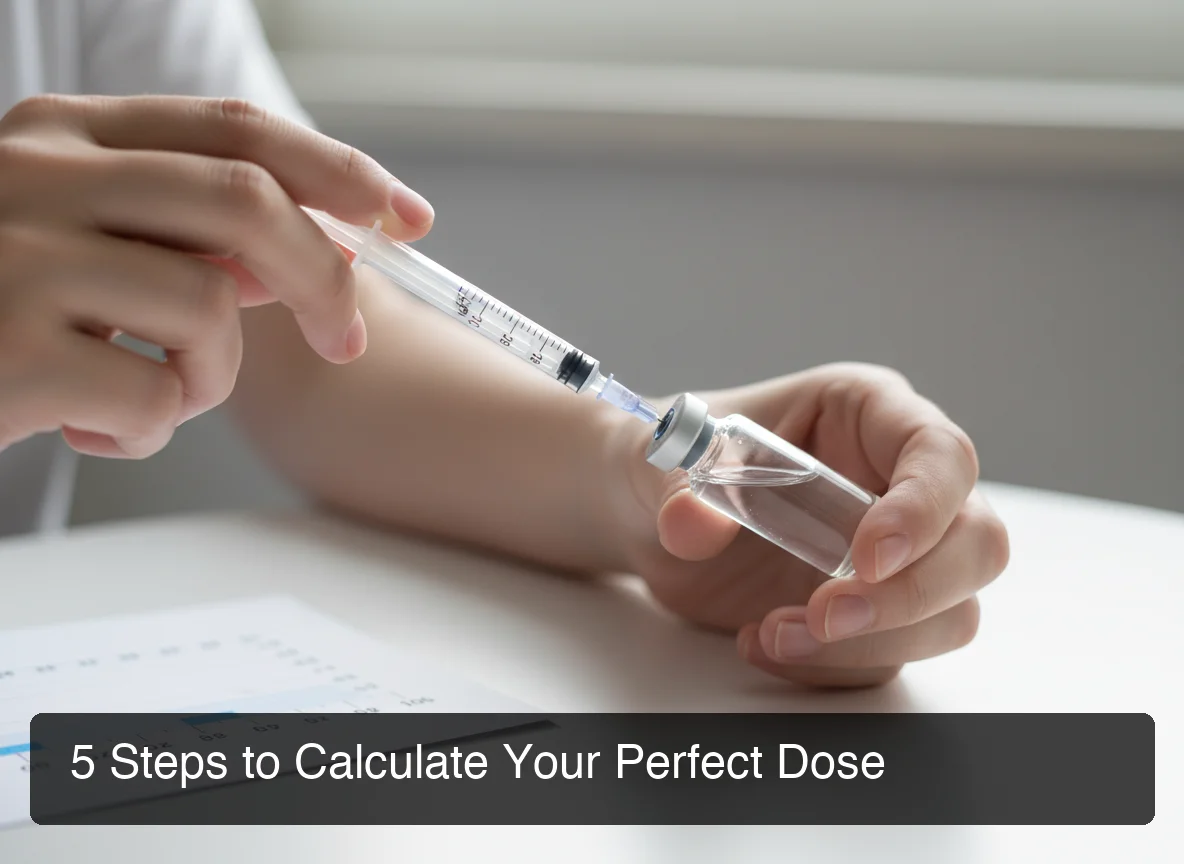 The five-step reconstitution process maps peptide vials to syringe marks with zero guesswork.
Reverse Calculation: Start With Syringe Units
If your syringe of choice is a U-50 (common for smaller doses), you'll need to recalculate:
- 0.10 ml × 50 units/ml = draw to the 5-unit mark
The same 250 mcg dose. Different syringe. Different mark. A calculator that doesn't account for syringe type gives you the wrong answer half the time.
How to Use a Peptide Dosing Calculator: The PeptideIQ Method?
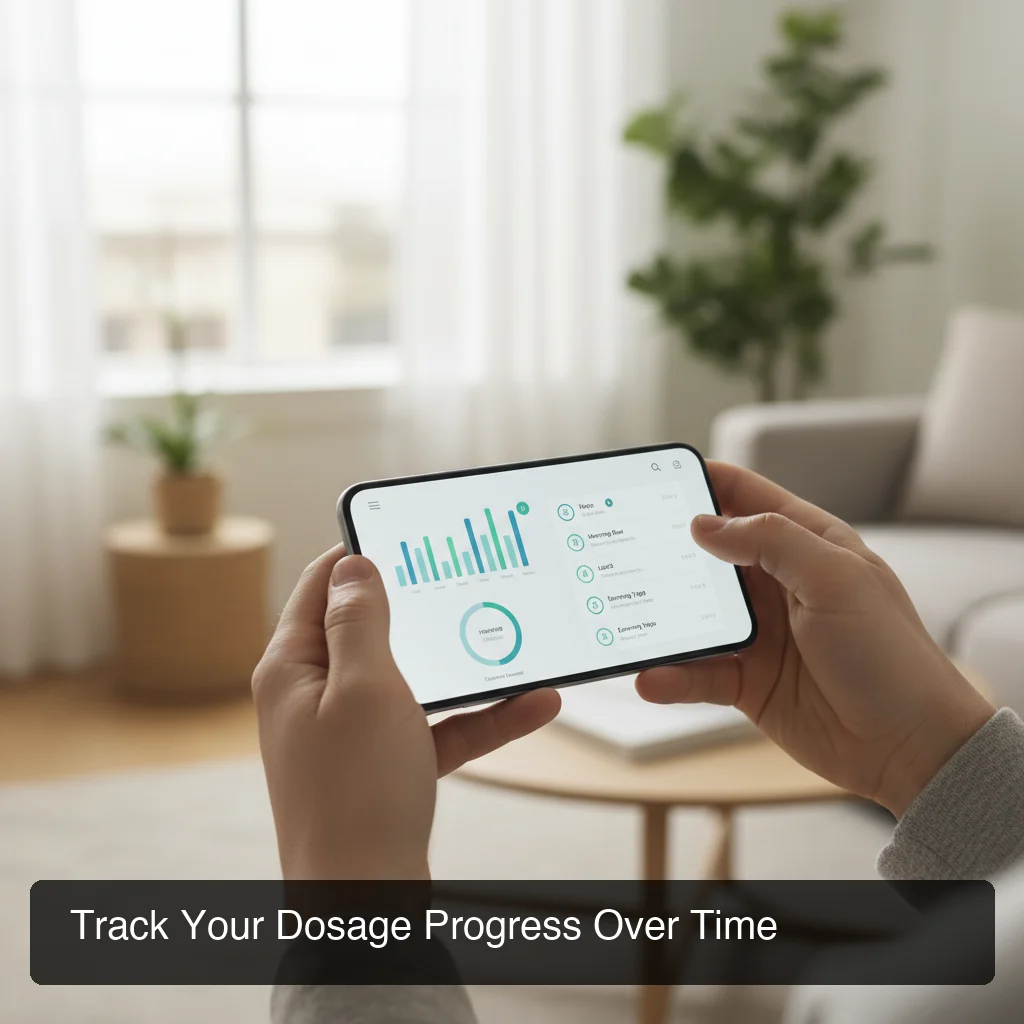 PeptideIQ's built-in reconstitution calculator and dosing tracker turn one-time math into a full protocol management system.
PeptideIQ's built-in reconstitution calculator handles all five reconstitution steps automatically. Enter your vial size, BAC water volume, target dose, and syringe type — the app outputs the exact unit mark to draw to, plus a visual syringe illustration with the line marked at the correct position.
But the calculator is only one part of the system. Where PeptideIQ differs from standalone tools is what happens after the calculation.
From One-Time Calculation to Protocol Companion
Every dose logged in PeptideIQ is tied to your active protocol. The app tracks vial inventory, protocol timeline (Day 14 of 56), full dose history, and wellness check-ins — energy, mood, sleep, and goal metrics — tied to each injection.
This is the difference between a dosing calculator and a dosing system. You calculate once per vial. You track for the entire protocol.
The AI co-pilot adds another dimension: if you log fatigue consistently during week 3, PeptideIQ's AI — which already knows your protocol, cycle day, and wellness history — can tell you whether that's expected for your peptide at this phase.
Bottom line: A standalone calculator tells you what to draw. PeptideIQ tells you what to draw, confirms your vial concentration, tracks every dose against your protocol, and flags patterns your manual log would never catch.
Can You Adjust Your Peptide Dosage Mid-Protocol and Stay Safe?
Yes — mid-protocol dose adjustments are common, especially with GLP-1s (semaglutide, tirzepatide) that follow a defined titration schedule. The rule is: only adjust with a logged baseline. Without dose history, you cannot tell whether a change helped, hurt, or did nothing.
Three scenarios warrant dose adjustments:
- GLP-1 titration: Standard practice. Week 1–4 at 0.25 mg semaglutide, escalate to 0.5 mg at week 5 if tolerated.
- Tolerance plateau: A 10–15% dose reduction followed by 2 weeks off can restore sensitivity.
- Side effect response: Persistent nausea or injection-site reactions may indicate your dose is above your optimal threshold.
Adjusting without a log is adjusting blindly. You need to know what dose you were on, how long you held it, and what your wellness metrics looked like — that baseline is what makes the post-adjustment comparison meaningful. For quick reference on common dosing ranges, a peptide dosage cheat sheet organized by peptide type provides a useful protocol anchor.
What's the Difference Between Dosing Calculator Tools and Manual Calculation?
A standalone peptide dosing calculator gives you a one-time answer. Manual calculation requires you to run the math yourself, introducing human error at every step. An integrated protocol tool combines the calculation with ongoing tracking — giving you accuracy on Day 1 and pattern data through Day 56.
Calculator Tool Comparison
| Method | Calculation Accuracy | Syringe Type Support | Protocol Tracking | Dose History | Mid-Cycle Adjustments |
|---|---|---|---|---|---|
| Manual calculation | Error-prone | Manual | None | None | No support |
| Standalone web calculator | High | Varies | None | None | No support |
| Standalone app (PepCalc) | High | Yes | None | None | No support |
| PeptideIQ | High | Yes (U-100/50/30) | Full cycle management | Per-injection log | Tracked and notified |
The key distinction is persistence. A web calculator forgets your inputs the moment you close the tab. A protocol-integrated system remembers every vial, dose, and cycle day — and uses that data to give increasingly useful feedback over time.
Get Started with PeptideIQ
Peptide dosing precision requires two things: an accurate calculation on day one, and a log good enough to support smart decisions throughout the protocol. PeptideIQ's reconstitution calculator handles the first; its protocol hub handles the second.
Download PeptideIQ on the App Store
Not ready yet? Explore the peptide guide for beginners to understand how dosing fits into your first full protocol setup.
Frequently Asked Questions
What is a peptide dosing calculator used for?
A peptide dosing calculator converts your target dose, vial peptide amount, bacteriostatic water volume, and syringe type into a precise syringe unit measurement. It eliminates manual unit conversion errors — the most common cause of under-dosing or over-dosing. Most calculators handle reconstitution math and syringe unit output simultaneously.
How do you calculate peptide dose from body weight?
Multiply your target dose in mcg/kg by your body weight in kilograms. For example, a 0.25 mg/kg semaglutide dose for an 80 kg person equals 20 mg. Most peptides use flat-dose protocols rather than weight-based dosing — always verify which method applies to your specific peptide before calculating.
How much bacteriostatic water should I add to a peptide vial?
The most common reconstitution is 2ml BAC water per 5mg vial — yielding 2,500 mcg/ml. Smaller volumes increase concentration; larger volumes decrease it. Either approach works, but changing your reconstitution volume requires recalculating your syringe units to match.
What syringe should I use for peptide injections?
U-100 insulin syringes (1ml, 100 units) are standard for most doses above 100 mcg. U-50 and U-30 syringes offer finer precision for smaller doses. The syringe type changes the unit mark for any given volume — a dosing calculator must account for your specific syringe to give a correct answer.
Can I adjust my peptide dose mid-protocol?
Yes, but only with a logged dose history as your baseline. GLP-1 protocols follow defined titration schedules. For other peptides, keep adjustments incremental (10–15%) and always log the change — without a baseline, there's no meaningful way to evaluate the effect.
What's the difference between mcg and mg in peptide dosing?
Micrograms (mcg) and milligrams (mg) differ by 1,000 — 1 mg = 1,000 mcg. Most research peptides dose in mcg (e.g., 250 mcg BPC-157); GLP-1s like semaglutide dose in mg (e.g., 0.25 mg). Confusing these two units is among the most dangerous calculation errors in peptide use.