
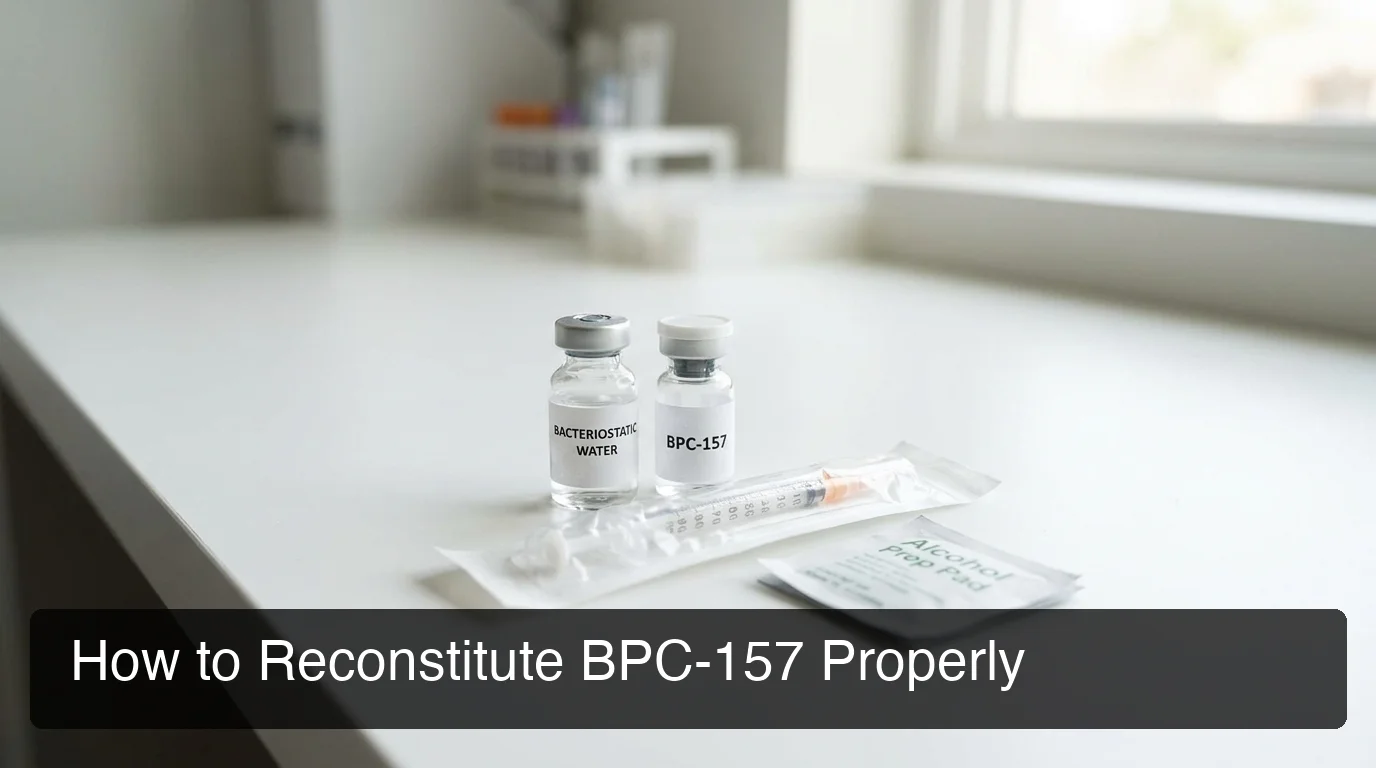
How to Reconstitute BPC-157 | PeptideIQ
How to Reconstitute BPC-157: Step-by-Step Guide
BPC-157 arrives as freeze-dried powder — you cannot inject it directly. Knowing how to reconstitute BPC-157 correctly is the difference between a stable, effective solution and a degraded vial you'll discard in a week.
Key Takeaways
- BPC-157 reconstitution requires precise ratios of bacteriostatic water to powder; most users follow 1–2 mL water per 5 mg peptide for standard mixing.
- Proper reconstitution preserves peptide stability — contamination, incorrect temperature, or wrong solvents can degrade potency within days.
- Most reconstituted BPC-157 stays viable for 2–4 weeks refrigerated; labeled vials with reconstitution dates prevent dosing errors and waste.
- Using an insulin syringe and maintaining sterile technique reduces injection site reactions and ensures consistent dosing across cycles.
- PeptideIQ tracking logs reconstitution dates, dosages, and batch info automatically — eliminating guesswork and enabling protocol optimization.
Contents
- What Is BPC-157 Reconstitution and Why Does It Matter?
- How to Reconstitute BPC-157: What Supplies Do You Need?
- How to Reconstitute BPC-157 Step-by-Step?
- What Is the Correct Reconstitution Ratio for BPC-157?
- How Long Does Reconstituted BPC-157 Stay Potent in the Fridge?
- What Are the Most Common BPC-157 Reconstitution Mistakes?
- How Do You Calculate Your First BPC-157 Dose After Reconstitution?
- Get Started with PeptideIQ
- Frequently Asked Questions
What Is BPC-157 Reconstitution and Why Does It Matter?
BPC-157 reconstitution is the process of dissolving freeze-dried peptide powder in bacteriostatic water to create an injectable solution. Without it, the peptide cannot be administered. Done incorrectly — wrong solvent, contaminated supplies, or poor ratio — the solution can degrade within hours and the vial is wasted.
Peptide powders are lyophilized (freeze-dried) to extend shelf life. In dry form, BPC-157 remains stable for months stored properly. Once mixed with liquid, the clock starts — stability now depends on solvent quality, refrigeration, and sterile handling at every draw.
This is where most first-time users fail — not because the process is complex, but because the instructions that come with a vial are almost always minimal or absent. If you're new to peptides, our peptide guide for beginners covers the full protocol lifecycle first.
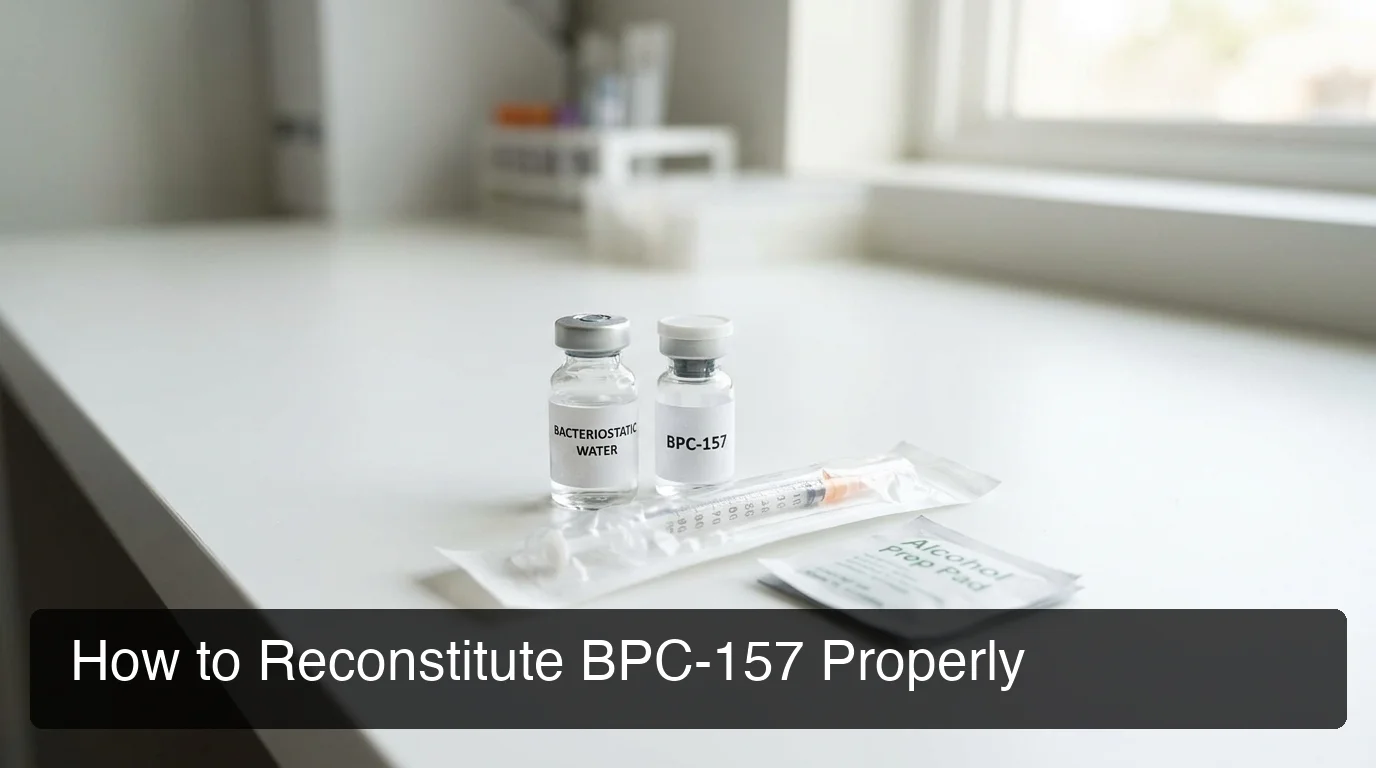 All reconstitution supplies laid out before starting — preparation is half the protocol.
How to Reconstitute BPC-157: What Supplies Do You Need?
To reconstitute BPC-157 safely, you need bacteriostatic water (not sterile water or tap water), U-100 insulin syringes, alcohol swabs, and your BPC-157 powder vial. Bacteriostatic water is non-negotiable — its 0.9% benzyl alcohol preservative prevents bacterial growth across 28–30 days of multi-dose use.
Missing or substituting any item on this list introduces contamination risk or produces an incorrect concentration.
Why Bacteriostatic Water Is Non-Negotiable
Sterile water for injection is the most common substitute users reach for — it is not the same thing. Sterile water has no antimicrobial preservative, meaning any microorganism introduced during a draw will multiply. Bacteriostatic water for BPC-157 is specifically designed for multi-dose vials, and the benzyl alcohol is what keeps each subsequent draw safe.
Key insight: Never use tap water, saline, or plain sterile water to reconstitute BPC-157. The preservative in bacteriostatic water is what makes a 28-day window viable — without it, you're looking at 1–3 days before discarding.
Your complete supply checklist:
- Bacteriostatic water (BAC water) — 10 mL vials from a reputable source
- Insulin syringes — U-100, 29–31 gauge, 1/2 inch needle
- Alcohol swabs — 70% isopropyl alcohol
- BPC-157 vial — labeled with mg amount (typically 5 mg or 10 mg)
- Clean surface — or a sterile prep pad
- Permanent marker — to label the vial immediately after reconstitution
Bacteriostatic water is the foundation of safe reconstitution for all peptide mixing — not just BPC-157.
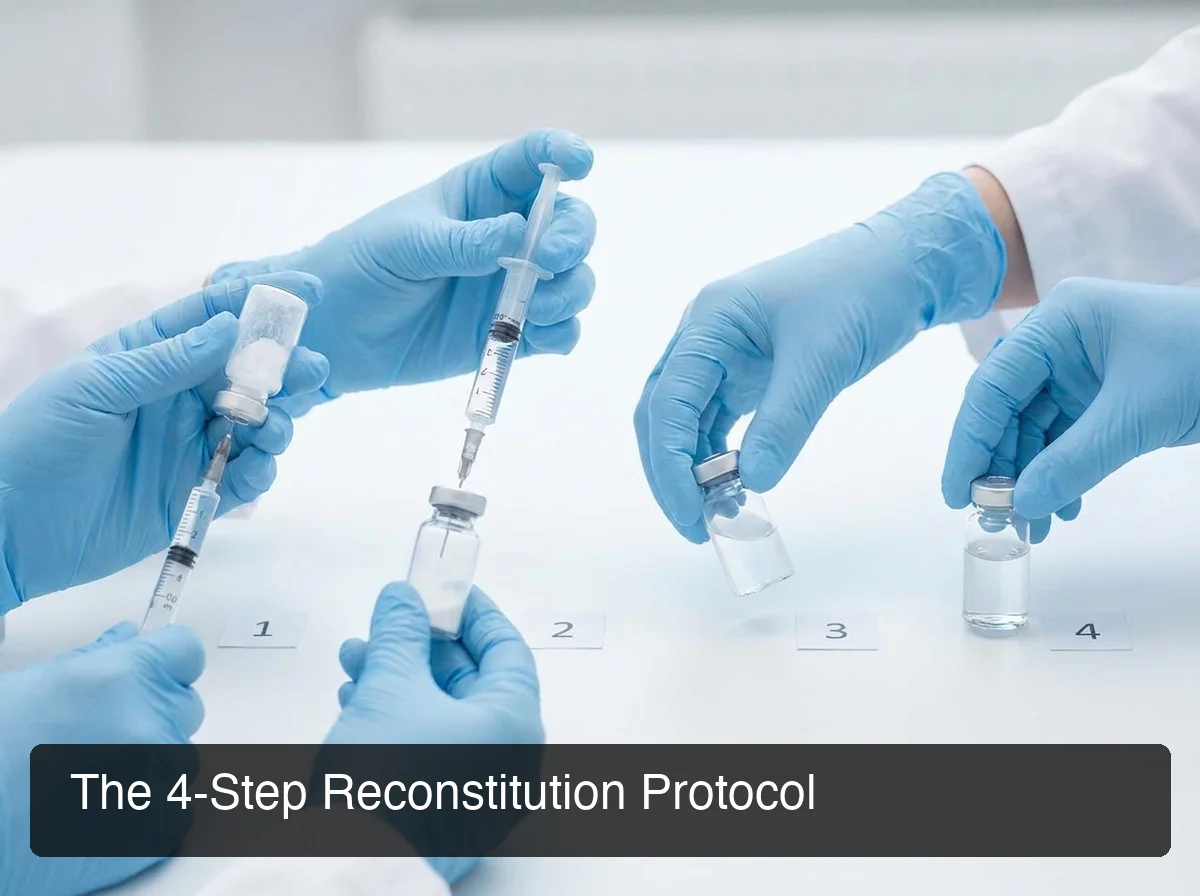 Sterile technique at each stage — from swabbing the stopper to the final label — separates a stable solution from a contaminated one.
How to Reconstitute BPC-157 Step-by-Step?
Reconstituting BPC-157 takes under five minutes with supplies ready. The critical rules: swab every rubber stopper before piercing, inject the water slowly down the vial wall rather than onto the powder, and never shake — only swirl gently. The powder should fully dissolve into a clear, colorless solution.
Follow these four steps precisely.
Step 1 — Sanitize Your Workspace and Supplies
Wipe your work surface with an alcohol swab. Then swab the rubber stopper of both the bacteriostatic water vial and the BPC-157 vial. Let the alcohol dry for 10 seconds before piercing — wet alcohol can carry contaminants into the solution.
Step 2 — Draw Your Bacteriostatic Water
Using a fresh insulin syringe, draw the volume of bacteriostatic water your chosen ratio requires (see the ratio section below). Pull the plunger back to your target volume, check for air bubbles, tap the syringe, and push any bubbles out before proceeding.
Step 3 — Inject Water Slowly Down the Vial Wall
Insert the needle into the BPC-157 vial at a slight angle, aiming the tip at the inner glass wall rather than at the powder. Push the plunger slowly — let the water run down the side of the vial. This minimizes foaming and reduces mechanical stress on the peptide structure.
Injecting directly onto the powder creates turbulence that can damage fragile peptide bonds — the wall-injection method is the standard across all peptide protocols.
Step 4 — Swirl Gently and Label Immediately
Remove the needle and gently roll the vial between your palms. Swirl in slow circles — the powder should dissolve within 30–60 seconds into a fully clear solution. If it hasn't dissolved after two minutes, refrigerate for 10 minutes and try again.
Label the vial immediately with the reconstitution date and the calculated concentration (e.g., "5 mg / 2 mL = 2,500 mcg/mL — reconstituted 2026-05-12"). This step gets skipped constantly and causes dosing errors weeks later.
What Is the Correct Reconstitution Ratio for BPC-157?
The standard BPC-157 reconstitution ratio is 1–2 mL of bacteriostatic water per 5 mg of peptide. More water produces a more dilute solution — requiring a larger syringe draw per dose, but reducing injection discomfort. Most users prefer 2 mL per 5 mg for clean, readable syringe units.
The right ratio depends on your vial size and target dose. This table covers the most common configurations:
| Vial Size | BAC Water Added | Concentration | 250 mcg Dose = Draw To |
|---|---|---|---|
| 5 mg | 1 mL | 5,000 mcg/mL | 5 units on U-100 |
| 5 mg | 2 mL | 2,500 mcg/mL | 10 units on U-100 |
| 5 mg | 5 mL | 1,000 mcg/mL | 25 units on U-100 |
| 10 mg | 2 mL | 5,000 mcg/mL | 5 units on U-100 |
| 10 mg | 4 mL | 2,500 mcg/mL | 10 units on U-100 |
By the numbers: The 2 mL / 5 mg ratio is the most forgiving — a 10-unit draw for 250 mcg leaves less room for syringe misreads than a 5-unit draw at the same dose.
For dosing math beyond this table, a peptide dosing calculator removes all arithmetic. Enter your vial size, water volume, and target dose to get your exact draw amount instantly.
How Long Does Reconstituted BPC-157 Stay Potent in the Fridge?
Reconstituted BPC-157 shelf life is approximately 28–30 days when stored at 2–8°C using bacteriostatic water. Potency degrades progressively after that point — peptide bonds break down and efficacy drops even when the solution still appears clear. Always label vials with the reconstitution date and discard at 30 days.
Temperature consistency matters more than most users account for. Store vials on a middle or back fridge shelf — not near the door where temperature fluctuates with every opening.
What Cuts Into the 28-Day Window?
- Contamination during draws — swab the stopper before every draw, not just the first
- Temperature spikes — brief room temperature exposure during draws accumulates across 20+ doses
- Wrong solvent — plain sterile water degrades within 1–3 days regardless of refrigeration
- Freeze-thaw cycling — freezing reconstituted peptide is not recommended and can denature the structure
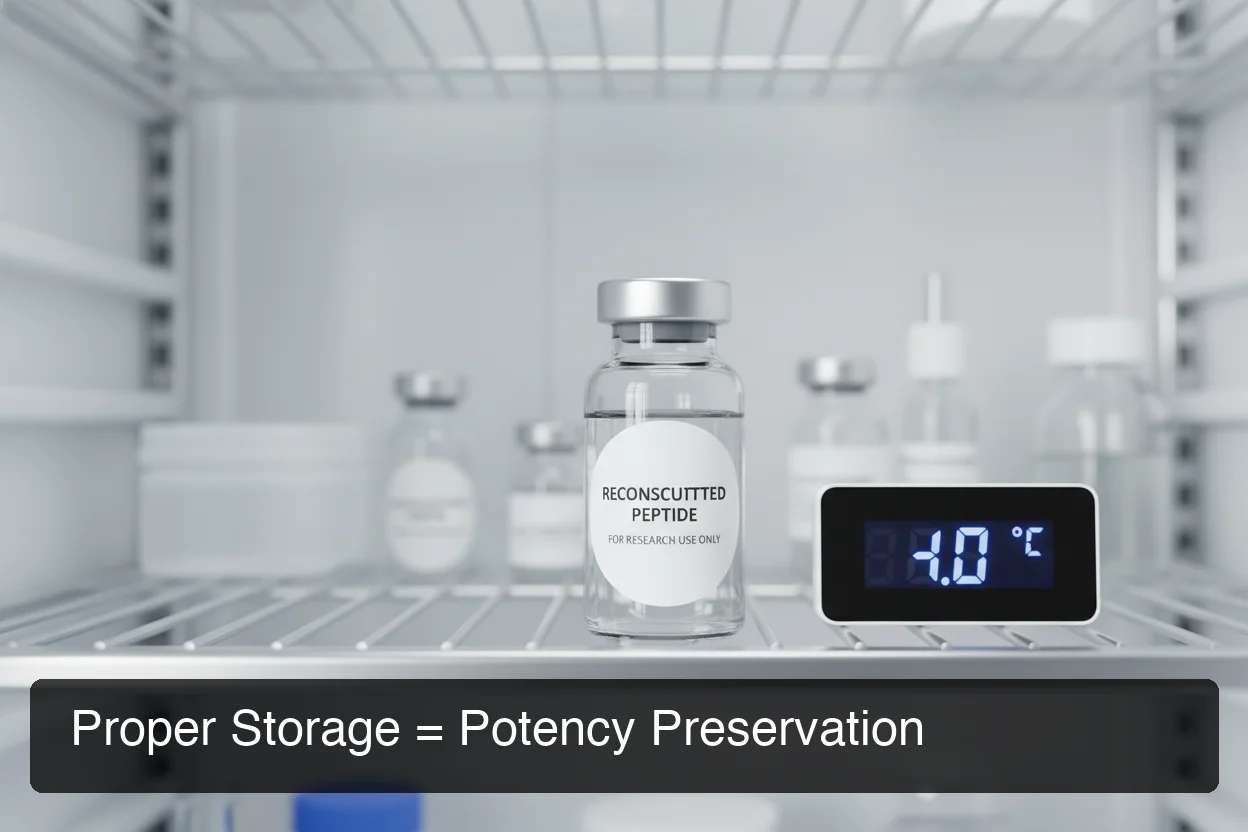 Label every reconstituted vial with date and concentration — a 30-second habit that prevents costly dosing errors.
At 250 mcg twice daily, a 5 mg vial reconstituted in 2 mL gives 20 doses — roughly 10 days at that frequency, well within the stability window. Understanding how long BPC-157 takes to work helps you plan your cycle length relative to vial capacity.
What Are the Most Common BPC-157 Reconstitution Mistakes?
The most common BPC-157 reconstitution mistakes are using the wrong solvent, shaking instead of swirling, skipping stopper sanitization, and failing to label the vial. Each mistake either compromises potency directly or creates dosing errors that compound across the full cycle.
Reconstitution Errors and How to Fix Them
- Using sterile water, saline, or tap water — Only bacteriostatic water provides the multi-dose shelf life BPC-157 requires. The most common and most expensive mistake.
- Shaking the vial — Vigorous agitation creates foam and mechanical stress that fragments peptide bonds. Always swirl gently.
- Not swabbing the stopper — The rubber stopper is not sterile from the factory. Alcohol-wipe every puncture point every time.
- Skipping the label — An unlabeled vial in the fridge is a dosing error waiting to happen. Date plus concentration, every time.
- Injecting water directly onto the powder — Aim at the glass wall, not the powder, to minimize turbulence and preserve peptide integrity.
- Leaving the vial at room temperature between draws — Return to the fridge within 10 minutes of drawing your dose. Routine temperature exposure adds up quickly.
Key insight: If your reconstituted solution is cloudy, has visible particles, or has a yellow tint — discard it. A degraded or contaminated vial is not worth injecting.
For users who want to avoid reconstitution entirely, note that oral BPC-157 skips this process — but at a bioavailability tradeoff. Our BPC-157 oral peptide guide covers the full administration comparison so you can make an informed choice.
How Do You Calculate Your First BPC-157 Dose After Reconstitution?
 PeptideIQ's reconstitution calculator shows the exact syringe mark to draw to — no arithmetic needed.
After reconstitution, calculating BPC-157 dosage requires knowing your vial concentration and converting your target mcg dose into syringe units. The formula: (Target Dose in mcg ÷ Concentration in mcg/mL) × 100 = Units to draw on a U-100 syringe. Most beginners start at 250 mcg per dose, once or twice daily.
This is where most users get stuck — not in the mixing, but in reading the syringe correctly.
How to Read Your Insulin Syringe
A U-100 insulin syringe holds exactly 1 mL = 100 units. Each small graduation mark = 1 unit = 0.01 mL.
Worked example: You reconstituted 5 mg BPC-157 in 2 mL BAC water.
- Concentration: 2,500 mcg/mL
- Target dose: 250 mcg
- Calculation: (250 ÷ 2,500) × 100 = 10 units
Draw to the "10" mark on your U-100 syringe. For a 500 mcg dose at the same concentration, draw to the "20" mark. The math scales linearly — the peptide dosing calculator handles any combination automatically.
Bottom line: Once reconstituted, the math is the only remaining step most users struggle with. PeptideIQ's built-in reconstitution calculator takes your vial size, water volume, and target dose — and outputs a visual syringe with the exact fill line marked. No manual calculation required.
When your first dose is logged, the next question is always timing. Knowing how long BPC-157 takes to work — and tracking your response week by week — is the difference between guessing and actually knowing if the protocol is delivering results.
Get Started with PeptideIQ
Reconstitution is the technical foundation — but the ongoing work of tracking doses, monitoring vial expiry, calculating exact draw amounts, and measuring whether the protocol is actually working is where most users fall off.
PeptideIQ handles all of it: a built-in reconstitution calculator, dose logging with visual syringe guidance, automatic vial expiry alerts, and an AI co-pilot that knows your specific cycle from Day 1.
Download PeptideIQ on the App Store and start tracking your protocol today.
Not ready yet? Start with our peptide guide for beginners — it covers the full protocol setup from zero.
Frequently Asked Questions
What is the best water for reconstituting BPC-157?
Bacteriostatic water (BAC water) is the only recommended solvent for BPC-157 reconstitution. It contains 0.9% benzyl alcohol, which prevents bacterial growth in multi-dose vials over 28–30 days. Sterile water, normal saline, and tap water are not suitable substitutes and will substantially shorten the solution's usable life.
How much bacteriostatic water do I add to a 5 mg BPC-157 vial?
Most users add 2 mL of bacteriostatic water to a 5 mg BPC-157 vial. This creates a 2,500 mcg/mL concentration — a 250 mcg dose draws to exactly 10 units on a U-100 insulin syringe, which is easy to read accurately. Adding 1 mL doubles the concentration and halves the draw volume.
Can I shake the BPC-157 vial to help it dissolve faster?
No. Shaking creates foam and mechanical stress that can damage peptide bonds and reduce potency. Instead, gently roll the vial between your palms and swirl in slow circles. The powder dissolves fully in 30–60 seconds without agitation. If it hasn't dissolved in two minutes, refrigerate briefly and try again.
How long does reconstituted BPC-157 last in the fridge?
Reconstituted BPC-157 stored at 2–8°C using bacteriostatic water is stable for approximately 28–30 days. Always label vials with the reconstitution date. Discard any solution that becomes cloudy, changes color, or shows visible particles — these signal degradation or contamination regardless of how many days have passed.
Do I need to reconstitute BPC-157 if I take it orally?
No. Oral BPC-157 — in capsule or dissolved form — does not require injection reconstitution. However, subcutaneous injection typically delivers more consistent systemic exposure. Our BPC-157 oral peptide guide covers the bioavailability tradeoffs and protocol differences between routes so you can choose based on your situation.
What syringe size is best for BPC-157 injections?
A U-100 insulin syringe with a 29–31 gauge, 1/2 inch needle is the standard for subcutaneous BPC-157 injections. The fine gauge minimizes injection site soreness. For abdominal subcutaneous injection — the most common site — the 1/2 inch length provides adequate depth without going intramuscular.