
Peptide BPC-157 and TB-500: Stack Dosing & Timing
Peptide BPC 157 and TB500: How the Stack Works and How to Run It
You have two vials, two schedules, and a forum thread telling you the pair is a "Wolverine stack." What nobody explains is how a peptide bpc 157 and tb500 stack is actually supposed to be timed, dosed, and judged.
This article is general education, not medical advice. Neither peptide is FDA-approved, and a clinician should review anything you inject.
Key Takeaways
- BPC-157 and TB-500 are studied for different aspects of tissue repair: BPC-157 mostly for local healing, TB-500 (a synthetic version of thymosin beta-4) for cell migration and systemic repair. The idea of stacking them rests on that split, not on human trials of the pair.
- Commonly reported schedules put BPC-157 on a daily or twice-daily rhythm (roughly 100–500 mcg per day) and TB-500 on 2–3 injections a week (roughly 2–6 mg weekly in total). Sources disagree, so these are reported ranges, not prescriptions.
- Most users report early changes around weeks 2–4 and the clearest benefit around weeks 4–8, depending on the injury. That is anecdote, not trial data.
- Evidence is mostly animal studies. Human safety data on the combination is essentially absent, and product quality in the gray market is a real risk.
- Two schedules with different rhythms are easy to get wrong. Logging every dose, symptom, and pain score is the only way to tell whether the stack is working.
Contents
- What Are BPC-157 and TB-500, and Why Stack Them?
- How Do Peptide BPC 157 and TB500 Work Together in the Body?
- What's the Ideal Peptide BPC 157 and TB500 Stack Dosage?
- When Should You Inject BPC-157 vs TB-500 in a Stack?
- How Long Does It Take to See Results From a BPC-157 TB-500 Stack?
- Is It Safe to Combine BPC-157 and TB-500?
- What Side Effects Should You Expect When Stacking BPC-157 and TB-500?
- How to Track Your BPC-157 TB-500 Stack Progress
- Get Started with PeptideIQ
- Frequently Asked Questions
What Are BPC-157 and TB-500, and Why Stack Them?
BPC-157 is a 15-amino-acid peptide studied in animals for tendon, ligament, muscle, and gut healing. TB-500 is a synthetic version of thymosin beta-4, a protein involved in cell migration and blood vessel growth. People stack them hoping local repair and whole-body repair reinforce each other.
Both compounds sit in the "gray" zone. They are sold as research chemicals, neither has FDA approval, and the human evidence is thin. In PeptideIQ's library, the honest label for this category is closer to "strong animal evidence" or "anecdotal only" than to "proven."
The reason people pair them is practical. BPC-157 is usually injected near an injury, while TB-500 is injected anywhere in the subcutaneous tissue and is thought to act systemically. If you want the full science behind that logic, the BPC-157 and TB-500 peptide stack guide goes deeper on mechanisms and expected outcomes.
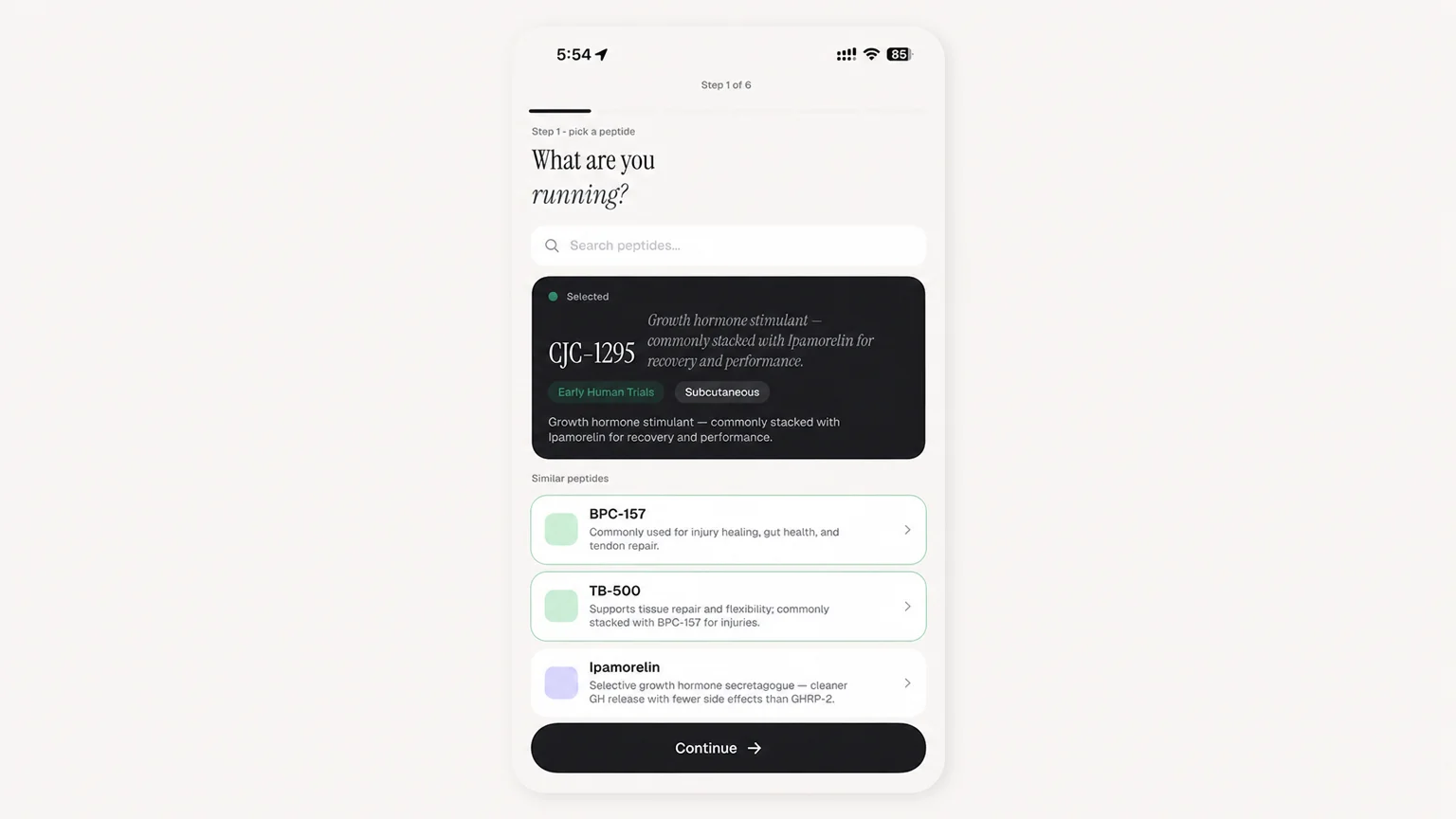 PeptideIQ's protocol builder lists both BPC-157 and TB-500, each with a one-line description, when you start a new protocol.
How Do Peptide BPC 157 and TB500 Work Together in the Body?
The proposed synergy is complementary action. BPC-157 is linked in rodent studies to angiogenesis, collagen organization, and growth-factor signaling at the injury site. TB-500 is linked to actin regulation, which helps cells move to damaged tissue. Neither claim has been tested as a pair in controlled human trials.
Think of a torn tendon as a construction site: BPC-157 is the on-site crew, TB-500 the dispatch system getting repair cells to the address.
That is a model, not a result. Anecdotal reports describe the combination feeling faster than either alone, but those reports come from people who also rested, rehabbed, and often changed several variables at once.
Reality check: "Synergy" is a hypothesis built from separate animal studies. If anyone quotes you a percentage speed-up for the pair, ask for the paper.
Two details explain the different schedules. BPC-157 is cleared quickly in animal data, so it gets frequent dosing, while TB-500 persists longer and gets fewer injections.
What's the Ideal Peptide BPC 157 and TB500 Stack Dosage?
There is no validated ideal dose. Commonly reported BPC-157 ranges are about 100–500 mcg per day, often split into one or two injections. TB-500 is commonly reported at about 2–6 mg per week, split across two or three injections. Treat these as ranges users cite, then confirm with a clinician.
Dosing guidance online varies by a factor of five or more, which is exactly why guessing is risky. Different sources also use different vial sizes and different water volumes, so the same "dose" can mean very different syringe draws.
| Parameter | BPC-157 | TB-500 |
|---|---|---|
| Commonly reported dose | ~100–500 mcg per day | ~2–6 mg per week total |
| Typical frequency | Daily, sometimes split twice | 2–3 times per week |
| Injection location | Often near the injury (subcutaneous) | Subcutaneous, rotated across sites |
| Dose units | mcg | mg (a thousand times larger) |
| Reported cycle length | ~4–8 weeks | ~4–8 weeks, often with a lower maintenance phase |
| Evidence level | Strong animal evidence | Strong animal evidence, limited human data |
The mcg versus mg mismatch trips up beginners. A TB-500 dose is measured in milligrams, a BPC-157 dose in micrograms, and mixing those up produces a thousandfold error.
Before you draw anything, your reconstitution math has to be right. Our walkthrough on how to reconstitute BPC-157 shows the steps, and the same logic applies to the TB-500 vial.
Common mistake: Using the same water volume for both vials "to keep it simple" and then copying a draw volume from someone else's post. Concentration, not volume, determines your dose.
For single-peptide specifics on the TB-500 side, the TB-500 protocol breakdown covers cycle length and recovery data in more detail.
When Should You Inject BPC-157 vs TB-500 in a Stack?
BPC-157 is typically injected on a fixed daily schedule, often morning, or morning and evening if split. TB-500 follows a calendar pattern, such as Monday, Wednesday, and Friday. Many users inject both in the same session on TB-500 days, but nothing proves that same-day timing beats separate timing.
The practical point is that the two schedules have different rhythms. One is a daily habit, the other is a thrice-weekly appointment. People usually forget the second one first.
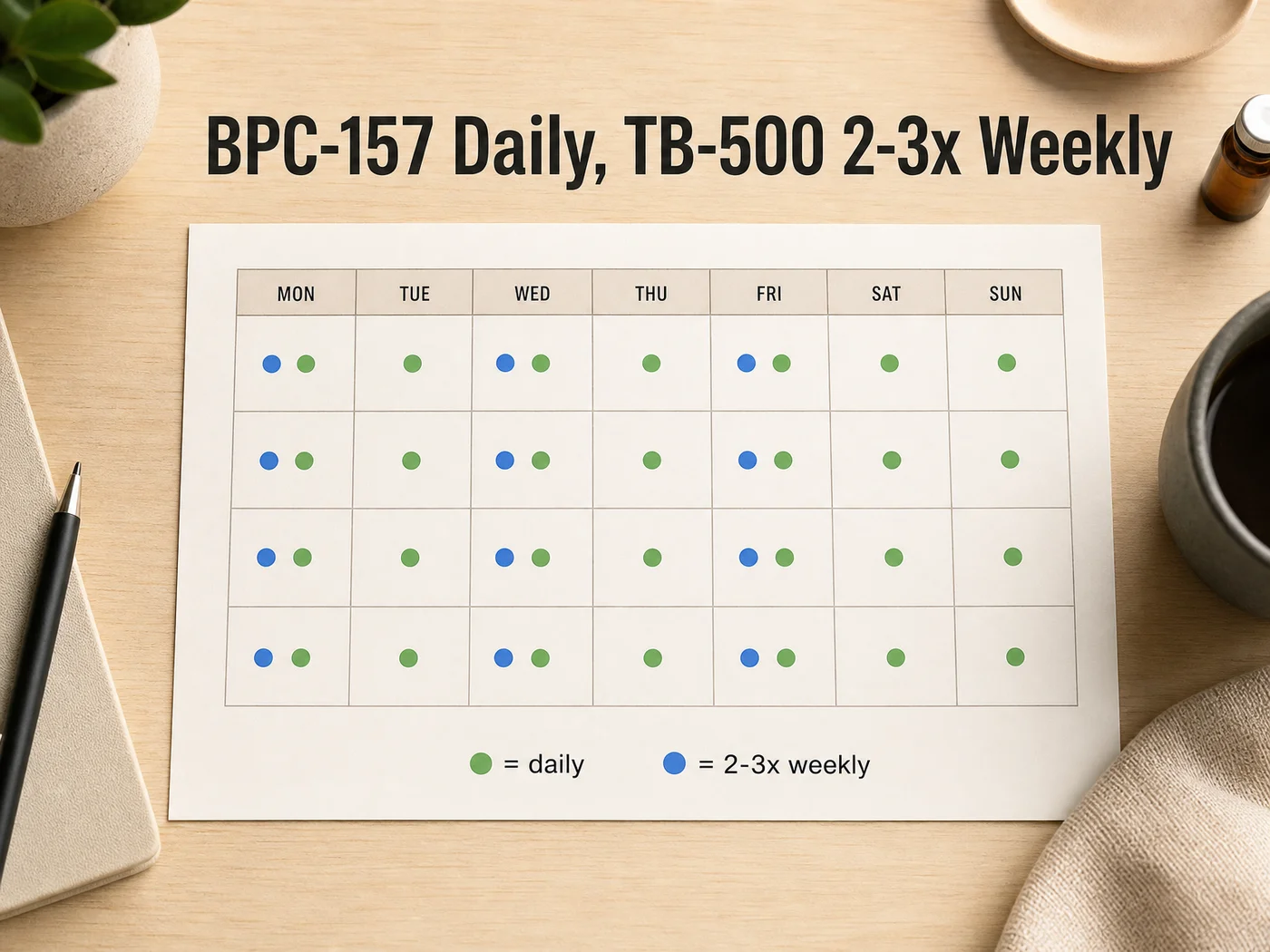 A 4-week view makes the different rhythms visible: BPC-157 every day, TB-500 on a few set days.
Some habits that make the schedule hold up:
- Anchor BPC-157 to something you already do daily, like brushing your teeth.
- Pick fixed TB-500 days and put them in a calendar, not in your head.
- Rotate injection sites rather than reusing the same patch of skin.
On days both are due, keep two separate syringes and label them. Mixing the two peptides in one syringe is something you should only do on a pharmacist's or prescriber's instruction.
How Long Does It Take to See Results From a BPC-157 TB-500 Stack?
Users commonly report early changes, such as less morning stiffness, within 2–4 weeks, with the clearest benefit between weeks 4 and 8. Severity matters: a minor tendon irritation may respond sooner than a chronic injury. These timelines are anecdotal and no controlled human study confirms them.
A realistic timeline looks like this:
- Weeks 1–2: Mostly adaptation. Don't expect much, and don't change doses because of a quiet first fortnight.
- Weeks 3–4: Early signals such as reduced pain at rest, easier movement, or better sleep.
- Weeks 5–8: The window where most reported benefit appears, with more load tolerance.
- After week 8: Time to evaluate honestly whether to stop, rest, or discuss next steps with a clinician.
The trouble is that pain is noisy. Only a logged trend across weeks separates a real result from a good day.
Worth knowing: Recovery from an injury happens without any peptide at all. A pain-score trend that was already improving before you started tells you very little about the stack.
Our look at how long BPC-157 takes to work covers the single-peptide timeline if you want a comparison point.
Related: What Peptide Does Joe Rogan Use? What the Record Shows
Is It Safe to Combine BPC-157 and TB-500?
Nobody can say it is proven safe. Animal studies show few toxic effects for each peptide on its own, but there are no large human trials of either, and none of the combination. The larger practical risks are contaminated or mislabeled gray-market product, dosing errors, and unsterile technique.
FDA testing has found that a substantial share of online peptide products contained wrong dosages or undeclared ingredients. That risk applies to both vials, and it doubles in a stack because you are trusting two suppliers or two batches.
Pregnant or nursing people, anyone with a current or past cancer diagnosis (both compounds are linked to angiogenesis and cell growth in the research), and people on blood thinners or other prescription drugs should talk to a clinician first.
Heart and kidney questions come up often in community threads. The data is sparse, so anyone with existing conditions should involve a doctor first.
Two practical safety rules are worth stating plainly:
- Change one thing at a time. Add the second peptide only after you know how the first one feels.
- Stop and get medical advice for hives, swelling of the face, chest pain, or a spreading, hot injection site.
What Side Effects Should You Expect When Stacking BPC-157 and TB-500?
The most commonly reported effects are mild: injection-site redness, soreness, or bruising, plus occasional fatigue, headache, dizziness, or nausea. Reports are anecdotal, and with two compounds started together, you often can't tell which one caused a symptom.
That last problem is the real cost of stacking. If you start both on the same day and feel flat by day four, you have no clean way to assign the blame.
A few ways to keep symptoms interpretable:
- Log the symptom with severity: mild, moderate, or severe, not just "felt off."
- Note the timing: a headache 30 minutes after an injection reads differently from one that appears at night.
- Stagger if you can: starting BPC-157 first and adding TB-500 after a week or two gives you a cleaner read.
Mild injection-site reactions usually pass. Anything severe, or anything that persists, is a reason to stop and see a professional rather than troubleshoot in a forum.
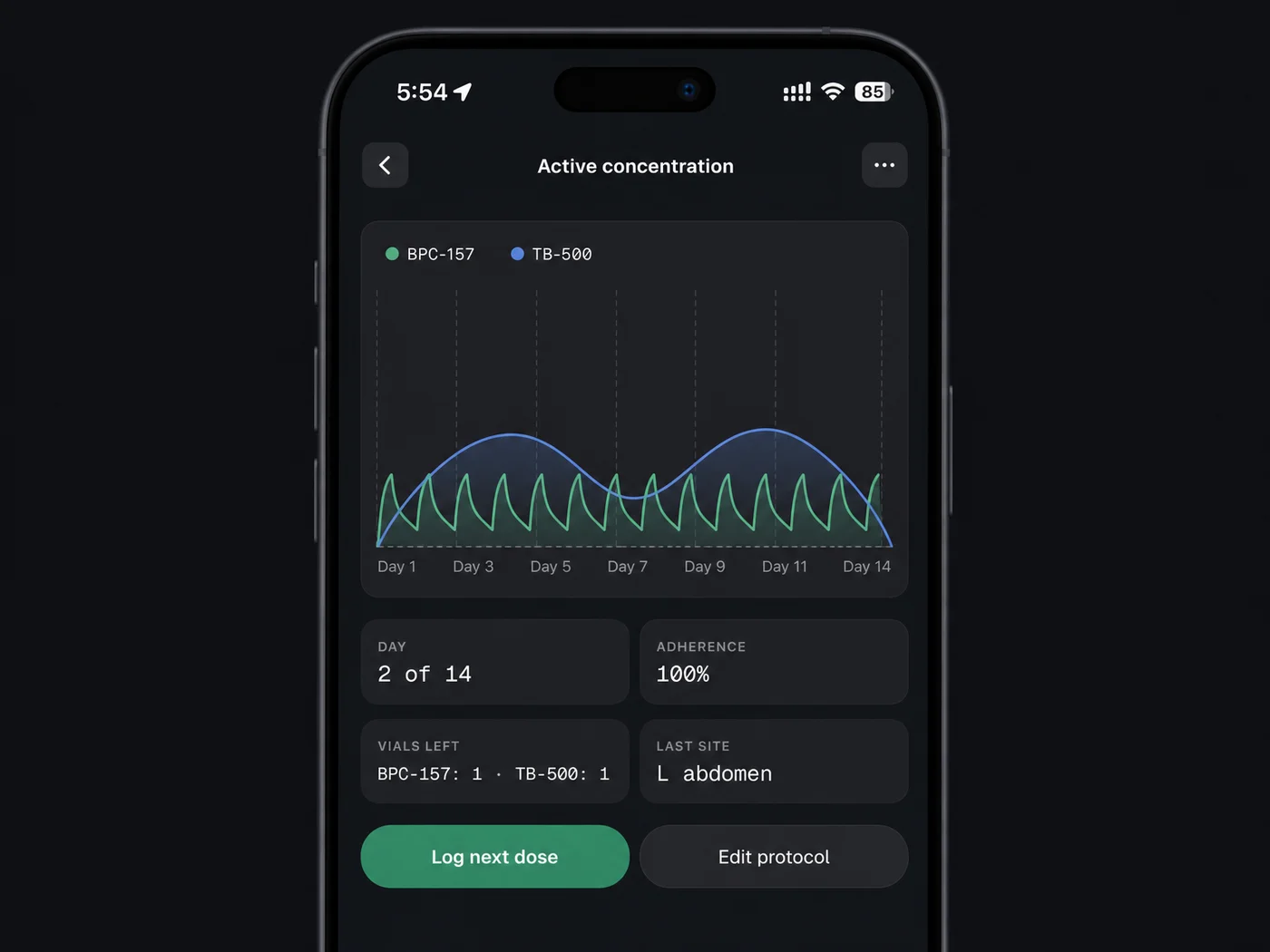 Illustrative mockup: a daily peptide produces frequent small peaks, a twice- or thrice-weekly one produces slower, wider peaks.
How to Track Your BPC-157 TB-500 Stack Progress
Tracking a stack means logging three things for each peptide: every dose and its time, how you feel each day, and any side effects. Then compare your pain or recovery score across weeks. Without that record, "is it working?" is a mood, not a measurement.
This is where most stacks quietly fail. The schedules differ, the vials have different concentrations, and the signal you are looking for, pain trending down over several weeks, moves slowly.
PeptideIQ is built around that problem. For a stack, the Protocol Hub shows one color-coded card per active peptide, with cycle day, next dose, and doses left in the vial. Each logged dose records injection site rotation, four quick wellness sliders (including a goal metric like pain level), and an optional side-effect grid with severity.
Open any active peptide and you see an estimated active-concentration curve, built from the peptide's half-life and your logged doses. That is the idea the mockup above illustrates: a short-half-life peptide dosed daily and a longer-acting one dosed a few times a week produce curves with very different shapes.
Beyond logging, a few features matter for stacks specifically:
- Missed-dose nudge: a prompt inside a 6-hour window asks whether you took it, forgot to log it, or want to skip.
- Wellness correlation view: overlay any two metrics, such as pain score against adherence.
- Inventory manager: per-vial concentration and expiry tracking, so BPC-157 and TB-500 vials don't get confused.
PeptideIQ is an iOS app currently in pre-launch, with a waitlist open. It does not tell you what to take; it keeps the record that lets you and your clinician judge whether the stack is doing anything.
Get Started with PeptideIQ
A BPC-157 and TB-500 stack is two schedules, two concentrations, and weeks of slow feedback. PeptideIQ keeps all of it in one place so you can see what is actually happening.
Frequently Asked Questions
Why are BPC-157 and TB-500 used together?
People pair them because they are studied for different aspects of repair. BPC-157 is associated with local tissue healing, and TB-500 with cell migration and systemic recovery. The combination is popular in the "Wolverine stack" idea, but it has not been tested as a pair in controlled human trials.
How often do you inject BPC-157 and TB-500?
Commonly reported schedules put BPC-157 on a daily or twice-daily rhythm and TB-500 on two to three injections per week. Cycles often run four to eight weeks. These are community-reported patterns, not approved guidance, so confirm any schedule with a qualified clinician first.
Can you take BPC-157 and TB-500 at the same time?
Many users inject both on the same day, using separate syringes. Nothing shows that same-day timing outperforms separate timing. Starting one peptide first and adding the other a week or two later makes side effects easier to attribute.
What are the negative side effects of peptide injections?
Reported effects are usually mild: injection-site redness, bruising, soreness, fatigue, headache, or nausea. Serious reactions such as swelling, hives, or chest pain need prompt medical attention. Contaminated or mislabeled gray-market product is an additional risk that no dosing schedule removes.
What does PeptideIQ do for a peptide stack?
PeptideIQ is an iOS app that organizes each active peptide on its own card, logs doses with injection-site rotation, and records daily wellness and side effects. It adds weekly insight cards and an estimated active-concentration view. It is in pre-launch with a waitlist at peptideiq.io.
Is a BPC-157 and TB-500 stack legal?
Legal status varies and is changing. In February 2026, US officials announced that 14 previously restricted peptides would return to legal compounding status. Neither BPC-157 nor TB-500 is FDA-approved, so check current rules in your country and talk to a licensed prescriber.