
BPC-157 TB-500 Peptide Stack: Science & Results | PeptideIQ
BPC-157 TB-500 Peptide Stack: The Science, Protocols & Results
If you've used BPC-157 or TB-500 separately and seen results, combining them into a BPC-157 TB-500 peptide stack is the logical next step — the science explains why the combination outperforms either peptide alone.
Key Takeaways
- Synergistic Recovery: BPC-157 accelerates local tissue repair and collagen synthesis while TB-500 enhances systemic blood flow and cell migration — two complementary mechanisms that create a faster overall healing window than either alone.
- Proven Dosing Ranges: BPC-157 typically 500 mcg–1 mg daily; TB-500 2–5 mg weekly with a loading phase in weeks 1–2. Stacking requires timing discipline to maximize synergy.
- Results Timeline: Most users report noticeable improvement by week 2–3, with peak results between weeks 8–12. Tracking dose consistency reveals sub-optimal protocol patterns early.
- Injection Beats Oral for Stacks: Subcutaneous or intramuscular injection delivers reliable bioavailability for both peptides. Oral TB-500 has minimal evidence; injectable remains the standard.
- Track Your Stack: Dose consistency and timing adherence are make-or-break. Logging every injection lets you correlate timing with recovery milestones and course-correct before weeks are wasted.
Contents
- What Are BPC-157 TB-500 Peptides and How Do They Heal?
- How Do BPC-157 and TB-500 Work Together in a Stack?
- What's the Optimal Dosing Protocol for BPC-157 and TB-500?
- How Long Does It Take to See Results from the BPC-157 TB-500 Peptide Stack?
- Which Administration Routes Are Best for This Peptide Stack?
- How Does the BPC-157 and TB-500 Stack Compare to Other Recovery Protocols?
- Who Benefits Most from Stacking BPC-157 and TB-500?
- What Should You Expect During Your First Month on This Stack?
- What Stack Protocols Do PeptideIQ Users Choose?
- Frequently Asked Questions
What Are BPC-157 TB-500 Peptides and How Do They Heal?
BPC-157 is a 15-amino acid peptide derived from a protein found in gastric juice, studied for its ability to accelerate healing of tendons, ligaments, muscles, and gut tissue. TB-500 is a synthetic version of Thymosin Beta-4 — a naturally occurring protein that regulates cell migration and blood vessel formation throughout the body. Together, they form what many in the recovery space call the "Wolverine Stack."
BPC-157 works at the injury site, stimulating collagen synthesis and angiogenesis — the growth of new blood vessels directly into damaged tissue. Animal studies show consistent improvement in tendon and ligament healing speed versus controls.
TB-500 works systemically. It regulates actin — essential for cell structure and movement — enabling injured cells to migrate to repair sites faster. If you're newer to peptide mechanisms, the complete guide to what peptides are explains the underlying biology clearly.
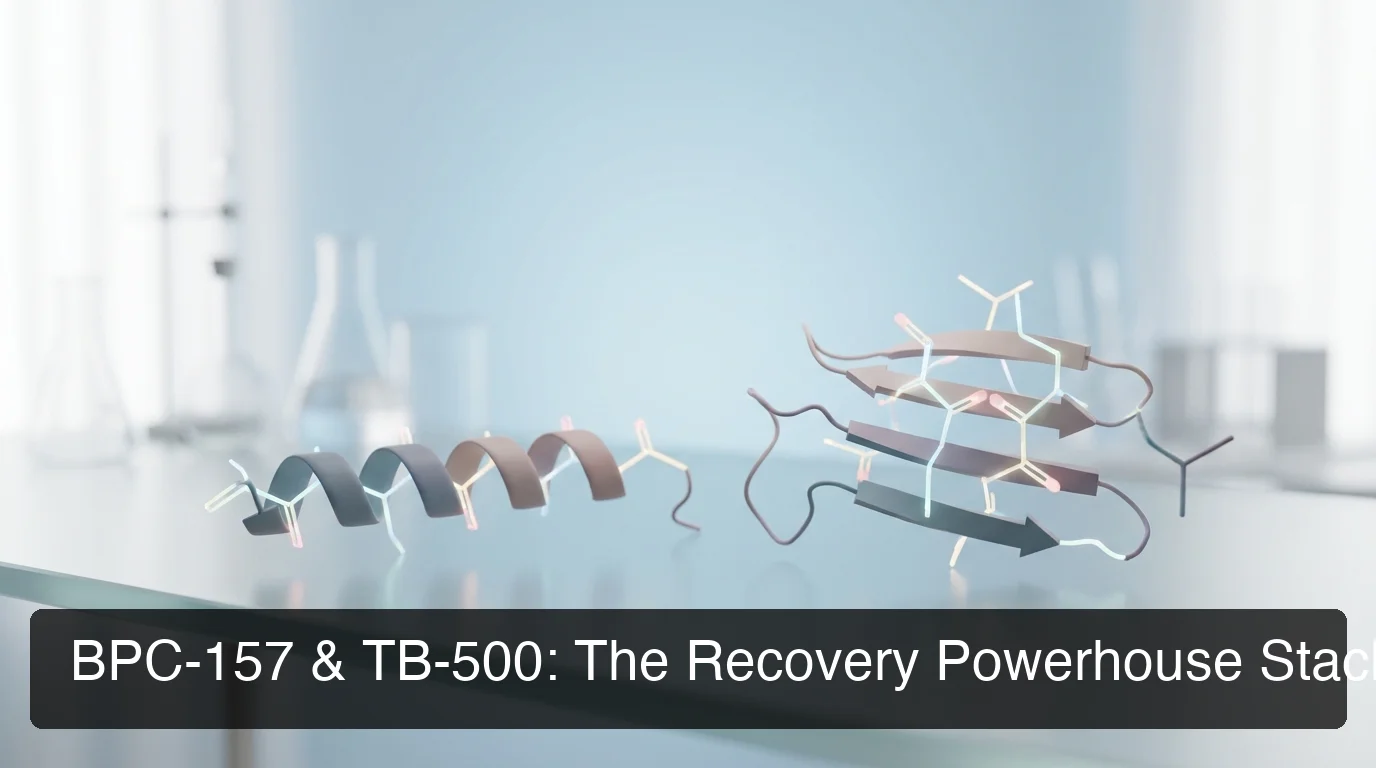 BPC-157 and TB-500 target different phases of healing — local tissue repair vs. systemic recovery.
How Do BPC-157 and TB-500 Work Together in a Stack?
BPC-157 and TB-500 target complementary but non-overlapping phases of healing. BPC-157 drives local repair — collagen production, angiogenesis, and tissue signaling at the injury site. TB-500 works systemically — mobilizing repair cells, reducing inflammation body-wide, and improving blood delivery to damaged tissue. The combination creates a multi-front recovery response neither peptide achieves alone.
The synergy is mechanistic. BPC-157 signals the body to build new blood vessels into damaged tissue. TB-500 amplifies delivery — increasing actin upregulation and cell migration that moves repair materials to the site faster. Think of it as infrastructure and logistics: BPC-157 builds the road, TB-500 fills it with traffic.
Key insight: Because BPC-157 and TB-500 operate on non-overlapping pathways, combining them doesn't create dose competition — it creates a multi-front healing response that consistently outperforms either peptide alone in animal recovery models.
Animal studies show faster wound closure, tendon repair, and muscle recovery with combination protocols compared to single peptides. Human clinical data remains limited, but the mechanistic rationale is well-characterized.
What's the Optimal Dosing Protocol for BPC-157 and TB-500?
For a BPC-157 and TB-500 peptide stack: BPC-157 at 500 mcg–1 mg daily (single morning dose or split into two 250–500 mcg injections), and TB-500 at 2–5 mg per week — with a 2-week loading phase at 4–10 mg/week followed by 2–2.5 mg/week maintenance. Standard cycle length is 8–12 weeks.
Both peptides can be injected the same day — separate sites by several hours and distinct anatomical regions to avoid localized absorption overlap.
BPC-157 and TB-500 Dosing Reference Table
| Parameter | BPC-157 | TB-500 |
|---|---|---|
| Standard dose | 500 mcg–1 mg/day | 2–5 mg/week |
| Loading phase | Not typically used | 4–10 mg/week (weeks 1–2) |
| Maintenance dose | 500 mcg/day | 2–2.5 mg/week |
| Administration | SubQ or IM | SubQ or IM |
| Frequency | Daily | 1–2x per week |
| Cycle length | 8–12 weeks | 8–12 weeks |
For full protocol breakdowns — phase structures, dose escalation schedules, and cost-per-week analysis — see the BPC-157 and TB-500 stack protocol guide.
By the numbers: A 12-week stack uses approximately 42–84 mg of BPC-157 and 30–60 mg of TB-500 total. Accurate reconstitution math and consistent dose logging are non-negotiable at that scale.
How Long Does It Take to See Results from the BPC-157 TB-500 Peptide Stack?
Most BPC-157 and TB-500 peptide stack users report meaningful improvement by weeks 2–3, with peak outcomes between weeks 8–12. The timeline follows a predictable arc: TB-500 drives early inflammation reduction in week 1, while BPC-157's structural repair effects accumulate progressively over the full cycle.
Here's what to expect week by week:
- Week 1: TB-500's anti-inflammatory action reduces swelling and stiffness. Most users notice change within 5–7 days.
- Weeks 2–3: BPC-157's angiogenic effects contribute. Improved circulation accelerates tissue remodeling; pain scores drop noticeably.
- Weeks 4–6: Structural repair dominates. Collagen production compounds; recovery from training shortens.
- Weeks 8–12: Peak outcomes. The largest gains in mobility, pain reduction, and strength occur in this window.
Missing doses compounds quickly — especially for BPC-157, where daily consistency drives the angiogenic effect. Tracking every injection against your recovery scores converts the protocol from guesswork into measurable data.
Which Administration Routes Are Best for This Peptide Stack?
For a BPC-157 and TB-500 peptide stack, subcutaneous injection is the standard route — reliable absorption, low barrier to self-administration, and applicable to both peptides. Intramuscular injection near the target tissue is an alternative for BPC-157. Oral routes have minimal evidence for TB-500 and limited evidence for BPC-157 in a stacked context.
Subcutaneous injection into the abdomen, outer thigh, or lower back is the most practical approach. Daily BPC-157 dosing requires site rotation to prevent tissue buildup — tracking which sites you've used is as important as tracking your doses.
 Subcutaneous injection with site rotation is the standard for both BPC-157 and TB-500 in a stacked protocol.
For BPC-157, some users prefer intramuscular injection near the injured tissue to deliver it closer to the target site. For TB-500, subcutaneous remains the evidence-backed default.
Preparing Your Stack
Both peptides require reconstitution with bacteriostatic water before injection. The step-by-step BPC-157 reconstitution guide covers preparation ratios and syringe calibration — the same principles apply to TB-500. Proper storage extends peptide shelf life: reconstituted peptides need refrigeration, and tracking expiry per vial is essential for maintaining stack potency.
Pro tip: When injecting both peptides the same day, use separate anatomical regions — abdomen for BPC-157, thigh for TB-500 — to prevent localized absorption competition over a long cycle.
How Does the BPC-157 and TB-500 Stack Compare to Other Recovery Protocols?
The BPC-157 and TB-500 stack outperforms single-peptide protocols on complex, multi-tissue injuries by addressing both local repair and systemic recovery simultaneously. Compared to NSAIDs or rest-only approaches, the stack drives structural tissue repair rather than just managing symptoms.
| Protocol | Mechanism | Timeline | Best For |
|---|---|---|---|
| BPC-157 alone | Local tissue repair, angiogenesis | 8–10 weeks | Focused tendon/ligament injury |
| TB-500 alone | Systemic anti-inflammatory, cell migration | 6–8 weeks | Widespread inflammation, muscle recovery |
| BPC-157 + TB-500 stack | Local + systemic: multi-front repair | 8–12 weeks | Complex injuries, accelerated recovery |
| NSAIDs | Inflammation suppression only | Days (temporary) | Acute pain management |
| Physical therapy alone | Functional movement restoration | 12–24 weeks | Structural rehab without peptides |
| GHK-Cu | Collagen remodeling, antioxidant signaling | 8–12 weeks | Skin/connective tissue focus |
Who Benefits Most from Stacking BPC-157 and TB-500?
The BPC-157 and TB-500 stack delivers the greatest benefit to experienced peptide users dealing with complex or slow-healing injuries — tendon tears, ligament damage, post-surgical recovery, and chronic overuse conditions that haven't fully resolved on single-peptide protocols.
 Athletes and chronic injury sufferers are the primary candidates for a combined BPC-157 and TB-500 protocol.
The stack is best suited for:
- Athletes with acute injuries — ligament sprains, muscle tears, tendonitis — where local repair and systemic inflammation reduction are both required.
- Chronic pain sufferers — overuse injuries (rotator cuff, Achilles, patellar tendon) that haven't resolved with single-peptide protocols or physical therapy alone.
- Post-surgical recovery — orthopedic procedures where accelerating tissue healing alongside standard rehabilitation is the goal.
- Experienced peptide users — those who've already run BPC-157 or TB-500 independently and understand their baseline response.
If you're new to peptides, starting with BPC-157 alone first is recommended. The BPC-157 oral peptide bioavailability guide covers single-peptide administration options as a starting point.
What Should You Expect During Your First Month on This Stack?
In the first month of a BPC-157 and TB-500 peptide stack, expect a phased response: inflammation reduction in week 1, measurable pain improvement by weeks 2–3, and early structural repair by week 4. Most users see the largest functional gains in mobility and daily pain levels before the 30-day mark.
Week 1–2: Loading and Inflammation Control
TB-500's loading phase drives systemic anti-inflammatory signaling within days. Reduced swelling and morning stiffness are the clearest early indicators the stack is active.
Week 3–4: Pain Reduction and Early Repair
BPC-157's angiogenic and collagen-stimulating effects compound by week 3. Pain scores typically improve 20–40% from baseline. Range of motion at the injured site often increases measurably within this window.
Signs the Stack Is Working
- Morning stiffness shortens week over week
- Pain at the injury site trends consistently lower
- Recovery time from training decreases
- Mobility improves without flare-ups
If none of these markers shift by week 4, review dose consistency, reconstitution ratios, and storage conditions before adjusting the protocol itself.
 Week-over-week tracking reveals which phase of the stack is driving improvement — and surfaces protocol issues early.
What Stack Protocols Do PeptideIQ Users Choose?
PeptideIQ users running the BPC-157 and TB-500 peptide stack most commonly choose the standard 8–12 week protocol with daily BPC-157 and twice-weekly TB-500, tracked together in the Protocol Hub for dose reminders, site rotation guidance, and week-over-week recovery score comparison.
The challenge with any multi-peptide stack isn't the science — it's execution. Missed BPC-157 doses break the daily angiogenic signaling chain. Inconsistent TB-500 timing disrupts the loading-to-maintenance transition. PeptideIQ's Protocol Hub manages both peptides on a single screen: dose reminders, injection site rotation, and a visual cycle progress indicator across both schedules simultaneously.
The AI co-pilot is initialized with your full protocol, cycle phase, and wellness logs — so when you ask "My pain score hasn't improved in 3 days, is that normal for week 2?" it responds from your actual data. Weekly AI insight cards surface meaningful patterns: if your pain score dropped 2.1 points in week 3, the app contextualizes that against typical BPC-157 timelines. That's the difference between guessing and knowing your stack is working.
Get Started with PeptideIQ
Running the BPC-157 and TB-500 peptide stack is only as effective as your protocol adherence. PeptideIQ manages both peptides together — dose reminders, injection site rotation, wellness logging, and AI insights that know your specific cycle and data.
Download PeptideIQ on the App Store
Frequently Asked Questions
What is TB-500 and BPC-157 used for?
BPC-157 is used for tendon, ligament, and muscle repair — it stimulates collagen synthesis and angiogenesis at the injury site. TB-500 supports systemic recovery by enhancing cell migration and reducing body-wide inflammation. Together, they target local tissue repair and systemic recovery simultaneously, making them effective for complex injuries that don't respond to single-peptide protocols.
How quickly does BPC-157 take to work?
Most BPC-157 users report noticeable improvement between weeks 2–3 of a daily protocol. Early effects — reduced inflammation and mild pain relief — appear within the first 7–10 days. Structural benefits including collagen formation accumulate between weeks 4–12. Cycle length matters as much as daily consistency for capturing the full effect.
Can BPC-157 cause liver damage?
No peer-reviewed evidence links BPC-157 to liver damage at typical protocol doses. Some animal research suggests it may have hepatoprotective properties. The real risk is peptide quality — contaminated or misdosed products from unverified sources are the primary concern. Sourcing from trusted suppliers matters far more than BPC-157's inherent pharmacology.
What is the downside of taking peptides?
The primary downsides are sourcing risk (gray-market products with unverified purity), the injection learning curve, and limited long-term human clinical data. BPC-157 and TB-500 lack FDA approval for human use. Honest evidence assessment and consistent dose tracking are the minimum responsible infrastructure for managing the risks of self-directed peptide protocols.
Should BPC-157 and TB-500 be injected at the same site?
No — use separate sites or different anatomical regions on the same day. Separate injection points by at least 2–3 inches, or use distinct body regions (abdomen for BPC-157, thigh for TB-500). Rotating sites across daily BPC-157 doses maintains consistent absorption over a long cycle and reduces localized tissue irritation.
What's the difference between subcutaneous and intramuscular injection for this stack?
Subcutaneous injection into fat tissue is standard for both peptides — reliable absorption, lower discomfort, easy to self-administer. Intramuscular injection near the injury site is sometimes used for BPC-157, though absorption advantage over subcutaneous isn't conclusively established in human data. Most practitioners and experienced users default to subcutaneous for both compounds.
Is the BPC-157 and TB-500 peptide stack safe to run without medical supervision?
Both peptides have well-characterized profiles in animal studies, but neither is FDA-approved for human use and individual responses vary. Running a multi-peptide stack without dose tracking and monitoring adds unnecessary risk. Logging wellness metrics and using an AI co-pilot that knows your actual data is the minimum responsible infrastructure for this protocol.