
What Peptide Does Joe Rogan Use? What the Record Shows
What Peptide Does Joe Rogan Use? What's Actually on the Record
General education, not medical advice. Most peptides discussed here are not FDA-approved for the uses people mention, and nothing on this page is a recommendation to take one. Decisions about any compound belong with a clinician.
Search "what peptide does Joe Rogan use" and the results arrive as confident lists: a stack of three or four compounds, sometimes with doses, usually with a supplement link nearby. Almost none of them say where the claim came from. That gap between a podcast clip and a "protocol" is the whole story, so let's separate what is on record from what is repeated.
What Peptide Does Joe Rogan Use, According to His Own Words?
The one peptide publicly tied to Joe Rogan is BPC-157. He has talked about it on his podcast, including its use for elbow tendinitis. That is a spoken account on a show, not a published regimen, and it does not tell you a dose, a schedule, a source, or whether he uses it today.
That is the full list of what can be attributed to him with confidence. Everything past it, including named stacks, vial brands, and injection timing, is added by someone else.
Plenty of pages ranking for this query also name TB-500, ipamorelin, or thymosin. Some of those names trace to guests mentioning compounds on the show, which is a different thing from the host confirming his own use. A name said aloud in a conversation is not a prescription list.
What Joe Rogan Has Said About BPC-157 on His Podcast
He has discussed BPC-157 in the context of a stubborn elbow tendinitis, describing it as something he tried for that problem. That context matters. A tendon complaint is the use case, and the commentary is one person's account of one injury.
Read it for what it is: an anecdote from a single person, told conversationally, with no controls, no measurements, and no way for a listener to know what else changed during recovery. Rest, training load, time, and other treatments all move tendon pain on their own.
If you want to judge a claim like this, go to the source and listen to the full segment rather than a summary of it. Summaries are where "he mentioned it" quietly turns into "he takes it every day."
The Honest Answer to "What Peptide Does Joe Rogan Use" Is Short
A protocol is a set of specifics. Compound, dose, units, frequency, cycle length, injection site, where the vial came from, what was reconstituted and when. A public figure speaking for a few minutes almost never gives these, and when they do, nobody can verify them.
Here is what you cannot know from a clip:
- The actual dose, or whether it changed over weeks.
- Whether the product was pharmacy-compounded, research-grade, or something else.
- What labs, injuries, or medications sit behind the decision.
- Whether the person stopped, restarted, or switched.
- What a clinician, if any, advised.
Without those, the question has an honest answer of one sentence. Anyone offering you the rest is guessing, or selling.
A Podcast Mention Is Evidence of Interest, Not Efficacy
BPC-157's reputation rests heavily on animal studies and on stories like this one. Human trial data for the tendon and joint uses people quote is thin. Our own overview of peptides for joint pain and what the evidence shows separates the preclinical findings from the anecdotes line by line.
This is where celebrity attention distorts the picture. A famous mention raises the number of people who search, buy, and talk about a compound. It does not raise the quality of the evidence behind it.
Reality check: Fame changes how many people try a peptide. It does not change what the studies show about it.
Should You Copy a Celebrity's Peptide Stack?
No. A stack copied from a public figure fits that person's body, history, and goals, none of which you share, and its details usually cannot be confirmed anyway. Whether a peptide suits you depends on your own goal, your bloodwork, and a clinician who knows your history.
Start with the safety side. Peptides sit in a gray zone: some are FDA-approved drugs, many are not, and quality varies badly in the unregulated market. If you are weighing risk, read what happens when someone takes the compound at the center of the Rogan conversation: BPC-157 side effects, what's normal and what isn't, and the daily-use question in is it safe to take BPC-157 every day.
Also resist the shortcut of assuming all peptides behave alike. Peptides vs steroids is a common confusion, and the answer differs by compound, so a claim about one does not carry over to another. The same goes for side effects of other peptides: each has its own profile, and a friend's or a celebrity's experience does not predict yours.
 A notebook beats a clip: your own record is the only protocol evidence that is about you.
Starting a Peptide Protocol Without Copying Someone Else's
Begin with your goal and a clinician, not a compound. Write down what you want to change, a baseline you can measure, the dose and schedule you and your clinician agree on, and the point at which you will stop. Then record everything.
If you have already decided to use a peptide, the practical groundwork matters more than the name on it. Our peptide guide for beginners walks through setup, and if your vial is freeze-dried powder, the step-by-step on how to reconstitute BPC-157 covers the water and math. Those steps apply to reconstitute BPC-157 or any peptide that arrives as a powder.
Before the first dose, decide four things:
- The goal. "Less elbow pain climbing stairs" is measurable. "Feel better" is not.
- The baseline. A pain score, a lift, a sleep number. Whatever you will compare against.
- The stop rule. What side effect, or what lack of change by what date, ends the trial.
- The review date. A set point to look at the data with your clinician.
Skipping the stop rule is the most common mistake. Without one, a protocol drifts on because stopping feels like losing.
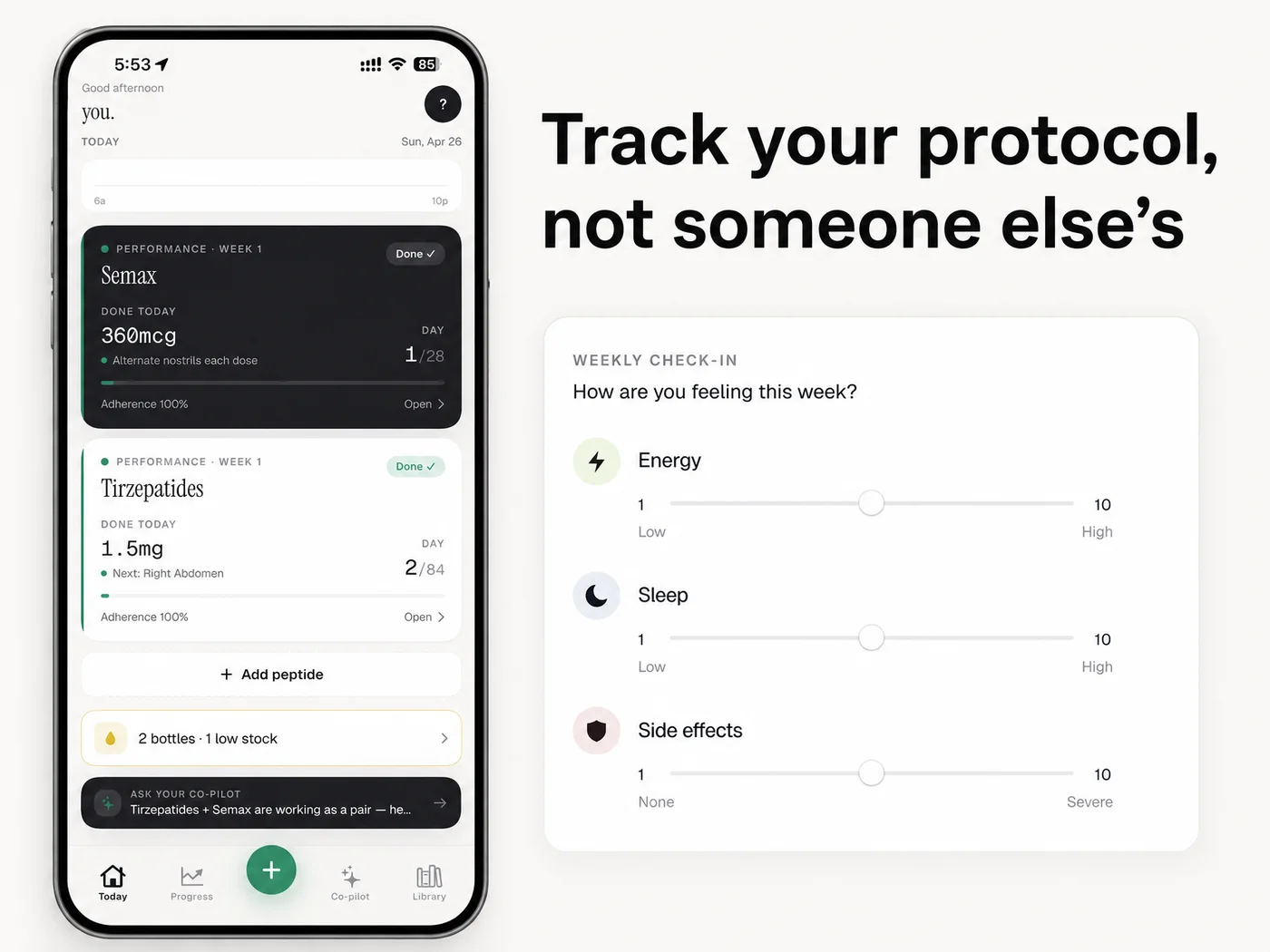 Logged doses on the left, a weekly check-in on the right: the two things a celebrity clip can never give you.
How Would You Track a Peptide Protocol So You Know It Works?
Log every dose, a daily or weekly rating for the symptom you care about, and any side effect, then compare the trend against your baseline and your stop rule. A tracked protocol turns "I read it online" into data you and your clinician can actually judge.
This is the part nobody on a podcast can do for you. Your own numbers show whether a pain score moved, whether sleep got worse, or whether you missed half your doses.
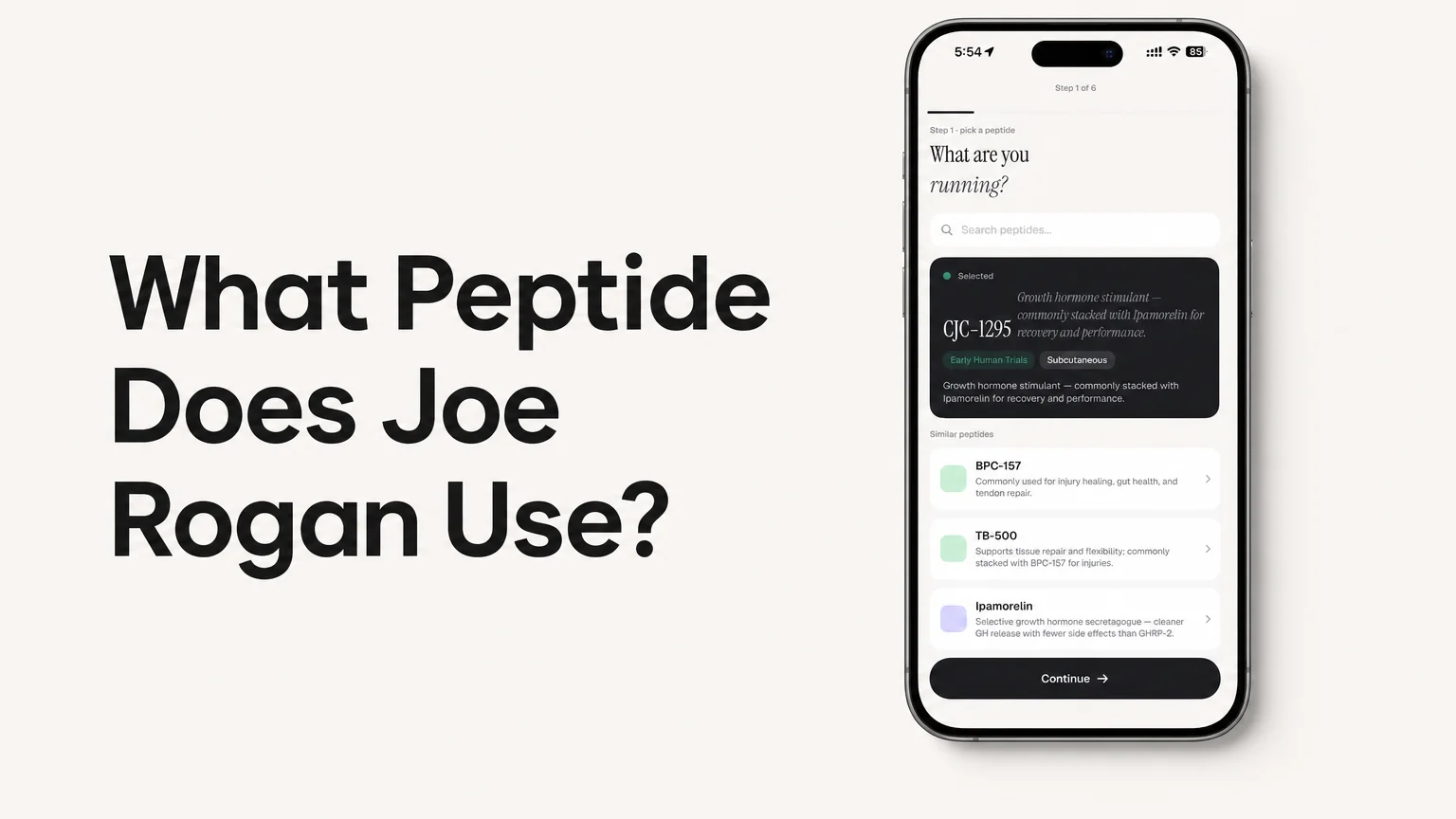
PeptideIQ, an iOS app now collecting a waitlist, is built around that loop. Its protocol builder starts with a "What are you running?" step: you pick a peptide from a searchable library and the screen shows a short description, an evidence badge, and similar peptides. In the screenshot, CJC-1295 is the selected card with an "Early Human Trials" badge, and BPC-157, TB-500 and ipamorelin are listed beneath it. It is a record-keeping step, not a recommendation.
From there the app tracks dose and schedule, logs wellness sliders and side effects, and can export a doctor-friendly PDF of dose history and symptoms. That export is the useful bit for the appointment where you discuss whether to continue.
Quick recap
- Joe Rogan has discussed BPC-157, including for elbow tendinitis. That is a podcast account, not a published protocol.
- His dose, schedule, source, and current use are not on record, so none can be copied.
- Longer "Rogan stack" lists online are secondhand and often mix in compounds other people mentioned.
- Decide your own goal, baseline, and stop rule with a clinician before you start.
- Log doses and symptoms so your own data, not a stranger's story, tells you if it works.
Get Started with PeptideIQ
If you are going to run a protocol anyway, the safest habit is recording it. PeptideIQ keeps your doses, symptoms, and check-ins in one place so you can judge your own results.
FAQ
What peptides does Joe Rogan take?
Only BPC-157 is publicly tied to him, in his podcast discussion of elbow tendinitis. Other compounds named online often come from guests or secondary lists. No dose, schedule, or current use is on record, so any full "Rogan stack" is unverified.
Does Joe Rogan take BPC-157?
He has discussed using BPC-157 for tendinitis on his show. That is a past, spoken account. Whether he uses it now, at what dose, or on what schedule is not public, and it would be inaccurate to state it.
Is a celebrity's peptide stack safe to copy?
No. A stack is tailored to one person's body, goals, and medical history, and its details usually cannot be verified. Safety depends on your own bloodwork, health conditions, product quality, and a clinician's guidance, none of which a podcast clip supplies.
How do I know if a peptide is working for me?
Set a measurable goal and baseline first, then log doses, a rating for your target symptom, and side effects over time. Compare the trend with your stop rule at a planned review date. Without records, improvement is just a feeling.
Is BPC-157 FDA-approved?
No. BPC-157 is not an FDA-approved drug, and human evidence for the uses people quote is limited. Much of its reputation comes from animal studies and personal accounts, so discuss any use with a clinician before deciding.