
Is It Safe to Take BPC-157 Every Day? The Evidence
Is It Safe to Take BPC-157 Every Day? What the Evidence Shows
Is it safe to take BPC-157 every day? It's the standard way people run it, and short daily courses at commonly cited doses are not associated with serious harm in the reports and animal studies that exist. But "not associated with harm" is a weaker claim than "proven safe," and the gap between the two is the whole story.
BPC-157 is not FDA-approved, and almost no controlled human safety data backs it up.
This article is general information, not medical advice. If you have a health condition or take prescription medication, talk to a clinician before you start.
Is It Safe to Take BPC-157 Every Day? What "Safe" Means Here
Nobody can honestly call daily BPC-157 proven safe, because the human evidence is thin. What exists is a large body of rodent research, plenty of anecdotal reports, and no serious-adverse-event signal at typical doses over short courses. Daily dosing is not the risky variable. Dose, duration, and product quality are.
Most of the published work on BPC-157 comes from animal studies, largely from one research group. Human trials are scarce and small. That is why the FDA has not approved it, why the agency flagged it among bulk substances with potential safety risks for compounding, and why the World Anti-Doping Agency has prohibited it since 2022.
So "safe" here means something narrower: no known red flags at typical doses, in a short course, from a trustworthy source. Anyone promising more than that is selling something.
Key Takeaways
- Daily dosing is the most common BPC-157 schedule; commonly cited doses run roughly 250-500 mcg per day, with some sources going up to 1,000 mcg.
- There is no proven long-term human safety record. Evidence is mostly animal studies, and BPC-157 is not FDA-approved.
- Reported side effects are mild and mostly anecdotal: nausea, dizziness, fatigue, and injection-site irritation.
- Courses typically run 4-8 weeks, and many people take a break afterward rather than run it indefinitely.
- Consistent daily logging is how you tell a working protocol from a placebo-feeling one.
What's the Difference Between Daily and Alternate-Day BPC-157 Protocols?
A daily protocol means one injection (or a split pair) every day for the length of the course. An alternate-day protocol means one dose every other day, cutting the total number of injections roughly in half. Daily is the more common choice for acute injuries; alternate-day is used by people who want fewer injections or a lower cumulative dose.
Neither schedule has been compared head to head in a controlled human trial. The choice comes down to preference, tolerance, and what your clinician or protocol source recommends.
PeptideIQ's Cycle Planner treats this as an explicit setup step. Step 5 of the six-step flow, "Injection Schedule," lets you pick daily, every X days, or specific days of the week, and the review screen shows the full plan before you commit.
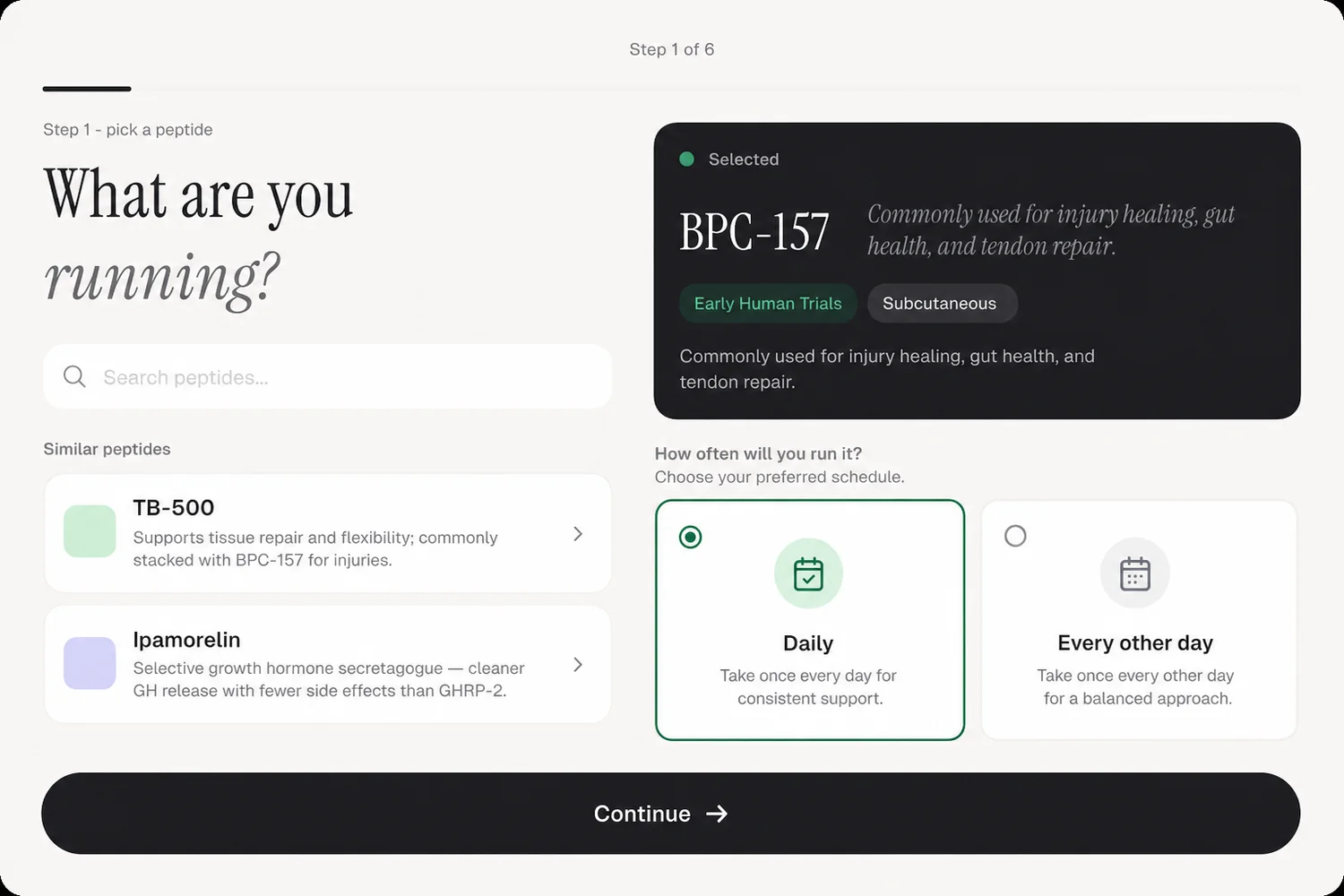 Illustrative composition of the Cycle Planner: BPC-157 selected, with daily and every-other-day options side by side.
How Much BPC-157 Do People Take Daily?
Sources we reviewed put daily BPC-157 at roughly 200-500 mcg once or twice a day, with a few clinics citing 500-1,000 mcg total. The spread reflects how little standardized data exists. Higher is not better: one source describes diminishing returns above 500 mcg a day.
Those are reported ranges, not prescriptions. For a full breakdown by weight and goal, see our BPC-157 dosage guide.
Two practical points matter more than the exact number.
First, dosing accuracy depends on reconstitution, and a math error there is a bigger safety risk than a daily schedule; our walkthrough on how to reconstitute BPC-157 covers it. Second, a reconstituted vial doesn't last forever. PeptideIQ's inventory tracker assumes about 30 days refrigerated for BPC-157 and counts doses remaining as you log them.
Reality check: Forum posts describing 1-2 mg a day are anecdotes, not evidence. Nobody has shown that a higher dose heals faster, and nobody has shown it's harmless.
Can Daily BPC-157 Cause Side Effects or Tolerance?
Reported side effects are generally mild: nausea, dizziness, headache, fatigue, and redness or irritation at the injection site. There is no established evidence of tolerance building with daily use, but that is partly because nobody has studied it properly. Absence of data is not the same as absence of risk.
If you notice unusual tiredness, our piece on BPC-157 fatigue covers the likely causes. Injection-site problems usually trace back to technique, not the peptide.
There is also a theoretical concern worth naming. BPC-157 appears to promote new blood vessel growth in animal models, which is part of how it may aid healing. That raises an unproven but reasonable caution for anyone with a cancer history, which is a conversation for your doctor, not a forum.
Product quality is the other real risk. Gray-market vials vary in purity and actual content, and contamination matters more than dose frequency.
Is It Safe to Take BPC-157 Every Day for 8 Weeks or Longer?
Most protocols run 4-8 weeks, and there is no human data supporting continuous use beyond that. Longer courses are an extrapolation, not an evidence-based practice. The prudent pattern is a defined start and end date, then a break and a reassessment.
That's why "how long" matters more than "how often." Our guide to BPC-157 cycle length breaks down 4-, 6-, and 8-week courses by injury type, and the Cycle Planner builds it in: a weeks-on slider, an optional rest period, and a calendar preview of active versus rest weeks.
Open-ended daily use is the pattern to avoid. Without an end date you can't judge whether it's working, and you're extending exposure past anything the evidence covers.
Should You Take BPC-157 Every Day or Cycle It?
For most people, a daily course followed by a break is the more defensible structure. You get a clean before-and-after comparison, you limit cumulative exposure, and you force a decision point. Skipping the break feels like momentum but mostly removes your ability to learn anything.
How Do You Know If Daily BPC-157 Is Working?
You know it's working by measuring, not by feel. Track one concrete metric tied to your goal, such as a pain score, range of motion, or gut symptoms, plus a dose log, and compare week over week. Most reports place visible changes between weeks 2 and 6, depending on the tissue.
Our article on how long BPC-157 takes to work lays out realistic timelines by condition. If nothing has moved by week 4 to 6, that is information too: the protocol, the product, or the diagnosis may be the problem.
Delivery route matters here as well. If daily injections are the sticking point, our comparison of the oral BPC-157 peptide explains what changes, and what doesn't, when you swap the route.
Consistency is what makes your data readable. A week with three missed days tells you nothing about whether the peptide works.
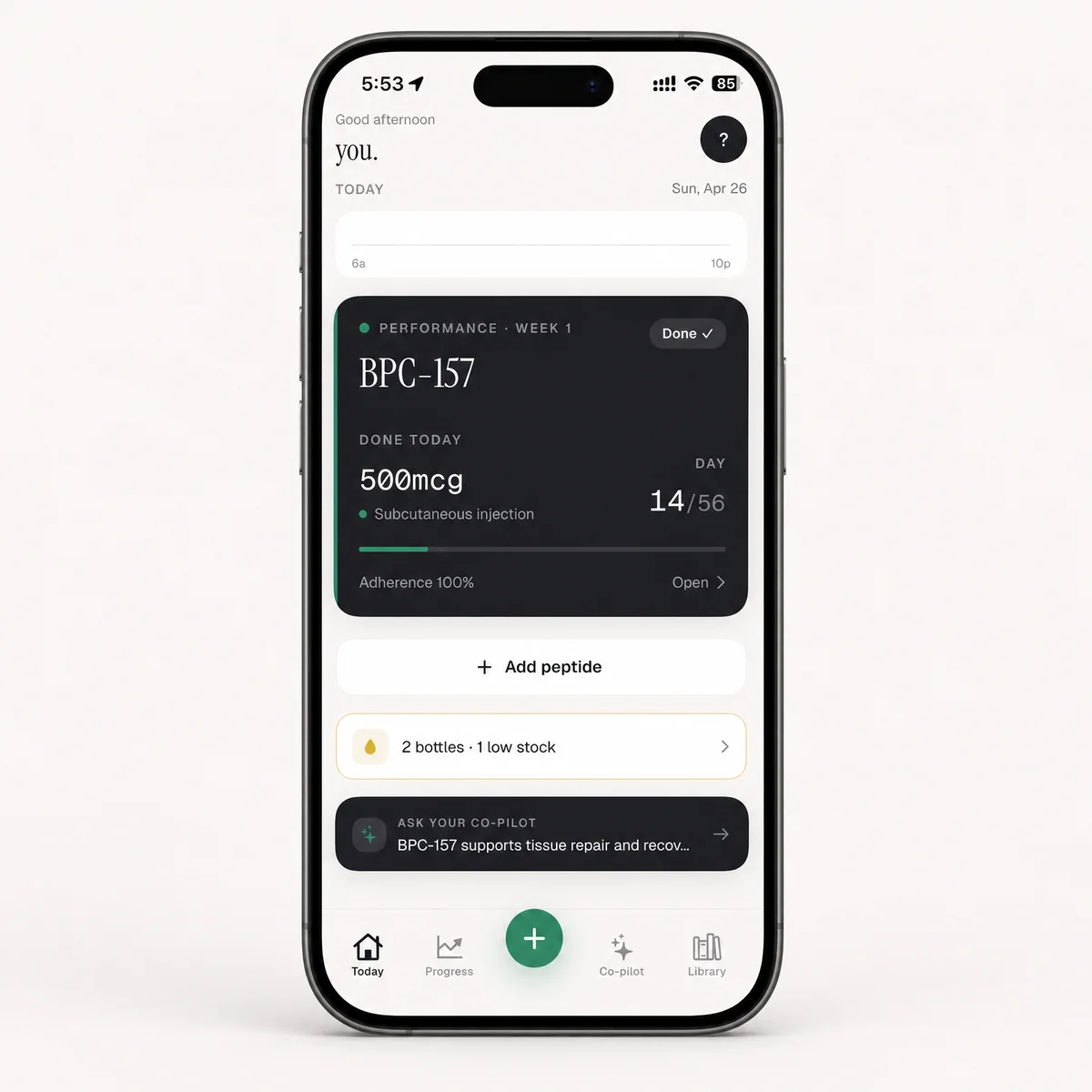 Illustrative Today screen: one card per protocol, with dose, cycle day, and adherence on the face of it.
How PeptideIQ Simplifies Daily Protocol Tracking
Daily protocols fail quietly: a missed dose here, a forgotten vial date there, and by week five you can't say what you actually did. PeptideIQ's Today screen puts one card per active peptide in front of you, showing the dose logged, your cycle day (for example, Day 14 of 56), and an adherence figure.
Progress data sits behind it. You log a pain score or other goal metric, and the app plots your trend against the cycle so "is this working?" has an answer that isn't a guess. Phase transitions and rest weeks are scheduled up front, which keeps you from drifting into open-ended use.
PeptideIQ doesn't tell you whether BPC-157 is safe for your body. It shows you what you did and what happened, which is the information your clinician needs to give you a real answer.
Get Started with PeptideIQ
If you've decided to run a daily protocol, build it with an end date, a rest period, and a log you'll keep. PeptideIQ is in pre-launch with a waitlist open now.
FAQ
Is it safe to take BPC-157 every day for a month?
A month of daily BPC-157 at commonly cited doses has not been linked to serious adverse events in available reports, but controlled human safety data is lacking. It is not FDA-approved. Use a reputable source, keep the course time-limited, and involve a clinician, especially if you have existing conditions.
Can you take BPC-157 every day without a break?
There is no human evidence supporting indefinite daily use. Most protocols run 4-8 weeks, followed by a rest period and reassessment. Running it continuously removes your ability to judge whether it helps and extends exposure beyond anything studied, so a defined end date is the safer pattern.
Does BPC-157 stop working if you take it daily?
No evidence shows BPC-157 loses effect with daily use, but tolerance has not been studied in humans either. If results stall past week 6, review the dose, product quality, and your tracking data before increasing anything. More is not shown to be better.
What are the side effects of taking BPC-157 daily?
Reported effects are mostly mild: nausea, dizziness, headache, fatigue, and injection-site redness. Serious effects are not well documented because studies are scarce. A theoretical caution exists around blood-vessel growth in people with a cancer history; consult a clinician if anything unusual appears.