
BPC-157 Dosage: Complete Reference Guide | PeptideIQ
BPC 157 Dosage: The Complete Reference Guide
BPC 157 dosage questions have a clear answer: 250–500 mcg daily, subcutaneously, for 4–8 weeks. What most guides skip is everything that makes that number work — timing, injection site specificity, cycle consistency, and how to know whether it's actually doing anything.
Key Takeaways
- Standard BPC-157 beginner dosage ranges from 250–500 mcg daily, with 4–8 week cycles being the most documented protocol for injury recovery
- Injection delivery reaches tissue directly at higher bioavailability than oral capsules, making dose timing and consistency the critical variables — not the exact mcg count
- Individual response to BPC-157 varies widely; consistent protocol logging is the only reliable way to assess whether your dosage is achieving results
- Most users report visible recovery improvements between weeks 3–6, making adherence and accurate dose tracking essential for success
- PeptideIQ automatically tracks your cycle phase, remaining doses, and recovery metrics — removing guesswork from protocol management
Contents
- What Is the Optimal BPC 157 Dosage for Beginners?
- How Does BPC 157 Dosage Vary by Injury Type and Recovery Goal?
- What's the Difference Between BPC-157 Capsules and Injection Dosing?
- Can You Take Too Much BPC-157?
- Should You Adjust BPC-157 Dosage Based on Body Weight?
- How Long Does a BPC-157 Vial Last at Standard Dosing?
- Why Protocol Logging Transforms BPC-157 Results
- Get Started with PeptideIQ
- Frequently Asked Questions About BPC-157 Dosage
What Is the Optimal BPC 157 Dosage for Beginners?
The standard BPC-157 beginner dosage is 250–500 mcg daily, administered subcutaneously near the injury site or in the abdomen for systemic use. New users typically start at 250 mcg once daily for the first one to two weeks to assess tolerance before moving toward 500 mcg. A full beginner cycle spans 4–8 weeks of consistent daily dosing.
Once-daily dosing administered close to the injury site is the most common beginner approach for injury recovery. Some users prefer a split: 250 mcg in the morning and 250 mcg in the evening for a 500 mcg total daily dose. No strong evidence shows split dosing outperforms a single daily injection, but many find it easier to maintain consistent timing across a twice-daily schedule.
 Standard BPC-157 dosage starts at 250 mcg daily and scales to 500 mcg based on individual tolerance and recovery goals.
The "beginner" range exists for a real reason. Individual response varies significantly, and starting at the lower end gives your log enough signal to assess whether adjustment is needed. Jumping to 1,000 mcg based on forum recommendations adds cost without clear evidence of proportionally better results for typical injury recovery.
Worth knowing: BPC-157 has an exceptionally favorable safety profile in animal models — no LD50 has been established even at extremely high doses. The practical reason to stay within established ranges is tracking integrity: escalate too early and you lose the baseline data that tells you whether the protocol is actually producing results.
How Does BPC 157 Dosage Vary by Injury Type and Recovery Goal?
BPC-157 dosage shifts based on injury site and recovery severity. Tendon and ligament injuries typically use 400–500 mcg daily near the injury site. Gut health protocols favor lower doses of 200–300 mcg orally. Systemic or multi-site recovery goals generally fall in the 250–500 mcg subcutaneous range without targeting a specific location.
Injection proximity matters as much as dose quantity. For localized tissue injuries — chronic tendinitis, ligament tears, or joint inflammation — subcutaneous injection near the site concentrates the peptide where healing is most needed rather than relying on pure systemic distribution.
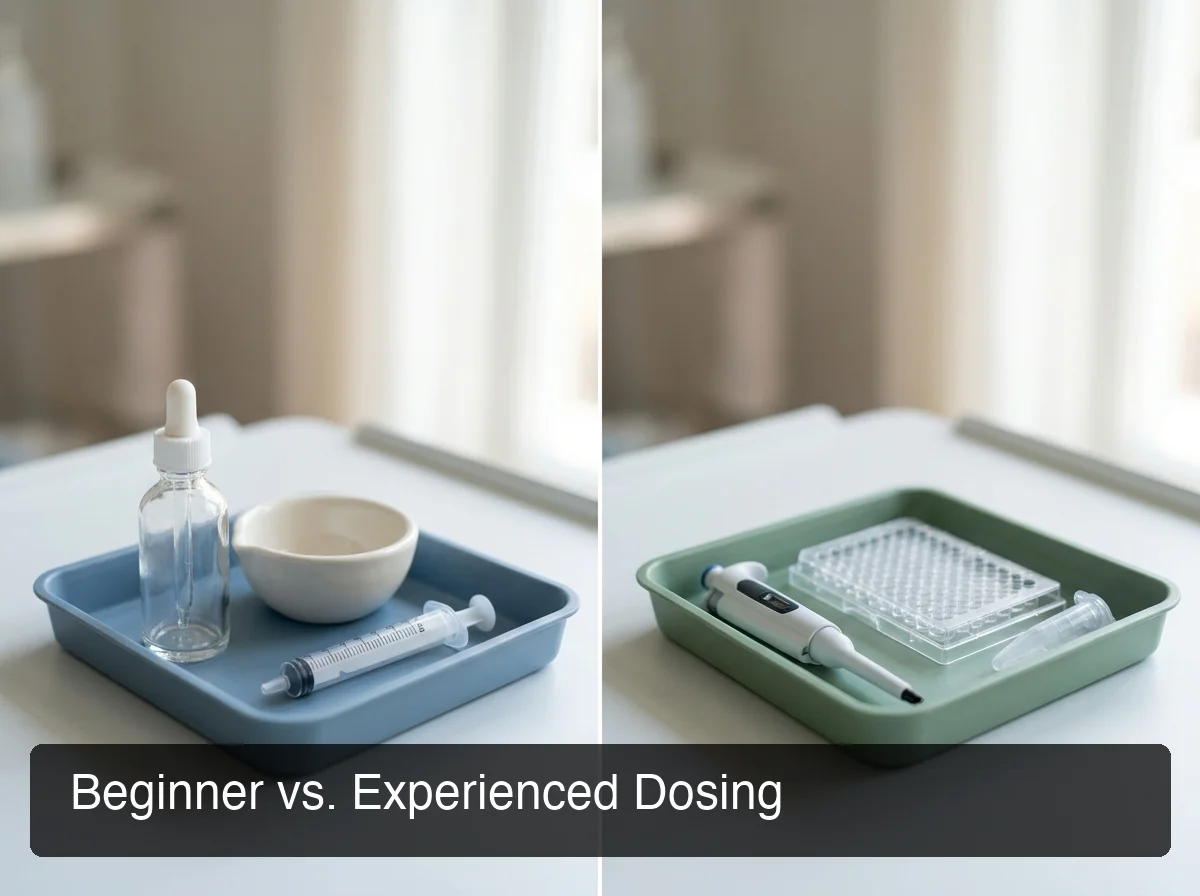 Beginner protocols start at 250 mcg daily; experienced users targeting specific injuries commonly run 400–500 mcg with site-adjacent injections.
| Recovery Goal | Typical Daily Dose | Administration | Injection Location |
|---|---|---|---|
| Tendon/Ligament Injury | 400–500 mcg | Subcutaneous | Near injury site |
| Joint Inflammation | 300–500 mcg | SQ or IM | Near affected joint |
| Gut Health / IBD | 200–300 mcg | Oral or SQ | Systemic |
| Muscle Injury | 300–500 mcg | IM or SQ | Near injury |
| General Recovery | 250–500 mcg | Subcutaneous | Abdominal or systemic |
| Neurological Support | 300–500 mcg | Subcutaneous | Abdominal |
Most injury recovery protocols at 500 mcg run 4–6 weeks, extending to 8 weeks for chronic or complex injuries. Beyond 8 weeks without a break is uncommon and lacks strong clinical precedent.
For users combining BPC-157 with TB-500 for synergistic tissue repair, dosing discipline across both peptides becomes essential — the BPC-157 TB-500 peptide stack guide covers the combined protocol, timing windows, and dose coordination in detail.
What's the Difference Between BPC-157 Capsules and Injection Dosing?
Injection delivers BPC-157 directly into systemic or local circulation with higher and more predictable bioavailability. Oral capsules survive gastric transit through BPC-157's unusual structural stability in acidic environments, but absorption is less consistent for non-gut applications. Injection remains the standard for musculoskeletal and tendon recovery; oral is used primarily for gut-related conditions.
The bioavailability difference has practical implications for dose selection. For gut health protocols — gastric ulcers, IBD, intestinal permeability — oral administration makes direct pharmacological sense because the peptide acts where it lands.
 Injury-specific injection protocols target BPC-157 delivery to the site of damage — proximity to the injury is as important as dose volume.
For musculoskeletal injuries, evidence consistently favors injection. The oral dose required to match injection-level systemic effects is not established, and most users report more predictable results with subcutaneous injection at standard ranges.
Oral dosing (gut health context):
- Capsules: 100–300 mcg per dose, twice daily
- Timing: typically before meals
- Limitation: substantially lower bioavailability for systemic injury recovery
Before you can execute any injection protocol accurately, you need to reconstitute your vial correctly. The BPC-157 reconstitution step-by-step guide covers the mixing process, BAC water ratios, and syringe unit calculations from start to finish.
Reality check: Oral BPC-157 marketed for systemic athletic recovery lacks the same evidence base as injection. The structural stability argument is legitimate, but absorption efficiency varies substantially between individuals and formulations. For joint or tendon targets, injection is the documented route.
Can You Take Too Much BPC-157?
No clinically defined toxicity threshold has been established for BPC-157. Animal studies have not produced a lethal dose at any tested amount. Anecdotally, doses above 1,000 mcg daily do not produce proportionally better outcomes for standard injury recovery and add significant supply cost without documented benefit.
The absence of a hard upper limit is not permission to dose high. Three practical reasons to stay within established ranges:
- Protocol accountability — A consistent baseline dose is necessary to assess whether BPC-157 is driving recovery improvements or whether other variables are responsible.
- Cost efficiency — At 500 mcg daily, a 5 mg vial lasts 10 days. Doubling to 1,000 mcg doubles cost without established evidence of doubled outcomes for typical injuries.
- Tracking signal — Variable dosing makes it nearly impossible to identify meaningful patterns in recovery progress across a cycle.
Common side effects at standard doses — mild fatigue, transient nausea, injection site soreness — are typically short-lived in the first week. Staying within the 250–500 mcg range keeps these predictable and interpretable.
Should You Adjust BPC-157 Dosage Based on Body Weight?
Some practitioners use a 2–3 mcg/kg body weight formula for subcutaneous injection. Under this approach, a 75 kg person targets 150–225 mcg per dose. Most community protocols, however, use flat dose ranges of 250–500 mcg rather than weight-based scaling — no published data defines an optimal per-kg ratio for BPC-157 in humans.
Weight-based dosing has theoretical backing: heavier individuals have larger tissue mass and greater systemic distribution volume. The challenge is that no clinical threshold defines exactly where body weight begins to matter at the doses typical of injury recovery protocols.
A practical middle-ground framework based on established ranges:
- Under 70 kg — Start at 250 mcg daily
- 70–100 kg — 250–500 mcg daily
- Over 100 kg — 500 mcg as a starting dose; some experienced users extend to 750 mcg with careful logging
For a cross-peptide dosing reference that includes both weight-adjusted and flat-dose approaches, the peptide dosage cheat sheet covers BPC-157 alongside the 10 most commonly used peptides in one scannable reference.
How Long Does a BPC-157 Vial Last at Standard Dosing?
Vial longevity depends on two variables: vial size and daily dose. Most commercially available BPC-157 vials come in 5 mg sizes, with some suppliers offering 2 mg or 10 mg options.
| Vial Size | Daily Dose | Total Doses | Days Supply |
|---|---|---|---|
| 2 mg (2,000 mcg) | 250 mcg | 8 doses | 8 days |
| 2 mg (2,000 mcg) | 500 mcg | 4 doses | 4 days |
| 5 mg (5,000 mcg) | 250 mcg | 20 doses | 20 days |
| 5 mg (5,000 mcg) | 500 mcg | 10 doses | 10 days |
| 10 mg (10,000 mcg) | 500 mcg | 20 doses | 20 days |
Reconstituted BPC-157 stored refrigerated remains stable for approximately 28–30 days. This creates a practical constraint: a 5 mg vial at 250 mcg/day yields 20 days of supply but must be used or discarded within 30 days of mixing. Most users running a 4-week cycle at 500 mcg/day plan for two 5 mg vials per cycle.
Track remaining doses against your vial's reconstitution date from day one. Guessing at vial status mid-cycle leads to unexpected stockouts or using degraded peptide — both of which undermine the dosing consistency your results depend on.
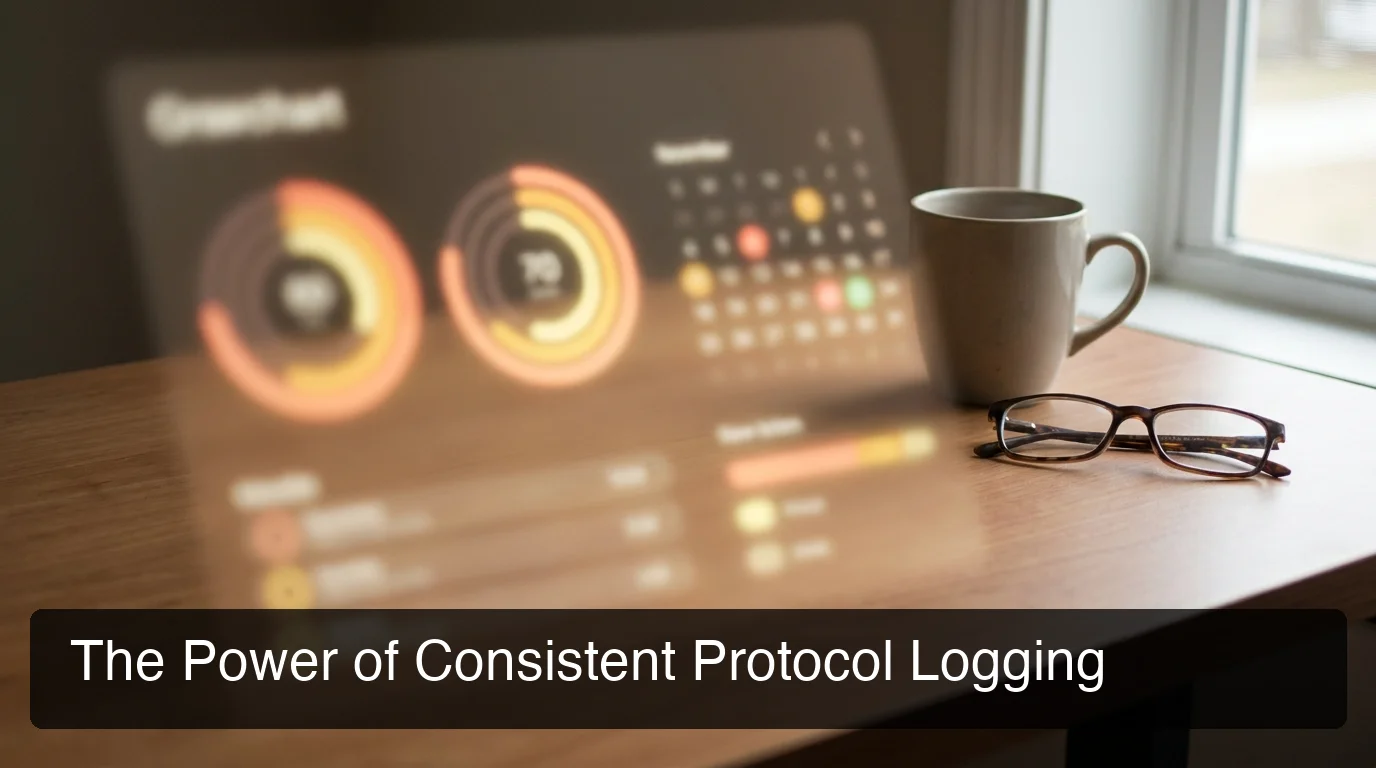 PeptideIQ tracks your BPC-157 cycle phase, remaining vial doses, and daily recovery metrics — the full picture in one 60-second check-in.
Why Protocol Logging Transforms BPC-157 Results
BPC-157 results are dose-dependent and time-dependent. They are also data-dependent. Most users who report "it didn't work" made one of three errors: inconsistent dosing, injecting at the wrong site, or running the protocol without a recovery baseline to measure against.
The problem is not motivation. Tracking a peptide protocol manually — daily doses, injection sites, recovery scores, vial expiry — across 4–8 weeks is genuinely hard to sustain in a notes app. Missed doses accumulate silently. Recovery improvements go unmeasured. Week four looks identical to week one without data to distinguish them.
PeptideIQ was built for exactly this problem. The app tracks your BPC-157 cycle phase, logs each dose with injection site rotation guidance, monitors daily recovery metrics — pain score, energy, sleep quality — and calculates remaining doses against your vial's expiry date. All of it in a 60-second daily check-in.
The AI co-pilot responds to symptoms and plateaus using your actual data. When you flag lower energy or stalled recovery on day 18, it does not return a generic peptide FAQ. It responds knowing your cycle phase, your recent wellness pattern, and how your current week compares to your week two baseline.
Here's what that looks like in practice: "Your average pain score dropped from 7.2 in Week 1 to 4.8 this week — a 33% reduction. BPC-157 protocols typically show the most improvement between weeks 3 and 6. Keep logging."
That feedback loop cannot exist without consistent logging from day one.
The short version: Consistent BPC-157 dosing is necessary for results. Consistent logging is how you know whether your dosage is actually working — and the only mechanism for course-correcting before weeks are wasted.
Get Started with PeptideIQ
BPC-157 works through consistency, and consistency requires a system. PeptideIQ handles cycle tracking, dose logging, injection site rotation, vial inventory, and recovery monitoring automatically — so your focus stays on recovery, not spreadsheets.
Download PeptideIQ on the App Store
Frequently Asked Questions About BPC-157 Dosage
What is the standard BPC-157 dosage for beginners?
The standard starting dose is 250–500 mcg daily via subcutaneous injection. Most protocols begin at 250 mcg once daily for the first one to two weeks to assess individual tolerance, then move toward 500 mcg if tolerated. A complete beginner cycle typically runs 4–8 weeks of consistent daily dosing near the injury site.
How often should you inject BPC-157?
Once daily is the most common frequency for BPC-157 injury recovery protocols. Some users divide the total daily dose into two injections — morning and evening — particularly at higher ranges like 500–1,000 mcg daily. No clinical data definitively shows split dosing outperforms a single daily injection for standard recovery goals.
Can you take BPC-157 orally instead of injecting?
Oral BPC-157 is viable for gut health conditions — the peptide's structure resists gastric acid degradation, making it one of the few peptides with plausible oral activity. For musculoskeletal and tendon recovery, subcutaneous injection near the injury site delivers more reliable and targeted results than oral capsules at any dose.
What is the maximum safe BPC-157 dose?
No established maximum safe human dose exists. Animal studies have not produced a lethal dose at any tested amount. Most protocols stay within 250–500 mcg daily; doses above 1,000 mcg are uncommon, add significant cost, and have no documented proportional benefit for standard injury recovery.
Does body weight affect BPC-157 dosage?
Some clinicians use a 2–3 mcg/kg body weight starting formula. Most community protocols use flat dosing in the 250–500 mcg range regardless of body weight. Heavier users over 100 kg typically default to the upper end of the standard range, but no published data precisely defines an optimal per-kg threshold for injury recovery.
How long does a BPC-157 cycle last?
Standard BPC-157 cycles run 4–8 weeks of daily dosing followed by a rest period. Four weeks is typical for acute injury support; six to eight weeks is standard for chronic injuries or complex recovery goals. Running beyond eight weeks continuously lacks documented precedent and is uncommon in established protocols.
How do you know if your BPC-157 dosage is working?
Consistent daily logging from cycle start is the only reliable way to measure results. Track a primary recovery metric — pain score, mobility, or strength — alongside each dose. Most users see measurable improvement between weeks 3 and 6; without a baseline, those improvements are invisible and underdosing or missed doses go undetected.