
BPC-157 Fatigue: Why It Happens & How Long | PeptideIQ
BPC-157 Fatigue: Why It Happens and How Long It Lasts
BPC-157 fatigue in the first week or two of a protocol is almost always the body shifting into a parasympathetic state, not a warning sign to stop. Research on the peptide's mechanism points to vagal nerve activity as part of how it works, and that shift can feel like low energy before it feels like recovery. For most people, it clears up within two weeks — here's how to tell that apart from a pattern that actually needs attention.
What Causes Fatigue When Starting BPC-157?
BPC-157 fatigue in the early days of a protocol is largely driven by a shift toward parasympathetic dominance — the peptide's documented activity along vagal pathways nudges the nervous system out of a stress-driven state, and that transition briefly reads as tiredness before it reads as recovery. Your body spends a lot of energy running in a sympathetic, "on alert" mode, especially if you started BPC-157 because of an injury that's been keeping you tense and guarded.
When that alertness drops, the felt experience is often heaviness or low drive rather than anything alarming. It's the same reason a hard massage or a long stretch of deep sleep can leave you groggy for an hour afterward — nervous system tone is shifting, and shifting takes a beat to settle.
This is also part of why how long BPC-157 takes to work is a more useful question than "is it working yet," since the fatigue phase is frequently the first measurable signal, not a sign of failure. The same vagal pathway tied to this early tiredness is also linked to heart rate regulation — heart rate regulation and the initial fatigue phase tend to move together in the research on BPC-157's systemic effects.
Key Takeaways
- BPC-157 can trigger temporary fatigue in early protocol stages (days 3–7) because it activates vagal tone and shifts the body into a parasympathetic state.
- Fatigue usually subsides by day 10–14 as the body adapts; this is distinct from adverse reactions and does not require stopping the peptide.
- Tracking energy levels daily helps you correlate fatigue timing with protocol stage and dose, separating normal adaptation from genuine side effects.
- Sleep quality, hydration, and carbohydrate intake directly influence whether fatigue is noticeable during BPC-157 use.
Related: BPC-157 Side Effects: What's Normal & What Isn't
Normal Energy Calibration vs. a Real Adverse Reaction
Most people lump every tired day into one bucket, but early-protocol fatigue and a genuine adverse reaction look different once you know what to check.
| Signal | Normal Energy Calibration | Possible Adverse Reaction |
|---|---|---|
| Timing | Days 3–7, tapering by day 10–14 | Starts late or worsens past day 14 |
| Pattern | Mild, comes and goes across the day | Persistent, heavy, doesn't lift with rest |
| Other symptoms | None, or mild appetite/sleep changes | Dizziness, rash, swelling, chest tightness |
| Response to hydration/food | Noticeably improves | Little to no change |
| What to do | Keep logging, no action needed | Pause dosing, reassess the vial and dose |
Worth knowing: A cloudy or discolored reconstituted vial can cause symptoms people blame on "BPC-157 fatigue" that are actually a contamination or degradation issue. If your reconstitution steps were rushed or the vial sat unrefrigerated, that's worth ruling out before assuming the peptide itself is the cause.
The parasympathetic shift behind normal calibration is also part of why gut healing protocols feel tiring at first — the same nervous system state that dials down alertness also happens to be the one associated with digestive repair.
How Long Does BPC-157 Fatigue Typically Last?
BPC-157 fatigue typically peaks between days 3 and 7 of a new protocol and tapers off by day 10 to 14, as the body adjusts to the shift in vagal and parasympathetic tone. A shorter, milder version can reappear briefly after a dose increase, but it's rarely as pronounced as the initial adjustment window.
Three factors tend to stretch or shrink that window:
- Dose size — higher starting doses often bring a more noticeable dip in the first few days.
- Sleep debt going in — starting a protocol already sleep-deprived amplifies how the calibration phase feels.
- Hydration and carbohydrate intake — both blunt the felt intensity of the early fatigue window.
Reality check: If fatigue is still just as heavy on day 18 as it was on day 5, that's no longer "calibration" — it's a pattern worth flagging, not one to wait out. Cycle length also matters here, since longer protocols have a longer runway for a second, smaller dip if the dose is adjusted mid-cycle.
How to Track Fatigue on Your BPC-157 Protocol
Guessing whether fatigue is normal or not from memory is exactly the trap most people fall into — a bad day three weeks in feels the same as a bad day three days in unless it's written down somewhere.
PeptideIQ's dose logging includes a daily energy slider from 1 to 10, tagged automatically to the protocol day it was logged on. That turns "I think I've been more tired lately" into an actual line you can look at — energy sitting at 4/10 on day 3, climbing to 7/10 by day 10, which is the shape a normal calibration curve is supposed to take.
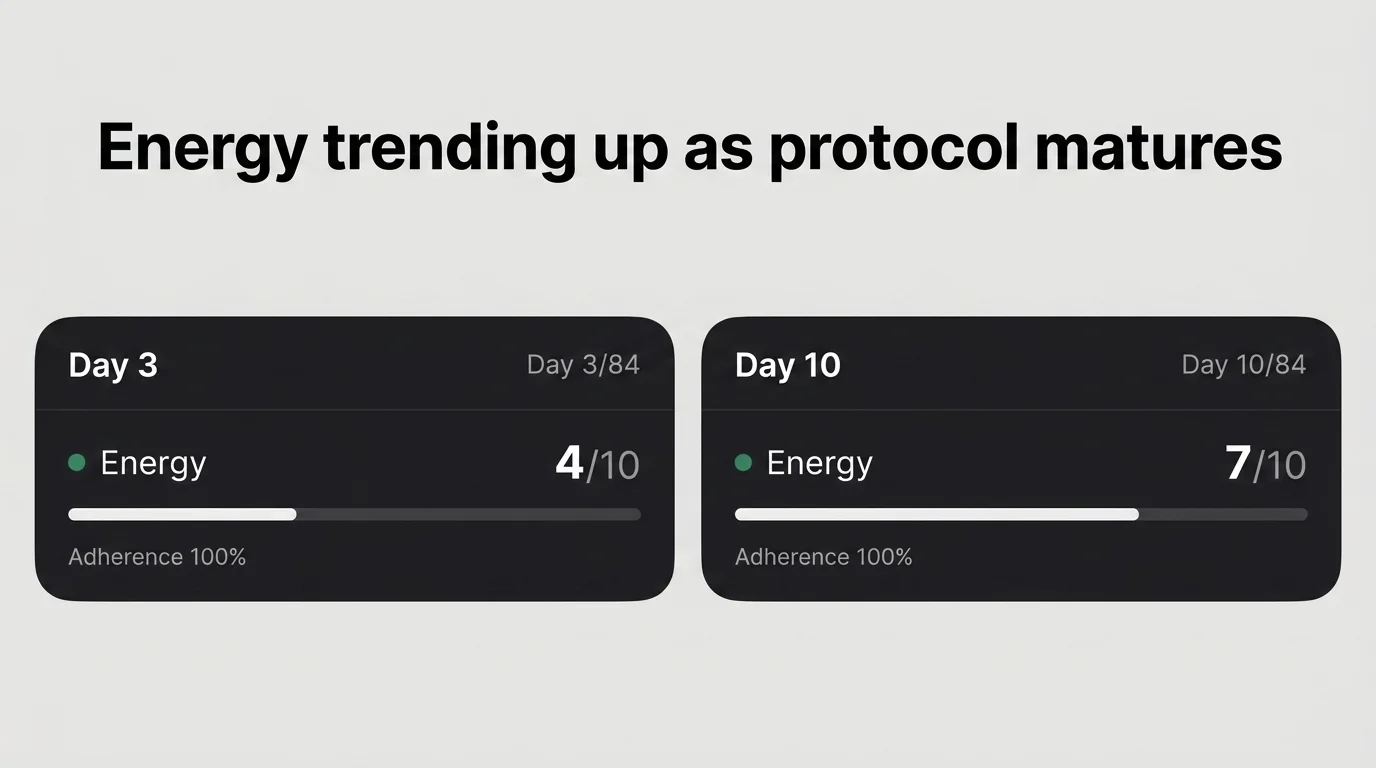 Energy logged against protocol day — day 3 at 4/10 climbing to day 10 at 7/10, the pattern normal calibration usually follows.
If your numbers don't follow that arc — flat or dropping instead of recovering by day 10 — that's the data point that tells you to look closer, not a feeling you have to talk yourself into trusting either way.
When Should You Reduce Your BPC-157 Dose If Fatigue Is Severe?
You should consider reducing your BPC-157 dose if fatigue is still severe past day 10–14, if it's paired with dizziness or nausea that doesn't resolve with hydration, or if it's noticeably worse than what your dosage range would predict for your body weight. Mild tiredness that's improving is not a reason to cut dose — a flat or worsening trend is.
A step-down approach works better than stopping outright for most people:
- Drop to the lower end of your current dosage band for 3–4 days.
- Keep logging energy daily so you can see whether the trend actually improves.
- If it doesn't improve at the reduced dose, that points away from calibration and toward something else worth discussing with a doctor.
Daily dosing gets an undeserved reputation here — BPC-157 daily dosing addresses energy adaptation concerns more effectively than sporadic dosing does, since a consistent schedule gives the nervous system a steadier signal to adjust to rather than a series of small shocks.
How Does BPC-157 Fatigue Compare to Fatigue From Other Peptides?
BPC-157 fatigue tends to be milder and shorter-lived than fatigue from other peptide categories, since it's tied to a brief nervous-system shift rather than a metabolic or hormonal adjustment. GLP-1 peptides like semaglutide often cause fatigue tied to a caloric deficit that can run for weeks, not days. Growth hormone peptides such as CJC-1295 and Ipamorelin can produce grogginess if dosed too close to a meal, since they require fasted administration to work as intended.
That distinction matters if you're running more than one peptide — PeptideIQ's stack view separates fatigue logs by which peptide is active that day, so a rough week doesn't get misattributed to the wrong compound in your stack.
Get Started with PeptideIQ
Telling normal calibration apart from a real problem shouldn't rely on guesswork three weeks into a protocol you can't remember clearly. PeptideIQ logs your daily energy score against your exact protocol day automatically, so the pattern is visible instead of something you're trying to recall from memory.
FAQ
Is BPC-157 Making Me Tired, or Is Something Else Going On?
If fatigue started within the first week of your protocol and is easing up by day 10–14, it's most likely the normal parasympathetic shift tied to BPC-157's mechanism. If it started later or keeps getting worse, hydration, sleep debt, or vial quality are more likely culprits worth ruling out first.
Is Fatigue a Common BPC-157 Side Effect?
Yes — mild, temporary fatigue is one of the more commonly reported effects during the first one to two weeks of a new BPC-157 protocol. It's linked to the peptide's vagal activity rather than toxicity, and it typically resolves without any change to dosing.
Can BPC-157 Cause Low Energy Beyond the First Two Weeks?
Low energy that persists past two weeks is no longer typical calibration and is worth investigating rather than waiting out. Check hydration, sleep quality, and vial storage first, then consider a dose adjustment if none of those explain the pattern.
Can BPC-157 Give You More Energy Instead of Fatigue?
Some users report a noticeable energy rebound once the initial parasympathetic phase resolves, often described as feeling clearer or steadier rather than wired. This tends to show up right around the same day-10-to-14 window where the early fatigue fades.