
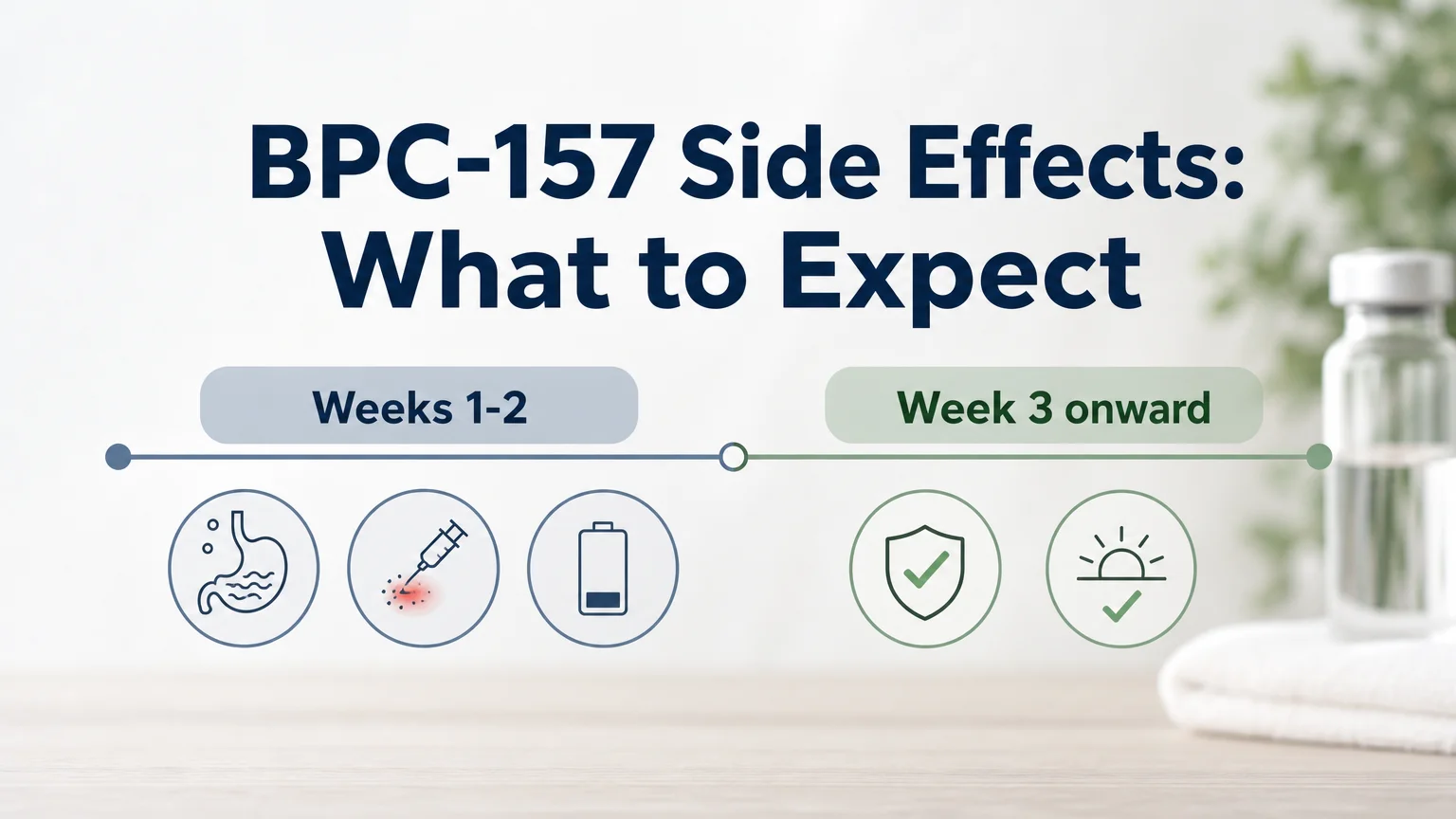
BPC-157 Side Effects: What's Normal & What Isn't
BPC-157 Side Effects: What's Normal, What Isn't, and When to Stop
Search for BPC-157 side effects and you land in one of two camps: forum posts saying nothing ever goes wrong, and clinic pages warning of dangers they can't name. Neither helps when you're three days in and your stomach feels off. This guide separates what people actually report from what's proven, and tells you where the line for pausing sits.
General education, not medical advice. BPC-157 is not FDA-approved, so talk to a licensed clinician before starting, changing, or stopping it.
Key Takeaways
- The most commonly reported BPC-157 side effects are mild: injection-site soreness or redness, nausea, headache, dizziness, and fatigue.
- Reports cluster in the first couple of weeks, but timing data is anecdotal. No controlled trial has measured how long side effects last.
- Allergic-type reactions, chest pain, fainting, severe abdominal pain, or signs of bleeding are reasons to stop and get medical care.
- Human safety evidence is very thin: a few small studies and case reports, plus a large body of animal research.
- Logging each symptom with a severity level turns "is this normal?" into a pattern you can actually read and show a clinician.
Contents
- What are the most common BPC-157 side effects?
- What does the human evidence actually show?
- Does BPC-157 cause nausea, fatigue, or headaches?
- Are BPC-157 side effects normal and temporary?
- How long do BPC-157 side effects last?
- Which BPC-157 side effects are dangerous?
- How can you reduce BPC-157 side effects?
- When should you stop taking BPC-157?
- How PeptideIQ Helps You Track and Understand BPC-157 Side Effects
- FAQ
What are the most common BPC-157 side effects?
The most commonly reported BPC-157 side effects are injection-site redness, soreness, or bruising, followed by mild nausea, headache, dizziness, and fatigue. Almost all of these come from user reports and clinic summaries rather than controlled trials, so there are no reliable incidence rates.
Here is the realistic list, roughly in order of how often people mention it:
- Injection-site irritation: redness, a small lump, tenderness, or a bruise where you injected.
- Nausea or an unsettled stomach: usually mild and often tied to injecting near mealtimes.
- Headache: typically dull and short-lived.
- Fatigue or heaviness: often in the first days of a protocol.
- Dizziness or lightheadedness: brief, sometimes after a dose.
- Sleep or mood changes: reported less often and harder to attribute.
Notice what's missing: a number. Nobody can tell you "12% of users get nausea," because that study doesn't exist. Anyone quoting percentages is guessing.
The short version: Reported effects are mild and local or digestive. The honest caveat is that "reported" is doing a lot of work in that sentence.
What does the human evidence actually show?
Almost everything published on BPC-157 comes from rodent studies, many from a single research group. In humans there are only a handful of small reports. One retrospective case series looked at knee-pain injections, and a very small 2025 pilot gave intravenous doses to two adults. Both reported no adverse effects, but samples this small can't rule anything out.
That is why the FDA hasn't approved BPC-157 and why WADA has prohibited it in sport since 2022. "No serious problems reported" is not the same as "proven safe," a point we cover in more depth in whether it is safe to take BPC-157 every day.
One more variable gets missed. FDA testing has found up to 40% of online peptide products contained incorrect dosages or undeclared ingredients. Some "BPC-157 side effects" may really be reactions to what was in the vial, or to a reconstitution mistake.
Does BPC-157 cause nausea, fatigue, or headaches?
Yes, all three are reported, usually mild. Nausea and headache tend to appear within hours of a dose, while fatigue is more often described over the first week or two. None has been proven to be caused by BPC-157 itself, because there are no placebo-controlled human trials to compare against.
Each one has more than one plausible explanation. That is worth knowing before you blame the peptide.
Nausea
Mild nausea is among the most-mentioned complaints. Injecting on a very full or very empty stomach, a slightly high dose, or a contaminated vial could each produce it. If it comes with vomiting or severe abdominal pain, that's a different category, covered below.
Headache
Dehydration is a common and fixable contributor. Sleep disruption and the stress of starting something new can add to it. A headache that is severe, sudden, or paired with vision changes is not a "normal adjustment" symptom.
Fatigue
Early tiredness is widely reported and sometimes described as part of the body settling in. We unpack the possible reasons in our guide to BPC-157 fatigue and when it's worth worrying. The key habit is the same: log it, because a pattern tells you more than a single bad day.
Are BPC-157 side effects normal and temporary?
Mild side effects like injection-site soreness, light nausea, or brief tiredness are common among BPC-157 users and usually fade on their own, which is why people often treat them as adjustment effects. "Normal" here is a judgment call based on anecdote, not an established clinical category.
A useful way to sort what you feel is by three questions:
- Is it mild? You notice it, but you can go about your day.
- Is it fading or stable? Better or flat across days, not climbing.
- Is it explainable? Poor sleep, low water intake, or a rotated injection site could account for it.
If all three are yes, watching and logging is a reasonable response. If any answer is no, move toward the "when to pause" section instead.
Reality check: "It's probably adjustment" is a hypothesis, not a diagnosis. Treat a symptom that gets worse over several days as new information, even if the first two days felt manageable.
How long do BPC-157 side effects last?
Most mild BPC-157 side effects are described as lasting hours to a few days, with early-protocol fatigue or stomach upset sometimes stretching to one to two weeks. There is no controlled data on duration, so these windows come from user reports and should be read as rough expectations, not guarantees.
A practical timeline for what people describe looks like this:
| Effect | Typical reported window | Needs attention if |
|---|---|---|
| Injection-site redness or soreness | Hours to 2–3 days | Spreading redness, heat, pus, or fever |
| Mild nausea | Within hours of a dose; fades over days | Vomiting, or it persists past two weeks |
| Headache | Hours | Severe, sudden, or with vision changes |
| Fatigue | First 1–2 weeks | Deepening, or paired with dizziness or fainting |
| Dizziness | Minutes to hours | Fainting or chest symptoms |
If you are also wondering when benefits arrive, our breakdown of how long BPC-157 takes to work puts these early weeks in context. Side effects and results don't follow the same clock.
The signal that matters is direction. A symptom that shrinks week over week is behaving differently from one that holds steady or grows, and only a log can show you that.
Which BPC-157 side effects are dangerous?
Stop and seek medical care for swelling of the face or throat, trouble breathing, a widespread rash, chest pain, fainting, severe or persistent abdominal pain, or any sign of bleeding. These are rare in the reports available, but they are not the kind of symptoms to watch and wait on.
Serious reactions to any injectable are possible, whatever the compound. Contamination, a non-sterile technique, or an allergy to an ingredient can all trigger them. That is one reason the vial's origin matters as much as the peptide.
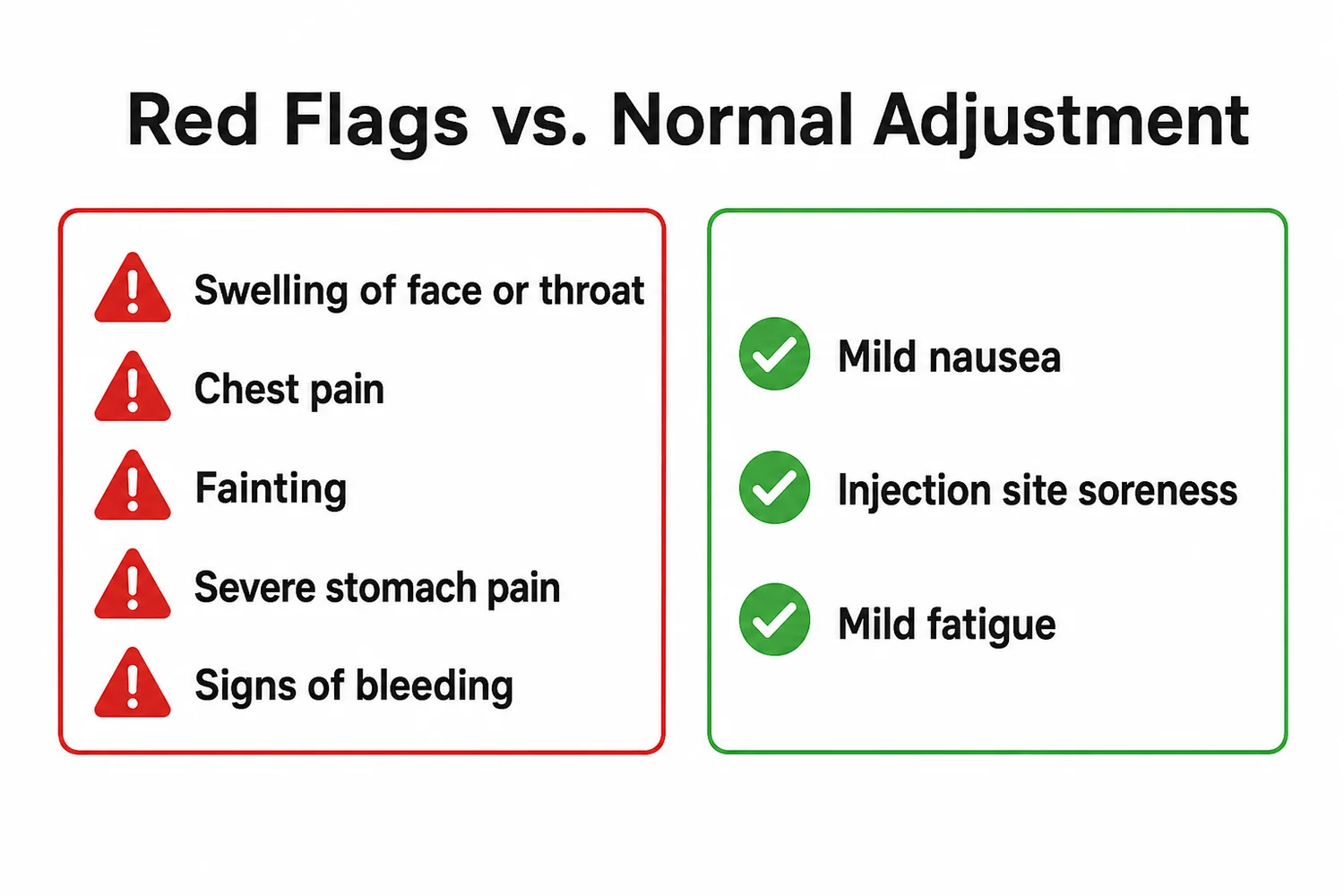 Red flags on the left call for stopping and getting care; the mild effects on the right are what people usually describe.
A separate, theoretical concern is worth naming without exaggeration. BPC-157 is studied for promoting blood-vessel growth in tissue repair, and some clinicians worry that this could matter for anyone with an existing tumor or a cancer history. Nobody has shown this happens in humans, but if that describes you, it is a question for your oncologist before you start, not after.
Common mistake: Waiting out a skin reaction that is spreading, hot, or painful. Local irritation is common; local irritation that expands is a possible infection.
How can you reduce BPC-157 side effects?
You can lower the odds of side effects by sourcing from a verified supplier, using sterile technique, rotating injection sites, staying hydrated, and not exceeding the dose your clinician or protocol recommends. Most of the controllable risk sits in product quality and handling, not in the peptide itself.
A short checklist:
- Verify the source. Ask for third-party test results, and be wary of vendors who can't produce them.
- Rotate sites. Don't reuse the same spot day after day. That's the simplest way to reduce soreness.
- Check your math. Reconstitution mistakes are a common way people accidentally overdose. See our BPC-157 dosage guide before drawing up a dose.
- Drink water. It's cheap, and headaches and fatigue are both common complaints.
- Change one thing at a time. If you start BPC-157 and a new supplement the same week, you can't tell which one caused what.
Stacking deserves its own caution. Running BPC-157 alongside another compound makes it harder to know the source of a symptom, as we note in our guide to the BPC-157 and TB-500 stack.
When should you stop taking BPC-157?
Pause BPC-157 and contact a clinician if a side effect is severe, worsening over several days, or interfering with daily life. Stop immediately and seek urgent care for allergic-type reactions, chest pain, fainting, or bleeding. If you're unsure, pausing costs you a few days; ignoring a warning sign can cost far more.
Here is a simple three-tier rule many users find workable:
- Mild and stable: keep going, keep logging, and look at hydration, sleep, and injection technique.
- Moderate or worsening: hold your next dose, check your math and your vial, and talk to a clinician.
- Severe or alarming: stop, and get care the same day.
Bring your log. A clinician can do far more with "headache, moderate, four days in a row, started after the second week" than with "I've been feeling off." That detail is the single most useful thing you can hand over.
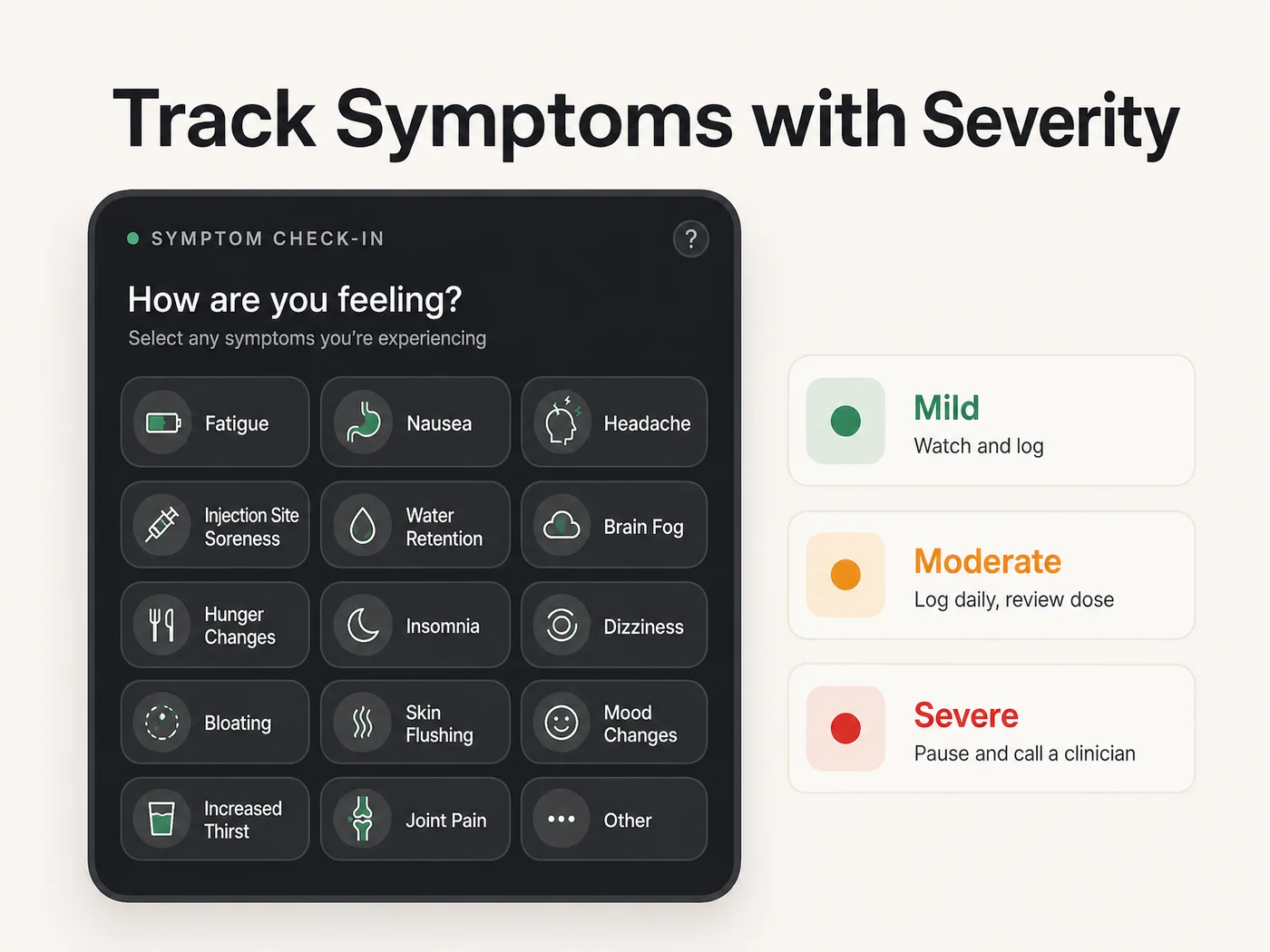 An illustration of the check-in PeptideIQ is built around: pick the symptom, then tag it Mild, Moderate, or Severe.
How PeptideIQ Helps You Track and Understand BPC-157 Side Effects
The hard part of side effects is not recognizing a sore injection site. It's remembering, ten days later, whether the headache came before or after you changed your dose.
When you log a dose in PeptideIQ, there's an optional side-effects step with a quick-tap symptom grid: Fatigue, Nausea, Headache, Injection Site Soreness, Water Retention, Brain Fog, Hunger Changes, Insomnia, Dizziness, Bloating, Skin Flushing, Mood Changes, Increased Thirst, Joint Pain, and Other. Each symptom gets a Mild, Moderate, or Severe tag. That severity tag is what separates a passing adjustment from a pattern worth acting on.
The app also connects the dots for you. If you log a headache while your water intake sits below half of your daily goal, it surfaces a hydration prompt, because that's a common and fixable factor. Logging a side effect can also open the AI co-pilot, which already knows your protocol day and recent check-ins.
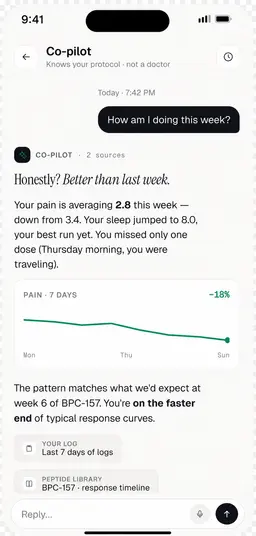 A real co-pilot weekly summary: pain trend, sleep, and adherence read together, with the response compared against typical week-6 BPC-157 patterns.
The screenshot above shows why context matters. The co-pilot reads one week of logs at once and notes a missed dose alongside the pain trend, so a symptom is judged against what else happened that week, not in isolation. When it's time to see a clinician, the doctor-friendly PDF export includes your side-effects log along with dose history and wellness metrics.
PeptideIQ is a wellness tracking and guidance app, not a medical one. It can help you see the pattern; it can't diagnose it.
Get Started with PeptideIQ
If you're going to run BPC-157, a clear log of what you felt and when beats memory every time. PeptideIQ is an iOS app currently in pre-launch, and the waitlist is open.
Not ready to try it yet? Keep this checklist handy and start a simple notes log today: date, dose, symptom, severity.
FAQ
Is BPC-157 safe?
BPC-157 is not FDA-approved, and human safety data is limited to a few small studies and case reports. Animal research is extensive, but animals aren't people. No serious adverse events are well documented at typical doses, though that reflects thin evidence, not proof of safety.
What are the side effects of BPC-157?
Reported effects are mostly mild: injection-site redness or soreness, nausea, headache, dizziness, and fatigue. They come from user and clinic reports, not controlled trials, so incidence rates are unknown. Allergic reactions, chest pain, fainting, and bleeding signs are rare warning signs that need urgent medical care.
Does BPC-157 cause headaches?
Headaches are among the commonly reported effects and are usually mild and short-lived. Dehydration, poor sleep, or a contaminated or mis-dosed vial may contribute. A sudden, severe headache, or one with vision changes or confusion, is not routine and warrants medical attention.
Can BPC-157 cause nausea?
Yes, mild nausea is one of the most frequently mentioned effects. It often appears within hours of a dose and fades over days. Try changing injection timing relative to meals and check your dose math. Persistent vomiting or severe abdominal pain means stopping and calling a clinician.
How long do BPC-157 side effects last?
Mild effects are usually described as lasting hours to a few days, and early fatigue or stomach upset may continue one to two weeks. No controlled study has measured duration, so treat this as a rough guide. Effects that worsen or persist beyond two weeks deserve a clinician's input.
Should I stop BPC-157 if I get side effects?
Stop immediately for allergic-type reactions, chest pain, fainting, severe abdominal pain, or bleeding. For moderate or worsening symptoms, pause and talk to a clinician. Mild, stable effects can reasonably be monitored while you log severity daily and check hydration, sleep, and technique.