

Is BPC-157 Hard on the Kidneys? What Evidence Shows
Is BPC-157 Hard on the Kidneys? What the Evidence Does and Doesn't Show
General education, not medical advice. BPC-157 is not an FDA-approved drug, and nothing here is a recommendation to use it. Kidney questions belong with a clinician.
Nobody can say yes or no with confidence. There are no published human trials built to test whether BPC-157 harms or protects the kidneys, so the honest answer is that the human evidence does not settle it.
Is BPC-157 Hard on the Kidneys?
The human evidence does not settle it. No human trial has been designed to measure kidney effects, and the few human studies are tiny. Animal studies, mostly in rats, report kidney protection rather than damage, but animal results do not prove safety in people, especially people who already have kidney disease.
That answer has two parts, and they pull in different directions. Preclinical work looks reassuring. Human data is close to absent.
A 2025 systematic review in the HSS Journal covered 36 studies of BPC-157 in musculoskeletal medicine. Only one involved humans, a small knee-pain series. The authors found no harm in animals, but they were explicit that clinical safety data in people is lacking.
Key Takeaways
- The human evidence on BPC-157 and kidney damage is too thin to call it safe or harmful. Absence of reports is not proof of safety.
- Rat studies reporting kidney protection are preclinical. They show a signal worth studying, not a result you can apply to your own kidneys.
- Forum stories of kidney trouble are anecdotes. Most cannot separate BPC-157 from dehydration, NSAIDs, creatine, high protein intake, or existing kidney disease.
- Creatinine, BUN, and eGFR are the standard kidney markers. A baseline test before a protocol, and a repeat during it, gives you data instead of guesses.
- Anyone with known kidney disease, or on dialysis, should involve their nephrologist before considering any peptide.
What Do Studies Show About BPC-157 and Kidney Function?
Kidney-specific findings come almost entirely from rats. Studies report less kidney tissue injury after hind-limb ischemia, renal artery ligation, and raised abdominal pressure. All are short, small, injury-model experiments, and none tested long-term use in healthy kidneys or in people with kidney disease.
Here is the evidence, with its level labelled:
- Rats, lower-limb ischemia-reperfusion (2025, Medicina): treated animals showed fewer kidney lesions on histology and higher antioxidant activity in kidney tissue. This group is independent of the Zagreb lab that produced most BPC-157 research.
- Rats, renal artery ligation (Zagreb group, 2019 abstract): a meeting abstract reporting reduced severity of renal ischemia injury.
- Rats, intra-abdominal hypertension (2023, Pharmaceuticals): less renal congestion and interstitial edema in treated animals.
- Humans: a handful of pilot studies in knee pain, interstitial cystitis, and a two-person intravenous safety pilot. None was powered or designed to answer a kidney question.
 Kidney questions are answered with lab values, not with forum anecdotes or rat histology.
One more caveat. Most BPC-157 research comes from one research group, and independent replication in humans is what is missing. That is the gap, and it is why "promising in rats" cannot be rewritten as "safe for your kidneys."
Reality check: Rat tissue protection after an injury is a different question from what happens to your kidneys after months of injections from an unregulated vial.
Related: What Peptide Does Joe Rogan Use? What the Record Shows
Is BPC-157 Hard on the Kidneys? Why Forums Say Yes
Most reports are anecdotes where BPC-157 is one of several variables. Dehydration, anti-inflammatory painkillers, creatine, heavy protein intake, and undiagnosed kidney disease can all move kidney markers or cause symptoms, and a forum post rarely records any of them.
A Reddit thread titled "BPC-157 causes kidney damage" and another about BPC-157 and dialysis rank for this keyword. They are worth reading to see what readers fear. They are not evidence. Nobody in them has published labs from before the protocol.
Product quality adds noise. FDA testing, cited widely in the peptide world, found that up to 40% of online peptide products had incorrect doses or undeclared ingredients. If a gray-market vial contains something else, any symptom is unattributable.
People are usually injured while using BPC-157, often for a tendon or joint problem. The pain that sent them looking for BPC-157 is frequently treated with ibuprofen or naproxen, and NSAIDs are a well-known cause of kidney strain. That confound alone can explain a lot of anecdotes.
Signs Your Kidneys May Be Reacting to a Peptide
Early kidney trouble is often silent. Symptoms that deserve a call to a clinician include noticeably less urine, swelling in the ankles or face, foamy urine, new unexplained fatigue, or nausea. These are not specific to peptides, and only a blood and urine test can confirm anything.
Watch for patterns, not single days:
- Urinating much less than usual despite drinking normally
- Puffiness around the eyes, or swollen ankles
- Foamy or dark urine that persists
- New fatigue or nausea that does not fit your sleep or workload
Severe symptoms, or sudden changes, mean getting medical care rather than waiting to see. Our guide to what the evidence says about the risk of taking peptides places kidney concerns in the wider risk picture, and the sister piece on BPC-157 and the heart covers the cardiovascular side. That one is a separate question.
Who Should Check Kidney Function Before Using BPC-157?
Anyone considering BPC-157 benefits from a baseline kidney panel, and people with known kidney disease, diabetes, high blood pressure, or regular NSAID use need a clinician's input first. For anyone on dialysis, no human data exists, so the decision is not one to make alone.
Higher-priority groups include:
- People with chronic kidney disease or reduced eGFR
- People with diabetes or hypertension, the two most common causes of kidney disease
- Daily users of ibuprofen, naproxen, or similar painkillers
- Anyone stacking several compounds. Combining peptides adds unknowns, as covered in how BPC-157 and TB-500 stacks work
- Anyone using high doses or long cycles. Dose and duration matter for any organ question, and the BPC-157 dosage reference shows how widely reported doses vary
Dose and cycle length are not independently validated for kidneys. Tracking when effects appear also helps separate normal from concerning, which the BPC-157 timeline explains.
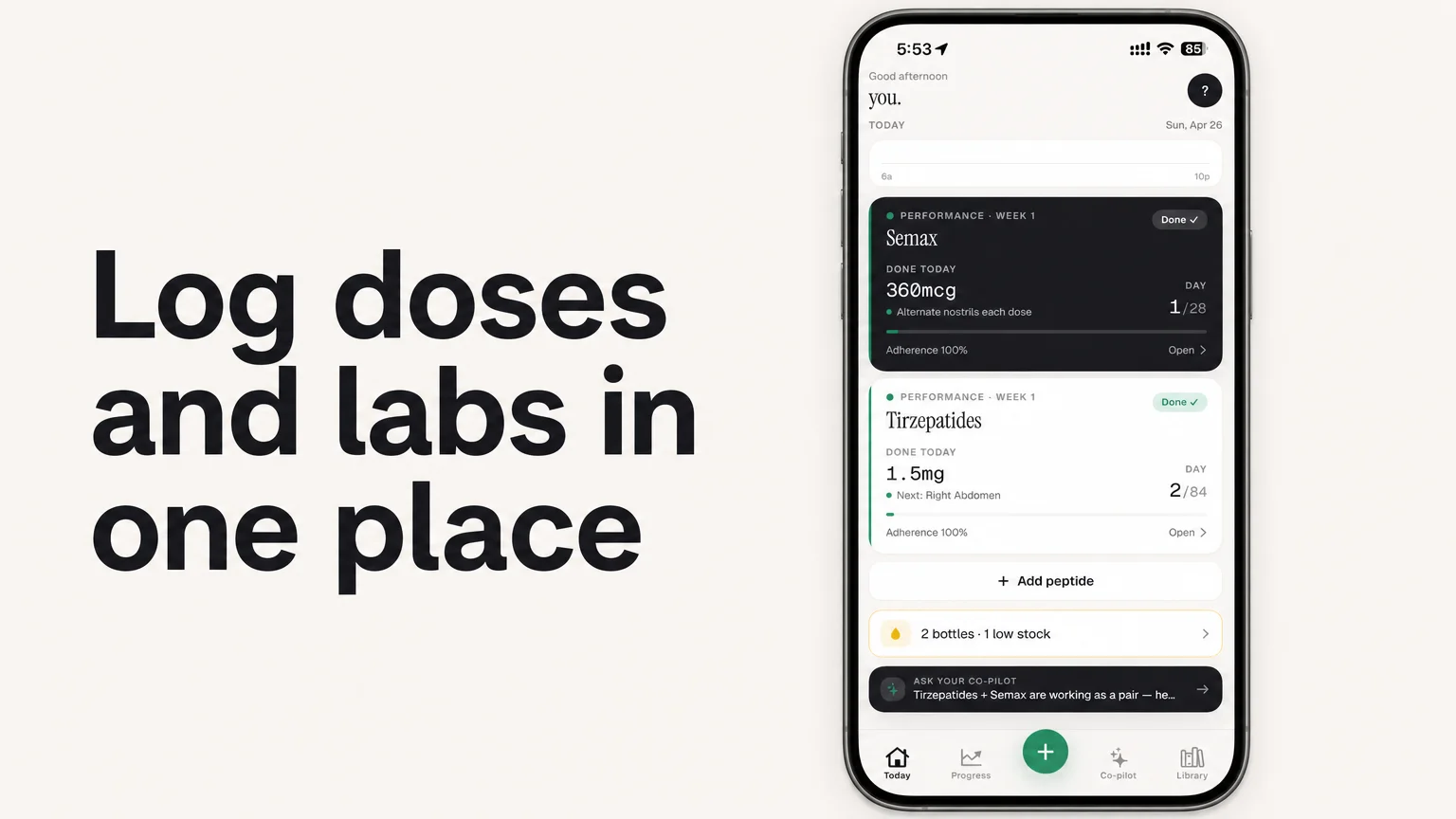 Dose logging and labs sit in the same place, so a result can be read against what you took and when.
How to Track Kidney Markers During a BPC-157 Protocol?
Get a kidney panel before you start, then repeat it during the protocol at a schedule your clinician sets. The three markers to track are creatinine, BUN, and eGFR. A trend against your own baseline tells you far more than any single number.
What each marker is:
- Creatinine: a waste product from muscle. Rising creatinine can signal reduced kidney filtering, though creatine supplements and hard training can nudge it.
- BUN (blood urea nitrogen): a waste product from protein breakdown. Dehydration and high protein intake can raise it.
- eGFR: an estimate of filtering rate, calculated from creatinine, age, and sex. Values persistently under 60 for three months or more are a standard threshold for chronic kidney disease.
PeptideIQ's Bloodwork Tracker has a Kidney section for exactly these three markers. You enter results by hand from your lab report, and each value gets a color-coded status badge. A trend chart plots any marker across tests with the reference range overlaid, so a drift from your baseline is visible even while every value stays "normal."
Pair that with the dose log. Log each dose, then use the optional side-effect grid, which includes Increased Thirst and Water Retention, and the hydration tracker. If a creatinine rise lines up with a dehydrated week or a new painkiller, you and your clinician can see it. When it lines up with nothing, that is also information.
The Doctor Export builds a PDF with your dose history, side-effect log, and bloodwork with trend charts, so the appointment starts from data. To be clear, PeptideIQ does not diagnose anything and does not tell you whether your kidneys are fine. It organizes your records so a clinician can.
Get Started with PeptideIQ
If you are going to run a protocol anyway, the safest habit is recording it. PeptideIQ keeps doses, symptoms, and labs side by side so a kidney marker is never read in isolation.
FAQ
Can BPC-157 cause kidney damage?
There is no confirmed human evidence that it does, and none that it doesn't. Rat studies report kidney protection after injury, while human data is limited to a few small pilots. Anecdotal reports exist but cannot separate BPC-157 from other causes.
Is BPC-157 safe for people with kidney disease?
Unknown. No human trial has tested BPC-157 in chronic kidney disease or dialysis, and animal data does not transfer reliably. Anyone with reduced kidney function should discuss any peptide with a nephrologist before considering it.
Which blood tests check kidney function?
Creatinine, BUN, and eGFR are the standard blood markers, often paired with a urine test for protein. A baseline before starting and repeat tests afterward show whether values drift from your own normal.
Does PeptideIQ diagnose kidney problems?
No. PeptideIQ stores the lab values you enter, shows trends against reference ranges, and exports a PDF for your clinician. It is a tracking tool, not a diagnostic one, and it cannot tell you your kidneys are healthy.