
What Is the Risk of Taking Peptides? The Risk Ladder
What Is the Risk of Taking Peptides? A Sorted Risk Map
General education, not medical advice. If you have a medical condition or take prescription drugs, talk to a clinician first.
What is the risk of taking peptides? It is not one number. It depends on which peptide, where it came from, how it was mixed and dosed, and who is injecting it. For approved drugs like semaglutide, the risks are documented. For many gray-market peptides, the honest answer is that nobody has measured them well.
Most of the danger sits in controllable steps, not in the molecule itself. That is the good news, and the rest of this page sorts those steps from highest to lowest leverage. For the broader verdict, see our overview of whether peptides are safe.
What Is the Risk of Taking Peptides?
The risk of taking peptides comes from five places: unverified sourcing and purity, dosing and reconstitution errors, injection technique, interactions with other drugs or peptides, and pre-existing conditions. Long-term human safety data is thin for most non-approved peptides, so unknowns are part of the risk.
Think of it as a ladder. Each rung has a different evidence level, and you control some rungs far more than others.
- Sourcing and purity — well documented as a hazard. Unregulated products can be contaminated, impure, or mislabeled.
- Dose and reconstitution — well understood as a mistake pattern. The math is simple, but errors are easy.
- Injection technique — well understood. Infection and site reactions are basic injection risks.
- Interactions — limited data for most peptides, solid labeling for approved drugs.
- Pre-existing conditions — mixed. Some warnings are firm, others are theoretical.
Key Takeaways
- Peptide risk has five sources: sourcing and purity, dose and reconstitution, injection technique, interactions, and pre-existing conditions.
- Sourcing, dose, and technique are the most controllable and best documented risks (well-understood).
- Most non-approved peptides have limited or no long-term human safety data.
- FDA approval varies by peptide: semaglutide and tirzepatide are approved drugs, while many gray-market peptides are not approved for the uses people try them for.
- Logging doses and symptoms over time turns vague worry into a record you can show a clinician.
The Most Common Peptide Side Effects
Reported side effects are usually mild and short-lived: injection site soreness, headache, fatigue, nausea, and appetite changes. Reports for unapproved peptides are largely anecdotal, so treat frequency claims with caution. Approved GLP-1 drugs carry more formal warnings, including gastrointestinal effects and a risk of pancreatitis listed on their labels.
Here is what tends to show up across peptide types:
- Injection site soreness, redness, or a small lump
- Headache and fatigue
- Nausea, bloating, and other digestive changes
- Water retention, flushing, or sleep disruption with some growth-hormone-type peptides
- Dizziness or brain fog
We keep the full side-effect catalogue in the real downsides of peptides, so this page does not repeat it. Peptide-specific profiles differ, so a general list should not be stretched to cover every compound.
Reality check: "Mild" is a pattern, not a guarantee. A symptom that is mild on day one and worse on day ten is the one worth catching.
Related: Sermorelin Side Effects: What the Published Data Shows
Which Risks Depend on the Peptide and the Source?
Risk depends first on regulatory status. Approved peptide drugs such as semaglutide and tirzepatide have trial data and labeled warnings. Gray-market peptides such as BPC-157 or CJC-1295 are sold without that oversight, so both the evidence and the product itself are uncertain.
Source matters as much as the peptide. A vial from an unverified seller can differ from its label in purity, amount, or contamination. Independent analyses of unregulated injectable peptides have raised concerns about contamination, manufacturing impurities, and inaccurate dosing.
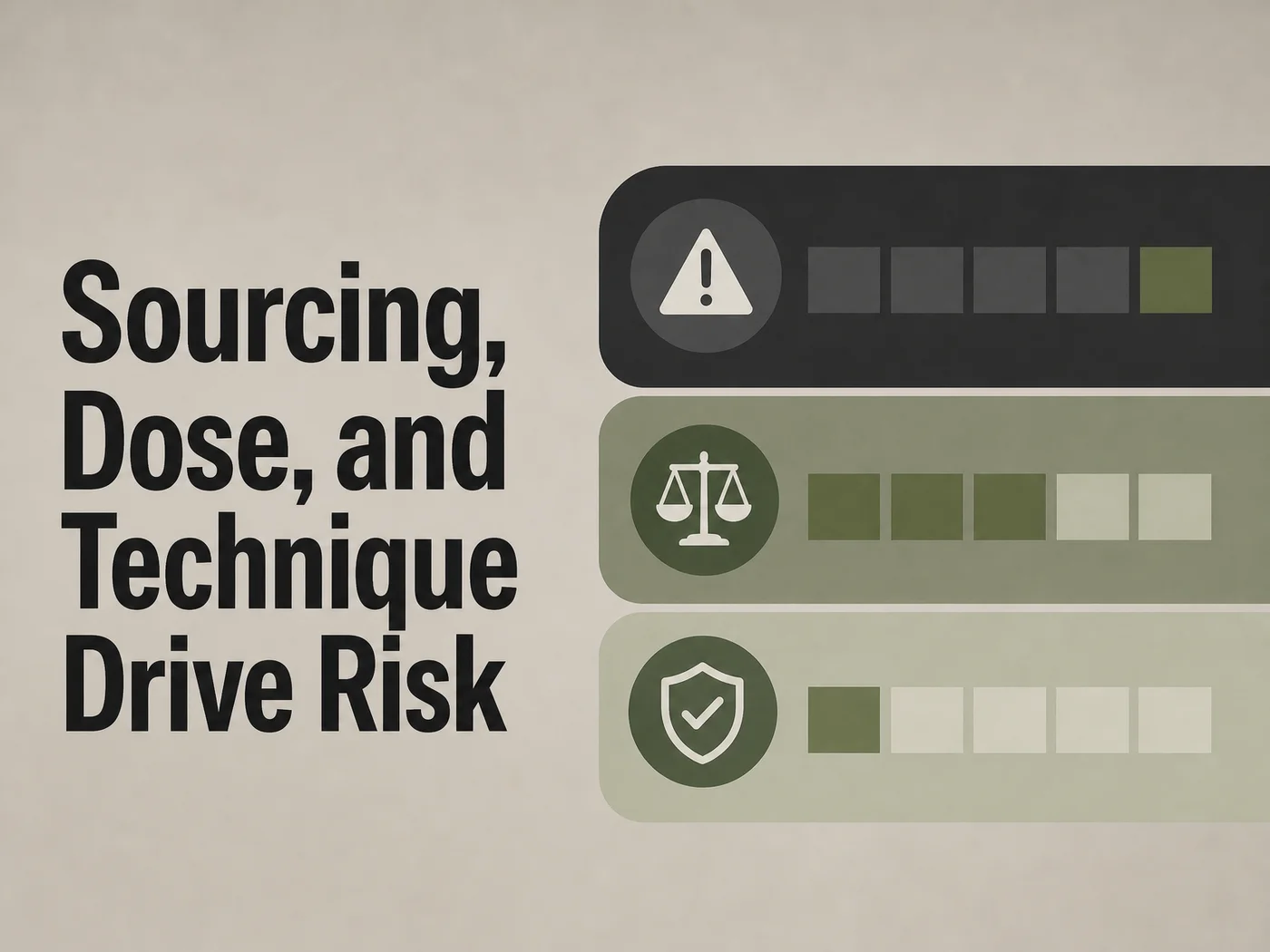 Sourcing, dose, and technique are the tiers you can actually control.
Rankings by evidence are in the safest peptides, ranked by evidence. Peptides are not steroids, but people compare them constantly, and the comparison hides how different the risks are.
What Is the Risk of Taking Peptides at the Wrong Dose or Technique?
Most peptides arrive as freeze-dried powder that you mix with bacteriostatic water. The math covers how much water to add, the resulting concentration, and how many syringe units to draw. A decimal slip can mean ten times the intended dose.
Technique adds a second layer:
- Use a new sterile syringe every time.
- Rotate injection sites so one area is not used repeatedly.
- Store reconstituted vials as the supplier or prescriber directs.
- Never share needles or vials.
Infection and site reactions are ordinary injection risks. They are also the easiest to reduce.
Common mistake: Changing two things at once, such as a new vial and a higher dose. If something goes wrong, you cannot tell which change caused it.
Who Should Not Take Peptides?
People who are pregnant or breastfeeding, have active cancer or a history of it, or have a serious medical condition should not take non-approved peptides without clinician oversight. Some peptides influence growth, hormones, or immune signaling, and the safety data in these groups is limited or absent.
Others who should get medical input first:
- People on prescription drugs, especially diabetes or blood-pressure medication, where interactions are plausible
- People with autoimmune conditions, since some peptides affect immune signaling
- Anyone with pancreatitis history considering GLP-1 drugs
- People under 18
Physician skepticism is mostly about missing evidence, not hostility; we cover the reasoning in why doctors are wary of peptides.
 PeptideIQ's Today screen keeps every active protocol and its adherence in one place.
How Can You Track Peptide Risks Over Time?
Track doses, symptoms, and severity in one place so changes show up as a pattern instead of a feeling. A simple log of what you took, when, and how you felt gives you and your clinician something concrete to review.
This is where guessing turns into data. PeptideIQ's dose log includes an optional symptom grid with 15 quick-tap options, including fatigue, nausea, headache, injection site soreness, water retention, brain fog, insomnia, and dizziness. Each symptom is tagged Mild, Moderate, or Severe, and you can add a custom symptom as free text.
The app does not detect or prevent adverse events. It records what you report so you can see whether a symptom started after a dose change, a new vial, or a new stack. The same log tracks injection-site rotation and the interaction reference, so the context sits beside the symptom.
PeptideIQ is pre-launch, and the waitlist is open.
When to Stop a Peptide and See a Doctor
Stop and get medical care for signs of an allergic reaction (hives, swelling of the face or throat, trouble breathing), severe or persistent abdominal pain, fever or spreading redness at an injection site, or any symptom you would call severe.
For moderate symptoms that persist or worsen, pause and talk to a clinician rather than pushing through. Clinical oversight changes the risk picture, because a prescriber can check dose, source, and interactions. Bring your log; it answers the first three questions they will ask.
FAQ
Are peptides dangerous?
Risk varies. Approved peptide drugs have known, labeled risks. Unapproved peptides carry added uncertainty from sourcing, purity, and limited human data. Danger is highest with unverified sources, dosing errors, and ignored symptoms.
Are peptides FDA approved?
Some are. Semaglutide and tirzepatide are FDA-approved drugs. Many gray-market peptides are not approved for the uses people try them for, so check the status of each peptide individually.
What are the most common side effects of peptide injections?
Injection site soreness, headache, fatigue, and nausea are most often reported. Severity ranges from mild to severe, and reports for unapproved peptides are mostly anecdotal rather than from controlled trials.
How can I lower my risk if I decide to use peptides?
Verify your source, double-check reconstitution math, use sterile technique, change one variable at a time, and log doses and symptoms. Involving a clinician lowers risk further, especially with other medications.
What does PeptideIQ track for side effects?
PeptideIQ's dose log offers a 15-symptom quick-tap grid with Mild, Moderate, and Severe tags, plus a free-text custom symptom. It records what you report. It does not detect or prevent adverse events.