

Why Don't Doctors Like Peptides? What They Worry About
Why Don't Doctors Like Peptides? What They're Really Worried About
Picture a patient mentioning, halfway through an appointment, that they've been injecting a peptide for six weeks. The physician asks four things: what exactly, what dose, from where, and what has changed since. Most people can answer one of those, and that gap is why don't doctors like peptides, more than any opinion about the molecules themselves.
This article is general education, not medical advice. Talk to a licensed clinician before starting, changing, or stopping any peptide.
Why Don't Doctors Like Peptides? It Usually Isn't the Molecule
Most physicians aren't objecting to peptides as a class. Many peptides are ordinary medicine, and semaglutide and tirzepatide are FDA-approved drugs prescribed every day. The skepticism targets unapproved compounds used without screening, without verified products, and without any record of what happened.
That distinction matters because "doctors hate peptides" is a lazy summary. A clinician who happily prescribes a GLP-1 can still wince at a gray-market vial of BPC-157 that arrived from an unknown vendor.
The discomfort is professional, not personal. Their training says: don't endorse what you can't verify, and don't manage what you can't measure.
The Four Concerns Behind Physician Skepticism
Strip away the eye-rolling and doctors' concerns about peptide use tend to collapse into four practical worries. None of them is exotic.
- No approval, thin human evidence. Many popular peptides rest on animal studies and anecdote.
- Unverified products. FDA testing of online peptide products has found up to 40% with incorrect dosages or undeclared ingredients.
- No screening or monitoring. Nobody checked your conditions, medications, or baseline labs before the first injection.
- No data. There is no log of doses, timing, symptoms, or outcomes to evaluate.
What a physician is mentally screening for
When a patient discloses peptide use, the doctor is quietly running a checklist: existing conditions that a new compound could aggravate, interactions with current prescriptions, injection technique and site problems, and early warning signs worth watching. Without a record, they're guessing.
Doctors also tend to lump peptides in with performance and enhancement drugs, even though most peptides people discuss are signaling molecules rather than anabolic steroids. That's an association patients have to work against, and a clear record helps.
Are Peptides Legal and FDA-Approved for Clinical Use?
Some are, most popular ones are not. Semaglutide and tirzepatide are FDA-approved prescription drugs. Compounds such as BPC-157 are not approved for human use, and the FDA treats peptides as drugs, which is why legal status and approval are two different questions with different answers.
Regulatory news in 2026 around compounding access made headlines, but access to compounding is not the same as an approval backed by large human trials. Physicians keep that line sharp because their liability and their patients' safety sit on it.
Our guide on whether peptides are legal walks through FDA status, compounding rules, and the gray market in detail.
Why Don't Doctors Like Peptides That Lack Human Evidence?
Because medicine runs on human trial data, and for most popular peptides it barely exists. Animal results can be promising and still fail to translate, which is why "it healed a rat's tendon" doesn't move a clinician. Without human data, a doctor cannot estimate benefit, risk, or the right dose.
Ask a physician what would change their mind and the answer is nearly always the same: controlled human studies, large enough to show both benefit and harm. Anecdotes, however sincere, don't substitute, because they only record the people who felt better and kept posting.
This is the honest center of the conversation. If you want the detail, our breakdown of what the research actually shows separates strong evidence from hopeful extrapolation, and the safety evidence summary does the same for risk.
Reality check: "Not proven unsafe" and "proven safe" are different claims, and physicians are trained to hold out for the second one.
For people weighing a supervised route, is peptide therapy safe covers what clinician-led protocols involve. Cost is the other thing that tends to surface: patients are often paying out of pocket with no medical context, and the numbers in our peptide therapy cost breakdown explain why that makes doctors uneasy.
What Doctors Actually Respect: Records, Not Reassurance
Here is the part that gets lost in forum arguments. A clinician can disagree with your choice and still respect how you made it.
What earns that respect is specific and dull:
- A baseline. Weight, symptoms, and relevant labs before you started.
- Exact doses and dates. Not "about 250, most days."
- Side effects with severity. Logged when they happen, not recalled later.
- Measured outcomes. Pain score, sleep, adherence, bloodwork trends.
- Honesty about the source. Vendor and batch, if you know them.
 A one-page summary changes the conversation from "what are you taking?" to "what does this show?"
Compare two appointments. In one, a patient says they've been "doing BPC-157 for a while and it seems to help," while in the other, they hand over six weeks of dated doses, a pain score trend, and a note about injection-site soreness on days 9 and 10. Same compound, completely different clinical conversation.
Using Peptides Without Your Doctor's Approval
Practically, many peptides can be bought without a prescription, so no one stops you. But "can" isn't "should." Without a clinician you have no screening, no baseline labs, no monitoring, and no one checking interactions, which are exactly the safeguards that make physicians nervous.
You don't need a doctor to sign off, and you shouldn't expect them to endorse something unapproved. What you do need is for them to know. Telling your clinician what you take, in organized form, lets them watch for what you can't see yourself.
Some will still say no. That's their call, but it's a very different outcome from a physician learning about your protocol by accident.
How PeptideIQ Closes the Trust Gap
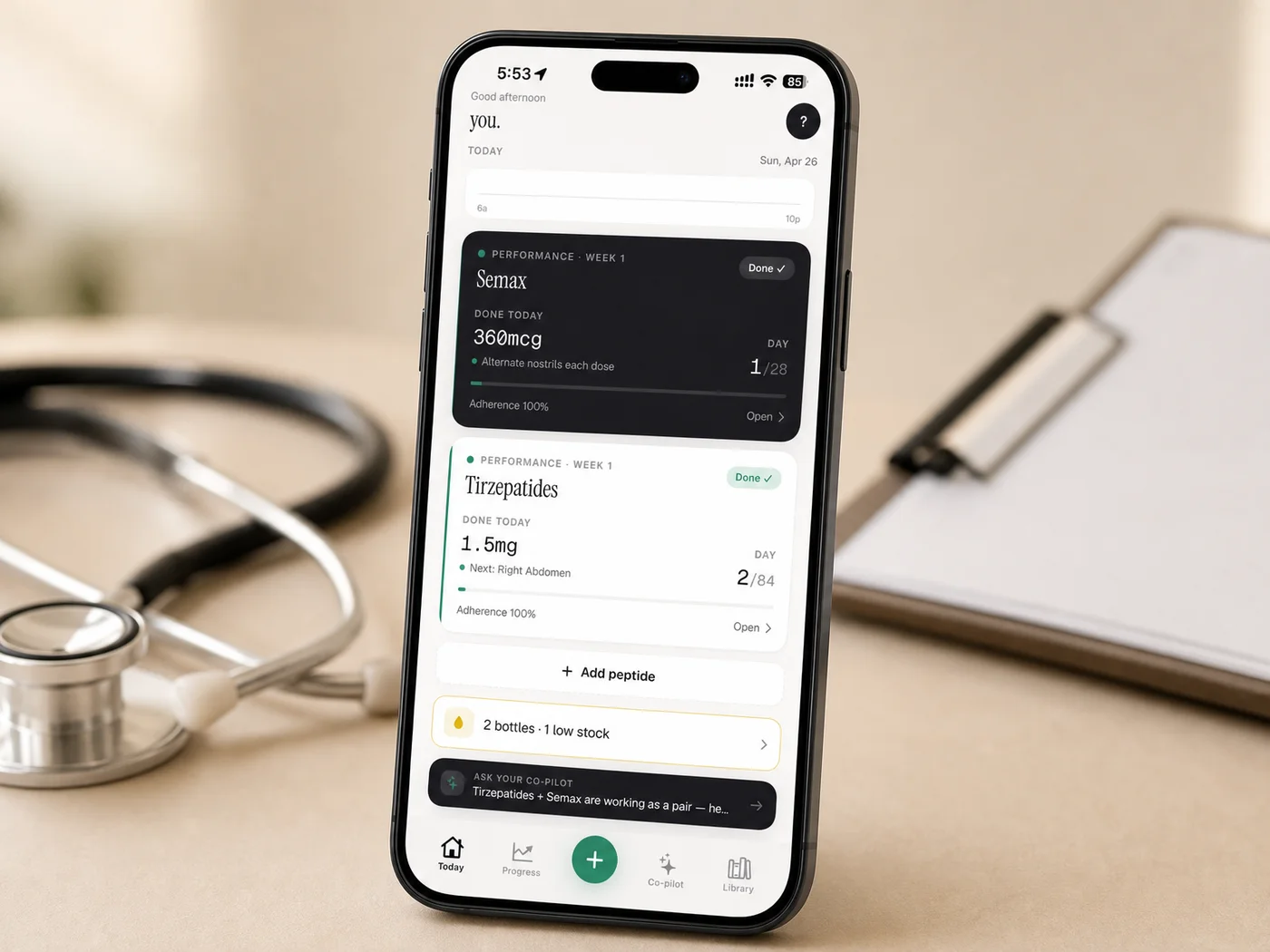 The Today screen: each active protocol with its dose, cycle day, and adherence in one view.
Everything in the list above is the thing PeptideIQ is built to produce. Each dose is logged against a planned protocol, so the cycle day and adherence are recorded rather than remembered. Wellness sliders and a symptom grid with Mild, Moderate, and Severe tags capture side effects when they occur.
When it's time to see your doctor, the Doctor Export generates a PDF built for a healthcare provider: dose history, wellness metrics, side effects log, bloodwork results with trend charts, and weight trend, filtered by date range. It's generated on your device, and nothing leaves it unless you choose to share it.
PeptideIQ is a wellness tracking and guidance app, not a medical device, and it won't make your doctor agree with you. It gives them something they can actually evaluate.
Quick Recap
Quick recap
- Doctors object to unverified, unmonitored, undocumented use, not to peptides as a whole class.
- Approved peptides like semaglutide and tirzepatide are routine medicine; many popular ones are not approved.
- The real gaps are human evidence, product quality, screening, and data.
- You don't need approval, but you do need transparency, and a documented log is the strongest form of it.
Get Started with PeptideIQ
If you're already running a protocol, the most useful thing you can do before your next appointment is start recording it properly. PeptideIQ is in pre-launch with a waitlist open now.
FAQ
Do doctors ever recommend peptides?
Yes, for approved ones: semaglutide and tirzepatide are FDA-approved and prescribed routinely. Doctors are far more cautious with unapproved compounds such as BPC-157, which lack human trial data and regulatory approval. Whether one is recommended depends on the specific peptide, your health history, and the clinician's judgment.
Can I use peptides without a doctor's approval?
Many gray-market peptides can be bought without a prescription, but that doesn't make self-directed use safe. Product quality is uncertain and nobody screens your conditions or medications. Telling a clinician what you take, even if they disagree, is the safer path.
Are peptides FDA-approved?
Some are, since semaglutide and tirzepatide are FDA-approved drugs. Many widely discussed peptides, including BPC-157, are not approved for human use. Compounding access is a separate question from approval, which requires evidence of safety and effectiveness from human trials.
What should I bring to a doctor about my peptide use?
Bring the peptide name, dose, start date, source if known, any side effects with severity, and your measured outcomes such as pain, sleep, weight, or lab results. A dated one-page summary is far more useful than memory.
Is peptide therapy the same as taking peptides on my own?
No. Peptide therapy usually means a clinician-supervised protocol with screening and monitoring, while self-directed use means you source, dose, and monitor everything yourself. The safety, cost, and evidence picture differ, and a supervised route tends to answer more of a doctor's concerns.