
Peptide Therapy Cost: What You Actually Pay | PeptideIQ
How Much Does Peptide Therapy Cost? A Transparent Breakdown
Budgeting for peptide therapy is harder than it looks. The vial price is the number everyone quotes — but by the time you add bacteriostatic water, syringes, cold storage, and the occasional wasted dose from an expired vial, your real monthly spend often runs 20–35% above what you saw advertised.
This breakdown covers actual peptide therapy cost ranges by type, hidden supply costs, and what it takes to run a protocol that delivers results rather than receipts.
Key Takeaways
- Peptide therapy costs range from $50–$500+ per vial, with full monthly protocols running $200–$2,000+ depending on peptide type and source.
- Compounded peptides (BPC-157, CJC-1295, Ipamorelin) are typically cheaper than FDA-approved GLP-1s like semaglutide or tirzepatide — but without the consistency guarantees of pharmaceutical manufacturing.
- Hidden supply costs — bacteriostatic water, insulin syringes, swabs — add $25–$65 monthly and are rarely included in advertised prices.
- Insurance almost never covers peptide therapy; out-of-pocket budgeting from cycle one is essential.
- Tracking doses and vial usage can reduce effective per-dose cost by 15–25% by preventing waste and catching expiring vials before you lose them.
Contents
- What Is Peptide Therapy and Why Does It Cost So Much?
- How Much Does Peptide Therapy Cost Per Cycle?
- What Factors Determine the Price of Compounded Peptides?
- How Do FDA-Approved Peptides Compare to Compounded Options in Price?
- What Should You Budget for a Full Peptide Therapy Protocol?
- Are There Ways to Reduce Peptide Therapy Cost Without Sacrificing Results?
- How to Maximize Peptide Therapy ROI and Track Every Dollar
- Frequently Asked Questions
What Is Peptide Therapy and Why Does It Cost So Much?
Peptide therapy uses short chains of amino acids — administered by injection or oral route — to signal specific biological outcomes: tissue repair, fat loss, hormone regulation, immune support. Costs reflect pharmaceutical-grade synthesis, cold-chain logistics, and compounding pharmacy overhead that bulk supplement manufacturing doesn't carry.
If you're new to the category, what is a peptide covers the biology before you commit any budget. Peptides aren't off-the-shelf supplements. They require sterile manufacturing, careful handling, and refrigeration throughout their shelf life once reconstituted.
That infrastructure costs money at every link in the supply chain before the vial reaches your fridge. A price that seems high isn't necessarily a markup — it may be the actual cost of doing it right.
Worth knowing: FDA testing has found incorrect dosages or undeclared ingredients in up to 40% of online peptide products sourced outside licensed compounders. For a clear-eyed look at where real safety risk lives, is peptide therapy safe covers the clinical evidence honestly — including where it's thin.
 Real peptide therapy costs start at the vial but don't end there — supplies, storage, and precision all factor in.
How Much Does Peptide Therapy Cost Per Cycle?
Peptide therapy costs range from $50–$500+ per vial depending on peptide type, vial size, and whether it's compounded or FDA-approved. A full monthly protocol typically runs $200–$2,000+, with most beginner protocols in the $250–$600 range before supply costs.
Here's what the market actually looks like in mid-2026:
| Peptide | Type | Cost Per Vial | Monthly Protocol | Monthly Spend |
|---|---|---|---|---|
| BPC-157 | Compounded | $50–$120 | 2–3 vials (5mg each) | $100–$360 |
| CJC-1295 + Ipamorelin (stack) | Compounded | $140–$280 combined | 2–4 vials total | $200–$500 |
| GHK-Cu | Compounded | $60–$100 | 1–2 vials | $60–$200 |
| Semaglutide (compounded) | Compounded | $150–$300 | 1 vial | $150–$300 |
| Semaglutide (Ozempic / Wegovy) | FDA-Approved | $800–$1,200 | 1 pen | $800–$1,200+ |
| Tirzepatide (Mounjaro / Zepbound) | FDA-Approved | $1,000–$1,500 | 1 pen | $1,000–$1,500+ |
| TB-500 | Compounded | $60–$150 | 1–2 vials | $60–$300 |
The beginner-friendliest entry point remains BPC-157 for injury recovery or a simple CJC-1295/Ipamorelin stack for growth hormone optimization — both widely researched and reasonably priced from reputable compounders.
For users evaluating options for the first time, the peptide guide for beginners covers which compounds fit which goals before you start pricing anything out.
What Factors Determine the Price of Compounded Peptides?
Compounded peptide pricing reflects synthesis complexity, vial size, purity testing standards, pharmacy licensing level, and cold-chain shipping requirements. A $60 BPC-157 vial and a $280 semaglutide vial aren't priced differently because of markup alone — the underlying production cost structure is genuinely different.
Five factors drive most of the price variation you'll see across vendors:
- Synthesis complexity. Longer peptide chains cost more to manufacture cleanly. Semaglutide's 31-amino-acid structure requires more synthesis steps than BPC-157's 15-residue sequence.
- Purity standards. Reputable compounders test each batch for potency, sterility, and endotoxin levels. That testing is not free — and not universal at the low end of the market.
- Vial size and concentration. A 10mg vial yields more doses than a 5mg vial at the same price-per-vial — unit economics improve with larger sizes, but upfront cost rises. First cycles should start small until you've confirmed the protocol works for you.
- Pharmacy licensing tier. 503A compounders serve local patients via prescription; 503B facilities operate under stricter federal oversight, ship nationally, and carry higher overhead reflected in pricing.
- Cold-chain shipping. Peptides ship refrigerated or frozen. Express cold-chain adds $15–$40 per order depending on destination and season.
Reality check: The cheapest peptide online is often priced that way for a reason. Choosing on price alone without vetting the source is how people end up with 60%-potency vials — which cost twice as much per effective dose, not half.
How Do FDA-Approved Peptides Compare to Compounded Options in Price?
FDA-approved peptides — semaglutide as Ozempic/Wegovy, tirzepatide as Mounjaro/Zepbound — cost $800–$1,500+ monthly without insurance. Compounded semaglutide from licensed pharmacies runs $150–$300 monthly. That's a four-to-eight-times price difference for a chemically similar compound, with trade-offs in oversight and consistency.
The 2026 regulatory landscape added complexity. After the RFK Jr. policy reversal in February 2026, 14 previously restricted peptides returned to legal compounding status — expanding accessible options and moderating prices in several categories, including BPC-157 and TB-500.
What this means for your budget:
- GLP-1s (semaglutide, tirzepatide): Brand versions remain $800–$1,500/month without coverage. Compounded alternatives, now more widely available again, run $150–$350/month. Most GLP-1 users — unless they have employer insurance that covers brand-name GLP-1s for type 2 diabetes — are using compounded versions.
- Growth hormone peptides (CJC-1295, Ipamorelin, Sermorelin): Compounded only; no FDA-approved equivalents. Pricing is market-driven, $60–$150 per vial.
- Healing peptides (BPC-157, TB-500): Compounded only, among the most affordable in the category.
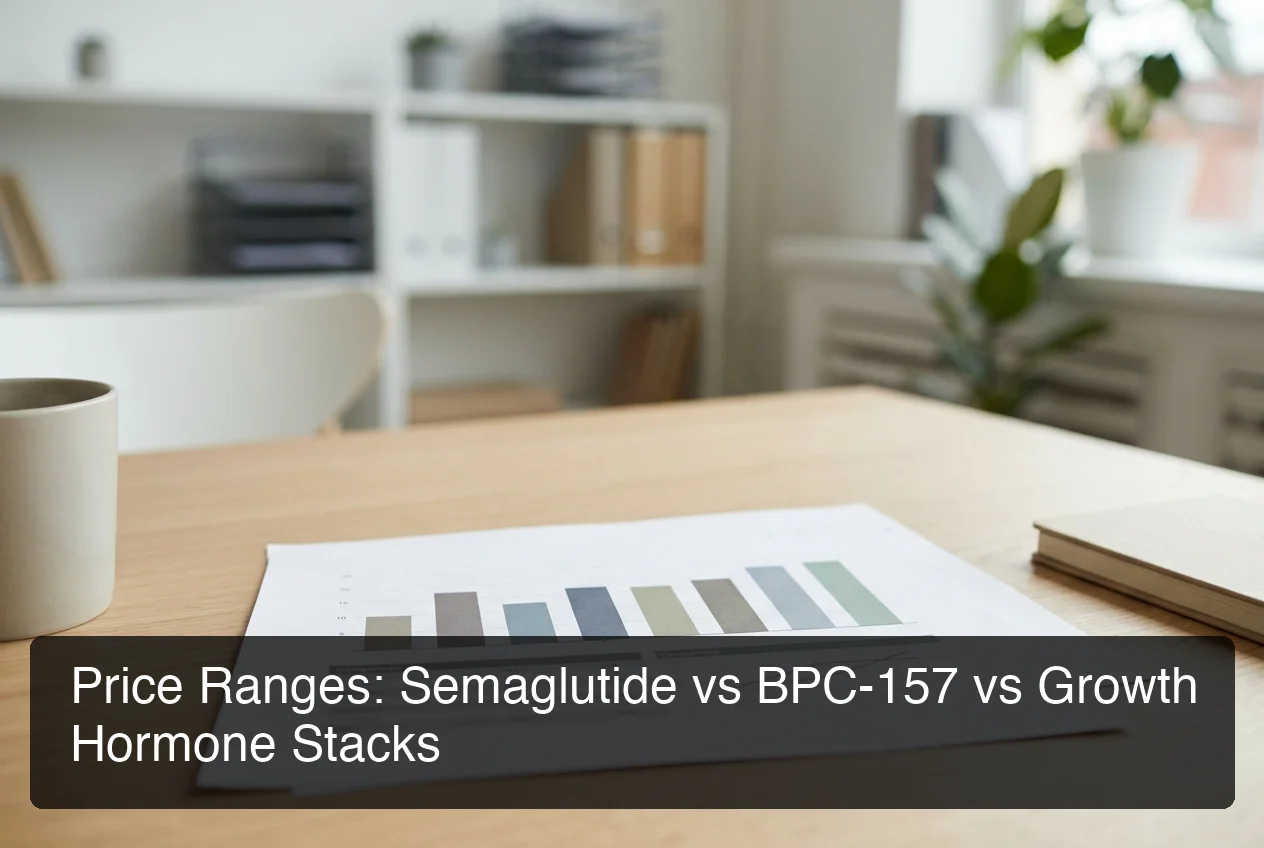 FDA-approved GLP-1s carry dramatically higher costs than compounded alternatives — that difference changes your monthly budget entirely.
On insurance: The situation is mostly settled. Standard health insurance does not cover peptide therapy or compounded peptides. Some plans cover brand-name semaglutide for diagnosed type 2 diabetes — not off-label weight loss use. A small number of employer plans have added GLP-1 coverage, but these are exceptions. Budget as if you're paying out of pocket.
What Should You Budget for a Full Peptide Therapy Protocol?
A realistic total budget includes peptide cost plus bacteriostatic water, insulin syringes, alcohol swabs, and optional periodic bloodwork. Most users underestimate total monthly spend by $50–$100 when they look at vial prices alone.
Here's what two common protocols actually cost per month:
CJC-1295 + Ipamorelin Stack (12-week cycle)
| Item | Monthly Cost |
|---|---|
| CJC-1295 (1 vial, 5mg) | $100–$150 |
| Ipamorelin (1 vial, 5mg) | $80–$130 |
| Bacteriostatic water (30ml multi-dose) | $8–$15 |
| U-100 insulin syringes (30-pack) | $10–$20 |
| Alcohol swabs (200-pack) | $5–$8 |
| Total | $203–$323/month |
Semaglutide Protocol (20-week weight loss cycle)
| Item | Monthly Cost |
|---|---|
| Semaglutide 5mg vial (compounded) | $150–$300 |
| BAC water + syringes + swabs | $25–$40 |
| Periodic bloodwork (every 6–8 weeks) | $30–$80 |
| Total | $205–$420/month |
Bloodwork is optional but worth budgeting. Monitoring HbA1c on semaglutide, or IGF-1 on a growth hormone stack, gives you real data on protocol response — not just subjective impressions. It's also the evidence your doctor needs to engage constructively with what you're doing.
Pro tip: Buy bacteriostatic water in 30ml multi-dose vials rather than single-use 10ml vials — the per-ml cost drops significantly, and you reduce waste across a 12-week cycle.
Are There Ways to Reduce Peptide Therapy Cost Without Sacrificing Results?
Yes. The most effective ways to reduce peptide therapy cost without sacrificing results: buy larger vials once the protocol is confirmed, use evidence-backed minimum effective doses, prevent waste through accurate dosing and vial tracking, and avoid stacking peptides until you know each one works.
Specific strategies that work without compromising safety or results:
- Buy larger vials when the protocol is confirmed. If you've run one 8-week cycle of BPC-157 at 250mcg twice daily and know it works, buying 10mg vials instead of 5mg drops cost per dose substantially. Don't bulk-buy until you've validated the protocol.
- Use evidence-backed minimum effective doses. Many users start above the ranges showing results in published data. BPC-157 at 250–500mcg daily shows consistent outcomes in animal models and anecdotal literature; running at 1mg daily doubles your cost without clear additional evidence of benefit.
- Don't stack peptides before you know each works. Running three compounds simultaneously means you can't attribute effects — or lack of effects — to any individual peptide. Start with one, assess over a full cycle, then stack deliberately.
- Prevent waste through expiry tracking. Reconstituted BPC-157 expires in roughly 30 days refrigerated. An untracked vial used at irregular intervals is a likely loss. Every dose you miss or lose to expiry is money already spent that produced no result.
- Source from 503B-accredited compounders. Higher price than gray-market imports — significantly better potency consistency. A vial at 60% potency costs twice as much per effective dose, not half.
Understanding the benefits of peptide therapy alongside the costs helps you make spending decisions on data rather than hope. Users who track their results can calculate what they paid per measurable outcome.
 Justifying the investment gets easier when you have real progress data — not just a stack of receipts.
How to Maximize Peptide Therapy ROI and Track Every Dollar
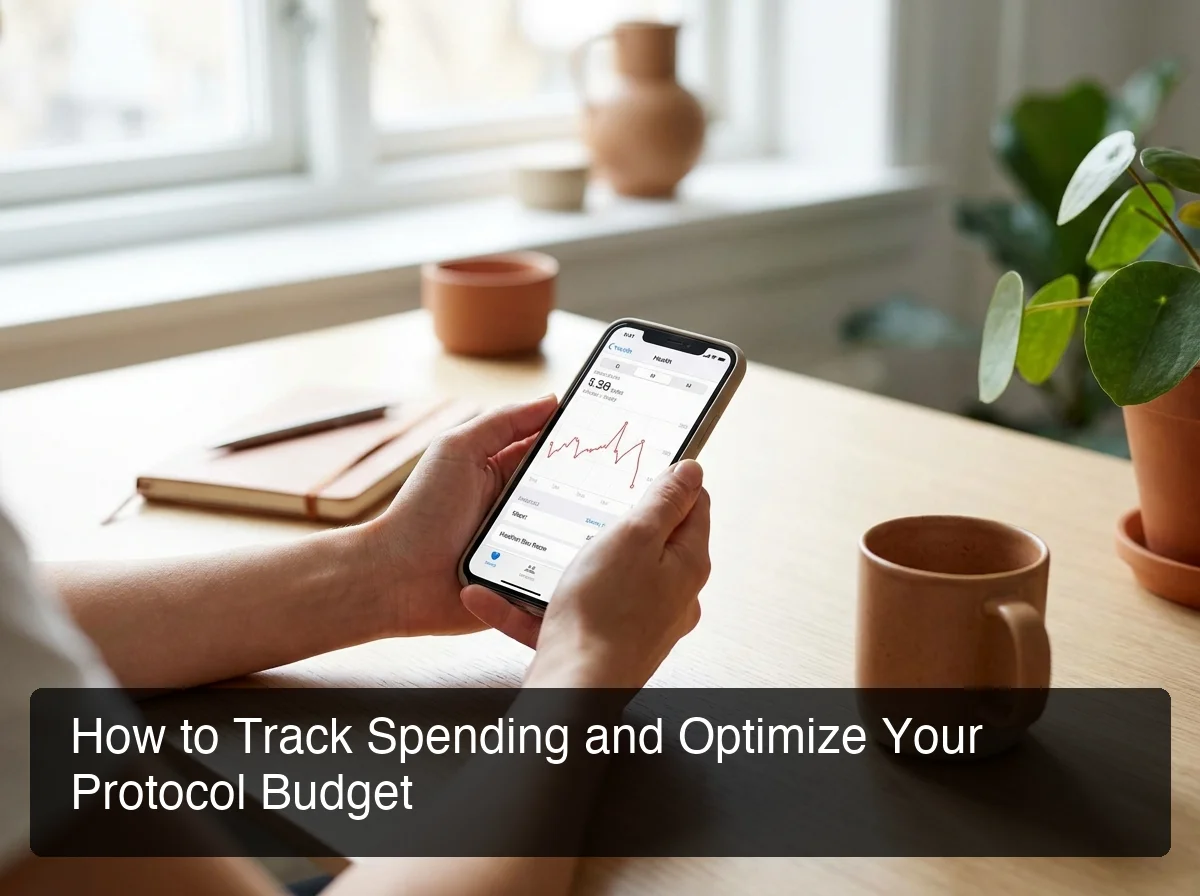 PeptideIQ's Inventory Manager auto-tracks doses remaining per vial and fires expiry alerts 5 days out — so you never discover waste after the fact.
Peptide therapy ROI comes down to two numbers: what you paid per dose, and how many of those doses actually reached your system at the correct concentration. Two things quietly destroy both: expired vials and imprecise reconstitution math.
PeptideIQ's Inventory Manager addresses both directly. For every vial in your protocol, it tracks the date reconstituted, BAC water volume added, resulting concentration, doses remaining (auto-decremented with each logged dose), and expiry date calculated per peptide type — BPC-157 at 30 days refrigerated, GLP-1s up to 90 days.
A low-stock alert fires when fewer than 7 days of doses remain — enough lead time to reorder without a gap in your protocol. An expiry warning fires 5 days before a vial expires regardless of doses remaining, so you don't discover an expired vial on day 31.
The reconstitution calculator determines per-dose cost precision: enter the peptide amount and BAC water volume, and the app outputs the resulting concentration plus exact syringe units per dose. All calculations save to the vial record automatically. An imprecisely reconstituted vial at 1.5× concentration means you're using 1.5× the peptide per injection without knowing it — burning through supply faster than your budget planned.
Core protocol tracking, including the Inventory Manager and dose logging, is available in PeptideIQ's free tier. AI co-pilot features and advanced analytics are on the subscription tier.
Get Started with PeptideIQ
Running a peptide protocol without tracking is spending money without a ledger. PeptideIQ turns your protocol into a data-driven system — every dose logged, every vial accounted for, every side effect noted so you can see exactly what you're paying per result.
Download PeptideIQ on the App Store
Frequently Asked Questions
How much does peptide therapy cost per month?
Most compounded peptide therapy protocols cost $200–$700 per month including supplies. A growth hormone stack (CJC-1295 + Ipamorelin) runs $200–$500 monthly; compounded semaglutide runs $175–$360 all-in. FDA-approved brand GLP-1s cost $800–$1,500+ without insurance — a significant premium over compounded equivalents.
How much do 3 months of peptides cost?
A 3-month compounded peptide protocol typically costs $600–$2,100+ depending on type. A basic BPC-157 protocol runs $450–$900 over 12 weeks; compounded semaglutide runs $600–$1,200 all-in over the same period. Budget an additional $80–$180 for supplies across the quarter.
Are peptides actually worth it?
For defined, measurable goals with a structured protocol, many users report outcomes that justify the investment — weight loss on GLP-1s, injury recovery on BPC-157, improved sleep and recovery on growth hormone peptides. The value calculation depends heavily on correct administration, consistent dosing, and whether you're tracking results. Peptides without a monitoring system make ROI nearly impossible to assess.
How are people affording peptides?
Most peptide users pay out-of-pocket for compounded versions. Strategies to reduce spend: confirm the protocol works before buying large volumes, use evidence-backed minimum effective doses, source from licensed compounders to avoid potency inconsistency, and track doses precisely to prevent waste before expiry. Some users time purchases around vendor cycles to maximize discounts.
Does insurance cover peptide therapy?
Standard health insurance doesn't cover peptide therapy or compounded peptides. Some employer plans cover brand-name semaglutide for diagnosed type 2 diabetes — not off-label weight loss — and some HSA-eligible functional medicine practices offer peptide protocols. For planning purposes, assume full out-of-pocket costs.
How much does BPC-157 cost?
BPC-157 from licensed US compounders typically costs $50–$120 per 5mg vial, lasting roughly 10 days at 250mcg twice daily. Monthly BPC-157 cost runs $100–$360 depending on vial size, protocol dose, and source. Gray-market imports price lower but carry documented potency and contamination risks that often make them more expensive per effective dose.
How long does a peptide injection last in your system?
This depends entirely on the peptide's half-life: BPC-157 clears within hours (requiring twice-daily dosing), semaglutide's 7-day half-life allows once-weekly injection, and CJC-1295 with DAC lasts 6–8 days. Half-life determines dosing frequency and directly affects how much supply you'll consume per cycle. More frequent dosing means more vials purchased — and meaningfully higher total peptide therapy cost over a 12-week protocol.