
Peptide Therapy Benefits: What the Evidence Really Shows
Peptide Therapy Benefits: What the Evidence Really Shows
In the STEP 1 trial, adults taking semaglutide 2.4 mg lost an average of 14.9% of their body weight over 68 weeks, against 2.4% on placebo. In SURMOUNT-1, the top tirzepatide dose averaged 20.9% over 72 weeks. Those are the peptide therapy benefits with real trial backing, and almost everything else sits several tiers below them.
Key Takeaways
- Peptide therapy benefits are best proven for FDA-approved GLP-1s: semaglutide averaged 14.9% weight loss at 68 weeks and tirzepatide up to 20.9% at 72 weeks.
- BPC-157, TB-500, and most longevity peptides have animal or early-stage human evidence, not Phase 3 proof.
- Full results build over months because doses are escalated gradually, and unapproved peptides have no reliable human timeline.
- Product quality varies: FDA testing found up to 40% of online peptide products had incorrect dosages or undeclared ingredients.
- Tracking a baseline, doses, outcome scores, and side effects is the only way to know if a peptide is working for you.
This article is general education, not medical advice. Talk to a licensed clinician before starting, changing, or stopping any peptide.
What Are the Real Benefits of Peptide Therapy?
Peptide therapy benefits depend entirely on which peptide you mean. Weight loss and glucose control are proven for FDA-approved GLP-1 drugs, while tissue repair, recovery, sleep, and longevity claims for other peptides rest mostly on animal studies, small human trials, and personal reports.
The table below sorts the main claims by how much human evidence stands behind them.
| Goal | Common peptides | Evidence tier | What the evidence supports |
|---|---|---|---|
| Weight loss | Semaglutide, tirzepatide | FDA-approved | Large Phase 3 trials, double-digit average weight loss |
| Cardiovascular risk | Semaglutide | FDA-approved | SELECT trial: 20% fewer major cardiac events in adults with heart disease and overweight |
| Abdominal fat (HIV lipodystrophy) | Tesamorelin | FDA-approved | Approved for this specific indication only |
| Injury and gut recovery | BPC-157, TB-500 | Strong animal evidence | Rodent studies; little controlled human data |
| Muscle, recovery, sleep | CJC-1295, ipamorelin | Early human trials | Raises growth hormone signaling; outcome data is thin |
| Skin, longevity | GHK-Cu, MOTS-c, epitalon | Early or preliminary | Topical skin work exists; systemic claims are mostly preclinical |
By the numbers: Semaglutide and tirzepatide produced nearly $30 billion in combined revenue in 2024. That scale exists because the trial results held up, which is not true of most gray-market peptides.
How Much Weight Can You Lose with Peptide Therapy?
On the FDA-approved GLP-1 peptides, the average adult in clinical trials lost roughly 15% to 21% of body weight, depending on the drug and dose. Results vary widely between individuals, and much of the weight tends to return if treatment stops.
These are the headline numbers from the pivotal trials:
- Semaglutide 2.4 mg (STEP 1): 14.9% average loss at 68 weeks, versus 2.4% on placebo.
- Tirzepatide 5 mg, 10 mg, 15 mg (SURMOUNT-1): 15.0%, 19.5%, and 20.9% at 72 weeks.
- Both trials: paired the drug with diet and activity counseling, and averages hide a spread of responses.
If you are weighing which GLP-1 route fits, remember the averages describe groups. Your own trajectory is the number that matters, and you can only know it if you record it.
Do Clinical Studies Support Peptide Therapy Benefits?
Yes for approved peptides, and mostly not yet for the rest. Semaglutide, tirzepatide, and tesamorelin have randomized human trials behind their regulatory approval, while BPC-157 and many popular research peptides have animal data and a handful of small human reports.
That gap is the core of the peptide debate. Our breakdown of what the research actually shows for peptide effectiveness goes peptide by peptide, so here the point is simpler: "peptides work" is true of a drug class and false as a blanket statement.
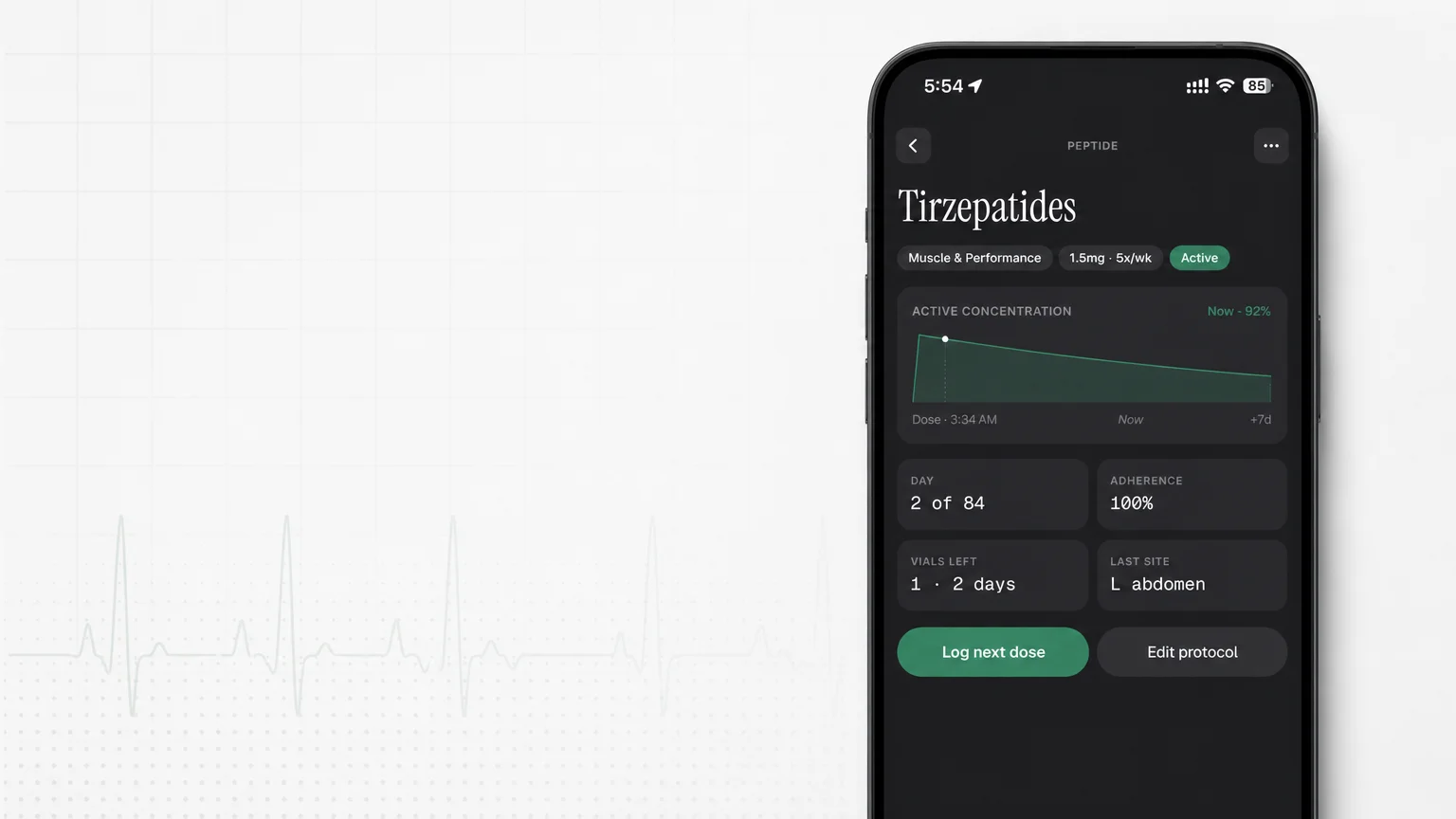 A protocol detail screen turns a peptide's schedule into something you can inspect: concentration curve, cycle day, and adherence.
Evidence also has a safety half. Benefits in a trial arrive with side effects in the same trial, which is why clinical evidence on whether peptide therapy is safe belongs next to any benefits discussion. An honest cost-benefit read needs both, and the actual risk side deserves its own careful look.
Which Peptides Offer the Most Evidence-Backed Benefits?
Ranked by human evidence: FDA-approved peptides (semaglutide, tirzepatide, tesamorelin) first, then peptides in early human trials (growth hormone secretagogues like CJC-1295 and ipamorelin), then peptides with strong animal data only (BPC-157, TB-500), and last, anecdote-driven claims with no controlled data.
If peptide terminology is still new, the primer on what a peptide is covers the basics. For choosing between tiers, three questions help:
- Is there a randomized human trial for the outcome I want?
- Does the product I can actually obtain match what was studied?
- Can I measure the outcome myself, week to week?
Longevity peptides such as MOTS-c, studied for energy and metabolism, mostly sit at the preclinical end of that ladder. Interest is high; proof is early.
How Long Until You See Peptide Therapy Results?
For GLP-1 drugs, early changes can show within weeks, but full effect builds over months because doses are escalated gradually. For unapproved peptides there is no reliable human timeline, so reports of results in days or weeks are anecdotes, not benchmarks.
Titration schedules explain most of the wait. Semaglutide in the STEP program stepped up over 16 weeks to reach 2.4 mg, and tirzepatide in SURMOUNT-1 increased in 4-week steps. A dose you have not reached yet cannot produce the full result.
What this means for you: If week 3 looks flat, check whether you are still on a starting dose before deciding the peptide failed. A flat line at a sub-therapeutic dose is expected.
What Separates Hype from Real Peptide Therapy Benefits?
Real benefits come with a named outcome, a measured baseline, a verified product, and a comparison against doing nothing. Hype skips all four: vague "wellness" gains, no baseline, unknown vendor, and no way to separate the peptide from placebo or lifestyle change.
Product quality matters more than most people assume. FDA testing found up to 40% of online peptide products contained incorrect dosages or undeclared ingredients, so a missing benefit can be a missing ingredient.
 Published evidence tells you what is possible; your own records tell you what happened.
Placebo is the other trap, especially for subjective goals like energy, sleep, and pain. A benefit you cannot measure against a baseline is a feeling, and feelings are easily shaped by expectation. Whether any of this is worth the money is a separate question from whether it works.
Can You Track Peptide Therapy Benefits Without an App?
Yes. A notes app or spreadsheet can work if you log the same fields every time: dose, date, one to three outcome scores, side effects, and any lab results. The challenge is consistency, because manual logs tend to break down once real life gets busy.
Here is what is worth recording, whichever tool you use:
- Baseline for your goal metric (weight, pain, sleep, recovery) before the first dose.
- Dose and timing, including missed doses, so adherence is a number rather than a guess.
- Weekly averages, not single-day readings, because daily scores are noisy.
- Side effects with severity, which are part of the benefit-risk balance.
- Bloodwork, if you and your clinician are monitoring markers.
Where a spreadsheet runs out is correlation. Seeing whether sleep improved because of the peptide, or because you stopped missing doses, takes overlaying data over time.
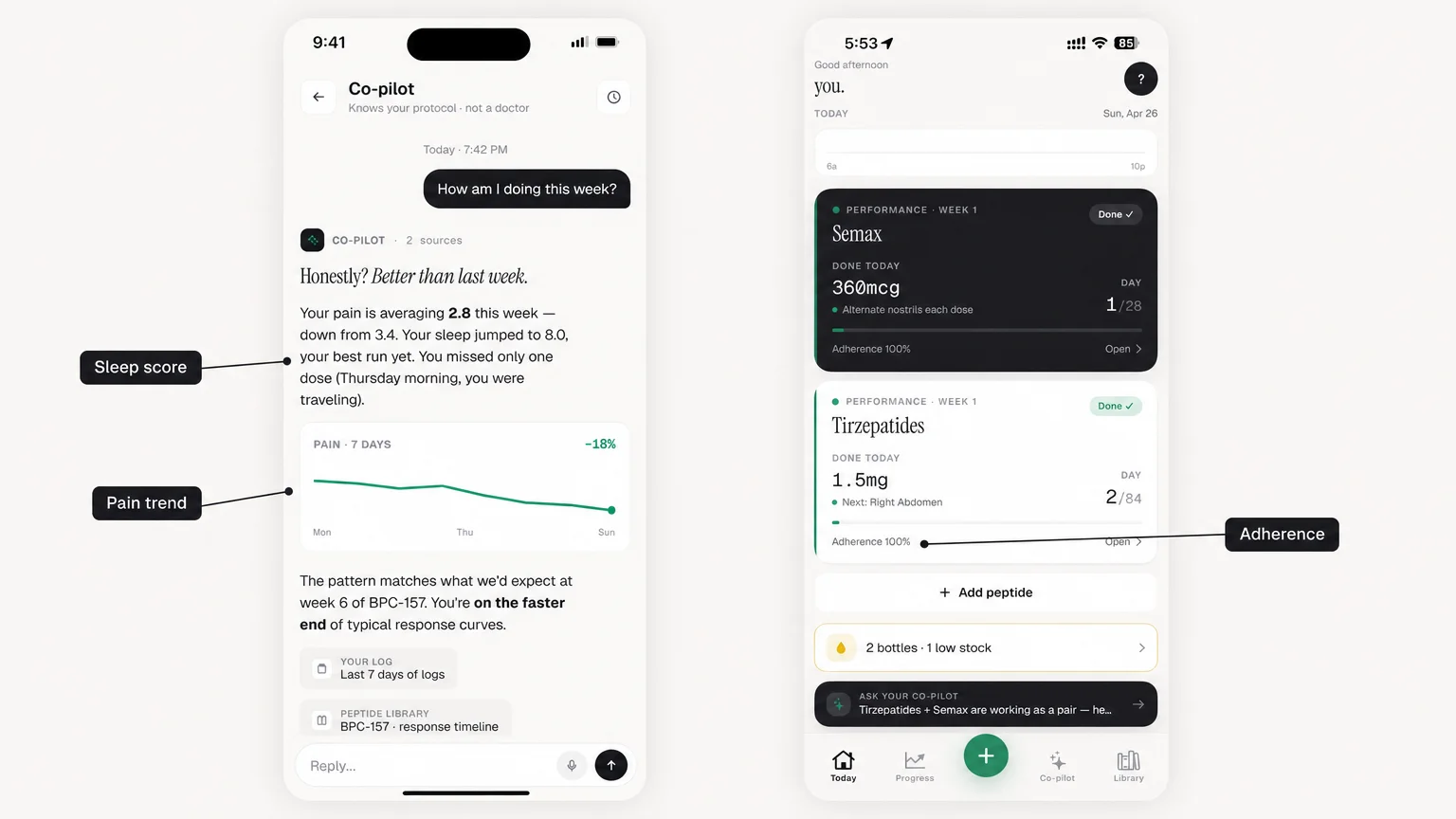 A weekly summary on one side, active protocol adherence on the other: outcome and consistency in the same picture.
How PeptideIQ Helps You Realize Peptide Therapy Benefits
PeptideIQ is built around the measurement problem this article keeps returning to. Each logged dose can carry four quick wellness sliders (energy, mood, sleep quality, and a goal metric that adapts to your objective), plus an optional side-effect grid tagged Mild, Moderate, or Severe.
The Progress view charts your goal metric over the cycle, annotated with events like dose increases and missed doses, and a weekly insight card summarizes that week's actual data. The Co-pilot screen above is a good example: it reports a pain average, a sleep score, and a missed dose from the week's logs, then compares the pattern to the expected response curve.
Bloodwork can be entered by hand, with trend charts against reference ranges, and a one-tap Doctor Export produces a PDF of dose history, wellness metrics, side effects, and labs. That gives a clinician something to evaluate rather than a memory. PeptideIQ is a wellness tracking and guidance app, not a medical device, and it does not replace your doctor.
Get Started with PeptideIQ
If you are already on a protocol, the most useful change you can make today is to start measuring it. PeptideIQ is in pre-launch with a waitlist open now.
FAQ
What are the main benefits of peptide therapy?
The best-proven benefits are weight loss and metabolic improvement from FDA-approved GLP-1 peptides like semaglutide and tirzepatide. Other claims, including tissue repair, better recovery, sleep, and anti-aging, have far less human evidence and depend on the specific peptide.
Do peptide therapy benefits last after you stop?
For weight loss, trials show much of the lost weight tends to return after stopping GLP-1 treatment. Benefits generally depend on continued use plus lifestyle changes. For other peptides there is little long-term human data, so durability is not well established.
How do I know if peptide therapy is working for me?
Record a baseline for your goal before the first dose, then log dose, adherence, weekly outcome scores, and side effects. Compare weekly averages rather than single days. If measures are flat after you reach your intended dose, discuss adjusting with a clinician.
Is peptide therapy worth it?
It depends on the peptide and your goal. For appropriate patients, approved GLP-1 therapy has strong evidence of benefit. For unapproved peptides, expected benefit is less certain and product quality varies, so it is worth weighing evidence, cost, and risk with a clinician.