

Is Peptides Safe? The Full Evidence Breakdown | PeptideIQ
Is Peptides Safe? What the Evidence Actually Shows
Search "is peptides safe" and you'll get two internets talking past each other. One says peptides are miracle compounds. The other says you're one gray-market vial away from a hospital visit. Neither is honest, and the real answer depends entirely on which peptide, which source, and which system you're using to track it.
Key Takeaways
- Semaglutide and tirzepatide are FDA-approved and prescribed to millions; BPC-157 and GHK-Cu have real animal and early human evidence but lack full FDA approval — evidence level is the first safety question, not an afterthought.
- FDA testing found up to 40% of online peptide products carried incorrect dosages or undeclared ingredients — the source matters as much as the compound.
- The most common real risks are mild and dose-dependent: nausea, fatigue, and injection site reactions, not the catastrophic outcomes forums imply.
- Inconsistent dosing and going solo without any tracking system cause more real-world harm than the peptides themselves.
- Structured protocol management — logging every dose, watching symptoms, rotating injection sites — is one of the few safety levers a user fully controls.
Contents
- Is Peptides Safe to Use?
- What Are the Main Safety Risks of Peptides?
- How Do FDA-Approved Peptides Differ From Compounded Peptides?
- What Peptides Are Safest for Beginners?
- How Can You Use Peptides Safely?
- Is Peptides Safe to Use Without Medical Supervision?
- How Do You Know if a Peptide Source Is Trustworthy?
- What Does Current Research Say About Long-Term Peptide Safety?
Is Peptides Safe to Use?
Some peptides are safe by any regulatory standard — semaglutide and tirzepatide are FDA-approved, studied in large clinical trials, and prescribed to millions. Others, like BPC-157 and GHK-Cu, have meaningful animal and early human data but sit outside FDA approval. Safety is not one answer; it's a spectrum tied to evidence level, sourcing, and how carefully a person tracks their own use.
This is where most articles fail. They either scare readers away from anything that isn't a pharmaceutical, or they wave away every risk because "peptides are natural." Neither holds up. If you're new to the topic entirely, our beginner's guide to what a peptide is covers the mechanism basics before you evaluate safety.
We've also published a deeper research breakdown on whether peptides are safe that goes long on the clinical literature. This guide takes a narrower angle: it maps the honest evidence-level landscape and shows what actually changes your risk exposure.
Reality check: The peptide market has three distinct tiers — FDA-approved, early clinical evidence, and gray-market/anecdotal. Treating all three as equally risky, or equally safe, is the single biggest mistake in how this topic gets discussed online.
Related: Peptide Therapy Benefits: What the Evidence Really Shows
What Are the Main Safety Risks of Peptides?
The documented risks of peptide use are injection site reactions, nausea, fatigue, headaches, and — for GLP-1 peptides specifically — gastrointestinal symptoms and a rare pancreatitis risk. Most of these are mild, dose-dependent, and predictable once you know what to expect from a given compound.
Semaglutide and tirzepatide users commonly report nausea in the first weeks of dose escalation, which typically fades as the body adjusts. BPC-157 and CJC-1295 users more often report injection site soreness or mild fatigue. None of this is unique to peptides — it mirrors how most bioactive compounds behave during titration.
The risk that gets underplayed isn't the peptide itself. It's what happens when someone doesn't know their own baseline. Without a log of symptoms, a headache in week two looks alarming. With three weeks of data behind it, the same headache is often just noise. Our breakdown of the real downsides users actually experience covers this pattern in more depth — most negative reports trace back to dosing errors or missing context, not the compound acting maliciously.
- Injection site reactions — redness, mild swelling, soreness; usually resolves within 24-48 hours
- GI symptoms (GLP-1 class) — nausea, occasional vomiting, most common during dose titration
- Fatigue and mood shifts — reported more with growth hormone secretagogues like CJC-1295
- Rare but serious — pancreatitis has been flagged with GLP-1 peptides in a small subset of users; this is why dose escalation protocols exist
How Do FDA-Approved Peptides Differ From Compounded Peptides?
FDA-approved peptides like semaglutide and tirzepatide go through controlled manufacturing, dosage verification, and large-scale trials before reaching a pharmacy. Compounded and gray-market peptides — BPC-157, CJC-1295, GHK-Cu among them — skip that pipeline entirely, which means purity, concentration, and labeling accuracy are not independently verified.
Semaglutide and tirzepatide generated nearly $30 billion in combined revenue in 2024 — a scale that comes with manufacturing oversight most compounds never see. Gray-market peptide imports, largely from Chinese suppliers, hit $328 million in 2025 with essentially none of that oversight. FDA testing of online peptide products found up to 40% carried incorrect dosages or undeclared ingredients.
That gap is not theoretical. It's the difference between a vial where the label matches the contents and a vial where you're trusting a Reddit thread. Legal status compounds the confusion here too — our full breakdown of where peptides stand legally is worth reading alongside this, since legal status and safety verification often move together.
| Tier | Examples | Evidence Level | Regulatory Status |
|---|---|---|---|
| FDA-Approved | Semaglutide, Tirzepatide | Large-scale clinical trials | Prescription, FDA-approved |
| Early Clinical / Strong Animal Evidence | BPC-157, GHK-Cu, Epitalon | Human trials underway or animal-model strong | Not FDA-approved; legal compounding status varies |
| Gray-Market / Unverified | Unbranded vials from overseas suppliers | Anecdotal, unverified purity | No oversight; up to 40% mislabeled per FDA testing |
On February 27, 2026, the US Health Secretary announced on a podcast appearance that 14 previously restricted peptides would return to legal compounding status — a policy shift that moved several compounds from gray-market ambiguity toward a clearer, more regulated middle tier. That's a meaningfully different safety picture than it was even a year ago, and it's part of why a clinical perspective on peptide therapy safety is worth reading if you're evaluating this through a doctor-supervised lens specifically.
What Peptides Are Safest for Beginners?
For most beginners, the safest starting point is whichever peptide has the most established evidence for their specific goal — semaglutide or tirzepatide for weight loss (FDA-approved), BPC-157 for injury recovery (strong early human data), or GHK-Cu for skin and cellular support (strong animal evidence, growing human data). "Safest" is really "best-documented for your use case," not a single universal answer.
This is also where evaluating "peptides rated safest by evidence level" gets genuinely useful, because the ranking changes depending on what you're optimizing for — weight loss safety data looks nothing like injury-recovery safety data.
A few starting points by goal:
- Weight loss — semaglutide or tirzepatide, ideally under a prescribing doctor's supervision
- Injury recovery — BPC-157, typically starting at 250mcg with a defined cycle length
- Skin and longevity — GHK-Cu, with attention to storage and reconstitution accuracy
- Muscle and performance — CJC-1295 with Ipamorelin, usually fasted administration
None of these categories are "safe" in isolation from how they're used. A well-documented peptide taken at the wrong dose, or stored incorrectly, still carries real risk.
How Can You Use Peptides Safely?
Using peptides safely comes down to three controllable factors: verified sourcing, accurate dosing, and consistent tracking — none of which require abandoning the compound entirely. Most safety incidents trace back to a missing system, not an inherently dangerous molecule.
This is the piece most guides skip, because it's not about the peptide — it's about the process around it. Someone running BPC-157 with a logged dose history, a clear injection-site rotation, and a record of how they felt each day is in a fundamentally different risk position than someone eyeballing a syringe with no notes.
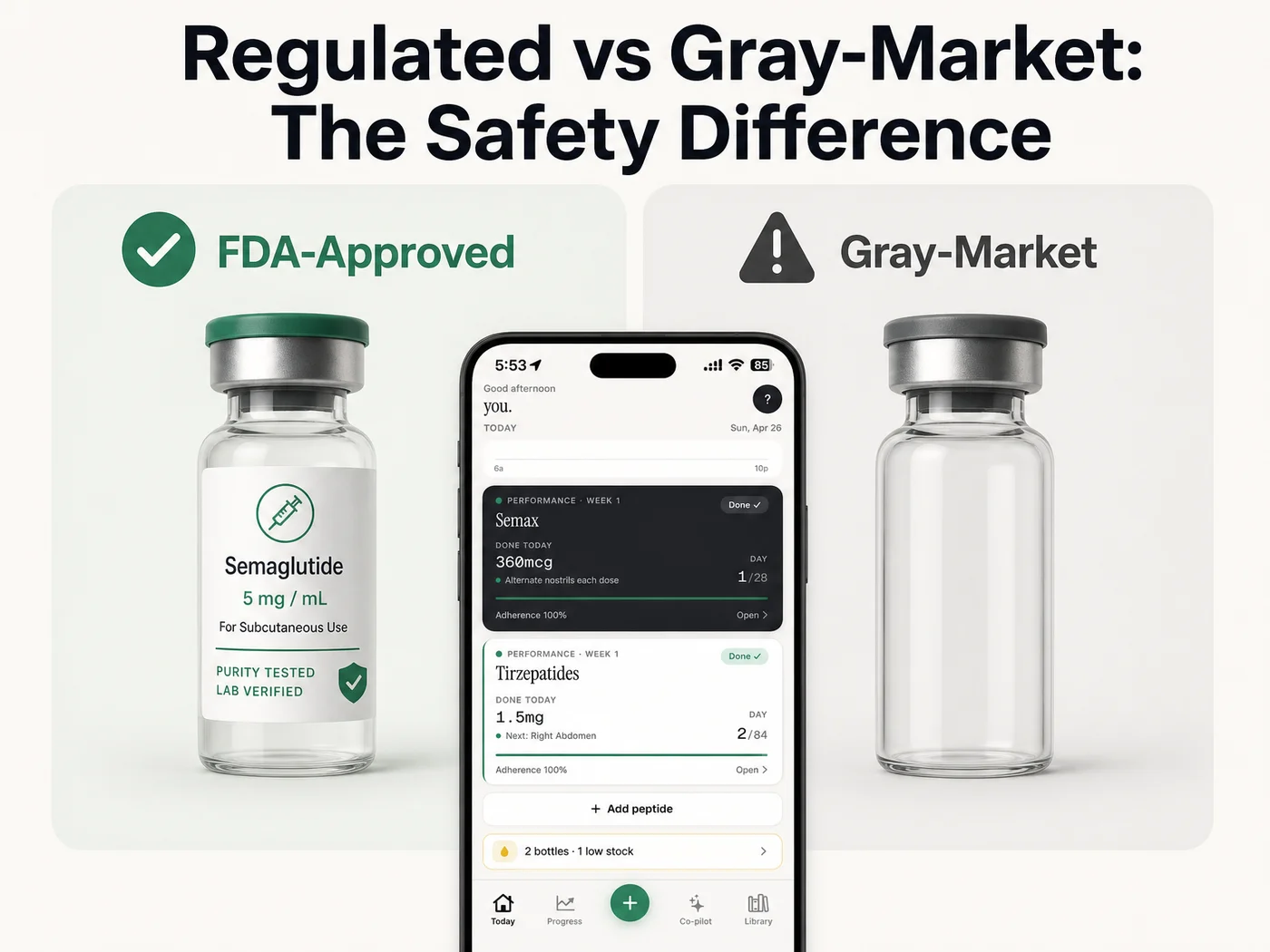 Structured adherence tracking — like the protocol view above — turns "I think I took it" into a verified log.
PeptideIQ was built around exactly this gap. It's an AI-guided system, not a passive logger — it tracks dose history, injection site rotation, symptom logs, and cycle timing, and its AI co-pilot answers questions with your actual data instead of generic advice. That structure is what separates a tracked, accountable protocol from a guess.
Is Peptides Safe to Use Without Medical Supervision?
Yes, for many peptides — but "without a doctor" should not mean "without any system." Beginners without medical supervision carry higher risk not because they lack a prescription, but because they lack dosing structure, symptom tracking, and a way to catch problems early. A logging system closes most of that gap.
Someone like Todd — new to peptides, a vial already in the fridge, no clinical background — isn't in danger because he lacks a doctor's note. He's in danger because he doesn't know what BAC water is, hasn't calculated his dose, and has no way to tell if week-two fatigue is expected or a warning sign.
 Daily tracking turns vague symptoms into a pattern you can actually interpret.
Worth knowing: For FDA-approved peptides like semaglutide, doctor supervision is standard practice and genuinely recommended. For early-clinical compounds like BPC-157, supervision is less common in practice, which makes personal tracking discipline the substitute safety layer — not a replacement for good judgment, but a real one.
That said, some situations genuinely warrant a doctor — pre-existing conditions, current medications, or symptoms that don't resolve within a few days. No tracking app replaces that judgment call; it just makes the decision to seek one clearer.
How Do You Know if a Peptide Source Is Trustworthy?
A trustworthy peptide source provides third-party testing documentation (like a Certificate of Analysis), clear concentration and expiry labeling, consistent batch numbers, and transparent sourcing — not just a low price and fast shipping. Vendors that can't produce testing documentation on request should be treated as unverified regardless of reviews.
Reddit reviews and forum reputation are a weak signal on their own — a vendor can look reliable for months before a bad batch surfaces. What actually reduces risk:
- Certificate of Analysis (COA) on request, ideally batch-specific
- Consistent labeling — concentration, reconstitution instructions, expiry date
- Traceable batch numbers, so a bad batch can be identified and avoided going forward
- No unrealistic claims — a source promising dramatic results fast is a red flag, not a selling point
The short version: If a vendor can't show you a batch-specific test result, you're trusting a label you can't verify — and FDA testing data says that's a real gamble roughly 40% of the time.
What Does Current Research Say About Long-Term Peptide Safety?
Long-term safety data is strong for FDA-approved peptides like semaglutide and tirzepatide, which have years of trial and post-market data behind them. For compounds like BPC-157 and GHK-Cu, long-term human data is still developing — the existing evidence is encouraging but not exhaustive, and evaluating peptide therapy legitimacy means being honest about that gap.
This is the section where overselling is most tempting, and most damaging to trust. Peer-reviewed research on peptide therapeutics notes that immunogenicity — an adverse immune response — can limit safety and efficacy even among approved compounds over long timeframes, which is exactly why post-market monitoring exists for drugs like semaglutide.
For gray-market compounds, "long-term safety" data mostly doesn't exist in the clinical sense — what exists is aggregated user-reported experience, which is useful but not equivalent to a trial. Real user safety experiences with peptides matter as a data point, but they're not a substitute for controlled research, and no honest source should present them as such.
Related: Why Don't Doctors Like Peptides? What They Worry About
Get Started with PeptideIQ
If you're already committed to a peptide protocol — or about to be — the highest-leverage move you can make is tracking it properly from day one. PeptideIQ's AI co-pilot knows your specific cycle, dose history, and symptom log, so questions like "is this normal?" get answered with your actual data instead of a generic forum reply.
Not ready to try it yet? Get Our AI Productivity Guide — free tips on tracking your protocol safely.
FAQ
Are peptides FDA approved?
Some are. Semaglutide and tirzepatide are FDA-approved and prescribed at scale. Most other popular peptides — BPC-157, CJC-1295, GHK-Cu, Epitalon — are not FDA-approved, though several gained legal compounding status after the February 2026 policy reversal.
Is peptide therapy legit?
Peptide therapy is legitimate when it's evidence-based and properly sourced — FDA-approved options have real clinical backing, and several other peptides have credible early-stage human data. It stops being legitimate when providers oversell unverified compounds as guaranteed results.
What is the safest peptide to take?
There's no single safest peptide — safety depends on your goal and the evidence tier. Semaglutide and tirzepatide have the strongest regulatory backing; BPC-157 has the most consistent early human evidence among non-approved compounds for injury recovery.
Are peptides safer than steroids?
Most peptides carry a milder side-effect profile than anabolic steroids, particularly around hormonal disruption, but "safer" doesn't mean "risk-free." Peptides from unverified sources can still carry contamination and dosing risks that rival or exceed a well-sourced steroid protocol.
Do doctors recommend peptides?
Doctors commonly prescribe FDA-approved peptides like semaglutide and tirzepatide. For non-approved compounds like BPC-157, physician support varies widely — some functional medicine doctors work with them, while many general practitioners won't discuss them at all.
What are the most common peptide side effects?
The most reported side effects are nausea and GI symptoms (especially with GLP-1 peptides), mild fatigue, headaches, and injection site soreness. These are typically dose-dependent and diminish as the body adjusts to a new protocol.