

Peptides for Joint Pain: What the Evidence Shows
Peptides for Joint Pain: What the Evidence Shows and How to Measure Your Own Result
Search for peptides for joint pain and you will find clinic pages promising cartilage repair, forum threads swearing by a weekly stack, and very little that tells you how much of it has been tested in people. The gap between the claims and the data is the whole story here.
General education, not medical advice. Most peptides discussed here are not FDA-approved for joint pain. If your pain is new, severe, or follows an injury, see a clinician before anything else.
Can Peptides for Joint Pain Actually Help?
Possibly, but nobody can promise it, because for the peptides most often discussed, the support comes mainly from animal studies and a handful of very small human reports. No peptide has been shown in a large, controlled human trial to relieve joint pain, so treat confident claims as marketing.
That is not the same as "they do nothing." It means the question is open, and an open question is a poor basis for a promise.
Here is the pattern worth noticing. A claim usually starts with a rat study, passes through a clinic blog, and arrives on your screen as "heals joints." Each handoff drops a caveat.
If you want the general framing first, what is a peptide covers the basics, and do peptides actually work explains why the answer depends on which peptide and for what.
The Peptides People Use for Joints, and Their Evidence Level
The names that come up most are BPC-157 and TB-500 for tendon, ligament, and joint complaints, plus GHK-Cu in some stacks. Each carries a different evidence level, and none is an approved joint-pain treatment. Collagen peptides are a separate thing: a food supplement, not an injectable.
PeptideIQ's library labels every peptide as FDA-Approved, Strong Animal Evidence, Early Human Trials, or Anecdotal Only. Here is how the usual suspects land on that scale, in our reading:
- BPC-157: Strong Animal Evidence. Not FDA-approved. This is the one people mean when they say "the Wolverine peptide."
- TB-500: Anecdotal Only for joint pain in people. It is usually paired with BPC-157, which makes it harder still to tell what did what.
- GHK-Cu: mostly discussed for skin and tissue repair; joint-pain claims rest on anecdote.
- Collagen peptides: sold as powders. Some small human trials exist, results are mixed, and they are digested like any protein rather than injected.
Notice what is missing from that list: a single entry labeled FDA-Approved for joint pain.
Tendon pain gets lumped in with joint pain constantly, and BPC-157 is the peptide most often asked about for both. If you are weighing the two most common names against each other, remember that a comparison of two weakly supported options is still a comparison of weakly supported options.
What Does the Evidence Actually Show for Peptides and Joint Pain?
Mostly animal data. A 2025 systematic review of BPC-157 in orthopaedic sports medicine found 36 studies; 35 were preclinical and only one involved people. The authors reported no clinical safety data in humans and urged caution for athletes and clinicians.
That review, by Vasireddi and colleagues, was published in the HSS Journal in 2025. It is the cleanest summary of where things stand.
The one human study was a small retrospective chart review of people given BPC-157 injections for knee pain at a single clinic. It had no control group and no validated outcome measures, and follow-up was by phone.
Its authors called it small. It is a reason to run a proper trial, not a result you can lean on.
 Rodent results are where most joint-peptide claims begin, and where most of them stay.
Why does the animal-to-human step fail so often? Rats heal fast, get a precisely timed dose into a surgically made injury, and live in a controlled cage. A 52-year-old with a cranky knee has none of those conditions.
Three questions will sort most claims:
- Who was studied? Rodents, cells, or people?
- Was there a control group? Without one, improvement could be time, rest, or placebo.
- What was measured? A validated pain or function score beats "felt better."
Most pages ranking for this topic fail the first question in the first paragraph. Often the sources they cite are animal studies or the same single chart review.
Safety Is Unproven for Most Peptides for Joint Pain
Safety is unproven rather than disproven. Without human safety trials, nobody can state a reliable side-effect profile, and gray-market vials add a second risk: you cannot verify what is in them. Stop and seek care if you notice swelling, rash, fever, or anything that worries you.
Two separate problems stack up. The first is the lack of long-term human data. The second is product quality, since unregulated vials vary in purity, concentration, and sterility.
Injection itself carries risks no matter what is in the syringe: infection, a reaction at the site, and mistakes in reconstitution math. BPC-157 side effects lists what people report and when to stop, and the downsides of peptides covers the broader risks and what research shows.
One more point matters for athletes and runners. Some sporting bodies prohibit certain peptides in competition, so check your sport's rules before you start anything.
If you do go ahead, the next step is measuring it. Here is what that looks like.
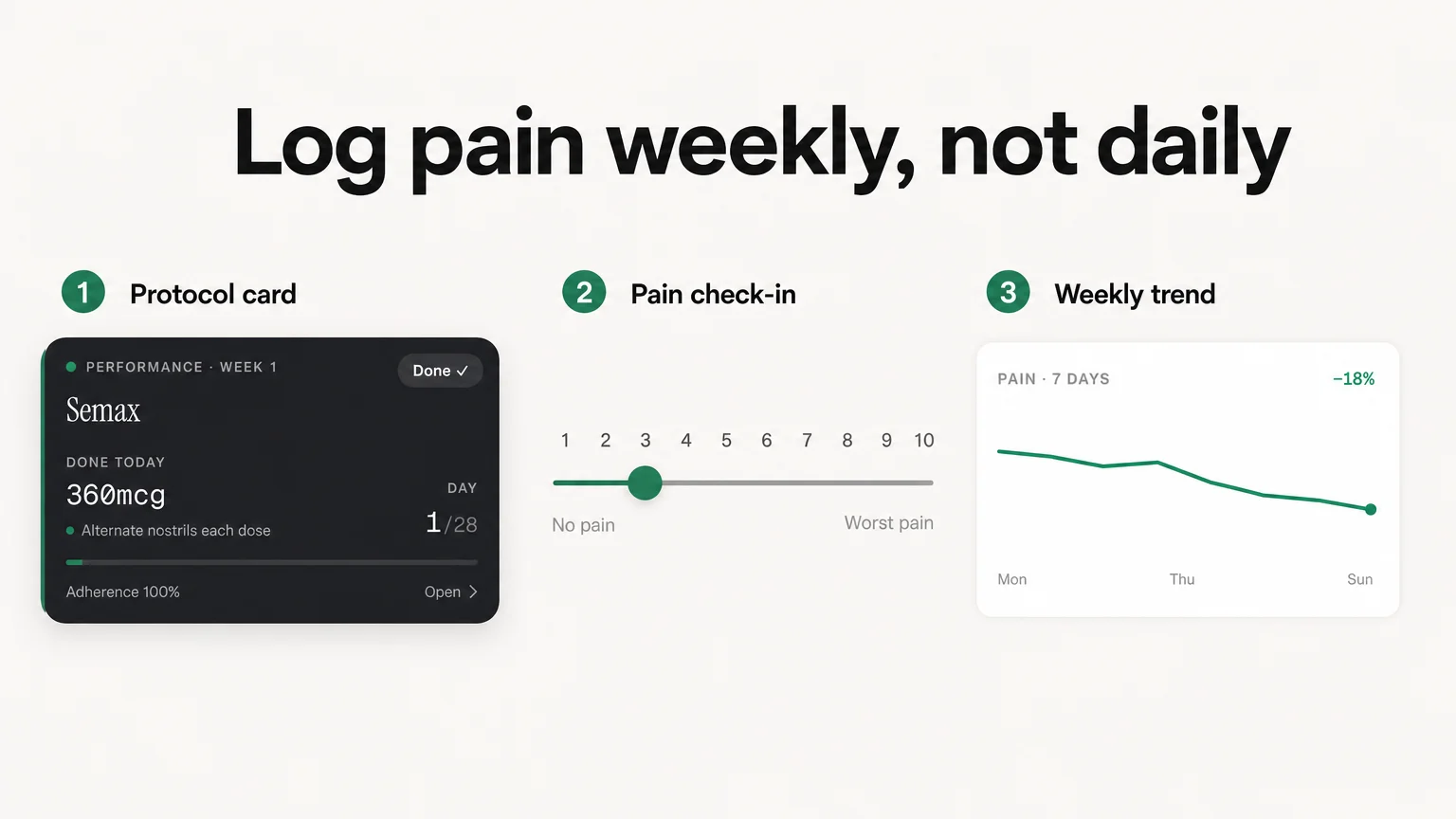 Three steps: the protocol you are on, a 1 to 10 pain score, and the weekly trend. The graph is an app screen, not study data.
How Do You Track Joint Pain on a Peptide Protocol?
Rate your pain on a 1 to 10 scale once a week, at the same time of day, and log your dose, sleep, and activity beside it. A weekly average smooths out good and bad days, so a real change shows up and a lucky Tuesday does not fool you.
Why weekly instead of daily? Joint pain swings with weather, sleep, and how far you walked yesterday. Logging every day invites you to chase noise.
A useful log has five fields:
- Pain score, 1 to 10, averaged across the week
- Dose and date, including any missed doses
- Activity, such as a long run or a hard leg day
- Sleep, because poor sleep inflates pain scores
- Anything else you changed, like a new supplement, brace, or physio plan
That last field is the one people skip, and it ruins the answer. If you start a peptide, a new knee brace, and physiotherapy in the same month, you will never know which one helped.
Here is where an app helps. PeptideIQ's Today screen shows each active protocol with its day count and adherence, and the weekly co-pilot summary graphs a seven-day pain trend.
In the screen above, the co-pilot reports an average pain score down from 3.4 to 2.8 over a week, alongside sleep and a missed dose. That is a demonstration of how the data is displayed, not evidence that any peptide works.
PeptideIQ is an iOS app, currently pre-launch, with a waitlist open. A notebook does the same job if you are consistent, and the method matters more than the tool.
How long should you track before deciding?
Pick the window before you start. Four to six weeks of weekly scores gives you a baseline and a trend. If your average pain has not moved in a direction you can see, the honest conclusion is that you have no evidence it helped.
When Joint Pain Belongs With a Doctor, Not a Peptide
See a clinician for pain that is new, severe, or hot and swollen, or that follows an injury or a fall. Also go if a joint locks, gives way, or comes with fever. These patterns can signal infection, a fracture, a tear, or inflammatory arthritis, none of which a peptide should be left to sort out.
Persistent pain in your joints deserves a diagnosis before a protocol. Osteoarthritis, a meniscus tear, tendinopathy, and gout all feel like "my joint hurts" and need different answers.
Bring your log to the appointment. A dated record of pain scores, doses, and activity is more useful to a clinician than "it's been a few months." Tell them about any peptide you are using, including where you bought it.
Quick recap
- Peptides for joint pain are supported mainly by animal data; the human evidence for BPC-157 amounts to one small, uncontrolled report.
- In PeptideIQ's evidence labels, BPC-157 sits at Strong Animal Evidence and TB-500 at Anecdotal Only. Neither is FDA-approved for joint pain.
- Measure it yourself: weekly 1 to 10 pain scores, logged with dose, sleep, and anything else you changed, over four to six weeks.
- New, swollen, hot, or injury-related pain needs a clinician first.
Get Started with PeptideIQ
If you decide to run a protocol anyway, a clean record of doses and weekly pain scores is the only fair way to judge it. PeptideIQ keeps that in one place; it is an iOS app, currently pre-launch, with a waitlist open.
FAQ
What is the best peptide for joint pain?
No peptide has been proven best for joint pain. BPC-157 is the one most discussed, backed mainly by animal studies and one small human report. If you are choosing, the honest answer is that the evidence cannot rank them for you.
Are peptides for athletes and runners worth trying for joints?
There is no controlled human evidence that peptides protect or repair runners' joints. Some sports organizations also ban certain peptides in competition. Rest, load management, and physiotherapy have far better support for overuse pain.
Do collagen peptides help with joint pain?
Evidence is mixed. Some small human trials report modest benefits, but results vary by product and study quality. Collagen peptides are a food supplement digested like protein, which makes them a different category from injectable peptides such as BPC-157.
How long does it take to tell if a peptide is working for joint pain?
Plan on four to six weeks of weekly pain scores. Record your dose, sleep, and activity alongside them. A visible downward trend in your weekly average is a signal; a single good day is not.
Is BPC-157 approved for joint pain?
No. BPC-157 is not FDA-approved for any use. Its status makes it a gray-market product, so quality and dosing vary between sellers. Talk to a licensed clinician before using it.