
GHK-Cu Injection Dosage: Protocol Guide | PeptideIQ
GHK-Cu Peptide Injection Dosage: Your Science-Backed Protocol Guide
Getting your GHK-Cu peptide injection dosage right is the difference between a protocol that transforms your skin and healing timeline—and a wasted cycle. Most users either dose too low and see nothing, or rush to high doses before their body adapts. Here's the data-backed protocol that actually works.
Key Takeaways
- GHK-Cu typical dosage ranges from 250mcg to 1000mcg per injection for most longevity protocols, with beginners starting at the lower end
- The right dose depends on your goals (skin/collagen vs. systemic healing), experience level, and individual metabolic response
- GHK-Cu injection frequency is typically 5–6 days per week; consistent timing is as important as the dose itself for optimal results
- Most users see visible skin and wound-healing improvements within 2–4 weeks at proper doses; deep collagen synthesis and systemic anti-aging effects take 6–8 weeks
- GHK-Cu works synergistically with other longevity peptides and protocols—dosing decisions should account for your full stack, not GHK-Cu in isolation
Contents
- What Is GHK-Cu and How Does It Work in the Body?
- What Is the Right GHK-Cu Peptide Injection Dosage for You?
- How Do You Calculate Your GHK-Cu Peptide Injection Dosage?
- How Often Should You Inject GHK-Cu—And For How Long?
- What Happens If You Over-Dose or Under-Dose GHK-Cu?
- What's the Difference Between GHK-Cu and Other Longevity Peptides?
- How Long Does It Take to See GHK-Cu Results?
- How to Track Your GHK-Cu Results (And Why You Should)
- Get Started with PeptideIQ
- Frequently Asked Questions
What Is GHK-Cu and How Does It Work in the Body?
GHK-Cu (glycyl-L-histidyl-L-lysine copper) is a naturally occurring copper tripeptide that activates collagen synthesis, accelerates wound healing, and modulates over 4,000 human genes involved in anti-aging and tissue regeneration. Plasma levels decline sharply from ~200ng/mL at age 20 to ~80ng/mL by age 60—making injectable supplementation the primary way to restore youthful signaling.
This isn't a trendy biohacking compound. GHK-Cu has 50+ years of published research, with documented effects on skin elasticity, wound healing, inflammation reduction, and lung tissue repair.
The copper component is essential. Without it, the tripeptide cannot bind to its target receptors or trigger downstream gene activation. Topical forms exist, but subcutaneous injection bypasses the skin barrier and delivers GHK-Cu directly into systemic circulation—why injection protocols consistently outperform topical application for systemic longevity goals.
 GHK-Cu delivered subcutaneously reaches systemic circulation—topical application alone won't achieve longevity-grade results.
What Is the Right GHK-Cu Peptide Injection Dosage for You?
GHK-Cu injection dosage scales with your goal. Skin and anti-aging protocols use 250–500mcg daily; general longevity and wellness protocols use 500mcg–1mg; active injury and tissue repair protocols use 1–2mg per injection. Beginners always start at the lowest dose in their goal category and escalate only after assessing week 3–4 response.
The ranges below reflect published clinical research and widely-used subcutaneous injection protocols:
| Goal | Dose Per Injection | Frequency |
|---|---|---|
| Skin & collagen (anti-aging) | 250–500mcg | 5–6x/week |
| General longevity & wellness | 500mcg–1mg | Daily or 5x/week |
| Pain & inflammation reduction | 1–2mg | 5x/week |
| Injury & tissue regeneration | 1.5–2mg | Daily |
| Advanced anti-aging (experienced) | 1–2mg | Daily |
Start at the lowest effective dose for your goal category. If you're new to peptides entirely, review a peptide guide for beginners before committing to a GHK-Cu cycle—the fundamentals on reconstitution and injection apply here.
By the numbers: Clinical dosage ranges for GHK-Cu span 0.5mg–4mg per dose in published protocols, but 1–2mg/day covers the vast majority of longevity and wellness goals. Higher doses don't necessarily produce better results—they increase cost and copper-load risk.
 Scale your dose to your goal—start conservative and re-evaluate at weeks 3–4 before escalating.
How Do You Calculate Your GHK-Cu Peptide Injection Dosage?
To calculate GHK-Cu injection units: divide your target dose (mcg) by your reconstituted solution concentration (mcg/mL), then multiply by 100 for U-100 syringe units. A 50mg vial mixed with 2mL BAC water = 25,000mcg/mL. A 500mcg dose from that solution = 2 units on a U-100 insulin syringe.
GHK-Cu is commonly available in 50mg and 100mg lyophilized vials. Here's how the math works across common reconstitution ratios:
50mg Vial Reconstitution Examples
| BAC Water Added | Concentration | 250mcg dose | 500mcg dose | 1mg dose |
|---|---|---|---|---|
| 1mL | 50mg/mL | 0.5 units | 1 unit | 2 units |
| 2mL | 25mg/mL | 1 unit | 2 units | 4 units |
| 5mL | 10mg/mL | 2.5 units | 5 units | 10 units |
The 2mL reconstitution is the most practical for longevity protocols—it produces clean, measurable unit numbers at the most common dose ranges. Adding 5mL lowers concentration and improves precision at the lowest doses (250mcg = 2.5 units is easier to measure accurately than 0.5 units).
If you want a step-by-step calculation for your specific vial size, BAC water volume, and syringe type, a peptide dosing calculator handles every variable and outputs the exact unit mark to draw to.
Pro tip: Always add BAC water to the lyophilized peptide powder—never the reverse. Inject the water slowly down the side of the vial. Swirl gently to dissolve; never shake. Vigorous agitation degrades the copper binding and reduces bioavailability.
How Often Should You Inject GHK-Cu—And For How Long?
Inject GHK-Cu 5–6 days per week for best results. Daily dosing maximizes the cumulative gene-expression effects that drive collagen synthesis and systemic anti-aging benefits. Every-other-day works for lower-dose longevity protocols at 250–500mcg. Consistent timing matters as much as dose—irregular injections blunt the sustained signaling benefit.
Cycle Length Recommendations
Standard GHK-Cu cycles run 4–8 weeks on, followed by a 2–4 week rest period. The most common community protocol is 30 days on / 30 days off. Longer unbroken cycles increase the risk of receptor desensitization, though GHK-Cu's safety profile is notably strong.
For active injury or wound healing, daily dosing for 4–6 weeks with a 2-week break is the standard approach. If goals aren't fully met, repeat the cycle after the break.
Injection site rotation reduces local irritation and keeps absorption consistent. The lower abdomen and outer thighs are the most common subcutaneous sites for GHK-Cu. For detailed injection technique and site selection, see the guide on peptide injection sites and absorption.
Key insight: Consistent daily or near-daily dosing outperforms sporadic high-dose injection. GHK-Cu's mechanism depends on sustained gene activation—not peak blood levels—so frequency is more important than any single dose size.
What Happens If You Over-Dose or Under-Dose GHK-Cu?
Under-dosing GHK-Cu—below 250mcg for systemic goals—typically produces no measurable response within a 4–6 week cycle. Over-dosing above 3–4mg/day offers no documented benefit and raises the risk of copper-related side effects, injection site reactions, and unnecessary cost. The effective therapeutic window is relatively narrow: 250mcg–2mg covers nearly all validated protocols.
Signs You May Be Under-Dosing
- No change in skin texture, hydration, or elasticity by weeks 4–6
- No improvement in wound healing rate
- No shift in energy or recovery metrics across the cycle
Signs You May Be Over-Dosing
- Persistent injection site redness, warmth, or nodule formation
- Nausea or metallic taste (copper excess signal)
- Recurring headaches clustered around injection days
GHK-Cu has an excellent long-term safety profile at therapeutic doses, backed by decades of published research. Copper-related effects are rare at standard doses but are the primary signal to watch at higher ranges. For a detailed breakdown of expected vs. concerning reactions at each dose level, see the full guide on GHK-Cu side effects.
What's the Difference Between GHK-Cu and Other Longevity Peptides?
GHK-Cu's primary action is collagen regeneration, wound healing, and broad gene modulation—it's the most studied injectable longevity peptide for skin and tissue repair. Thymosin Alpha 1 targets immune system enhancement and antiviral defense. Epitalon focuses on telomere extension via pineal signaling. Each has a distinct mechanism; stacking them is additive, not redundant.
| Peptide | Primary Mechanism | Dosage Range | Typical Cycle |
|---|---|---|---|
| GHK-Cu | Collagen synthesis, gene modulation, wound healing | 250mcg–2mg/day | 4–8 weeks on/off |
| Thymosin Alpha 1 | Immune modulation, antiviral/antifungal defense | 1.6mg 2x/week | 4–6 weeks |
| Epitalon | Telomerase activation, circadian regulation | 5–10mg/day | 10–20 day course |
If you're exploring the full landscape of longevity peptides beyond GHK-Cu—including MOTS-c, LL-37, and Epitalon—a dedicated longevity peptides comparison is worth reviewing before designing a multi-compound stack.
For users stacking GHK-Cu with thymosin alpha 1 for combined immune and regenerative synergy, run overlapping cycles rather than back-to-back. The mechanisms complement each other with no known interactions.
Bottom line: GHK-Cu is the right starting point for most longevity-focused users—broadest evidence base, widest dose tolerance, and simultaneous action on skin, healing, and systemic anti-aging markers.
How Long Does It Take to See GHK-Cu Results?
GHK-Cu users typically see visible skin improvements—hydration, texture, reduced fine lines—within 2–4 weeks at proper doses. Collagen remodeling and systemic anti-aging effects take 6–8 weeks to manifest. Active wound healing accelerates noticeably within the first 2 weeks at doses of 1mg or higher.
Week-by-Week Timeline
Weeks 1–2: Anti-inflammatory response and early barrier improvement. Some users notice improved skin hydration quickly—this is water-binding and barrier restoration, not collagen synthesis yet.
Weeks 3–4: Visible changes in skin texture and elasticity. Wound or injury sites show noticeably faster resolution. Energy and recovery metrics start to trend upward in users tracking wellness logs.
Weeks 5–8: Deeper collagen synthesis and measurable changes in skin thickness. Systemic anti-aging markers—IGF-1 elevation, reduced inflammatory cytokines—shift in this window. This is the core result window for most longevity protocols.
Weeks 8+: For multi-cycle users, cumulative benefits compound. Repeat cycles typically show faster and deeper responses as baseline gene expression has already been primed.
 Results build gradually and compound across cycles—tracking weekly metrics is the only way to confirm your dose is working.
How to Track Your GHK-Cu Results (And Why You Should)
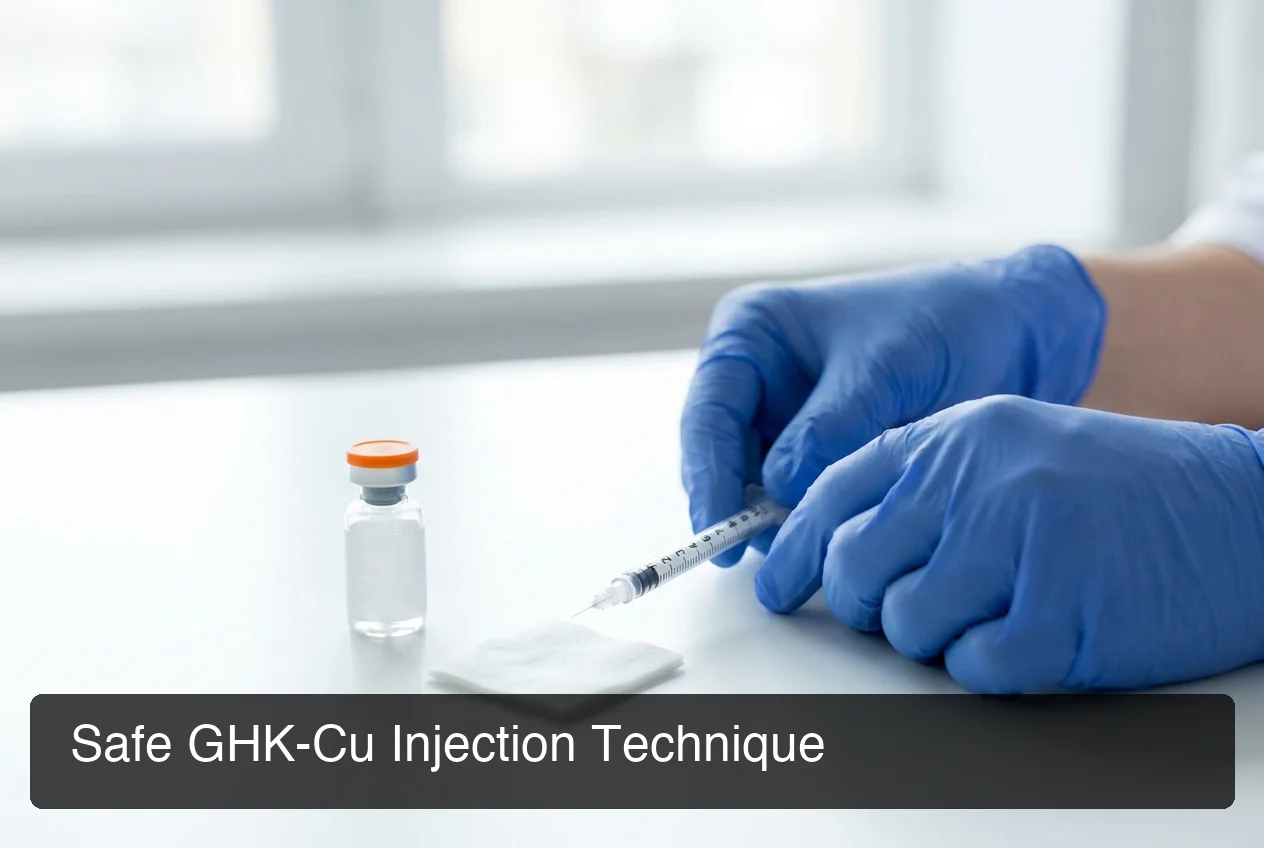 Precise injection technique and systematic tracking are what separate effective GHK-Cu protocols from wasted cycles.
Without tracking, you're flying blind on a peptide with a 6–8 week results timeline. A dose that "isn't working" at week 3 might need 4 more weeks—or it might genuinely need adjustment. You can't make that call without data: dose logs, skin and energy check-ins, and weekly trend comparisons.
This is where most GHK-Cu users fail. They run a vague protocol, log nothing, and either quit early or stay on too long without knowing whether it's working.
What to Log Every Dose
- Dose amount and injection site — rotation patterns directly affect absorption consistency
- Skin quality score (1–10) — texture, hydration, and firmness tracked weekly
- Energy and recovery score (1–10) — systemic response shows in these before visible markers appear
- Side effects — injection site reactions, metallic taste, headache clusters
- Progress photos — weekly comparison, critical for skin and wound healing goals
Once you've dialed in your dosage, understanding the full spectrum of GHK-Cu benefits—from neural regeneration to hair growth signaling—helps you interpret what your tracking data is actually showing week by week.
PeptideIQ is built specifically for this use case. The app logs every dose with injection site rotation tracking, captures energy, skin, and recovery on 1–10 sliders at each log-in, and generates weekly AI insight cards based on your actual cycle data—not generic peptide information. When you're at week 3 wondering whether 500mcg is working or whether you should escalate to 1mg, the AI co-pilot already knows your last 14 days of logs, your stated goals, and any side effects you've flagged.
Get Started with PeptideIQ
Running GHK-Cu without a tracking system means you'll never know if your dose is dialed in—or if the protocol is actually working. PeptideIQ is the guided AI system built for exactly this: protocol setup, dose logging with rotation tracking, and AI-powered weekly insights from your actual data.
Download PeptideIQ on the App Store
Frequently Asked Questions
What is the standard GHK-Cu injection dosage?
The standard GHK-Cu injection dosage is 250mcg–1mg per day for most longevity and skin protocols. Clinical protocols run up to 2mg/day for active injury or tissue repair. Beginners start at 250–500mcg and escalate only if no measurable response appears at weeks 3–4 of the cycle.
How do I convert my GHK-Cu dose to syringe units?
Divide your target dose in mcg by your solution concentration in mcg/mL, then multiply by 100 for U-100 syringe units. Example: 500mcg from a 25mg/mL solution (50mg vial + 2mL BAC water) equals 500 ÷ 25,000 × 100 = 2 units on a standard U-100 insulin syringe.
How often should I inject GHK-Cu?
Inject GHK-Cu 5–6 days per week for best results. Daily dosing maximizes cumulative gene-expression effects driving collagen synthesis. Every-other-day works for lower-dose (250–500mcg) longevity protocols. Consistent timing each day matters—irregular dosing blunts the sustained gene-activation benefit.
How long should a GHK-Cu cycle run?
A standard GHK-Cu cycle is 4–8 weeks on, followed by 2–4 weeks off. The most common protocol is 30 days on, 30 days off. Skin and collagen goals require the full 6–8 week cycle to see deep results. Injury repair often shows measurable improvement by week 4.
Can I stack GHK-Cu with other longevity peptides?
Yes—GHK-Cu stacks well with thymosin alpha 1 for combined immune and tissue regeneration benefits, and with Epitalon for telomere and anti-aging synergy. Run overlapping cycles rather than back-to-back. When managing a multi-peptide stack, use a tracking app to monitor timing, side effects, and protocol interactions per compound.
What happens if I miss a GHK-Cu injection?
Skipping one injection has minimal impact—GHK-Cu doesn't rely on peak blood-level timing the way fasted peptides do. Simply resume the next scheduled day. Don't double-dose to compensate. If you miss 3 or more consecutive doses, assess whether extending the cycle length is warranted.
Is GHK-Cu safe at these dosages?
At 250mcg–2mg/day, GHK-Cu has a well-established safety profile supported by decades of published research. Copper-related side effects—nausea, metallic taste, headache—are rare at standard doses. Injection site reactions are the most common issue and are managed by rotating sites consistently across your protocol.