
Peptides vs HGH: Evidence-Based Comparison | PeptideIQ
Peptides vs HGH: The Evidence-Based Comparison
The peptides vs HGH debate is one most athletes get wrong. HGH is assumed to be the gold standard for muscle gain, fat loss, and recovery — but the evidence increasingly favors peptides for targeted, sustainable results across most use cases.
Key Takeaways
- HGH works directly on bones, muscles, and metabolism; peptides stimulate your body to produce its own hormones naturally, offering more subtle but sustained results.
- Peptides are often faster-acting, more target-specific, and suit beginners better due to lower side effect profiles.
- HGH is tightly regulated and expensive ($1,500–$3,000/month); peptides cost $200–$800/month, making them accessible for long-term protocols.
- Both require consistent use and tracking — PeptideIQ makes peptide dose tracking effortless so you optimize your protocol without guesswork.
- The choice depends on goals: HGH for dramatic muscle gain and anti-aging, peptides for targeted, sustainable, and reversible results.
Contents
- What's the Key Difference Between Peptides and HGH?
- How Do Peptides Work Compared to Human Growth Hormone?
- Which Is More Effective: Peptides vs HGH?
- Are Peptides Safer Than Human Growth Hormone?
- How Much Does Peptide Therapy Cost vs HGH Treatment?
- Can You Use Peptides and HGH Together?
- How Long Does It Take to See Results: Peptides vs HGH?
- Frequently Asked Questions
 The peptides vs HGH debate comes down to mechanism: stimulation vs. replacement.
What's the Key Difference Between Peptides and HGH?
The core difference is mechanism: HGH delivers synthetic growth hormone directly into your bloodstream, while peptides signal your pituitary gland to produce more of its own. One replaces; the other stimulates. This single distinction drives almost every practical difference between the two — in safety, cost, regulation, and long-term sustainability.
HGH (human growth hormone) is a 191-amino acid protein produced naturally by your pituitary gland. Synthetic HGH therapy introduces a lab-manufactured version directly into your body, bypassing your own hormonal feedback loop entirely.
Peptides — specifically growth hormone secretagogues like CJC-1295, Ipamorelin, and Sermorelin — work differently. They bind to receptors in your hypothalamus and pituitary, triggering your body to pulse its own growth hormone naturally. If you're new to how this works, our complete beginner's guide to what peptides are covers the mechanism in depth.
Key insight: Because peptides work within your body's own regulatory system, your natural feedback loops stay intact — suppression and rebound effects are far less common than with direct HGH use.
Is HGH Technically a Peptide?
Yes — HGH is itself a peptide hormone. But when the fitness and biohacking communities say "peptides vs HGH," they mean growth hormone secretagogues (peptides that stimulate GH release) versus exogenous synthetic HGH (injecting the hormone directly). This distinction matters enormously for safety, legality, and outcomes.
How Do Peptides Work Compared to Human Growth Hormone?
Peptides work by stimulating pulsatile growth hormone release — mimicking your body's natural secretion rhythm. HGH bypasses this entirely by flooding the bloodstream with exogenous hormone. Peptides trigger; HGH delivers. The difference in how each compound interacts with your physiology is what makes peptides more flexible and forgiving for most users.
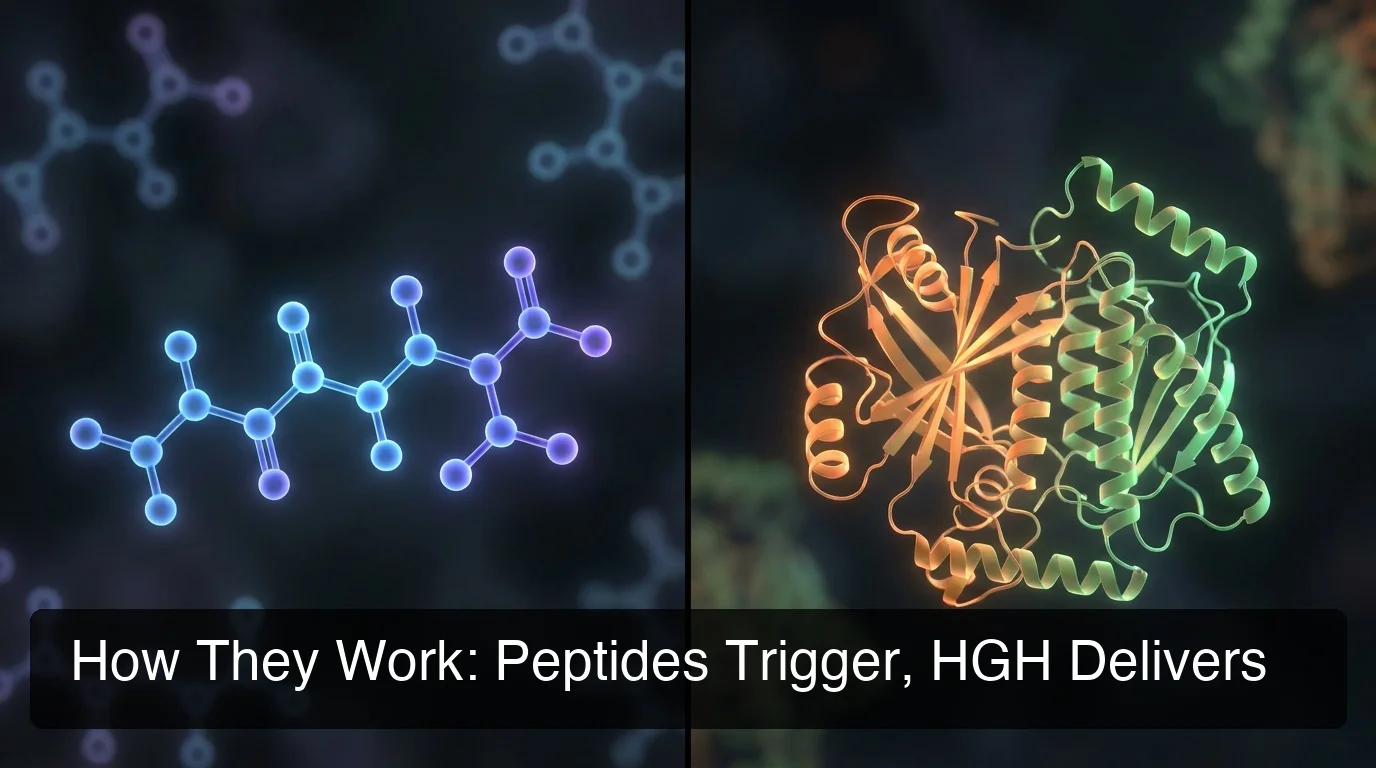 Peptides trigger natural pulsatile GH release; synthetic HGH bypasses your body's feedback system entirely.
Growth hormone secretagogues fall into two main categories:
GHRH analogs — CJC-1295, Sermorelin, Tesamorelin. These bind to GHRH receptors in the pituitary and stimulate GH synthesis and release.
GHRPs (Growth Hormone Releasing Peptides) — Ipamorelin, GHRP-2, GHRP-6. These bind to ghrelin receptors and trigger GH pulses independently. Most fitness-focused protocols stack one from each category for synergistic effect.
How HGH Works Differently
With synthetic HGH, you inject recombinant human growth hormone (rhGH) and it circulates immediately, triggering IGF-1 production in the liver. Your body doesn't need to "do" anything — it's direct delivery.
With peptides, your body's negative feedback systems stay active. GH is released in pulses that mirror natural physiology, which limits both the side effects and the suppression of native GH production. That pulsatile pattern is exactly what your pituitary evolved to work with.
Which Is More Effective: Peptides vs HGH?
Neither is universally better — effectiveness depends on the goal. HGH produces faster, more dramatic results for muscle gain and body composition; peptides offer more precise, targeted effects with a lower suppression risk. For fat loss, recovery, and sleep optimization, peptides like Ipamorelin and CJC-1295 are competitive with HGH at a fraction of the cost.
Evidence from studies on whether peptides actually work shows growth hormone secretagogues produce measurable increases in IGF-1, lean mass, and fat-free body mass — the same biomarkers used to evaluate HGH therapy.
Peptides vs HGH: Head-to-Head
| Factor | Peptides | HGH |
|---|---|---|
| Mechanism | Stimulates natural GH production | Replaces GH directly |
| Onset time | 4–8 weeks | 2–4 weeks |
| Monthly cost | $200–$800 | $1,500–$3,000 |
| Side effect ceiling | Low (mild, reversible) | High (acromegaly risk, insulin resistance) |
| Natural GH suppression | Minimal | High with long-term use |
| Reversibility | High | Lower |
| Legal status (US) | Legal compounding (most peptides) | Prescription only, tightly controlled |
| Best for | Targeted goals, beginners, long protocols | Dramatic muscle gain, advanced anti-aging |
 Peptides deliver 60–80% of HGH's benefits at 15–25% of the cost — the most practical value proposition for most users.
By the numbers: Users on well-designed peptide protocols typically report 60–80% of HGH's muscle-building and fat-loss benefits at roughly 15–25% of the cost — making peptides the dominant choice outside clinical HGH therapy.
Are Peptides Safer Than Human Growth Hormone?
Peptides generally carry a better safety profile than synthetic HGH because they preserve your body's natural feedback mechanisms. The most common peptide side effects — water retention, mild fatigue, injection-site reactions — are dose-dependent and reversible. HGH's risks, including insulin resistance, joint pain, and acromegaly at supraphysiological doses, are more significant and harder to reverse.
For a detailed breakdown of what to watch for, see the real downsides of peptides and clinical evidence on whether peptide therapy is safe.
HGH Side Effect Profile
Exogenous HGH at therapeutic and performance doses carries established risks:
- Acromegaly — bone and soft tissue overgrowth at supraphysiological doses
- Insulin resistance — HGH elevates blood glucose; chronic use can impair insulin sensitivity
- Joint pain and carpal tunnel syndrome — common even at approved therapeutic doses
- Natural GH suppression — chronic exogenous HGH can reduce pituitary output long-term
- Pronounced fluid retention — more significant than with peptides
Peptide Side Effect Profile
Growth hormone secretagogues are well-tolerated at clinical doses:
- Water retention (mild, typically weeks 1–3 then resolves)
- Transient fatigue or brain fog at higher doses
- Injection-site irritation
- Increased hunger (GHRP-specific, particularly GHRP-6)
Ipamorelin is considered the most selective GHRP, with minimal effects on cortisol or prolactin — which is why most beginners start there. Both overall peptide safety evidence and legal status by country are important to review before starting any protocol.
Bottom line: Peptides are not risk-free, but their side effect ceiling is meaningfully lower than HGH — and most effects resolve when you stop or reduce the dose. That reversibility is a key advantage for anyone optimizing long-term.
How Much Does Peptide Therapy Cost vs HGH Treatment?
 Tracking your peptide protocol week by week is the only way to know if your investment is actually working.
Peptide therapy costs $200–$800/month depending on compounds and doses; synthetic HGH runs $1,500–$3,000/month for pharmaceutical-grade treatment. Over a 12-month protocol, that gap reaches $10,000–$30,000 — which explains why peptides have become the dominant choice for fitness and longevity users outside of clinical HGH therapy programs.
What HGH Actually Costs
Pharmaceutical HGH (Norditropin, Genotropin, Humatrope) requires a prescription, regular bloodwork, and physician monitoring:
- Pharmaceutical-grade HGH: $800–$2,000/month at standard doses
- Compounded HGH (prescription required): $300–$600/month
- Medical oversight and labs: $200–$500/month additional
What Peptide Therapy Costs
Compounded peptides through licensed pharmacies:
- CJC-1295 + Ipamorelin stack: $150–$300/month
- Sermorelin: $100–$200/month
- Premium stacks (3+ compounds): $400–$800/month
The cost gap becomes most significant over 6–12 month protocols. For most fitness and anti-aging goals, peptides deliver comparable ROI to HGH at a fraction of the expense.
Key insight: Because peptide results are gradual and dose-dependent, consistent tracking is what separates users who see results from those who don't. Guessing at adherence wastes the investment — and the money.
PeptideIQ is built exactly for this: track every dose, monitor weekly progress trends, and let the AI co-pilot analyze whether your protocol is on track — so you're optimizing, not guessing.
Can You Use Peptides and HGH Together?
Yes — combining peptides and HGH is practiced in advanced protocols, typically pairing a lower HGH dose with peptides to maintain pulsatile GH release. This hybrid approach captures the direct benefits of exogenous HGH while keeping feedback loops partially active via peptide stimulation. It requires careful monitoring and bloodwork — not a beginner approach.
The logic: at high HGH doses, natural GH suppression is significant. Pairing a moderate HGH dose with Ipamorelin or CJC-1295 keeps the pituitary partially engaged, reducing long-term suppression risk while amplifying the total GH output.
Who Should Consider a Combined Protocol
This stacking approach is most appropriate for:
- Competitive bodybuilders in the off-season
- Advanced biohackers under physician-supervised protocols
- Patients on clinical HRT who want to preserve pituitary function
For beginners or intermediate users, starting with peptides alone is both safer and more cost-effective. A combined protocol adds complexity and cost without proportional benefit at typical fitness doses.
When Peptides Alone Are Sufficient
Most people pursuing performance, fat loss, recovery, and anti-aging get everything they need from growth hormone secretagogues alone. The case for adding HGH is strongest when you've fully optimized a peptide protocol, are under clinical supervision with regular labs, and your budget supports the 4–6x cost premium.
How Long Does It Take to See Results: Peptides vs HGH?
HGH produces measurable changes in 2–4 weeks; peptide results emerge more gradually over 4–8 weeks, with peak effects typically at 12–16 weeks on a well-run protocol. HGH's faster onset is due to direct IGF-1 elevation — peptides need consistent signaling cycles to build toward the same hormonal environment.
Peptide Results Timeline
- Weeks 1–3: Sleep quality improvement, mild energy increase (earliest reported effects from Ipamorelin/CJC-1295 users)
- Weeks 4–6: Recovery between sessions improves; early body composition changes emerge
- Weeks 8–12: Fat loss accelerates; lean mass gains become measurable on tape and scale
- Weeks 12–16: Peak protocol benefit; full IGF-1 elevation plateau reached
HGH Results Timeline
- Weeks 1–2: Fluid retention, joint sensation changes (early physiological indicators)
- Weeks 2–4: Energy, recovery, and mood improvement
- Weeks 4–8: Measurable body composition changes
- Weeks 8–16: Full anabolic effect plateau
The key variable in both cases is protocol adherence. Missed doses, inconsistent timing, and poor dose logging are the primary reasons users report underwhelming results. Tracking isn't optional — it's what turns a protocol into an outcome.
Get Started with PeptideIQ
If you're running a peptide protocol, tracking your doses and outcomes is the difference between results and guesswork. PeptideIQ is the AI-powered guided system built specifically for peptide users — dose tracking, protocol management, and an AI co-pilot that knows your specific cycle, data, and goals.
Download PeptideIQ on the App Store
Not ready yet? Explore the PeptideIQ peptide library to research compounds, protocols, and evidence levels before you commit.
Frequently Asked Questions
What's Better, Peptides or HGH?
It depends on your goal and budget. Peptides — specifically growth hormone secretagogues like CJC-1295 and Ipamorelin — deliver 60–80% of HGH's benefits at 15–25% of the cost, with a meaningfully safer side effect profile. For dramatic muscle gain or advanced anti-aging, HGH is more potent. For targeted, sustainable, reversible results, peptides win on every practical metric.
What Is the Closest Peptide to HGH?
Tesamorelin is the closest growth hormone peptide to synthetic HGH — it's FDA-approved, clinically studied for visceral fat reduction, and is the most validated GHRH analog in humans. CJC-1295 with DAC offers sustained GH elevation similar to prolonged-release HGH protocols, making it the most common HGH alternative in fitness and longevity protocols today.
Can You Take HGH and Peptides Together?
Yes — advanced protocols combine low-dose HGH with peptides like Ipamorelin to preserve pulsatile GH release while getting direct IGF-1 elevation. This requires physician supervision and regular bloodwork. For most fitness and anti-aging users, peptides alone are sufficient and significantly less expensive. Stacking is only justified after peptide-only protocols have been fully optimized.
Is HGH Considered a Peptide?
Technically yes — HGH is a 191-amino acid peptide hormone. But in practice, "peptides" in the fitness context refers to growth hormone secretagogues (CJC-1295, Ipamorelin, Sermorelin), which are distinct from synthetic HGH. One stimulates your body's natural GH production; the other replaces it directly. The mechanisms, costs, and risk profiles are fundamentally different.
How Long Should a Peptide Cycle Last vs HGH?
Peptide cycles typically run 12–16 weeks followed by a 4–8 week break to prevent receptor desensitization and maintain pulsatile GH responsiveness. HGH is often used in 3–6 month cycles under medical supervision. Peptide cycles are more flexible — stopping peptides returns your pituitary to baseline within days, unlike HGH which suppresses natural production longer.
Do Peptides Suppress Natural HGH Production?
Unlike synthetic HGH, growth hormone secretagogues preserve and enhance natural GH production rather than suppressing it. Peptides work within your body's own feedback system — stimulating GH pulses rather than replacing them. After stopping a peptide protocol, natural GH production returns to baseline quickly because the pituitary was stimulated, not bypassed.
What Does PeptideIQ Do for Peptide Users?
PeptideIQ is the AI-powered guided system for peptide users — build your protocol, track every dose, and get AI insights that know your data, your cycle, and your specific situation. It replaces scattered spreadsheets and guesswork with a structured system and a personalized AI co-pilot that's always one tap away.