
CJC-1295 Peptide Therapy: Protocol & Benefits | PeptideIQ
CJC 1295 Peptide Therapy: The Complete Protocol Guide
CJC 1295 peptide therapy is one of the most researched growth hormone protocols in anti-aging and performance medicine. If you're researching or already hold a vial, this guide covers what you need to understand — and safely execute — a proper protocol.
Key Takeaways
- CJC-1295 is a synthetic analog of GHRH that stimulates the pituitary gland to release growth hormone naturally, making it a foundational peptide in anti-aging and performance therapy.
- The typical CJC-1295 dosage ranges from 100–200 mcg per injection (2–3 times daily for Mod GRF 1-29), with results often appearing within 2–4 weeks and peak benefits around 8–12 weeks.
- Real-world benefits include improved lean muscle mass, faster recovery, enhanced fat loss, better sleep quality, and increased energy — but consistency and protocol adherence are critical.
- CJC-1295 is often stacked with ipamorelin, sermorelin, or other growth hormone secretagogues for synergistic effects; understanding these combinations helps optimize outcomes.
- While relatively safe, side effects can include injection site reactions, flushing, and transient elevated cortisol; starting low and monitoring your response prevents most adverse effects.
Contents
- What Is CJC 1295 Peptide Therapy and How Does It Work?
- How Much Growth Hormone Can CJC 1295 Peptide Therapy Increase?
- What Are the Real Benefits of CJC-1295 Peptide Therapy?
- How Long Does It Take to See Results From CJC-1295 Therapy?
- What Is the Standard CJC-1295 Dosage for Peptide Therapy?
- Is CJC-1295 Peptide Therapy Safe? Side Effects and Risks
- How Does CJC-1295 Compare to Sermorelin or Ipamorelin?
- How Much Does CJC-1295 Peptide Therapy Cost?
- Why Is CJC-1295 a Preferred Choice in Peptide Therapy Protocols?
- Frequently Asked Questions About CJC-1295 Peptide Therapy
What Is CJC 1295 Peptide Therapy and How Does It Work?
CJC-1295 is a synthetic analog of growth hormone-releasing hormone (GHRH) that binds to receptors in the pituitary gland, triggering pulsatile growth hormone release. Unlike synthetic HGH injections that replace your body's natural production, CJC-1295 works with your own system — amplifying the signals your pituitary already sends.
If you're new to this space, it helps to first understand what a peptide is and how these compounds interact with the body before diving into specific protocols.
CJC-1295 was originally developed as a treatment for growth hormone deficiency. Researchers discovered that its modified structure — particularly the drug affinity complex (DAC) variant — gave it an unusually long half-life compared to native GHRH, making it practical for non-daily dosing.
 CJC-1295 is a GHRH analog that works by stimulating your pituitary gland — not replacing its function.
What Is Mod GRF 1-29 (CJC-1295 Without DAC)?
Two variants appear in any CJC-1295 discussion: CJC-1295 with DAC and Mod GRF 1-29 (CJC-1295 without DAC) — and the difference matters for protocol design.
CJC-1295 with DAC has a half-life of 6–8 days because the DAC modification helps it bind to albumin in the blood, preventing rapid breakdown — dosed 1–2 times per week. Mod GRF 1-29 has a half-life of 15–30 minutes, producing a sharp, pulse-like GH release dosed 2–3 times daily in a fasted state.
Key insight: Most performance and anti-aging protocols use Mod GRF 1-29 (CJC-1295 without DAC) because it mimics the natural pulsatile pattern of GH release — a pattern that may be more physiologically aligned than the sustained elevation produced by the DAC variant.
How Much Growth Hormone Can CJC 1295 Peptide Therapy Increase?
CJC-1295 has demonstrated the ability to increase mean growth hormone levels by 2–10 fold in clinical studies, with IGF-1 levels (the downstream marker of GH activity) rising 1.5–3× above baseline. These increases are dose-dependent and occur within the first few weeks of consistent use.
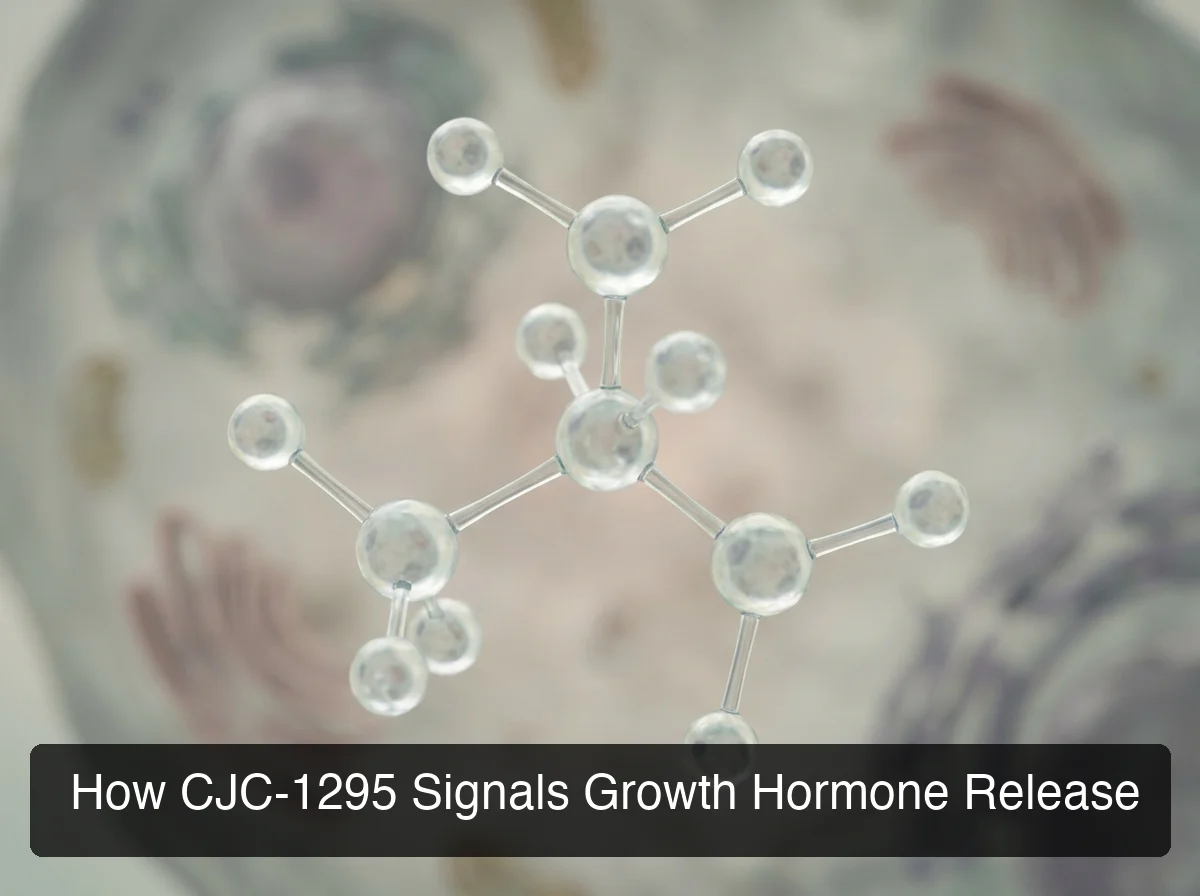 CJC-1295 binds pituitary receptors to amplify natural GH pulses — not suppress them.
A landmark phase II clinical study published in the Journal of Clinical Endocrinology & Metabolism found that CJC-1295 with DAC produced sustained, dose-dependent GH and IGF-1 increases lasting up to 6 days after a single injection.
IGF-1 is the most practical bloodwork marker for confirming CJC-1295 is working. A baseline before starting and a retest at 8 weeks gives you objective confirmation rather than relying on feel alone.
By the numbers: CJC-1295 with DAC raised mean GH levels by 2–10 fold and sustained elevated IGF-1 for 6+ days per injection in clinical research — making it one of the most potent GHRH analogs studied.
What Are the Real Benefits of CJC-1295 Peptide Therapy?
CJC-1295 peptide therapy benefits span five primary domains: lean muscle support, fat metabolism, physical recovery, sleep architecture, and anti-aging effects. These benefits emerge from sustained GH elevation, which drives IGF-1 signaling throughout muscle, bone, and metabolic tissues.
How Does CJC-1295 Support Lean Muscle and Recovery?
CJC-1295 increases GH and IGF-1, both of which directly stimulate muscle protein synthesis and satellite cell activation — the cellular mechanisms underlying muscle growth and repair. Users running CJC-1295 consistently report faster recovery between training sessions within 4–6 weeks.
Recovery from soft-tissue injuries also shortens noticeably under GH stimulation — a meaningful effect for anyone managing injury alongside performance goals.
Does CJC-1295 Help With Fat Loss?
Yes — GH is lipolytic. Elevated growth hormone promotes the breakdown of triglycerides in adipose tissue, particularly visceral fat. Most CJC-1295 users see measurable reduction in body fat percentage even without dramatic dietary changes. CJC-1295 for weight loss covers specific timelines and how dosage affects results.
What About Sleep, Energy, and Anti-Aging?
Sleep quality improvement is one of the most consistently reported early benefits. GH is secreted primarily during deep sleep, and CJC-1295's action reinforces this natural cycle — most users report deeper, more restorative sleep within 2–4 weeks.
Anti-aging effects — improved skin elasticity, collagen synthesis, cognitive clarity — are longer-horizon outcomes emerging at 8–12 weeks, typically tracking alongside sleep improvement.
How Long Does It Take to See Results From CJC-1295 Therapy?
CJC-1295 results follow a predictable timeline: sleep improvements appear within 1–2 weeks, recovery and energy within 2–4 weeks, and noticeable body composition changes at 6–8 weeks. Peak benefits — lean mass gains, sustained fat reduction, improved vitality — typically appear at the 10–12 week mark of a consistent protocol.
- Weeks 1–2: Improved sleep depth and quality; some users notice vivid dreams (a GH pulse indicator)
- Weeks 2–4: Enhanced recovery from training; mild increase in energy and motivation
- Weeks 4–8: Visible body composition shifts begin — reduced fat, subtle muscle fullness
- Weeks 8–12: Peak IGF-1 elevation; measurable changes in lean mass and fat distribution
- Weeks 12+: Continued benefits with potential for diminishing returns without a cycle break
Bottom line: CJC-1295 is not a fast-acting compound. Committing to a consistent 12-week minimum cycle — and tracking your results week by week — is what separates users who see transformative results from those who quit early.
 Tracking your weekly progress objectively is how you confirm CJC-1295 is working — not guessing.
What Is the Standard CJC-1295 Dosage for Peptide Therapy?
The standard CJC-1295 dosage is 100–200 mcg per injection for Mod GRF 1-29, dosed 2–3 times daily in a fasted state. CJC-1295 with DAC is dosed at 1–2 mg, 1–2 times per week. Total weekly exposure ranges from 200–600 mcg (no-DAC) or 1–4 mg (with DAC) depending on protocol and individual goals.
CJC-1295 With DAC vs. Mod GRF 1-29: Protocol Comparison
| Variant | Typical Dose | Frequency | Fasted Required? | Half-Life |
|---|---|---|---|---|
| CJC-1295 with DAC | 1–2 mg | 1–2× weekly | No | 6–8 days |
| Mod GRF 1-29 (no DAC) | 100–200 mcg | 2–3× daily | Yes | 15–30 min |
CJC-1295 with DAC is dosed in milligrams (mg), not micrograms (mcg) — always confirm units with your supplier before reconstituting.
How to Administer CJC-1295 Injections
CJC-1295 is administered subcutaneously into fatty tissue at the lower abdomen, thigh, or upper arm. Rotate injection sites with every dose to avoid tissue irritation.
For Mod GRF 1-29 specifically, timing matters. It should be administered fasted — at least 2 hours after eating — because elevated insulin blunts GH pulse amplitude significantly. Evening doses (30–60 minutes before sleep) capitalize on the body's natural overnight GH secretion window.
Key insight: Fasting compliance is not optional — a dose taken with elevated insulin can produce a fraction of the GH response of a properly timed fasted injection. Timing is part of the protocol, not a preference.
Is CJC-1295 Peptide Therapy Safe? Side Effects and Risks
CJC-1295 has a favorable safety profile in clinical studies when used at recommended doses. The most commonly reported side effects are mild and transient: injection site redness or soreness, facial flushing, headache, and water retention in the first 1–4 weeks. Serious adverse events are rare at standard doses.
 Understanding both benefits and risks of CJC-1295 before starting is fundamental to a safe protocol.
A comprehensive breakdown of what's normal, what's manageable, and what warrants stopping is covered in the CJC-1295 side effects guide, including rare effects like elevated cortisol or hypoglycemia symptoms.
How to Manage Common CJC-1295 Side Effects
Water retention in the first few weeks is the most common complaint. It typically resolves within 3–4 weeks as the body adapts. Reducing sodium intake and staying well-hydrated helps.
Injection site reactions — redness, soreness, mild swelling — are managed by rotating sites with every dose using a 29–31 gauge insulin syringe.
Elevated cortisol is a theoretical concern at high doses. If fatigue or mood changes worsen after 4+ weeks, a dose reduction or cycle break is warranted.
How Does CJC-1295 Compare to Sermorelin or Ipamorelin?
CJC-1295 targets GHRH receptors to stimulate GH release from the pituitary. Sermorelin uses the same pathway but with lower potency. Ipamorelin targets ghrelin receptors (GHSRs) — a complementary mechanism. Together, CJC-1295 + ipamorelin is the most popular GH optimization stack, amplifying growth hormone through two independent pathways simultaneously.
| Peptide | Mechanism | Half-Life | GH Increase | Best Use Case |
|---|---|---|---|---|
| CJC-1295 (no DAC) | GHRH analog | 15–30 min | High (pulsatile) | Anti-aging, performance |
| CJC-1295 with DAC | GHRH analog | 6–8 days | High (sustained) | Convenience dosing |
| Sermorelin | GHRH analog | 10–20 min | Moderate | Beginner GH therapy |
| Ipamorelin | GHSR agonist | ~2 hours | Moderate (selective) | Stack partner, low cortisol |
Sermorelin is often the recommended entry point for those new to GH peptides — lower potency and a longer prescribing track record. CJC-1295 is the step up when you want more pronounced GH stimulation.
Ipamorelin's value as a stack partner comes from its tolerability: unlike some GHRP peptides, it doesn't raise cortisol or prolactin significantly. Combining Mod GRF 1-29 with ipamorelin amplifies GH pulses through two independent pathways — making it the benchmark CJC-1295 stack for most protocols.
Bottom line: CJC-1295 is often the choice when you need stronger GH stimulation than sermorelin provides. Paired with ipamorelin, it forms the most widely used growth hormone peptide stack in the protocols community.
How Much Does CJC-1295 Peptide Therapy Cost?
CJC-1295 peptide therapy cost ranges from $50–$150 per vial (research-grade, 1–5 mg vials), with monthly costs running $100–$400 depending on variant and dosing frequency. Medically supervised protocols through peptide therapy clinics typically run $200–$600 per month, including physician oversight and lab monitoring.
The cost difference between DAC and no-DAC variants is minimal. Where costs diverge is between gray-market suppliers and medically supervised pathways — including lab tests, physician consultation, and compounding pharmacy fees. Budget additionally for bacteriostatic water ($5–$15), insulin syringes ($15–$25/box of 100), and a baseline IGF-1 blood panel ($75–$200).
Why Is CJC-1295 a Preferred Choice in Peptide Therapy Protocols?
CJC-1295 occupies a unique position: it's potent enough for meaningful clinical results, flexible enough for multiple dosing approaches, and backed by peer-reviewed research on its GHRH analog mechanism. It forms the foundation of most growth hormone optimization stacks because it amplifies the pituitary's own function rather than bypassing it.
CJC-1295 can run standalone, stack with ipamorelin for synergistic GH pulses, or combine with peptides targeting distinct recovery or longevity pathways. For users who have run sermorelin and want more pronounced results, it is consistently the next step.
Get Started With PeptideIQ
Tracking a CJC-1295 protocol without a system means guessing whether it's working. PeptideIQ tracks every dose, flags fasting windows, and gives you an AI co-pilot initialized with your exact cycle phase — grounded in your specific data, not generic advice.
Download PeptideIQ on the App Store
Frequently Asked Questions About CJC-1295 Peptide Therapy
What does CJC-1295 do for your body?
CJC-1295 is a GHRH analog that signals the pituitary gland to release more growth hormone in natural pulses. This drives downstream IGF-1 production, supporting muscle protein synthesis, fat metabolism, faster tissue recovery, improved sleep architecture, and — with extended use — anti-aging effects on skin elasticity and cognitive clarity.
How long should you take CJC-1295?
Most protocols run 8–12 weeks, followed by a 4–6 week break to prevent receptor desensitization. Twelve weeks on / 4–6 weeks off is the standard for performance and anti-aging goals; some users run continuous low-dose protocols under medical supervision.
What are the negative effects of CJC-1295?
The most common side effects are injection site reactions (redness, soreness), water retention in the first 2–4 weeks, facial flushing, and occasional headache. Less common effects include transient fatigue, elevated cortisol at high doses, and hypoglycemia symptoms — all rare at standard doses with proper fasting compliance.
Is CJC-1295 with DAC or without DAC better?
It depends on protocol goals. CJC-1295 with DAC offers dosing convenience (1–2 injections weekly) and sustained GH elevation. Mod GRF 1-29 (without DAC) produces sharper pulsatile release that mirrors natural GH secretion. Most stack protocols use Mod GRF 1-29 because it pairs cleanly with ipamorelin for synergistic twice-daily dosing.
Can CJC-1295 be stacked with other peptides?
Yes — CJC-1295 is most commonly stacked with ipamorelin (the benchmark combination), but also pairs with sermorelin, GHRP-2, or GHRP-6. Stacking targets two distinct GH-stimulating pathways simultaneously, producing a larger GH pulse than either peptide alone. The CJC-1295 + ipamorelin stack is widely considered the standard for GH optimization protocols.
How do I know if CJC-1295 is working?
The clearest objective indicator is IGF-1 elevation on bloodwork at the 6–8 week mark compared to your baseline. Early subjective signals include improved sleep quality (weeks 1–2), faster workout recovery (weeks 2–4), and body composition changes (weeks 6–8). Tracking these metrics consistently — rather than relying on feel — is how you confirm protocol effectiveness.