

Tirzepatide Side Effects: What to Expect Week by Week
Tirzepatide Side Effects: What to Expect Week by Week
Nausea on day three of tirzepatide is not a sign you did something wrong. Tirzepatide side effects follow a predictable pattern, and knowing that pattern in advance changes how you get through it.
Key Takeaways
- Tirzepatide's most common side effects (nausea, fatigue, vomiting) peak in weeks 2-4 and typically resolve within 2-3 weeks, though individual timelines vary by dose and body weight.
- Nausea is not a sign something is wrong — it's an expected physiological response that improves with dose titration, and people who log side effects and track trends report more confidence sticking with the protocol.
- Staying hydrated, eating smaller meals, and maintaining protocol consistency through the discomfort window are the three largest modifiable factors in side-effect tolerance.
- A structured tracking system lets you correlate side effects with dose, cycle phase, and lifestyle factors — turning anxiety into actionable insight instead of guesswork.
Contents
- What Are the Most Common Tirzepatide Side Effects?
- When Do Tirzepatide Side Effects Peak and How Long Do They Last?
- Why Does Tirzepatide Cause Nausea and When Does It Stop?
- How Do Tirzepatide Side Effects Compare to Semaglutide or Ozempic?
- Can You Reduce or Prevent Tirzepatide Side Effects?
- What Should You Do if Tirzepatide Side Effects Are Severe?
- How Do You Stay Consistent on Tirzepatide Despite Side Effects?
- Monitoring and Managing Side Effects
What Are the Most Common Tirzepatide Side Effects?
The most common tirzepatide side effects are gastrointestinal: nausea, diarrhea, vomiting, constipation, and decreased appetite, affecting roughly 12-30% of users depending on the symptom and dose. These are the same GLP-1/GIP class effects seen with semaglutide, just with a somewhat different intensity profile because tirzepatide acts on two receptors instead of one.
Beyond the digestive symptoms, users commonly report:
- Fatigue, especially in the first two weeks after a dose increase
- Injection site reactions — mild redness or soreness that fades within a day
- Headache, usually tied to reduced food or fluid intake
- Burping, heartburn, or a general "full" feeling after small meals
- Dizziness, most often linked to dehydration rather than the drug itself
Most of these are mild to moderate and directly tied to how fast your body adjusts to appetite suppression and slower gastric emptying — not a sign the medication is working against you.
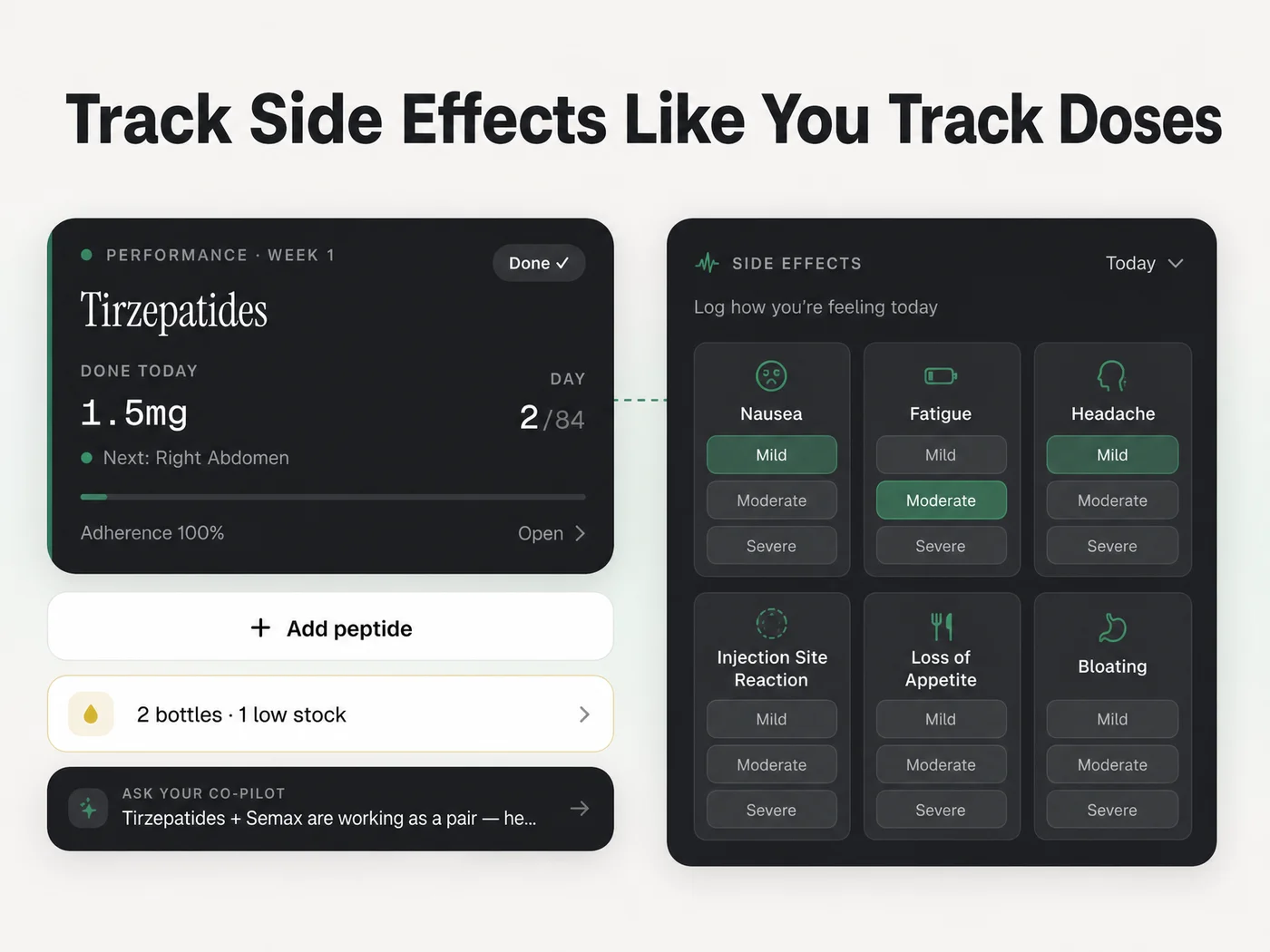 Logging side effects next to your dose history turns a vague "I feel off" into a pattern you can actually read.
Reality check: Nearly every first-time GLP-1/GIP user experiences at least one digestive symptom in the first month. That is the expected adjustment period, not an outlier reaction.
When Do Tirzepatide Side Effects Peak and How Long Do They Last?
Tirzepatide side effects typically peak between weeks 2 and 4 of a dose, then taper off over the following 2-3 weeks as your body adjusts to the new gastric emptying rate. Every dose escalation resets this cycle to some degree, which is why symptoms often return — usually milder — each time your protocol steps up.
The general pattern looks like this:
- Days 1-3: Mild symptoms, sometimes none at all
- Days 4-10: Nausea and appetite suppression build as the dose takes full effect
- Weeks 2-4: Peak intensity — this is when most people consider stopping
- Weeks 4-6: Noticeable tapering as the body normalizes
- Before next dose increase: Symptoms usually settle to a manageable baseline
Body weight, hydration status, and how fast your prescriber titrates the dose all shift this timeline. Slower titration schedules generally produce a flatter, more tolerable curve.
 The peak-and-fade pattern repeats with each dose step, though usually less intensely each time.
Why Does Tirzepatide Cause Nausea and When Does It Stop?
Tirzepatide causes nausea by slowing gastric emptying and activating GLP-1 and GIP receptors in the brainstem region that controls the vomiting reflex — the same mechanism responsible for the appetite suppression that drives weight loss. It is a side effect of the drug doing exactly what it is designed to do, not a malfunction.
For most people, nausea stops being a daily issue by week 3 or 4 at a given dose. It can reappear, usually more mildly, after each subsequent dose increase — which is why understanding tirzepatide dosing schedules matters before you start.
A few practical patterns worth knowing:
- Nausea is usually worse 1-3 hours after eating a large or fatty meal
- Morning nausea often improves once you eat something small and bland
- Nausea that starts suddenly weeks into a stable dose, rather than after an increase, is worth flagging to your prescriber
How Do Tirzepatide Side Effects Compare to Semaglutide or Ozempic?
Tirzepatide and semaglutide share nearly identical side effect categories — nausea, vomiting, diarrhea, constipation — but tirzepatide's dual GIP/GLP-1 action tends to produce a somewhat different intensity curve, with some users reporting less nausea and others reporting more, depending on individual receptor sensitivity. There is no universal "easier" option; response varies by person.
| Side Effect | Tirzepatide | Semaglutide (Ozempic) |
|---|---|---|
| Nausea | 12-30% of users | 15-20% of users |
| Diarrhea | 13-24% of users | 8-12% of users |
| Vomiting | 6-12% of users | 5-9% of users |
| Constipation | 6-17% of users | 24% of users |
| Injection site reaction | Mild, common | Mild, common |
| Weight loss potential | Generally higher | Generally lower |
Numbers are drawn from published clinical trial ranges and vary across studies and populations — treat this as a general comparison, not a personal prediction. For a full breakdown of what to expect on the semaglutide side, see our semaglutide side effects guide or the Ozempic-specific side effects article if you're comparing the branded formulation directly.
Can You Reduce or Prevent Tirzepatide Side Effects?
You cannot eliminate tirzepatide side effects entirely, but hydration, smaller and lower-fat meals, and a slower dose titration schedule are the three biggest modifiable factors in how tolerable the adjustment period feels. None of these guarantee zero symptoms, but each measurably reduces severity for most users.
Practical steps that consistently help:
- Drink water steadily through the day rather than large amounts at once — dehydration amplifies nausea, fatigue, and headache
- Eat smaller portions more frequently instead of three large meals
- Reduce fried, greasy, or very rich foods, especially in the 48 hours after a dose
- Stop eating once you feel "satisfied," not full — the drug changes that signal faster than habit does
- Ask your prescriber about a slower titration if side effects feel disproportionate to your dose
Worth knowing: Users who eat smaller meals and stay ahead of hydration in the first two weeks of a new dose consistently report a shorter, flatter peak than those who don't adjust anything.
What Should You Do if Tirzepatide Side Effects Are Severe?
Contact your prescriber promptly if you experience severe or persistent vomiting, signs of dehydration, intense abdominal pain, or symptoms of pancreatitis or gallbladder problems — these are uncommon but serious and require medical evaluation, not home management. Mild nausea is expected; these are not.
Watch for these warning signs specifically:
- Severe, unrelenting abdominal pain, especially radiating to the back
- Vomiting that prevents you from keeping fluids down for more than a day
- Signs of dehydration: dizziness, dark urine, rapid heartbeat
- Yellowing of the skin or eyes
- Symptoms that worsen rather than plateau after the first week of a dose
The clinical evidence and real-world data behind tirzepatide's safety profile are solid for the general population; if you're still deciding whether peptide therapy is legitimate for your situation, that context is worth reading before you start.
How Do You Stay Consistent on Tirzepatide Despite Side Effects?
Staying consistent through the side-effect window comes down to expecting the discomfort in advance, adjusting food and hydration habits proactively, and tracking whether symptoms are trending down rather than judging each bad day in isolation. People who quit early are usually reacting to a single rough day, not the actual trend line.
A few habits that separate people who push through from people who stop:
- Log symptoms daily, even briefly — a trend is more useful than a memory
- Compare this week to last week, not this week to a symptom-free ideal
- Keep a simple note of what you ate before a bad episode; patterns show up fast
- Remind yourself the peak window is finite — most people are through the worst by week 4
If you're comparing dosing strategies to smooth out this window, the semaglutide dosing for weight loss guide covers titration pacing that applies conceptually to tirzepatide as well.
Monitoring and Managing Side Effects
Structured tracking turns "is this normal?" into an answered question instead of an open worry — logging your symptoms against your actual dose and cycle day is what lets you tell the difference between expected discomfort and something worth flagging. Most people navigating this window aren't short on willpower; they're short on context.
This is where PeptideIQ's AI co-pilot changes the experience. Because it already knows your current dose, cycle day, and logged wellness data, a question like "is this nausea normal?" gets an answer grounded in your actual protocol — not a generic forum thread or a disclaimer-heavy medical page.
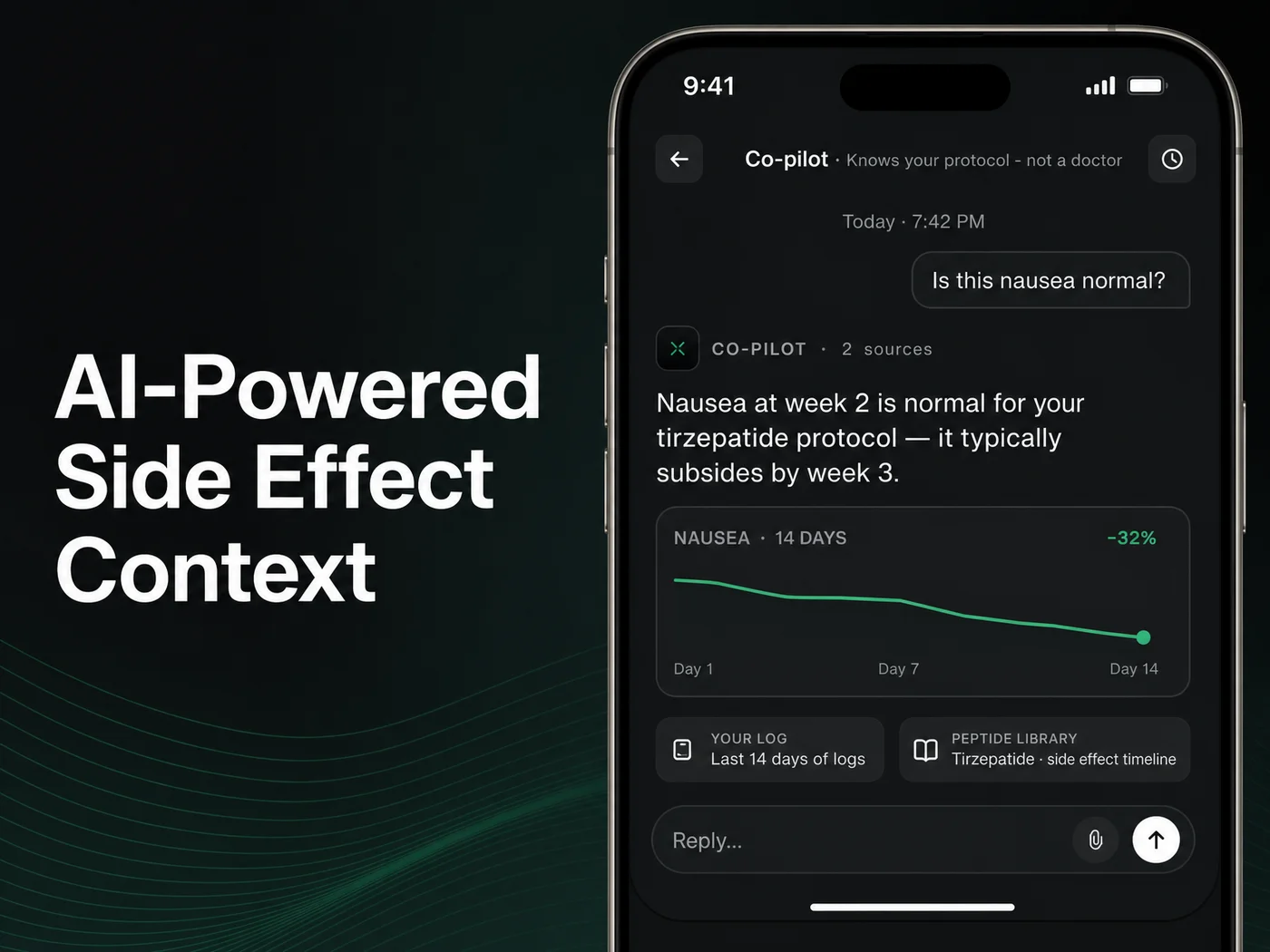 The co-pilot references your own logged history, not a generic answer, when you ask whether a symptom is expected.
That context is the difference between white-knuckling through a rough week and knowing, with your own data in front of you, that the trend is already moving in the right direction.
Get Started with PeptideIQ
If you're mid-protocol and unsure whether what you're feeling is normal, guessing is the hardest part to remove on your own. PeptideIQ pairs dose logging with an AI co-pilot that knows your cycle, your symptoms, and your history — so you get an answer grounded in your data, not a generic disclaimer.
Download PeptideIQ on the App Store — track your protocol and get side-effect context that's actually specific to you.
Not ready yet? Learn how PeptideIQ works — free access to the peptide library and AI co-pilot at launch.
Frequently Asked Questions
Is it normal to feel nauseous every day on tirzepatide?
Daily nausea is common in the first 2-4 weeks after starting or increasing your dose, especially around meals. It typically becomes intermittent rather than constant by week 3 or 4. Persistent daily nausea beyond six weeks at a stable dose is worth discussing with your prescriber.
How long do tirzepatide side effects last after each dose increase?
Most side effects intensify for 1-2 weeks after a dose increase, then taper over the following 2-3 weeks as your body adjusts. The pattern tends to repeat with each escalation but often feels milder than the first round.
Does tirzepatide cause more side effects than semaglutide?
Not universally — tirzepatide tends to cause more diarrhea and gastrointestinal symptoms in some studies, while semaglutide shows higher constipation rates in others. Individual response varies more than the drug class itself does.
What foods make tirzepatide side effects worse?
Fried, greasy, and very rich or sugary foods tend to worsen nausea and stomach discomfort, especially within 48 hours of a dose. Large meals in general slow an already-slowed gastric emptying process further.
Can you build tolerance to tirzepatide side effects over time?
Yes — most users report significantly reduced symptoms at a stable dose after the first 4-6 weeks. Tolerance often resets partially with each dose increase, though usually to a lesser degree each time.
Is PeptideIQ a medical app that treats tirzepatide side effects?
No. PeptideIQ is a wellness tracking and AI guidance app, not a medical or prescribing service. It helps you log symptoms, understand patterns in your own data, and know when a conversation with your prescriber is warranted — it doesn't replace medical care.