
Semaglutide Dosing for Weight Loss | PeptideIQ
Semaglutide Dosing for Weight Loss: The Complete Weekly Protocol
Semaglutide dosing for weight loss follows a fixed titration ladder: 0.25 mg weekly for the first month, then step increases every four weeks until you reach a maintenance dose of 1.7 mg or 2.4 mg. The schedule isn't arbitrary. It's built to let your gut adjust to the drug's slowed digestion before the dose gets strong enough to actually suppress appetite.
Full titration typically takes 16 to 20 weeks — most of the "is this even working" panic happens somewhere inside that window, before the dose has caught up to the effect people are expecting.
What Is Semaglutide Dosing for Weight Loss, Exactly?
Semaglutide dosing for weight loss is a four-week-hold titration schedule that starts at 0.25 mg weekly and rises to a maintenance dose of 1.7 mg or 2.4 mg. Each dose level is held for at least four weeks before advancing — a pace designed to build gastrointestinal tolerance before the dose reaches a therapeutically active level.
| Weeks | Weekly Dose | Phase |
|---|---|---|
| 1–4 | 0.25 mg | Starting |
| 5–8 | 0.5 mg | Escalation |
| 9–12 | 1.0 mg | Escalation |
| 13–16 | 1.7 mg | Escalation |
| 17+ | 2.4 mg | Maintenance |
 The standard titration ladder for semaglutide, four weeks per rung.
This is the weight-management (Wegovy) ceiling. Diabetes protocols (Ozempic) top out lower, at 1.0 mg or 2.0 mg, since the goal is glucose control rather than maximum appetite suppression. A small subset of clinical references note further escalation under provider guidance for patients who plateau at 2.4 mg, but that ceiling remains the standard endpoint for the overwhelming majority of protocols. Proper semaglutide titration for weight loss is less about the top number and more about not rushing the climb — the semaglutide dosage chart breaks down the exact week-by-week unit conversions if you're calculating from a compounded vial.
Key Takeaways
- Semaglutide dosing follows a titration schedule: starting at 0.25 mg weekly, increasing every four weeks until reaching maintenance (1.7 mg or 2.4 mg depending on protocol).
- Most weight loss happens during weeks 4–12, once your dose has climbed into the therapeutic range — the ramp-up phase is a tolerance-building period, not the results phase.
- Dose timing is flexible: your weekly injection can land on any day, and consistency matters more than which day you pick.
- Skipping a single dose rarely derails progress; if you're more than two days late, take it and resume your normal schedule.
- Logging your dose history against your weight trend is the only reliable way to tell if a given phase is actually working.
How Much Semaglutide Should You Take Per Week?
Weekly semaglutide dose is set by your titration phase, not your body weight — a 180-lb user and a 300-lb user both start at the identical 0.25 mg. What changes over time is which phase you're in, with the actual weekly amount ranging from 0.25 mg at the start to 2.4 mg at full maintenance.
Bodyweight determines total impact, not dose size. Receptor sensitivity — how quickly your GLP-1 receptors adapt to the drug — governs the pace of escalation, which is why the same four-week-hold structure applies whether you weigh 160 pounds or 280.
Worth knowing: Semaglutide dose timing is flexible. Injecting on the same day each week is a helpful habit, not a clinical requirement, and shifting by a day or two rarely changes the outcome.
How Do You Adjust Semaglutide Dosing for Weight Loss When It's Not Working?
If weight loss stalls at a given dose for eight or more weeks, moving up to the next tier — with your prescriber's input — is a normal, expected part of the protocol, not evidence that something has gone wrong. Most people who plateau at 1.0 mg respond again once they reach 1.7 mg or 2.4 mg.
How much a plateau should actually worry you depends on where you are in the schedule — someone questioning whether they can lose 20 lbs in 2 months on semaglutide is usually still early enough in titration that the dose, not the plan, is the limiting factor.
Before assuming you need a higher dose, rule out the usual culprits. Alcohol intake blunts GLP-1 efficacy and worsens the side effects of higher semaglutide doses — semaglutide and alcohol covers exactly how much that interaction matters. Supplement interactions can also affect how your body responds to a dose increase, which is worth checking before you assume the medication itself has stalled.
Escalating too has trade-offs worth tracking. Higher doses correlate with a faster rate of lean tissue loss alongside fat loss, and some users notice hair shedding at certain dose phases — both are reasons to log more than just the number on the scale.
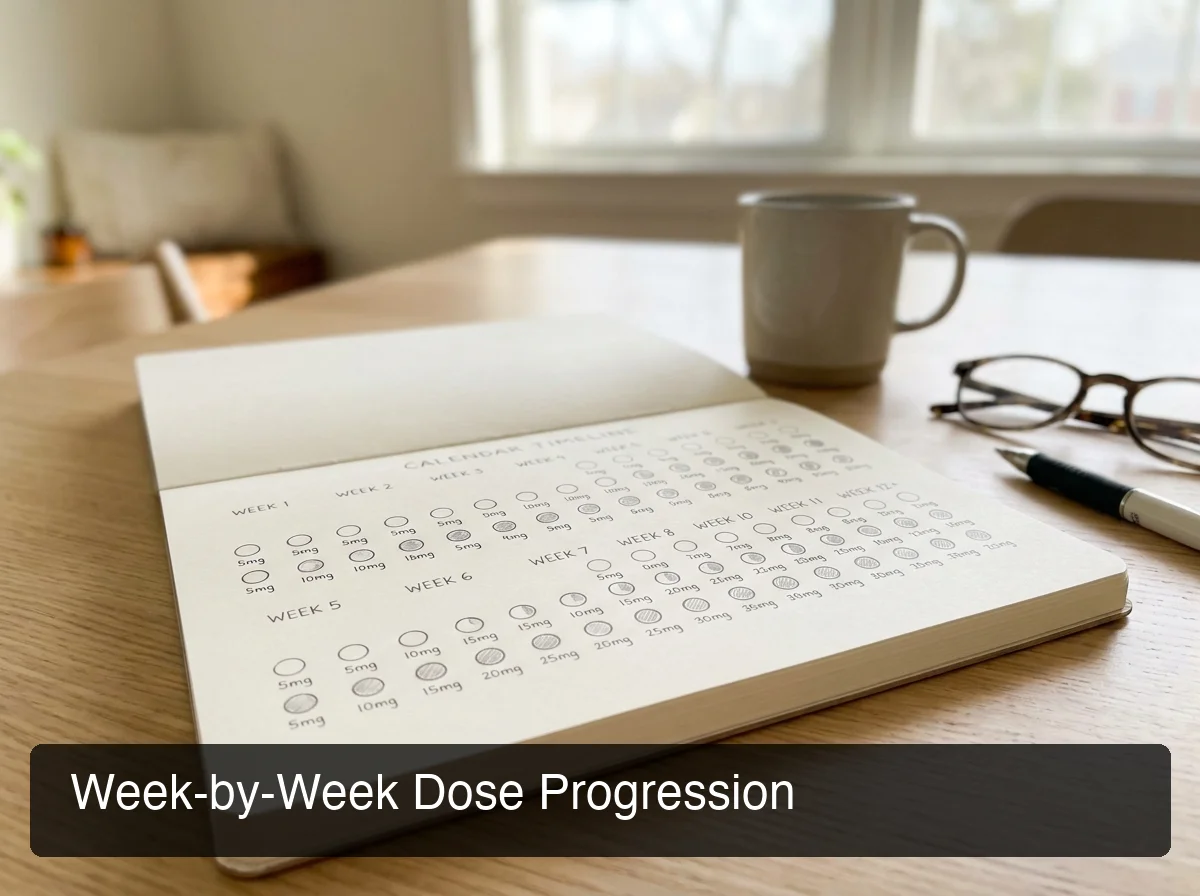 Every phase transition, mapped against the actual week it happens.
How PeptideIQ Automates Your Semaglutide Protocol
Building your own titration spreadsheet works until week nine, when you're trying to remember whether you were supposed to move up last Tuesday or the Tuesday after. PeptideIQ's Cycle Planner replaces that guesswork with a phase builder: set Phase 1 at weeks 1–4 for 0.25 mg, Phase 2 at weeks 5–8 for 0.5 mg, and so on through your full escalation.
Automatic phase transitions handle the part people actually get wrong. When week 5 arrives, the app reminds you the transition is due and updates your scheduled dose — you confirm it, you don't recalculate it. For anyone managing a 16-to-20-week protocol on top of a full schedule, that's the difference between a plan you follow and one you slowly abandon.
Download PeptideIQ on the App Store
What Happens If You Skip a Semaglutide Dose?
Missing a single semaglutide dose rarely undoes your progress. If it's been fewer than two days since your scheduled dose, take it as soon as you remember; if you're closer to your next scheduled dose, skip the missed one entirely and resume your normal weekly rhythm — never double up to make up for it.
Reality check: One missed dose is a rounding error. A pattern of missed doses is what actually flattens a titration curve, since your body never spends enough consecutive weeks at a given level to respond to it.
 A missed-dose pattern is easier to catch when your dose history and weight trend sit on the same screen.
As you move through each titration phase, expect the week-by-week results and side effects to shift along with it — appetite suppression intensifies as the dose climbs, and so does the chance of nausea if you climb too fast. Higher doses also tend to sharpen appetite suppression enough that certain foods start triggering nausea that didn't bother you at 0.25 mg, so what you eat matters more as you escalate, not less.
Frequently Asked Questions
What is the standard starting dose of semaglutide for weight loss?
The standard starting dose is 0.25 mg once weekly, held for four weeks before the first increase. This dose is meant to build gastrointestinal tolerance, not produce weight loss — meaningful appetite suppression typically doesn't begin until 0.5 mg or higher.
How much semaglutide should you take per week at full maintenance?
Full maintenance for weight management sits at 2.4 mg weekly, though some protocols plateau effectively at 1.7 mg. Diabetes-focused protocols use a lower 1.0–2.0 mg ceiling. Reaching either maintenance level takes 16–20 weeks on the standard four-week-hold schedule.
Can you change your semaglutide dose timing or day of the week?
Yes. Semaglutide only requires one injection every seven days, and the specific day is flexible as long as roughly a week separates doses. Consistency helps with routine, but shifting your injection day by one or two days doesn't meaningfully affect efficacy.
What happens if you skip a semaglutide dose?
If fewer than two days have passed since your scheduled dose, take it right away. If you're closer to the next scheduled date, skip the missed dose and resume your normal weekly schedule — doubling up is not recommended and increases side effect risk without added benefit.