
Do Peptides Need Refrigeration? | PeptideIQ
Do Peptides Need to Be Refrigerated? The Storage Guide for Active Users
Do peptides need to be refrigerated? For most compounds, yes — and the answer matters far more than most users realize. Peptides degrade quickly without proper temperature control, and a vial stored improperly can lose significant potency before any visible change appears.
Key Takeaways
- Most peptides must be stored at 2-8°C (standard refrigerator temperature) to prevent degradation and maintain full potency.
- Lyophilized (freeze-dried) peptides can last months to years when refrigerated, but degrade within days at room temperature.
- Reconstituted peptides are far more vulnerable — they typically last only 2-4 weeks refrigerated, and degrade even faster if left out.
- Improper storage is one of the most expensive mistakes peptide users make — a $100+ vial can become ineffective in weeks without cold chain management.
- Freezing at -20°C can extend shelf life to 1-2 years, but only with proper sealing to prevent moisture damage and ice crystal formation.
Contents
- Do Peptides Need to Be Refrigerated?
- What Temperature Should Peptides Be Stored At?
- How Long Do Peptides Last When Refrigerated?
- Do Peptides Need to Be Refrigerated or Can Room Temperature Work?
- Can You Freeze Peptides Instead of Refrigerating?
- Do All Types of Peptides Require the Same Storage Temperature?
- How Can You Tell If a Peptide Has Gone Bad from Improper Storage?
- Why PeptideIQ's Storage Tracking Matters
- Get Started with PeptideIQ
- Frequently Asked Questions
Do Peptides Need to Be Refrigerated?
Yes — most peptides need to be refrigerated. Lyophilized (freeze-dried) peptides should be stored at 2-8°C immediately upon receipt and kept refrigerated until reconstitution. Once mixed with bacteriostatic water, refrigeration becomes even more critical: reconstituted peptides degrade significantly faster and typically expire within 2-4 weeks even under ideal cold storage conditions.
Peptides are short chains of amino acids held together by peptide bonds. Those bonds are chemically fragile — heat, moisture, light, and oxygen all accelerate their breakdown. At room temperature (20-25°C), degradation rates increase dramatically, and your compound can lose meaningful potency within days.
This is not a gray area. Whether you are running BPC-157 for injury recovery, semaglutide for weight loss, or CJC-1295 for growth hormone support, the refrigeration requirement applies across the board.
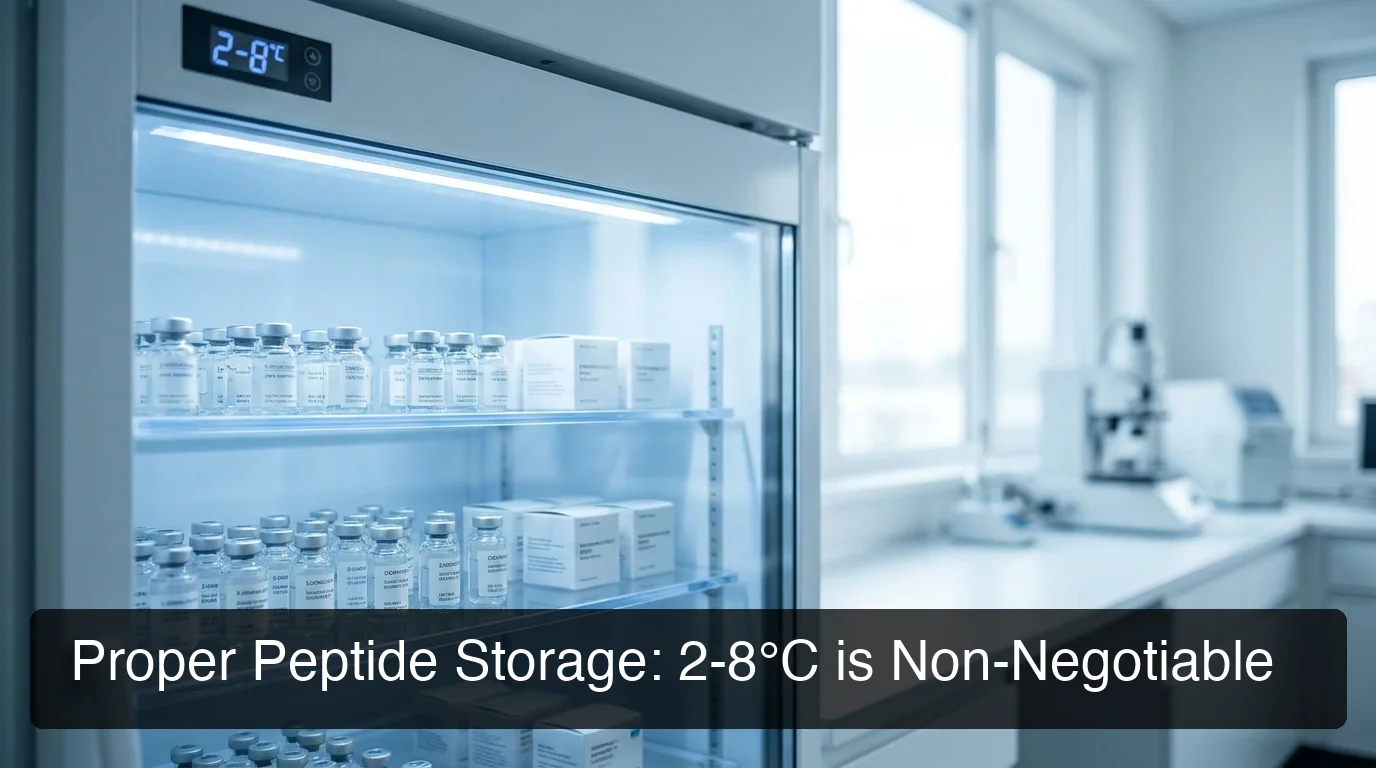 Proper cold storage at 2-8°C is the single most important step in preserving peptide potency from day one.
What Temperature Should Peptides Be Stored At?
Peptides should be stored at 2-8°C for standard refrigeration, or at -20°C for long-term frozen storage. The 2-8°C range matches a standard household refrigerator and is sufficient for most lyophilized peptides. Dropping to -20°C is recommended when you will not use the vial for several months or need to maximize shelf life to 1-2 years.
The stability window matters in both directions. Below 0°C without controlled freezing can cause ice crystal formation that damages peptide structure. Above 8°C, enzymatic and oxidative degradation accelerates significantly.
Why 2-8°C Is the Standard Clinical Range
Clinical peptide storage guidelines — including those used for FDA-approved compounds like semaglutide — specify 2-8°C as the validated refrigeration range. This is not arbitrary: stability studies consistently show that peptide degradation rates remain low within this band.
Avoid the refrigerator door. Temperature fluctuations from frequent opening can push door-stored items above 8°C. Store vials in the main body of the refrigerator, ideally in an opaque container that also protects from light exposure.
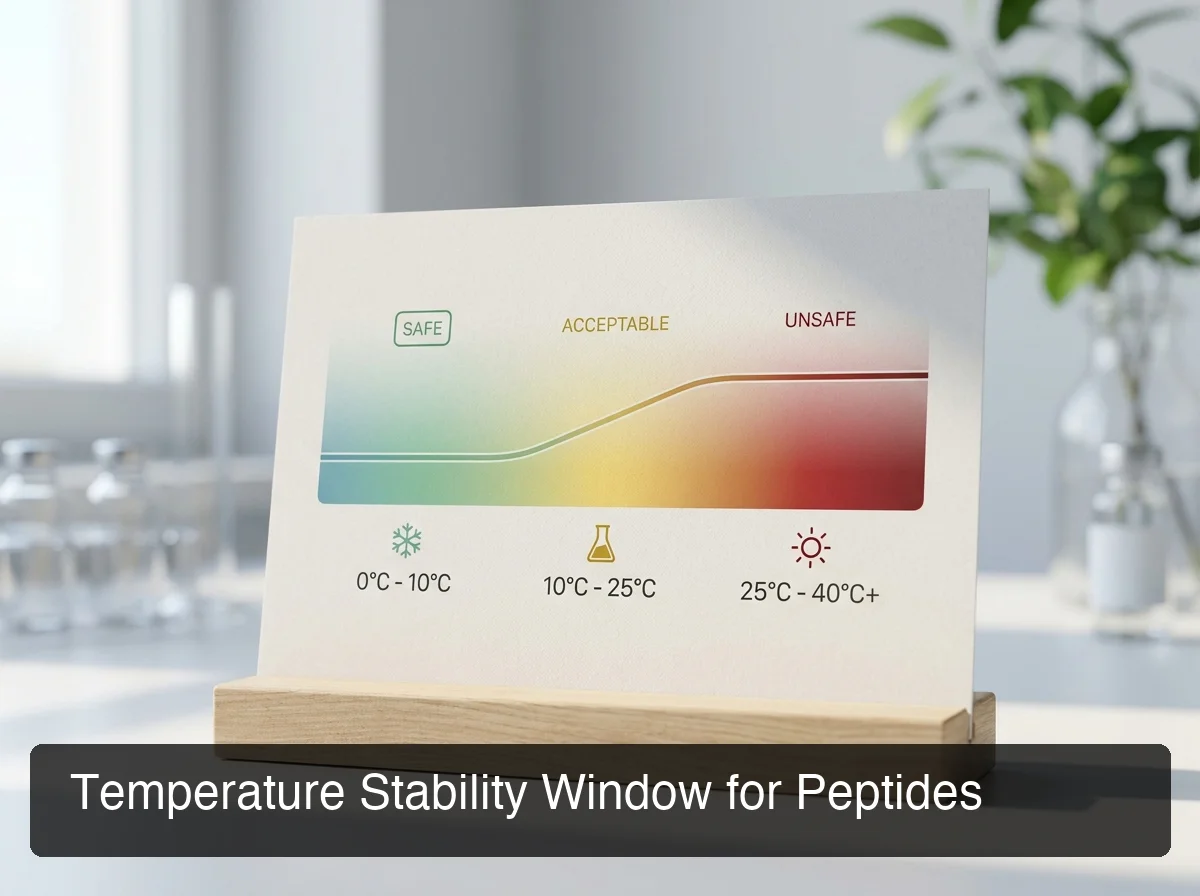 The 2-8°C band is the validated safe zone for most peptide compounds — deviations in either direction carry compounding risks.
Key insight: Refrigerator doors are the worst place to store peptides. Temperature swings from opening and closing can regularly push vials above 8°C — without any visible warning sign.
How Long Do Peptides Last When Refrigerated?
Lyophilized peptides stored at 2-8°C typically remain stable for 3-12 months, depending on the compound and packaging quality. Once reconstituted, refrigerated peptides last 2-4 weeks at most. Frozen lyophilized peptides at -20°C can remain stable for 1-2 years. Potency degrades progressively — the compound does not expire sharply overnight.
This is why understanding shelf life by form matters. A lyophilized (dry powder) vial is far more stable than a reconstituted solution. Many users make the mistake of reconstituting an entire vial at once, then refrigerating the full solution for months — cutting their effective dosing window dramatically.
Shelf Life by Peptide Form
| Form | Storage Condition | Estimated Shelf Life |
|---|---|---|
| Lyophilized (dry powder) | Frozen (-20°C) | 1-2 years |
| Lyophilized (dry powder) | Refrigerated (2-8°C) | 3-12 months |
| Lyophilized (dry powder) | Room temperature | Days to weeks |
| Reconstituted solution | Refrigerated (2-8°C) | 2-4 weeks |
| Reconstituted solution | Room temperature | 2-7 days |
Reconstituting only the doses you need for the next 2-4 weeks — rather than the entire vial at once — extends your total supply. For a full walkthrough of reconstitution best practices and how much BAC water to add, see the guide on bacteriostatic water for peptides.
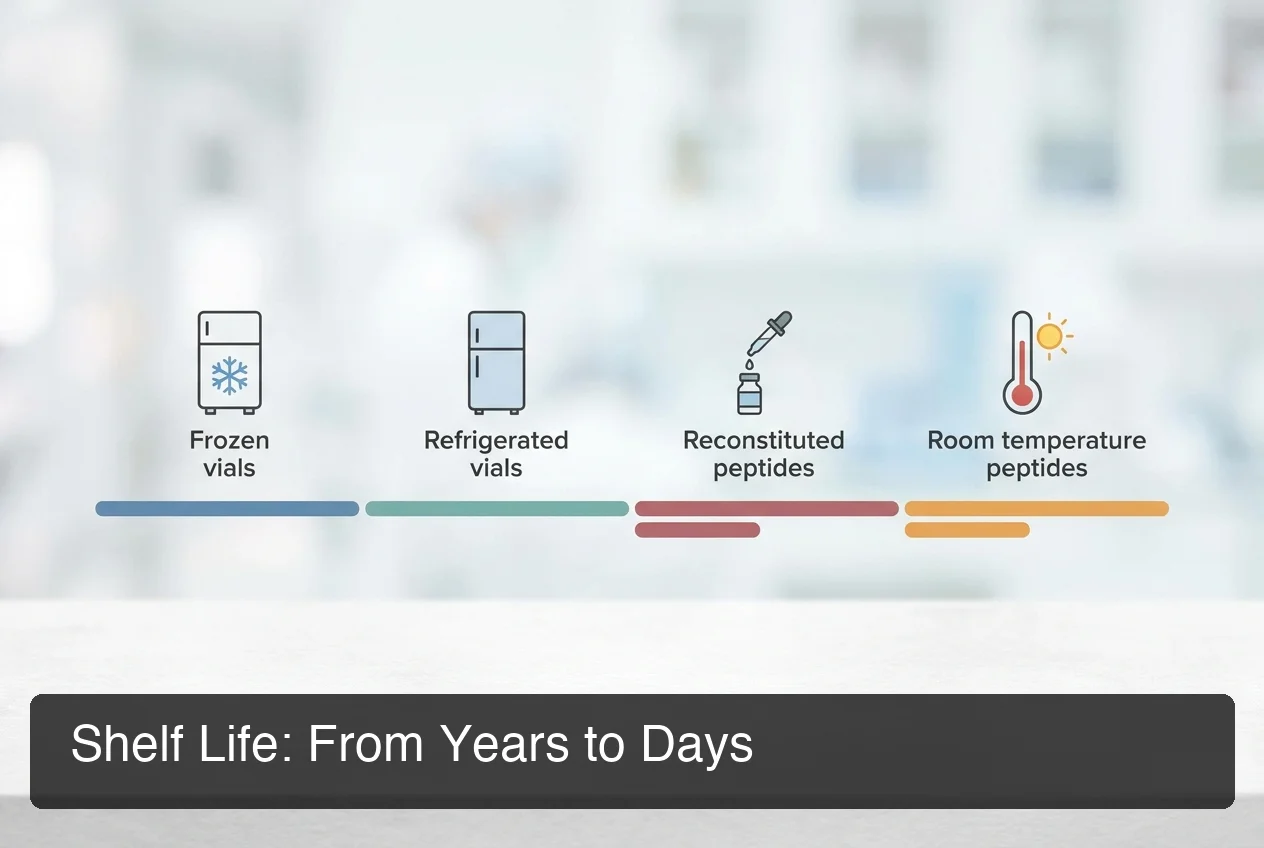 Shelf life drops sharply from years (frozen powder) to weeks (refrigerated solution) to days (room temperature) — form and temperature together determine potency.
By the numbers: Reconstituted peptides lose potency 4-12x faster than lyophilized powder at the same temperature. A vial lasting months as dry powder may become ineffective in under 2 weeks once mixed.
Do Peptides Need to Be Refrigerated or Can Room Temperature Work?
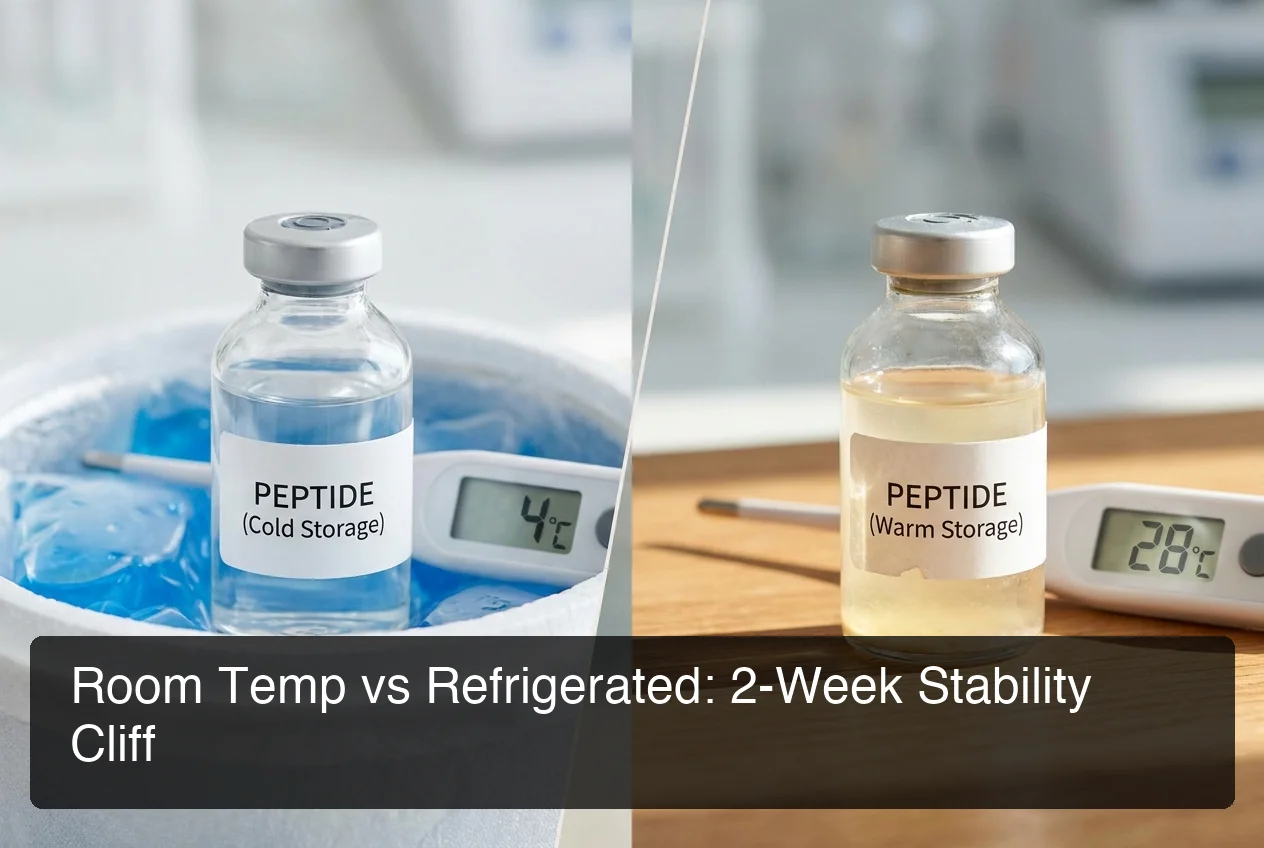
Do peptides need to be refrigerated, or can room temperature work? Room temperature is not a safe storage option for active use. At 25°C, lyophilized peptides can lose 10-30% of potency within weeks; reconstituted solutions can become ineffective within days. The peptide does not become visibly dangerous — it simply stops working, invisibly.
This is the hidden cost of improper storage. A $120 BPC-157 vial stored at room temperature for three weeks may still look identical to a fresh vial — clear, no visible particles — but deliver a fraction of the intended dose.
The Cumulative Temperature Excursion Problem
Brief temperature excursions (leaving a vial in a warm bag for 30 minutes) may not be immediately catastrophic, but cumulative exposure degrades stability over time. Every degree-hour above the recommended range compounds the damage.
If you need to maintain cold chain during transit — whether commuting or traveling — plan for insulated packaging with ice packs. This is the foundation of safe peptide travel logistics — maintaining cold chain during transit is the natural next challenge once refrigeration fundamentals are in place.
Which Peptides Degrade Fastest at Room Temperature?
- GLP-1 agonists (semaglutide, tirzepatide): Most temperature-sensitive; must stay refrigerated once reconstituted
- Growth hormone peptides (CJC-1295, Ipamorelin, Sermorelin): Moderate sensitivity; degrade faster than BPC-157 at room temp
- BPC-157: More resilient than GLP-1s, but still degrades meaningfully within 1-2 weeks unrefrigerated
- GHK-Cu, TB-500: Moderate sensitivity; lyophilized form holds up better than reconstituted
Bottom line: Room temperature is not a temporary solution — it is a potency countdown. Even resilient peptides like BPC-157 deliver diminishing returns after 1-2 weeks outside cold storage.
Can You Freeze Peptides Instead of Refrigerating?
Yes — freezing lyophilized peptides at -20°C or below is a valid long-term storage strategy and extends shelf life to 1-2 years. However, reconstituted solutions should not be repeatedly freeze-thawed, as ice crystal formation and freeze-thaw cycles degrade the peptide. If you freeze reconstituted peptides, thaw once and use immediately — do not refreeze.
The freeze-thaw problem is the main reason freezing reconstituted solutions is not recommended for routine storage. Every thaw and refreeze cycle causes ice crystals to form and break apart peptide chains, accelerating degradation in a way that is impossible to detect visually.
Best Practices for Long-Term Freezer Storage
- Keep vials sealed and lyophilized — do not reconstitute until you need them
- Use an airtight, moisture-proof container with silica desiccant packets to prevent humidity damage
- Store in the main freezer compartment — not the door — where temperature is most stable
- Allow vials to equilibrate to room temperature before opening to prevent moisture condensation on the powder
For comprehensive guidance on storage containers, humidity management, and light protection across your entire supply, the article on how to store peptides safely covers the full storage strategy beyond temperature fundamentals.
Do All Types of Peptides Require the Same Storage Temperature?
No — storage requirements vary by peptide class, manufacturer, and form. GLP-1 agonists like semaglutide follow FDA-validated protocols (2-8°C refrigerated; up to 28-56 days once in use depending on formulation). Research peptides like BPC-157 and TB-500 follow general biochemistry standards but have no FDA-mandated storage protocol — the 2-8°C standard is derived from stability science, not regulatory guidance.
Understanding your specific compound matters. At a structural level — which explains why some peptides degrade faster than others (see what is a peptide for the biochemistry) — stability depends on:
- Amino acid composition: Compounds with cysteine, methionine, or tryptophan are more vulnerable to oxidation
- Sequence length: Longer peptides tend to aggregate more readily at elevated temperatures
- Formulation: Lyophilized powder is inherently more stable than dissolved solution
- Excipients: Commercial formulations may include stabilizers that extend shelf life beyond base peptide stability
Compound-Specific Storage Reference
| Peptide | Recommended Storage | Reconstituted Shelf Life |
|---|---|---|
| Semaglutide | 2-8°C (FDA-validated) | 28-56 days at 2-8°C |
| BPC-157 | 2-8°C refrigerated | 2-4 weeks |
| CJC-1295 | 2-8°C refrigerated | 2-3 weeks |
| GHK-Cu | 2-8°C refrigerated | 2-4 weeks |
| TB-500 | 2-8°C refrigerated | 2-3 weeks |
| Ipamorelin | 2-8°C refrigerated | 2-3 weeks |
How Can You Tell If a Peptide Has Gone Bad from Improper Storage?
Visible contamination — cloudiness, particulates, or discoloration — is a definitive sign of degradation or bacterial contamination, and means you should not inject. However, most potency loss from improper storage is invisible. A degraded peptide often looks identical to a fresh one. The absence of expected protocol results after 3-4 weeks of consistent dosing is the most reliable indicator that potency has been lost.
This is the hidden danger: you cannot see the problem. Unlike expired food, there is no obvious visual cue. Signs that something is wrong include:
- Cloudiness or floating particles: Visible contamination — stop use immediately
- Unusual color: Yellow, brown, or dark tint in a solution that was clear when reconstituted
- No expected response: Consistent dosing with zero results after 3-4 weeks suggests potency loss
- Aggregation or precipitation: Clumping visible in the solution
Once you have confirmed refrigeration is necessary for your specific compound, the next step is choosing the right storage container — covered in detail in the upcoming guide on peptide vial storage.
Key insight: "Clear and odorless" does not confirm potency. Peptides can lose 50%+ of biological activity before any visible change is detectable in the vial.
Why PeptideIQ's Storage Tracking Matters
Proper refrigeration is only half the equation. The other half is knowing exactly when each vial was reconstituted, how many doses remain, and when the 2-4 week expiry window closes — across every compound you are running simultaneously.
 Knowing when your peptide was reconstituted is as important as knowing it is refrigerated — PeptideIQ's Inventory Manager tracks both automatically.
Most users manage this with phone notes or spreadsheets — which means missed expiry dates, wasted vials, and money spent on degraded compounds. PeptideIQ's Inventory Manager tracks every vial's reconstitution date, auto-calculates the expiry window by peptide type (BPC-157 = 30 days refrigerated; GLP-1s = up to 90 days), and fires expiry alerts 5 days before a vial expires — regardless of how many doses remain.
If you are running two or three compounds simultaneously, manual tracking becomes a liability. The compounds may not show visible signs of expiry, but the cost of running a full protocol on degraded peptides is real.
Get Started with PeptideIQ
Refrigerating your peptides is the foundation — but tracking reconstitution dates, expiry windows, and remaining doses across multiple vials is where most users slip. PeptideIQ handles inventory tracking automatically, so your storage discipline translates directly into protocol confidence.
Download PeptideIQ on the App Store
Frequently Asked Questions
Do peptides need to be refrigerated before reconstitution?
Yes. Lyophilized (dry powder) peptides should be refrigerated at 2-8°C from the moment you receive them, even before adding bacteriostatic water. Room-temperature exposure before reconstitution degrades the powder and shortens the effective shelf life of the resulting solution. Store sealed vials in the refrigerator body — not the door — from day one.
How long can BPC-157 stay unrefrigerated?
BPC-157 is more temperature-resilient than GLP-1 peptides, but brief room-temperature exposure is not risk-free. Lyophilized BPC-157 can tolerate short handling periods under 30 minutes without meaningful degradation. Reconstituted BPC-157 should not be left at room temperature for more than a few hours. Cumulative room-temperature exposure accelerates potency loss even without visible changes.
Should peptides go in the fridge or the freezer?
For active use — vials you will draw from over the next few weeks — the fridge at 2-8°C is correct. For long-term storage of lyophilized powder you will not use for months, the freezer at -20°C extends shelf life to 1-2 years. Never repeatedly freeze and thaw a reconstituted solution. Freeze only dry powder, and use it immediately after thawing.
What happens if my peptide gets warm?
Warmth accelerates peptide bond hydrolysis and oxidation, reducing potency progressively. A single brief exposure under 30 minutes at room temperature causes minimal harm. Repeated or prolonged warmth — hours to days — meaningfully degrades the compound. GLP-1 peptides are most sensitive; BPC-157 and GHK-Cu have somewhat more resilience but still degrade with cumulative heat exposure.
Is it safe to use a peptide that was left out overnight?
It depends on the compound and whether it is lyophilized or reconstituted. A sealed lyophilized vial left out overnight at room temperature likely retains significant potency, though some degradation has occurred. A reconstituted solution left out overnight represents higher risk. When in doubt, the cost of discarding an uncertain vial is lower than running a full protocol on a degraded compound.
Does PeptideIQ track peptide storage and expiry?
Yes. PeptideIQ's Inventory Manager automatically calculates the expiry window for each vial based on peptide type and reconstitution date, then fires a push notification 5 days before a vial expires. This eliminates the guesswork of manually tracking multiple compounds with different refrigerated shelf-life windows — so you never unknowingly inject from an expired vial.