
GHK Peptide (GHK-Cu): What It Does & Dosage | PeptideIQ
GHK Peptide (GHK-Cu): What It Actually Does and How to Track It
Type "ghk peptide" into a search bar right now and the first results you'll hit are $40 face serums on Amazon, not the peptide research behind them. That's a problem, because GHK-Cu is one of the more genuinely researched compounds in the longevity space — decades of published wound-healing and collagen studies, not TikTok speculation — and most of that gets buried under skincare marketing copy.
Key Takeaways
- GHK-Cu is a naturally occurring copper-binding tripeptide that activates collagen synthesis and cellular regeneration, backed by decades of clinical research in wound healing and fibrotic disease reversal.
- Effective GHK-Cu dosing ranges from 50–500mcg depending on goals, with most longevity users running 250–500mcg three times weekly; results typically appear after 4–12 weeks.
- Tracking biomarkers — skin elasticity, energy levels, wound healing speed, bloodwork markers — is essential to gauge whether GHK-Cu is working for your specific body. Guessing leads to abandonment.
- GHK-Cu stacks well with other longevity peptides (Epitalon, MOTS-c, LL-37, Thymosin Alpha-1) and doesn't interact negatively with most supplements, though timing and documentation matter.
- There's a gap between "I heard GHK-Cu is good for anti-aging" and "I ran this for 8 weeks and know exactly what changed." Without tracking, you can't tell which side of that gap you're on.
Contents
- What Is GHK-Cu and How Does It Stimulate Collagen?
- How Does GHK Peptide Compare to Other Longevity Compounds?
- What Dosage of GHK-Cu Should You Run?
- Does GHK-Cu Really Improve Skin Quality and Cellular Health?
- Can You Stack GHK-Cu With Other Peptides?
- How Long Does It Take to See Results From GHK-Cu?
- Is GHK-Cu Safe According to the Research?
- GHK Peptide Protocols by Goal: Skin, Joints, and Cellular Age Reversal
- Why PeptideIQ Makes GHK-Cu Tracking Effortless
- Frequently Asked Questions
What Is GHK-Cu and How Does It Stimulate Collagen?
GHK-Cu (glycyl-L-histidyl-L-lysine, copper) is a naturally occurring tripeptide that binds copper and signals cells to repair and remodel tissue. It activates decorin, a protein that organizes collagen fibers, and upregulates genes tied to collagen, elastin, and glycosaminoglycan production — the structural proteins that keep skin firm and wounds healing on schedule.
The peptide occurs naturally in human blood plasma, and its concentration drops sharply with age — from around 200 nanograms per milliliter in your twenties to roughly a quarter of that by your sixties. That decline tracks closely with slower wound healing and reduced collagen turnover, which is the biological hook researchers have been chasing since the compound was first isolated from human plasma decades ago.
GHK-Cu's effects go beyond collagen. Published research also links it to reduced inflammatory markers, antioxidant activity, and improved blood vessel formation in healing tissue — a broader repair signal, not a single-pathway trick.
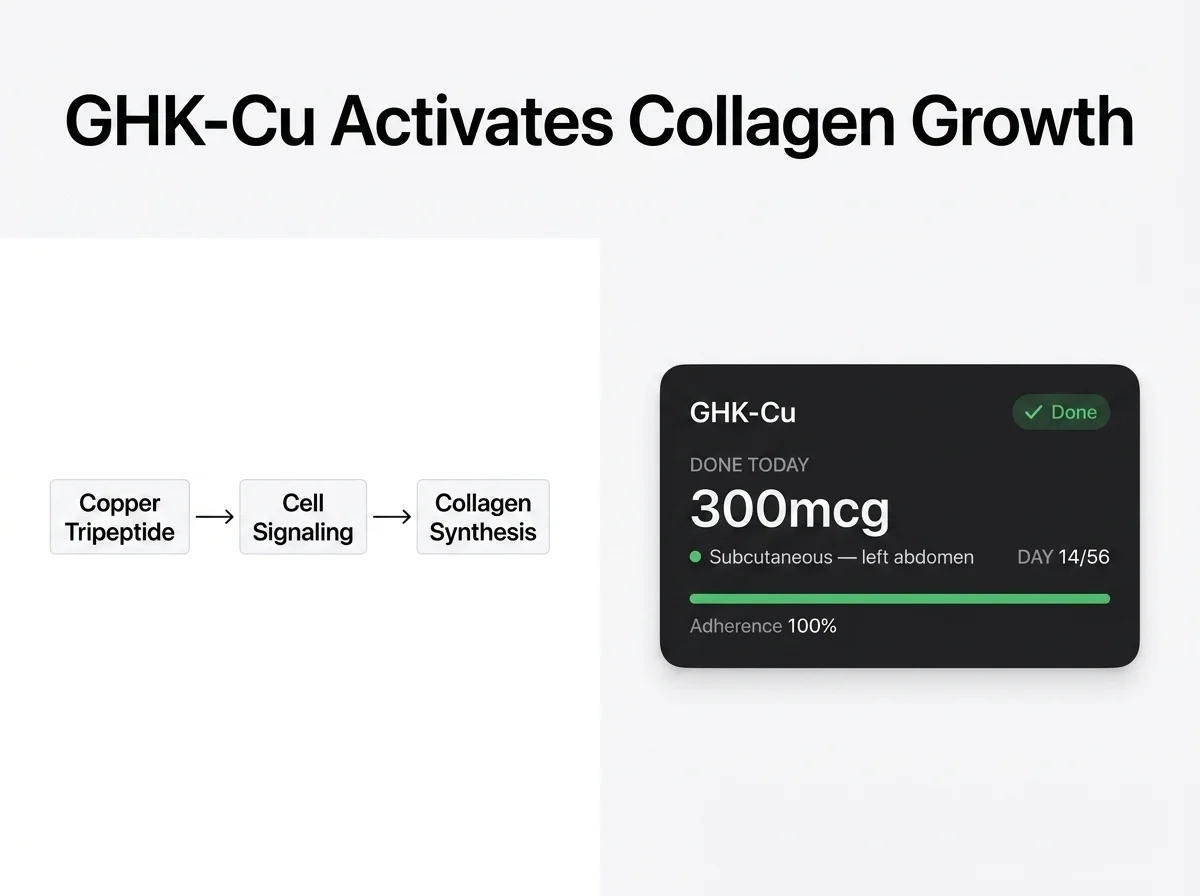 The mechanism is well-documented — what most guides skip is how to tell if it's actually working in your body.
Inside PeptideIQ's Peptide Library, GHK-Cu carries its own evidence badge and a plain-language protocol range instead of a vague "may help with aging" summary — the same treatment given to every compound in the library, not marketing copy specific to this one peptide.
How Does GHK Peptide Compare to Other Longevity Compounds?
GHK-Cu targets collagen and tissue-repair signaling specifically, while other longevity peptides work through entirely different pathways — Epitalon through telomerase, MOTS-c through mitochondrial metabolism, and Thymosin Alpha-1 through immune modulation. They're rarely substitutes for each other; longevity users typically pick based on which system they're trying to support.
| Peptide | Primary Mechanism | Typical Protocol | Evidence Tier | Best For |
|---|---|---|---|---|
| GHK-Cu | Collagen/elastin synthesis, tissue remodeling | 250–500mcg, 3x/week | Early Human Trials (wound healing) | Skin quality, tissue repair |
| Epitalon | Telomerase activation, pineal-derived | 5–10mg/day injectable, 10–20 day cycles | Early Human Trials | Cellular aging, sleep rhythm |
| MOTS-c | Mitochondrial-derived, metabolic regulation | Commonly cycled 2x/week | Early Human Trials | Metabolic health, exercise capacity |
| Thymosin Alpha-1 | Immune modulation | Commonly cycled 2x/week | Early Human Trials to Strong (immune indications) | Immune resilience, recovery |
None of these compete for the same job. A longevity-focused user chasing skin and connective tissue quality reaches for GHK-Cu first; someone prioritizing sleep and cellular repair timing looks at Epitalon's protocol data instead — and plenty of users eventually run both.
What Dosage of GHK-Cu Should You Run?
Most GHK-Cu protocols fall between 50 and 500mcg, with the exact number depending on your goal. Users focused on general skin and cellular support tend to stay lower, around 100–250mcg, while longevity users running a more aggressive protocol commonly land at 250–500mcg, three times weekly.
Subcutaneous injection into the abdomen is the most commonly reported administration route, similar to other small-peptide protocols. Because the effective dose sits in the microgram range, reconstitution accuracy matters more here than with milligram-dosed compounds — a small measurement error is a much bigger percentage swing at 300mcg than it is at 5mg.
Common mistake: Eyeballing a microgram dose off a syringe without confirming the actual concentration after reconstitution is how users end up running an unintentional 2x or 0.5x dose for weeks without noticing.
If you want the exact math worked out step by step — reconstitution ratios, syringe units, and a real cycle timeline — GHK-Cu peptide injection dosage breaks down the full protocol.
Does GHK-Cu Really Improve Skin Quality and Cellular Health?
Published research supports measurable effects on collagen synthesis, wound closure speed, and skin firmness, largely from topical and wound-care studies rather than large-scale trials specific to injectable anti-aging use. The mechanism is well-established; the anti-aging claims built on top of it are more extrapolated than proven at scale.
That distinction matters. A dermatology study showing improved skin firmness from a topical GHK-Cu formulation is real evidence — but it's evidence about topical delivery on facial skin, not proof that a systemic injectable protocol produces the same magnitude of change everywhere on the body.
Reality check: GHK-Cu has stronger clinical backing than most gray-market peptides, but "backed by research" and "proven to reverse aging" are different claims. The honest version sits somewhere in between, and that's still a meaningfully strong position.
Some pages describe GHK-Cu as "FDA approved" for skin repair. That's not accurate — GHK-Cu is not an FDA-approved drug for anti-aging or any systemic indication. It's a well-studied peptide with copper-complex ingredients permitted in cosmetic formulations, which is a different regulatory category entirely.
Can You Stack GHK-Cu With Other Peptides?
GHK-Cu stacks well with most other longevity peptides because its mechanism — tissue and collagen signaling — doesn't compete with pathways like telomerase activation or mitochondrial metabolism. Common pairings include Epitalon, MOTS-c, LL-37, and Thymosin Alpha-1, run on separate schedules within the same overall protocol.
- GHK-Cu + Epitalon — tissue repair paired with cellular aging support, one of the more frequently reported longevity combinations
- GHK-Cu + LL-37 — added for users specifically targeting wound or skin-barrier repair alongside general collagen support
- GHK-Cu + Thymosin Alpha-1 — immune resilience layered on top of a tissue-repair-focused base protocol
- GHK-Cu + MOTS-c — metabolic support running in parallel, minimal overlap in mechanism
The complexity isn't in whether these combine safely — it's in managing three or four different cycle lengths, rest periods, and dose timings at once without losing track of which change caused which result. Users chasing muscle and performance goals alongside longevity work sometimes layer in muscle-building peptides too, which only adds to the scheduling problem.
How Long Does It Take to See Results From GHK-Cu?
Most users report noticing changes in skin texture, wound healing speed, or energy somewhere between 4 and 12 weeks of consistent use. Cellular and biomarker-level changes tend to lag behind subjective ones, since collagen remodeling is a gradual structural process, not an overnight shift.
Two people running the identical dose can land at opposite ends of that 4-to-12-week window. Baseline collagen status, age, consistency of dosing, and even sleep quality all shift where an individual falls on that timeline.
Pro tip: Photograph the same skin area under the same lighting every two weeks from day one. Subjective memory is a bad judge of gradual change — a side-by-side photo from week 1 versus week 8 usually settles the "is this working" question faster than trying to recall how skin felt a month ago.
Is GHK-Cu Safe According to the Research?
GHK-Cu has a favorable safety profile in existing published research, with topical formulations widely used in cosmetics and injectable protocols reported with minimal adverse effects in the peptide community. It has not gone through the large-scale randomized trials required for FDA drug approval, so "safe" here means well-tolerated in available research, not medically guaranteed.
Reported side effects skew mild — injection site irritation, occasional headache, or temporary skin sensitivity at higher topical concentrations. There's no strong signal of serious adverse events in the literature, but the sample size behind that picture is small compared to an approved pharmaceutical.
For context on how GHK-Cu's evidence tier stacks up against compounds that do carry FDA approval, FDA-approved peptides vs gray market lays out exactly where the regulatory lines sit. And if you're weighing GHK-Cu as part of a multi-year protocol rather than a single cycle, peptides long-term effects covers what sustained users actually report.
GHK Peptide Protocols by Goal: Skin, Joints, and Cellular Age Reversal
GHK-Cu protocols vary meaningfully by goal — a 47-year-old targeting skin elasticity runs a different dose and cycle structure than a 60-year-old focused on joint and connective tissue recovery, even though both are using the same peptide. Goal-specific protocol design, not a single universal dose, is what separates a well-run cycle from a guess.
 Two longevity users, two different GHK-Cu approaches — the dose and cycle length aren't interchangeable.
- Skin elasticity focus — lower-to-moderate dose (100–300mcg), longer continuous cycles, biomarker tracking on skin quality and hydration
- Joint and connective tissue recovery — moderate-to-higher dose (250–500mcg), often paired with a structured rest period between cycles
- Cellular age reversal / general longevity — moderate dose run consistently alongside bloodwork tracking of inflammatory and collagen-adjacent markers over months, not weeks
The dose ranges overlap, but the tracking priorities don't. A skin-focused user cares about hydration and fine-line photos; a joint-focused user cares about pain scores and mobility. Running the same generic log for both means missing the signal that actually matters to each person.
Why PeptideIQ Makes GHK-Cu Tracking Effortless
Sarah, a 47-year-old who reads primary research before she'll try anything, doesn't want a gym-app interface asking her to log reps. She wants her GHK-Cu cycle, her skin and energy sliders, and her IGF-1 or inflammatory markers sitting in one place she can actually hand to her functional medicine doctor.
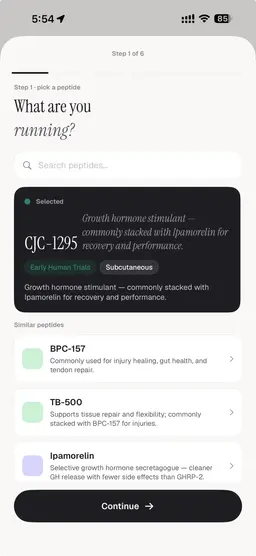 GHK-Cu appears in the Peptide Library with the same evidence-badge treatment as every other compound — no inflated claims, no vague marketing language.
That's what PeptideIQ's Peptide Library and Bloodwork Tracker are built for. GHK-Cu shows up with its evidence badge, a suggested protocol range, and storage guidance up front — tap "Add This to My Protocol" and it drops straight into the Cycle Planner with dose and cycle length pre-filled. The Bloodwork Tracker connects directly to that same protocol, so a marker tied to collagen synthesis or cellular regeneration can be charted against your actual GHK-Cu cycle dates instead of sitting in a separate lab PDF nobody revisits.
Download PeptideIQ on the App Store to get GHK-Cu protocol tracking, evidence-based library entries, and bloodwork trend charts on your phone before your next cycle starts.
Frequently Asked Questions
What does GHK peptide do?
GHK-Cu is a copper-binding tripeptide that signals cells to repair and remodel tissue, primarily by activating collagen, elastin, and glycosaminoglycan production. It also shows anti-inflammatory and antioxidant activity in published research, which is why it's studied for both wound healing and skin quality.
What are the side effects of GHK-Cu?
Reported side effects are generally mild — injection site irritation, occasional headache, or skin sensitivity at higher topical concentrations. Serious adverse events aren't well-documented in current literature, but the available safety data comes from a limited sample size compared to an FDA-approved drug.
How often should you inject GHK-Cu?
Most longevity users inject GHK-Cu three times weekly at 250–500mcg per dose, though protocols range from 50–500mcg depending on the goal. Consistency across the week matters more than hitting an exact time of day.
Is GHK-Cu peptide worth it?
For users focused on skin quality, tissue repair, or general cellular support, GHK-Cu has stronger published research backing it than most peptides in the gray market. Whether it's "worth it" for you specifically depends on tracking your own results — biomarkers and photos, not a general reputation.
What's the difference between topical and injectable GHK-Cu?
Topical GHK-Cu is formulated into skincare serums and targets surface-level skin firmness and hydration. Injectable protocols aim for a systemic effect on collagen and tissue repair beyond what a topical formulation can reach, and require a different dosing approach entirely.
Can beginners start with GHK-Cu?
Yes — GHK-Cu's dosing and side-effect profile are considered mild relative to many other peptides, making it a reasonable starting point for someone new to injectable protocols. Starting at the lower end of the 50–500mcg range and tracking biomarkers from day one is the safer approach for a first cycle.