

Muscle Building Peptides: What the Data Shows | PeptideIQ
Muscle Building Peptides: The Data on What Actually Works
Ask 10 serious lifters about muscle building peptides and you'll get 10 different recommendations. The research points to a narrower list than most communities suggest — and the primary variable separating strong cycles from disappointing ones isn't which compound you choose, it's whether you execute the protocol correctly.
Key Takeaways
- CJC-1295, Ipamorelin, and GHRP variants stimulate GH release — the most researched pathway for muscle building with peptides, showing 2–5 lbs of lean muscle gain per 8-week cycle in clinical settings
- GLP-1 peptides like semaglutide preserve muscle during fat loss; users who track protein intake alongside their protocol consistently maintain more lean mass than non-tracked approaches
- The muscle-building effect depends entirely on protocol adherence, training intensity, and nutrition — peptides amplify results, not substitute for effort
- Stack timing is critical: CJC-1295 + Ipamorelin requires fasted injection for maximum GH pulse — untracked cycles miss this window more often than most users realize
- Beginners see noticeable recovery improvement by Week 3 and muscle gain confidence by Week 6–8; experienced lifters adjusting protocols benefit most from week-to-week tracking of fatigue and recovery metrics
Contents
- What Are the Best Muscle Building Peptides?
- How Do Muscle Building Peptides Actually Work?
- What's the Difference Between Muscle-Building Peptides and Steroids?
- Which Peptide Stack Is Best for Muscle Growth and Fat Loss?
- How to Choose the Right Muscle-Building Peptide for Your Goals
- How Long Does It Take to See Results from Muscle-Building Peptides?
- How Much Do Muscle-Building Peptides Cost?
- Frequently Asked Questions
What Are the Best Muscle Building Peptides?
The most evidence-backed muscle-building peptides are CJC-1295, Ipamorelin, GHRP-2, Sermorelin, and MK-677. Each works through GH axis stimulation — increasing natural GH pulse amplitude or frequency. Clinical studies show 1.5–5% lean mass increases over 8–12 week cycles in resistance-trained adults. None replace training, and all require precise timing to deliver results.
Here's how the leading options compare:
| Peptide | Class | Mechanism | Standard Dose | Cycle | Evidence |
|---|---|---|---|---|---|
| CJC-1295 | GHRH analog | Extends GH pulse, elevates IGF-1 | 1–2 mg/week | 8–12 wks | Human RCTs |
| Ipamorelin | GHRP | Selective GH secretagogue, minimal cortisol | 200–300 mcg/dose | 8–12 wks | Human RCTs |
| GHRP-2 | GHRP | Strong GH release, modest cortisol increase | 100–300 mcg/dose | 6–8 wks | Human + animal |
| Sermorelin | GHRH analog | Natural GHRH mimic, lower GH spikes | 200–500 mcg/dose | 3–6 months | FDA-approved history |
| MK-677 | GH secretagogue | Oral GH stimulation, 24-hr elevation | 15–25 mg/day | 8–16 wks | Human RCTs |
| TB-500 | Thymosin β-4 | Satellite cell activation, recovery acceleration | 5–10 mg/week | 4–6 wks | Animal + early human |
For deeper data on the top-volume options, the full breakdown of peptides for muscle growth covers CJC-1295 and Ipamorelin clinical trial results in detail.
 Growth hormone secretagogues dominate the muscle-building peptide category — but mechanism differences between them determine how you stack and time them.
How Do Muscle Building Peptides Actually Work?
Muscle-building peptides primarily work by stimulating the hypothalamic-pituitary axis to increase GH secretion. More GH leads to elevated IGF-1, which activates mTOR signaling and accelerates muscle protein synthesis. In clinical studies, GHRH analogs like CJC-1295 increased mean GH secretion by 2–10 fold compared to baseline, with corresponding IGF-1 elevations of 30–70%.
The pathway has two lanes. GHRH analogs (CJC-1295, Sermorelin) extend the duration of each GH pulse — they work best timed to endogenous GH rhythms, with peak GH release occurring in deep sleep. Evening dosing amplifies that pulse. GHRPs (Ipamorelin, GHRP-2, GHRP-6) trigger the amplitude of GH release through the ghrelin receptor. They act fast and are typically used pre-workout or pre-sleep.
Understanding what peptides are at a mechanism level is foundational before committing to a protocol. The plain-language peptide primer covers receptor binding, half-lives, and how short amino acid chains produce measurable physiological effects.
By the numbers: A Journal of Clinical Endocrinology & Metabolism study found CJC-1295 increased GH area under the curve by 2–10x at 8 weeks, with a half-life of 5.8–8.1 days — the longest of any GHRH analog in clinical use.
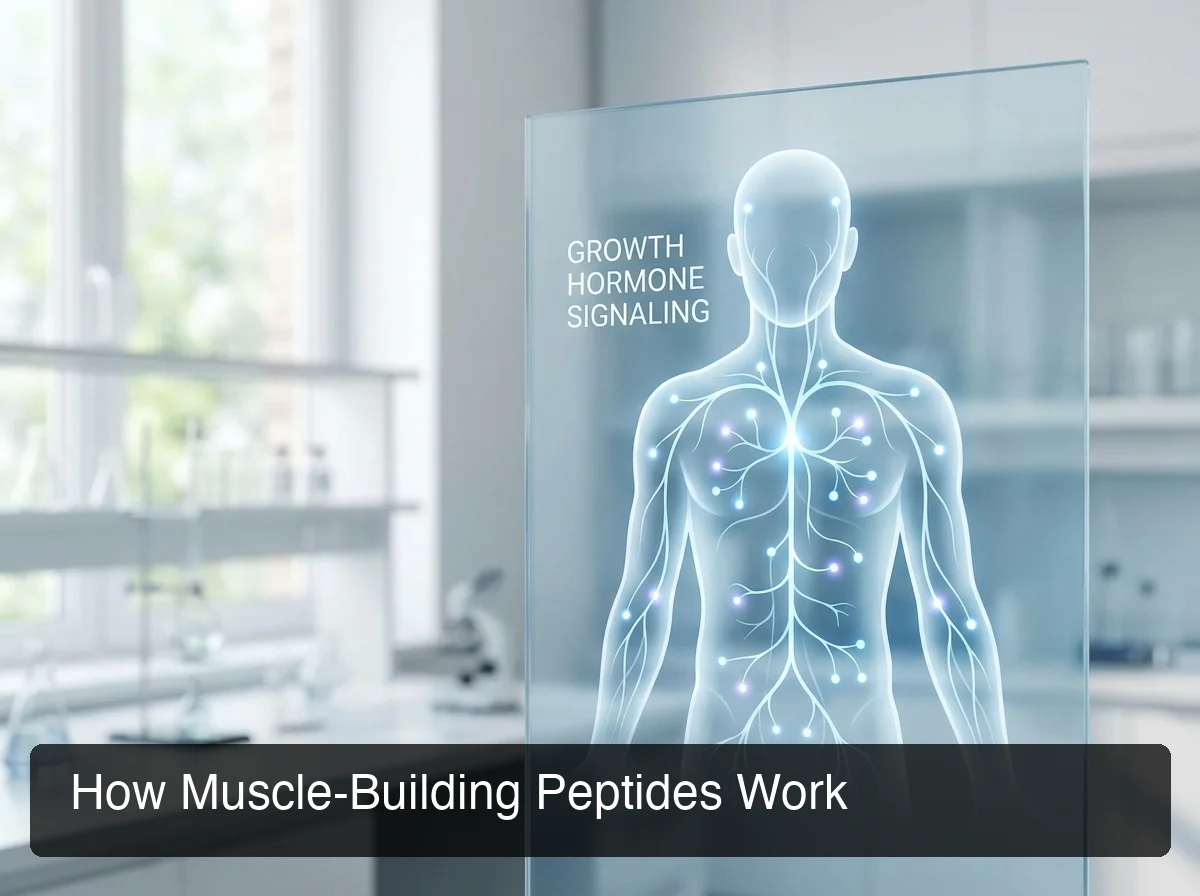 GHRH analogs and GHRPs target different steps in the same pathway — stacking both produces synergistic GH output that neither achieves alone.
What's the Difference Between Muscle-Building Peptides and Steroids?
Muscle-building peptides stimulate your body's own GH production — they are indirect. Anabolic steroids replace or massively amplify testosterone directly. Peptides show smaller muscle effects (1.5–5% lean mass gain per cycle) but carry significantly lower hormonal disruption risk. Unlike steroids, GHRH analogs and GHRPs do not suppress natural testosterone or require post-cycle therapy.
The distinction matters when setting expectations:
- Anabolic steroids deliver faster, larger mass gains (often 10–20 lbs in 12 weeks) at the cost of HPG axis suppression, PCT requirements, and cardiovascular and androgenic side effects
- Peptides work within natural physiological ranges, making them more suitable for long-term use and less likely to require medical management to exit
The honest look at whether peptides actually work covers what the current evidence does and doesn't support — including where claims outpace data in online communities.
The comparison to exogenous HGH is more direct: peptides vs HGH breaks down why most fitness users achieve similar IGF-1 outcomes at significantly lower cost using peptide secretagogues versus synthetic growth hormone.
Which Peptide Stack Is Best for Muscle Growth and Fat Loss?
The most studied combination for simultaneous muscle growth and fat loss is CJC-1295 + Ipamorelin. Together, they produce GH pulses 2–5x higher than either compound alone. Ipamorelin's receptor selectivity keeps cortisol neutral while CJC-1295 sustains IGF-1 elevation across the cycle. For users adding a fat-loss emphasis, some protocols include low-dose GHRP-2 pre-workout for additional GH amplification.
A practical three-phase stack protocol:
- Phase 1 (Weeks 1–4): CJC-1295 (1 mg) + Ipamorelin (200 mcg), both fasted, 3×/week. Establish baseline response; log recovery scores and energy levels daily.
- Phase 2 (Weeks 5–8): Increase Ipamorelin to 300 mcg if recovery scores trend positive. Track muscle fullness and strength week-to-week.
- Phase 3 (Weeks 9–12): Optional GHRP-2 addition (100 mcg pre-workout) for amplification; log any cortisol-adjacent symptoms including water retention or hunger spikes.
Worth knowing: Fasted injection isn't optional for GHRPs and GHRH analogs — elevated insulin blunts GH secretion significantly. The window is 90–120 minutes post-meal minimum. Most unmonitored protocols lose their edge here, not at the dose level.
For Ipamorelin-specific protocol comparisons with Sermorelin, the Ipamorelin vs Sermorelin data breakdown covers timing differences and mechanism trade-offs in detail.
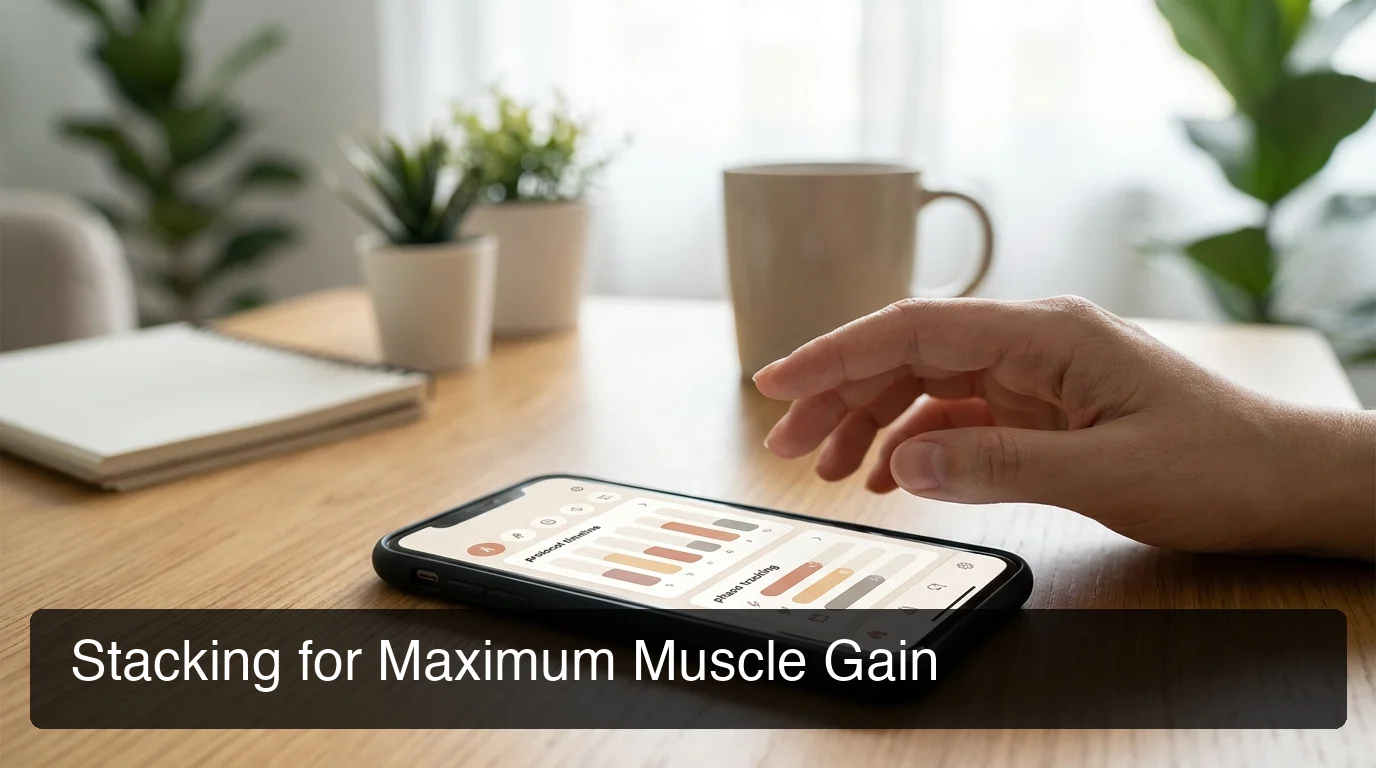 PeptideIQ's Protocol Hub organizes multi-peptide stacks with color-coded phase tracking — each card shows cycle day, next dose time, and automatic phase transition alerts.
How to Choose the Right Muscle-Building Peptide for Your Goals
The right compound depends on three variables: your training experience level, your primary goal (pure muscle gain, recovery, or body recomposition), and how systematically you can manage the protocol.
Beginners benefit from starting single-compound — Ipamorelin alone, or Sermorelin — before adding complexity. Stacking before understanding your baseline response makes it impossible to attribute results or isolate side effects.
Experienced lifters managing CJC-1295 + Ipamorelin + optional GHRP-2 need a system that tracks each compound separately. PeptideIQ's Protocol Hub assigns color-coded cards to each active peptide, tracks cycle phase and current day automatically, fires fasting window alerts before each GHRH/GHRP dose, and logs phase transitions without manual calendar management — the infrastructure that makes complex stacks actually trackable.
How Long Does It Take to See Results from Muscle-Building Peptides?
Results from muscle-building peptides follow a consistent timeline: recovery improvements emerge by Week 3, body composition shifts become measurable between Weeks 6–8, and peak lean mass gains appear at Weeks 10–12. Studies with CJC-1295 show statistically significant IGF-1 elevation within 1–2 weeks — the physiological change arrives well before any visible results.
Week-by-week expectations for a CJC-1295 + Ipamorelin protocol:
| Timeline | What Typically Happens |
|---|---|
| Week 1–2 | Better sleep quality; shorter recovery between sessions |
| Week 3 | Improved muscle pump; reduced DOMS; energy logging trends up |
| Week 4–6 | Visible strength increases; weight may shift toward lean mass |
| Week 6–8 | Body recomposition apparent; recovery metrics consistently higher |
| Week 10–12 | Peak lean mass and strength improvements on adherent protocols |
The gap between IGF-1 changes and visible results is why users who abandon at Week 4 almost never see the payoff. Consistent logging of recovery scores, sleep, and dose adherence is what makes Week 4 look like progress rather than a plateau.
 Week-by-week results for CJC-1295 + Ipamorelin: physiological changes precede visible body composition shifts by 3–4 weeks — tracking bridging this gap is what separates successful cycles from abandoned ones.
How Much Do Muscle-Building Peptides Cost?
Gray-market sourcing is widespread in this space, and cost varies significantly by source. Typical ranges for a 12-week cycle:
- CJC-1295 (5 mg vials): $50–90 per vial; roughly $300–500 for a full cycle
- Ipamorelin (5 mg vials): $40–70 per vial; similar cycle cost
- Sermorelin (compounding pharmacy): $80–150 per vial; higher quality assurance
- MK-677 (oral capsules): $60–100/month — the lowest-friction entry point
Gray-market sourcing drops these costs 40–60% but introduces significant quality risk. FDA testing found up to 40% of online peptide products contain incorrect dosages or undeclared ingredients — a dosage variance that is not a minor inconvenience at this potency level.
Reality check: Source documentation, lot numbers, and a certificate of analysis are the minimum quality indicators worth checking before committing to any compounding source or gray-market supplier.
Get Started with PeptideIQ
Managing CJC-1295, Ipamorelin, or a full GHRP stack without a system means guessing at timing, losing track of cycle phases, and missing the fasting windows that make these protocols actually work. PeptideIQ organizes your full protocol in one place — dose logging, phase tracking, fasting window alerts, and weekly AI insights tied to your specific cycle data.
Download PeptideIQ on the App Store
Frequently Asked Questions
Do peptides really work for muscle gain?
Yes, with caveats. GH secretagogues like CJC-1295 and Ipamorelin produce measurable IGF-1 elevation and lean mass gains of 1.5–5% per 8–12 week cycle in clinical studies. Results are real but modest compared to anabolic steroids — and highly dependent on protocol execution, fasted injection timing, and training consistency throughout the cycle.
What is better, TRT or peptides, for muscle building?
They operate through different pathways and aren't directly comparable. TRT directly increases serum testosterone, producing faster and larger muscle gains — typically 10–20 lbs per cycle. Peptides stimulate GH and IGF-1 without affecting the HPG axis, producing smaller gains (2–5 lbs) with significantly fewer hormonal side effects and no PCT requirement. Many experienced users combine both to target multiple anabolic pathways simultaneously.
What are the downsides of muscle-building peptides?
The main downsides are cost ($300–500+ per full cycle for quality sourcing), injection frequency (typically 3–7×/week for GHRH/GHRP protocols), modest effect sizes relative to expectations, and product quality risk from gray-market suppliers. Side effects are generally mild — water retention, joint achiness with MK-677, temporary fatigue — but quality variance in sourcing is a genuine safety concern, not just a performance one.
Can you combine multiple muscle-building peptides safely?
Yes, and stacking is common because CJC-1295 and Ipamorelin target different receptor pathways and produce synergistic GH output. The practical risk is protocol complexity: managing multiple compounds with different timing requirements, fasting windows, half-lives, and phase transitions without a tracking system leads to missed windows and unclear attribution when side effects appear. Systematic protocol tracking is the primary reason stacks succeed or fail.