
How to Travel with Peptides: TSA, Packing & Cold Chain
How to Travel with Peptides: TSA Rules, Packing & Cold-Chain Guide
Active on a peptide protocol and headed somewhere? Traveling doesn't have to disrupt your cycle — but it does require preparation that most guides skip.
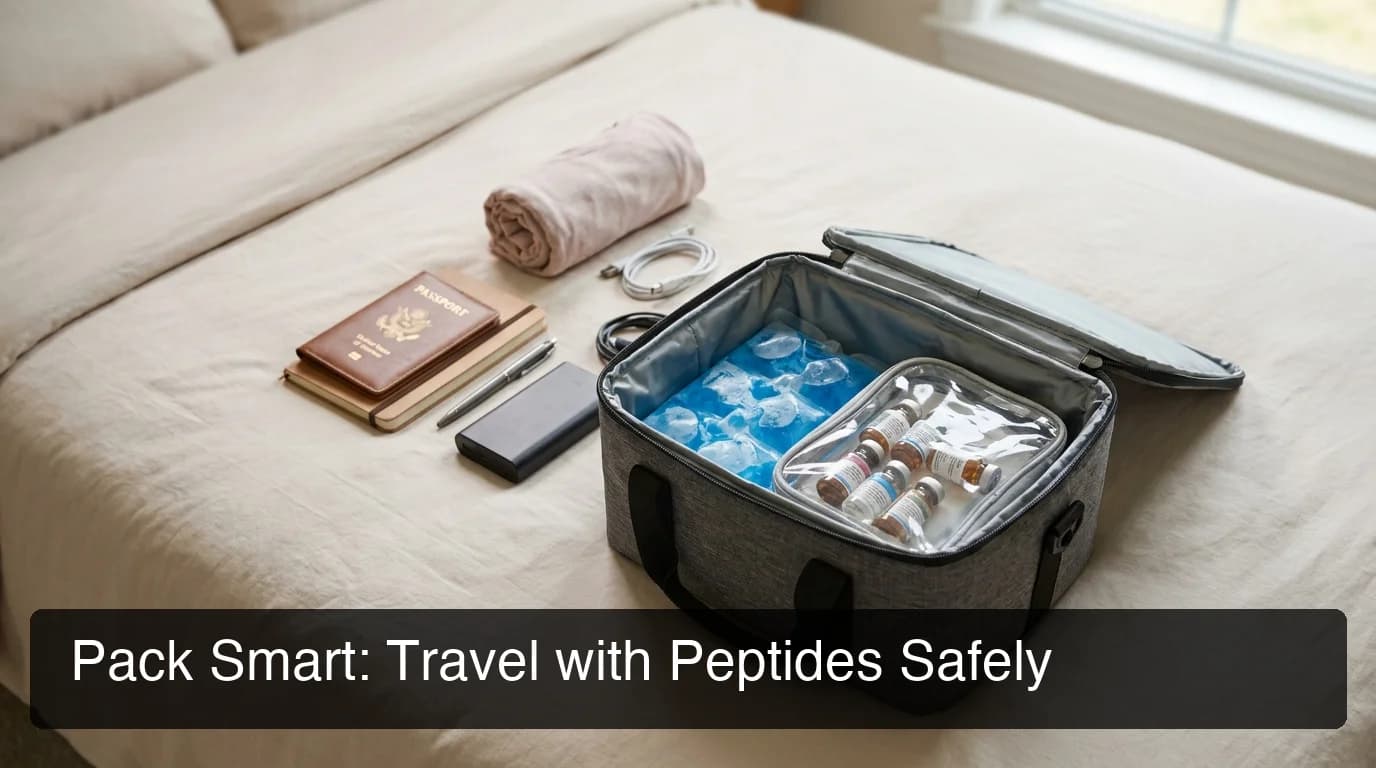
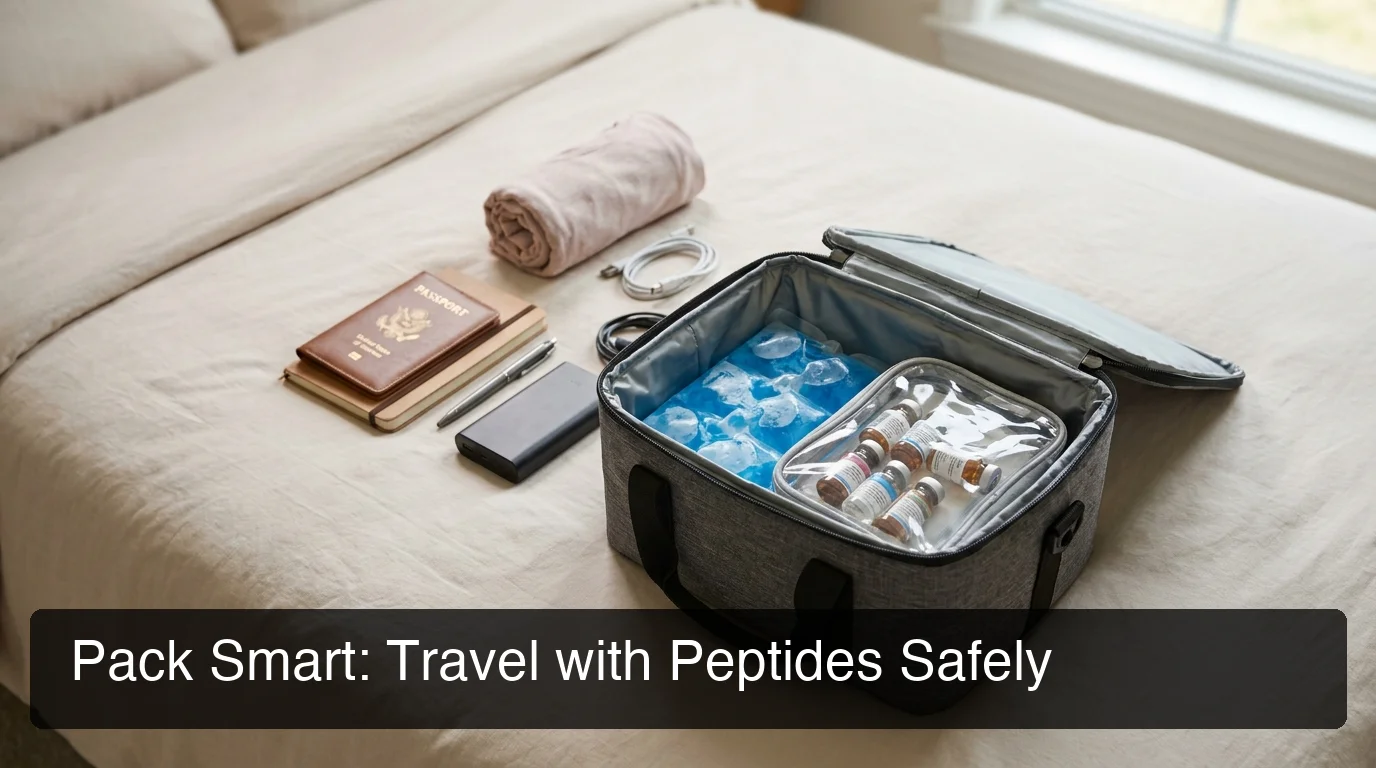 Everything you need to travel with peptides fits in a carry-on — if you pack it right.
Key Takeaways
- Peptides are legal to travel with domestically in the US; TSA allows them in carry-on and checked baggage when stored in original, clearly labeled containers.
- Maintaining 2–8°C refrigeration during travel requires an insulated cooler with ice packs and a thermometer — skipping refrigeration for even a few hours can degrade reconstituted peptide potency.
- International travel with peptides requires destination country research; many countries restrict or prohibit peptide importation, so confirm legality before departure.
- A travel cooler with 24–48 hour ice pack capacity, a thermometer, and a documented protocol ensure your cycle stays on track across time zones and distances.
Contents
- Can You Travel with Peptides?
- What Does TSA Say About How to Travel with Peptides?
- How Do You Pack Peptides for Air Travel?
- How to Travel with Peptides and Keep Them Cold?
- How PeptideIQ Helps When Traveling with Peptides
- Are Peptides Legal to Bring Across Borders?
- What's the Best Cooler for Traveling with Peptides?
- How Do You Maintain Injection Schedule While Traveling?
- Frequently Asked Questions
Can You Travel with Peptides?
Yes — you can travel with peptides domestically in the US. TSA classifies injectable medications, including peptides, as medically necessary liquids exempt from the standard 3.4 oz liquid rule. Both carry-on and checked baggage are allowed, though carry-on is strongly recommended to protect temperature stability and prevent accidental damage.
New to peptides and wondering why temperature matters so much? Our beginner's guide to what peptides are explains the biological fragility that makes proper storage — at home and in transit — non-negotiable.
Domestic vs. International Travel Rules
Domestically, the rules are clear: TSA is not looking to flag your peptides. If a screener has questions, a brief explanation that they're medically necessary resolves it quickly. The more complex scenario is international travel.
When you cross an international border, you're subject to your destination country's import regulations — not just TSA rules at departure. Entering a country that restricts or prohibits certain peptides can result in confiscation at customs, regardless of how smooth your US departure was.
Key insight: TSA controls what leaves the US. Customs at your destination controls what enters. For international travel, research both before packing.
What Does TSA Say About How to Travel with Peptides?
TSA permits medications including injectable peptides in both carry-on and checked baggage — they're exempt from the standard liquid limit under the "medically necessary" exception. TSA officers may ask to remove them from your bag for separate screening; clear labeling in original packaging makes this fast and frictionless.
Syringes and needles are also permitted when accompanying medication. You don't technically need a prescription for domestic travel, but carrying one (or a signed doctor's note) immediately resolves any questions a screener might raise.
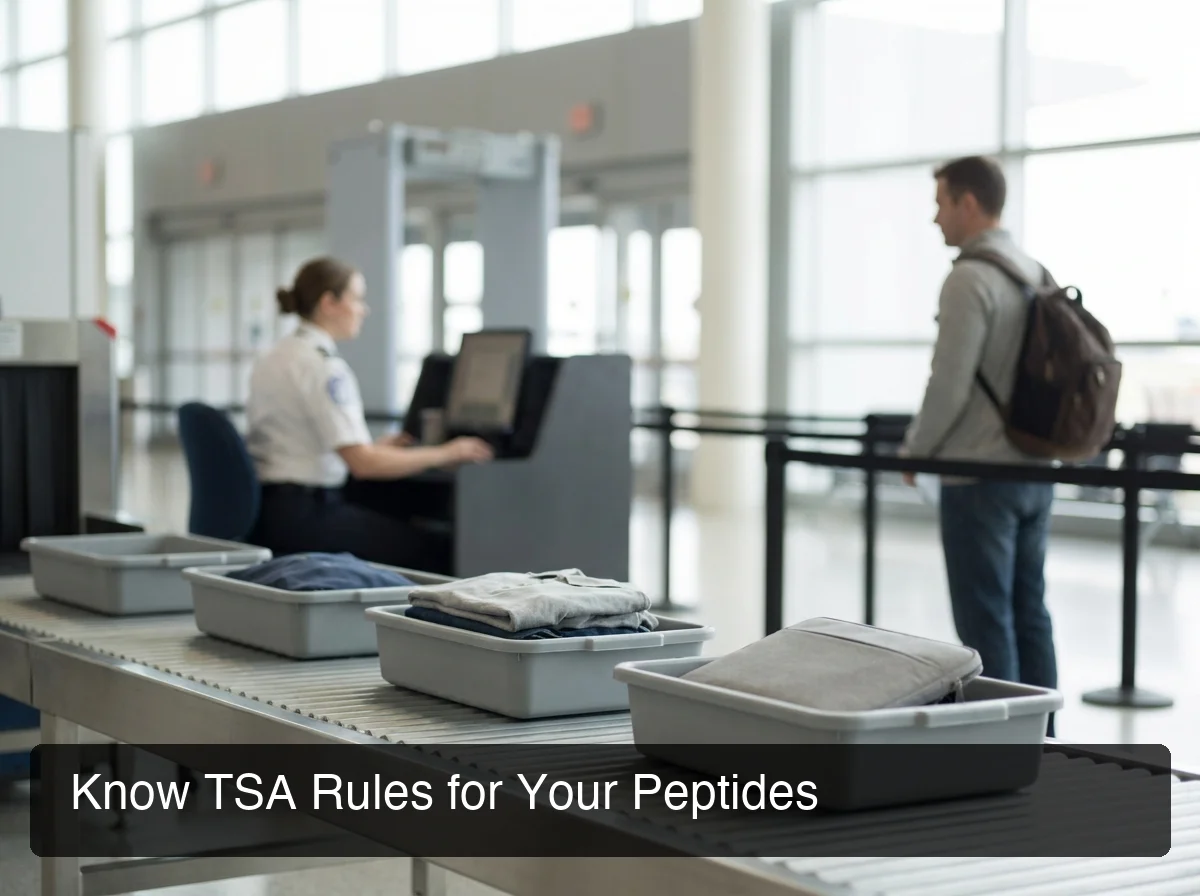 Properly labeled peptides and a doctor's note move through TSA screening without issue.
Do You Need a Doctor's Note?
Not strictly required for domestic flights, but highly practical. A signed note on letterhead stating what you're carrying, the medical purpose, and your dosage creates instant clarity at the checkpoint.
For international travel, a doctor's note becomes essential — and in some countries it's required documentation at customs. Get one before any international trip involving injectable compounds.
By the numbers: TSA screening for properly labeled injectable medications typically resolves in under 2 minutes, per traveler reports across peptide communities.
How Do You Pack Peptides for Air Travel?
Pack peptides in carry-on baggage only — never check them. Checked bags experience significant temperature swings and pressure changes that degrade peptide potency. Keep vials in original labeled containers, store in an insulated cooler with ice packs, and keep documentation accessible at the top of your bag.
Here's the non-negotiable packing list for air travel with peptides:
- Original containers with labels — never decant into unlabeled vials
- Insulated travel cooler or medical case — purpose-built for biologics or injectables
- Freeze-free ice packs — frozen solid before your flight, 24–48 hr rated
- Thermometer — verify temperature on arrival before injecting
- Doctor's note or prescription — mandatory for international, strongly advised for domestic
- Bacteriostatic water (if carrying reconstituted vials) — also in carry-on, clearly labeled
- Syringes and needles — in carry-on, with medication documentation
What Documents to Carry
Beyond a doctor's note, also bring:
- A printout of your protocol (peptide name, dose, frequency, schedule)
- Pharmacy receipt or vendor documentation if available
- For international travel: any country-specific import permits if required
Organized, printed documentation signals to any inspector that this is a legitimate medical situation — not something worth prolonged scrutiny.
Bottom line: Everything peptide-related goes in carry-on. If you absolutely must check a bag, use a hard-sided medical cooler — but this is a fallback, not a recommendation.
How to Travel with Peptides and Keep Them Cold?
Peptides require 2–8°C (36–46°F) refrigeration to maintain potency. During travel, this means a quality insulated cooler, multiple ice packs with at least 24-hour capacity, and a thermometer to verify the temperature hasn't drifted before you inject. A single-use chemical cold pack as backup is good insurance on long travel days.
This is the most technically demanding part of traveling with peptides. At home, your refrigerator handles it automatically. In transit, you're the refrigerator.
The cold-chain principles covered in our peptide storage guide apply equally during travel — the temperature thresholds and container best practices don't change because you're moving.
Reconstituted vs. Lyophilized Peptides in Transit
Lyophilized (freeze-dried, unreconstituted) peptides are significantly more stable than reconstituted vials at room temperature. If your timeline allows, travel with unreconstituted peptides whenever possible — they tolerate brief temperature excursions far better.
Once reconstituted, your peptide is on the clock. Reconstituted BPC-157 is stable for approximately 30 days refrigerated; at room temperature, degradation accelerates sharply. Plan your travel around your vial's reconstitution date, not just your departure date.
While freezing destroys peptides, a well-packed travel cooler maintains the optimal 2–8°C range — the same window as home refrigeration without the risk of ice crystal damage.
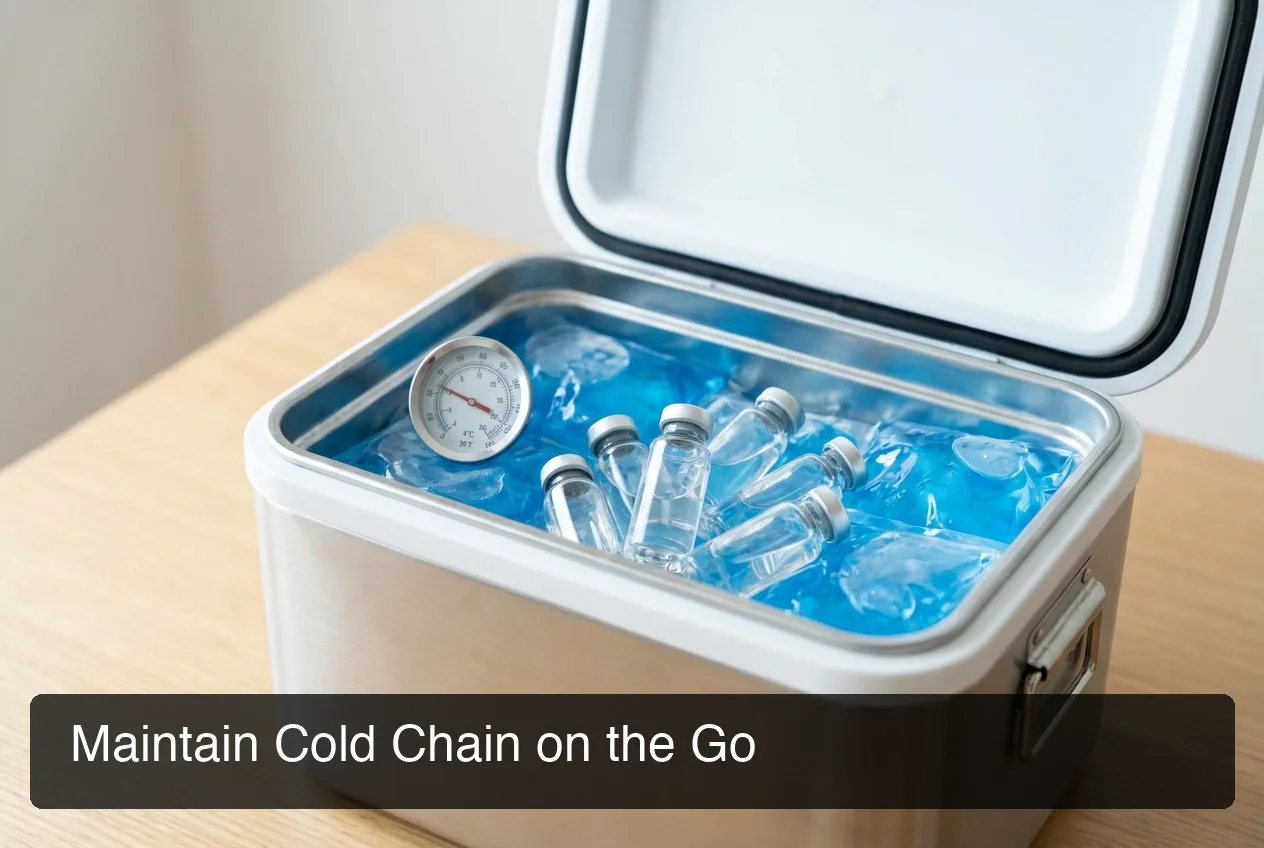 A quality insulated cooler keeps the 2–8°C window intact throughout your journey — same as home refrigeration, portable.
How PeptideIQ Helps When Traveling with Peptides
The biggest risk for mid-protocol travelers isn't TSA — it's losing track of where you are in your cycle. PeptideIQ tracks your active protocol, vial inventory, and injection schedule so you always know exactly what dose is due, how much is left in your current vial, and whether your protocol is on track — regardless of which time zone you're in.
PeptideIQ is offline-first, meaning dose logging and protocol tracking continue to work even without a data connection at 35,000 feet. When you land and log your travel dose, the app captures it and keeps your cycle day accurate.
For users managing injection timing across time zones, the app's scheduled dose reminders adjust to your logged activity — not just a fixed clock time — helping you stay consistent even when your schedule shifts.
Are Peptides Legal to Bring Across Borders?
Peptide legality at international borders varies significantly by country. Many countries — including Australia, New Zealand, Canada, and most of the EU — classify certain peptides as prescription-only or prohibited substances. Crossing with restricted peptides can result in confiscation or legal consequences, regardless of what was permitted at departure.
Research your destination country's import rules for each specific peptide you're carrying, not just the category generally. Semaglutide with a valid prescription may clear Australian customs; BPC-157 from an unlicensed vendor likely will not.
Relevant resources by region:
- US customs outbound: CBP.gov (cbp.gov)
- UK: MHRA import/export guidance
- Australia: TGA Therapeutic Goods Administration (tga.gov.au)
- EU: Your destination country's national medicines authority
Key insight: "It's legal where I bought it" is not a customs defense. Research destination regulations for each peptide specifically before crossing any border.
Countries With Known Restrictions
The UK, Canada, Australia, and New Zealand all have tighter import rules than the US. Japan and several other Asian countries enforce strict regulations on injectables regardless of compound type.
Even brief stopovers matter. Transiting through a country with tight import controls can create complications even if you never leave the terminal. Check the rules for every country your itinerary touches.
What's the Best Cooler for Traveling with Peptides?
The best travel cooler for peptides holds 2–8°C for at least 24 hours, fits in a carry-on, and seals tightly to prevent ice melt leakage. Medical-grade options built specifically for injectable medications outperform standard food-grade coolers for biologic stability on travel days.
| Cooler Type | Duration | Best For | Limitation |
|---|---|---|---|
| Medical insulin/biologic case (FRIO, Medicool) | 24–72 hrs | Day trips to long-haul flights | Higher cost ($40–$120) |
| Insulated medication pouch + ice packs | 12–24 hrs | Domestic flights under 8 hrs | Requires pre-frozen packs |
| Soft-sided insulated lunch bag | 6–12 hrs | Very short trips only | Not reliable beyond half a day |
| Hard-sided medical travel case | 48–96 hrs | Multi-day international trips | Bulkier and heavier |
For most travel scenarios, a purpose-built medical cooler bag with 2–4 properly frozen ice packs covers the journey reliably. The 48-hour capacity is the standard recommendation — it accounts for delays, layovers, and time between landing and reaching a hotel refrigerator.
How Do You Maintain Injection Schedule While Traveling?
Maintain your injection schedule as close to your home time zone as possible for the first 1–2 days, then gradually shift to the destination time zone over 2–3 days. For peptides requiring fasted administration — like CJC-1295 and Ipamorelin — align dose timing to local meal schedules rather than rigidly following home clock times.
For time zone shifts under 6 hours, most protocols can shift directly without dose adjustment. For long-haul travel with 8+ hour differences, a gradual shift prevents accidentally compressing or skipping doses.
Injection site rotation must also continue on travel days. Our guide to peptide injection sites and rotation technique covers how to maintain your rotation schedule — including how to adapt when your usual setup isn't available.
Managing Multi-Day Trips
For trips longer than 3–4 days, plan your vial inventory before departing. Know how many doses are in your current vial, the reconstitution date, and whether you'll need a second vial for the return trip.
Just as static vial storage requires proper containers, travel demands upgraded insulation and tighter inventory discipline. Running out of vials mid-trip or discovering a degraded batch on day 3 of a 7-day trip is the scenario you're preventing by planning ahead.
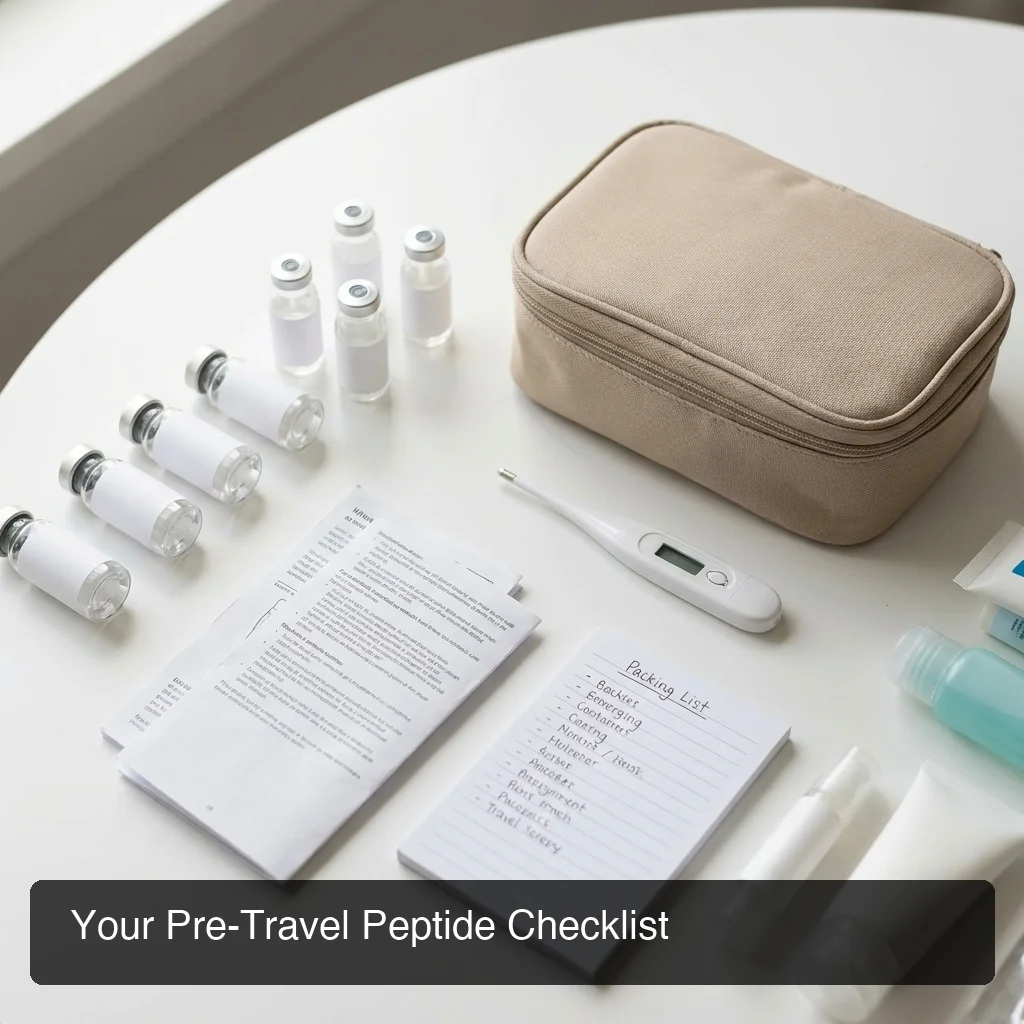 A pre-departure checklist eliminates guesswork at the security checkpoint and ensures your protocol stays intact on arrival.
Your Pre-Travel Peptide Checklist
Run through this before every trip involving an active protocol:
- All vials in original containers, clearly labeled
- Insulated cooler tested and holding temperature
- Ice packs frozen solid (minimum 24-hr capacity)
- Portable thermometer packed
- Doctor's note or protocol documentation printed
- Reconstitution supplies if traveling with lyophilized peptides
- Syringes, bacteriostatic water, alcohol swabs packed in carry-on
- Protocol schedule written out (doses due and when)
- Destination country import regulations verified
Get Started with PeptideIQ
Keeping your protocol on track during travel is easier when your cycle, vial inventory, and dose history are all in one place. PeptideIQ tracks everything so a missed dose or off-track cycle doesn't derail your progress. Download PeptideIQ on the App Store and keep your protocol organized wherever you go.
Download PeptideIQ on the App Store
Frequently Asked Questions
Can you travel with injectable peptides?
Yes. TSA permits injectable medications, including peptides, in both carry-on and checked bags. Carry-on is strongly recommended since checked luggage experiences temperature swings that can damage potency. Keep vials in original labeled containers, store in an insulated cooler with ice packs, and carry documentation confirming medical use.
Can peptides get through TSA?
Peptides pass TSA screening routinely when labeled correctly and stored in a medical-grade insulated case. TSA may perform a brief separate screening — this is standard for any injectable medication. A doctor's note isn't required domestically but significantly speeds up any questions at the checkpoint. International travel requires more documentation.
How long can peptides go unrefrigerated?
Lyophilized (freeze-dried, unreconstituted) peptides can tolerate several hours at room temperature without significant degradation. Reconstituted peptides are more sensitive — most should return to refrigeration within 4–6 hours maximum. Plan your travel day to minimize time outside the 2–8°C window, especially for reconstituted vials.
How do you pack peptides for travel?
Pack peptides carry-on only, in original labeled containers inside a medical-grade insulated cooler with frozen ice packs. Carry a doctor's note, protocol summary, syringes, and bacteriostatic water. A thermometer lets you verify the cold chain held on arrival. Never decant peptides into unlabeled containers before travel.
Are peptides legal to travel with internationally?
Legality varies by destination country. The US has relatively permissive domestic rules, but Australia, the UK, Canada, and the EU have stricter import regulations. Research each destination's specific rules for every peptide you're carrying — legality in your home country does not guarantee legal import elsewhere. A doctor's note or prescription is essential for international trips.
What temperature do peptides need during travel?
Most peptides require 2–8°C (36–46°F) during transport — the same range as home refrigeration. A medical-grade insulated cooler with 24–48 hour ice packs maintains this reliably. Use a thermometer to verify temperature hasn't drifted before injecting on arrival. Freezing is as harmful as overheating — avoid both extremes.