
Peptide Injection Pen: Types, Dose Math & Tracking
Peptide Injection Pen: Types, Dosing Math, and Tracking
Three numbers explain most of what a peptide injection pen does: 3 mL of cartridge capacity, 0.01 mL per dial click, and one needle per injection. One listed reusable model, an 80-unit pen, specifies exactly that. A syringe asks you to read a barrel; a pen asks you to turn a dial.
General education, not medical advice. Many peptides are not FDA-approved, and pens are built for insulin-style cartridges. Talk to a licensed clinician or pharmacist before you change how you inject anything.
Key Takeaways
- A peptide injection pen is a cartridge-based injector with a dose dial. Prescription GLP-1 pens arrive pre-filled; pens sold for other peptides are usually empty and you load the cartridge yourself.
- The pen removes the "draw to the 15-unit mark" step, but not the reconstitution math. You still need the concentration right before the cartridge is filled.
- Reusable pens suit repeat cycles; disposable pens suit short protocols. In our October 2026 search check, listings ran from about $13 to $40.
- Needles are single-use in either case, and site rotation matters just as much as it does with a syringe.
- A pen doesn't log anything. Tracking the last site and the dose is a separate job.
What Is a Peptide Injection Pen?
A peptide injection pen is a handheld injector that holds a sealed cartridge of liquid medication and delivers a set dose each time you dial and press. It works like an insulin pen. Disposable versions are thrown away when empty; reusable ones keep the pen body and swap the cartridge.
Prescription pens for semaglutide or tirzepatide come pre-filled and pre-set by the manufacturer. Pens marketed for other peptides are a different animal: most are sold empty, with room for a 3 mL cartridge, and you fill it from a reconstituted vial. Our guide to preparing peptides for injection covers that mixing step in detail.
That distinction is the part most product pages skip. Using an insulin-style pen with a vial-sourced peptide is a user-assembled setup, not something a manufacturer has validated for that peptide. It's a reason to involve a pharmacist, and a reason to be fussy about sterile handling.
Pen Types at a Glance
| Type | Who fills it | Dose resolution | Reuse | Price we saw (Oct 2026) |
|---|---|---|---|---|
| Pre-filled prescription pen | Manufacturer | Fixed by the drug's label | Discard when empty | Varies by prescription |
| Disposable empty pen | You | 0–60 unit dial (one listing) | Single cartridge | $13.30 |
| Reusable refillable pen | You | 80-unit dial, 0.01 mL minimum dose | Pen body reusable | $40.00 |
| U-100 syringe | You, every dose | Barrel markings | Single use | Not compared |
Prices come from search listings we pulled for this keyword (an Etsy disposable pen and a manufacturer's 80-unit reusable pen). Treat them as snapshots, not quotes. Cartridges and needles are separate line items on some listings.
Are Peptide Injection Pens Better Than Syringes?
Pens are better for dose consistency and convenience, not for safety by default. The dial makes it hard to misread a barrel, and the needle is hidden behind a shield. Syringes win on flexibility: any volume, any vial, no cartridge transfer.
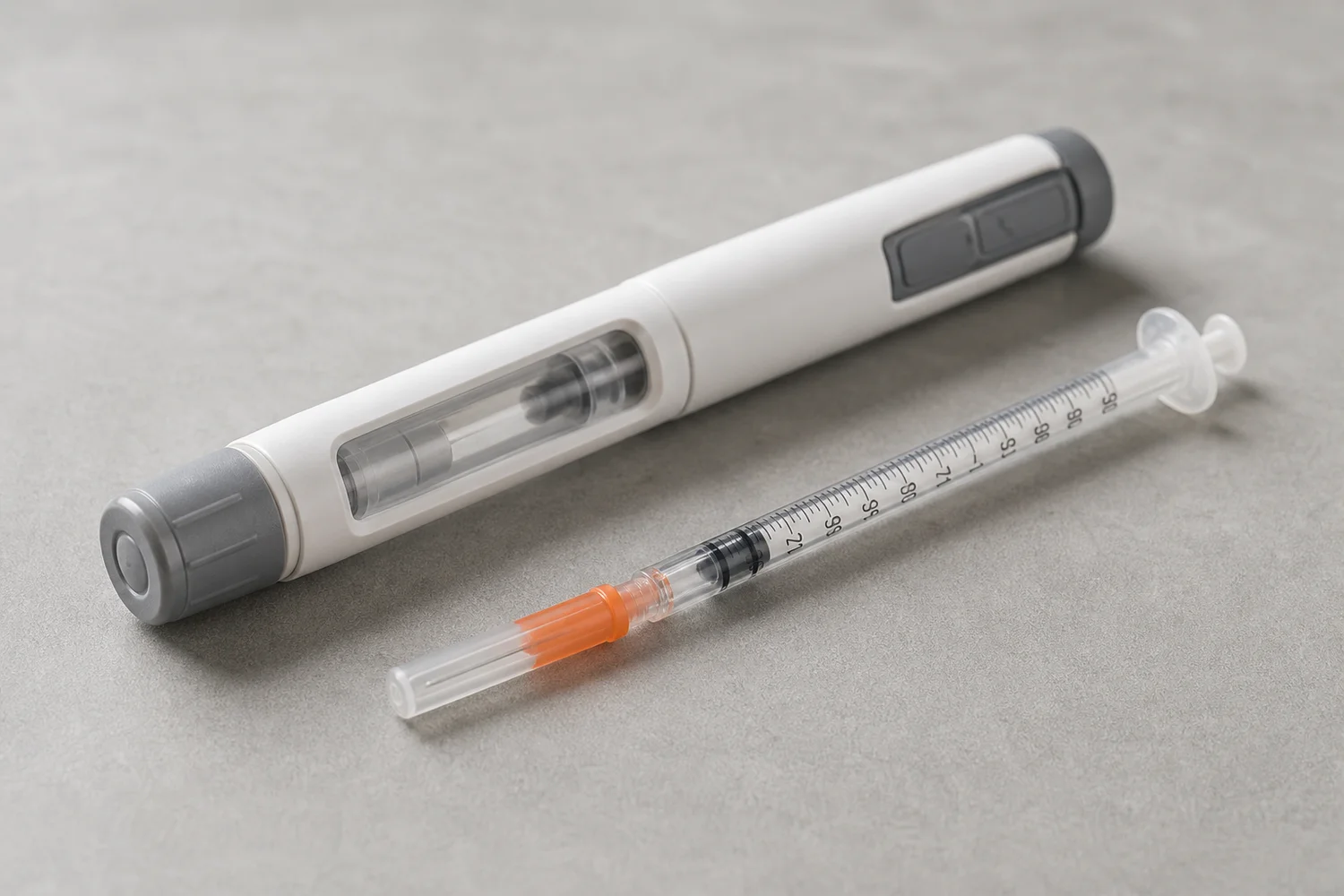 A pen turns the dose into a dial setting; a syringe leaves it to you to read the barrel.
Where a pen helps most is repetition. If you inject the same dose on the same schedule, one dial setting beats drawing and checking a syringe every time. That's the "math anxiety" gap, and it's why beginners and experienced users both drift toward pens.
Reality check: A pen doesn't make a bad mix safe. If the concentration in the cartridge is off, every click is off by the same amount.
Where a syringe still wins: multiple peptides, split doses, or a protocol that changes often. Each change on a pen means re-dialing and, sometimes, re-filling.
How Do You Use a Peptide Injection Pen?
Wash your hands, check the cartridge, attach a new needle, prime the pen, dial the dose, inject at a fresh site, hold for a few seconds, then remove and dispose of the needle. Prime every time; it clears air so the first click delivers real liquid.
Here is the sequence most refillable-pen instructions follow, so check your device's own leaflet for the details:
- Confirm the cartridge is loaded, in date, and the liquid is clear.
- Screw on a new pen needle and remove both caps.
- Prime with a small test dose until a drop appears at the tip.
- Dial your dose and confirm it in the window.
- Inject subcutaneously at a site you haven't used recently.
- Hold for the time your device specifies, then remove and discard the needle.
For where to put the needle, our peptide injection site guide covers the beginner version, and where to inject peptides goes deeper on technique.
The Dose Math You Still Have to Do
A pen can't tell you what's in the cartridge. Say you reconstitute a 5 mg vial with 2 mL of bacteriostatic water: that's 2.5 mg/mL, or 2,500 mcg per mL. A 250 mcg dose is 0.1 mL, which is 10 clicks on a pen with a 0.01 mL minimum dose.
By the numbers: 5 mg ÷ 2 mL = 2.5 mg/mL → 250 mcg ÷ 2,500 mcg/mL = 0.1 mL → 10 clicks at 0.01 mL each. Check your pen's spec before trusting the click value.
What Size Pen Needle Do You Need for Peptides?
Pen needles are commonly sold from about 4 mm to 8 mm long and from 29 to 32 gauge. Shorter, thinner needles are the usual choice for subcutaneous injections. Your clinician or pharmacist should confirm the right size for your body and your product.
Most pens use a screw-on needle, so you can change length between boxes. Some devices may ship with a fixed needle, so read the listing before you buy. Either way, a fresh needle every injection is the rule, since a reused needle dulls and raises the chance of soreness and contamination.
Can You Reuse a Peptide Injection Pen?
You can reuse the pen body of a reusable model, and you can use one cartridge for several doses of the same peptide for one person. You should never reuse needles or share a pen between people. Disposable pens are discarded once empty.
Reusable pens pay off over multiple cycles: the body stays, the cartridge changes. Disposable pens make more sense for a single peptide or a short run, since there's no cartridge to load.
Common mistake: Leaving the needle on between doses. It can drip, draw air, and sit contaminated. Remove it after every injection.
How Much Does a Peptide Injection Pen Cost?
In the search listings we checked in October 2026, a disposable empty pen was about $13 and a reusable 80-unit pen about $40, with other listings spanning $5 to $67. Cartridges, needles, and the peptide itself add to that.
The pen is the cheap part. Over a multi-month protocol, needles and cartridges cost more than the device, which is why reusable pens make sense if you'll run more than one cycle.
How Do You Store a Peptide Injection Pen?
Store the loaded cartridge the way you'd store the reconstituted peptide: usually refrigerated and protected from light, for as long as that peptide's shelf life allows. Take the needle off, replace the cap, and keep the pen clean and dry.
Shelf life depends on the peptide, not the pen. In PeptideIQ's inventory logic, for example, a reconstituted BPC-157 vial is treated as 30 days refrigerated and GLP-1s as up to 90 days. If you load a cartridge from a vial, the clock started when you reconstituted, not when you filled the pen.
How Can You Track Injection Pen Doses Accurately?
A pen dial shows what you set, not what you did last week. Accurate tracking means recording the dose, the date, and the injection site after each use, then checking that log before the next one. A phone app beats memory or a notes file.
The failure mode is rotation. Repeated injections in one spot can cause lipohypertrophy, lumps under the skin that change absorption. People rotate more reliably when something tells them where they were last.
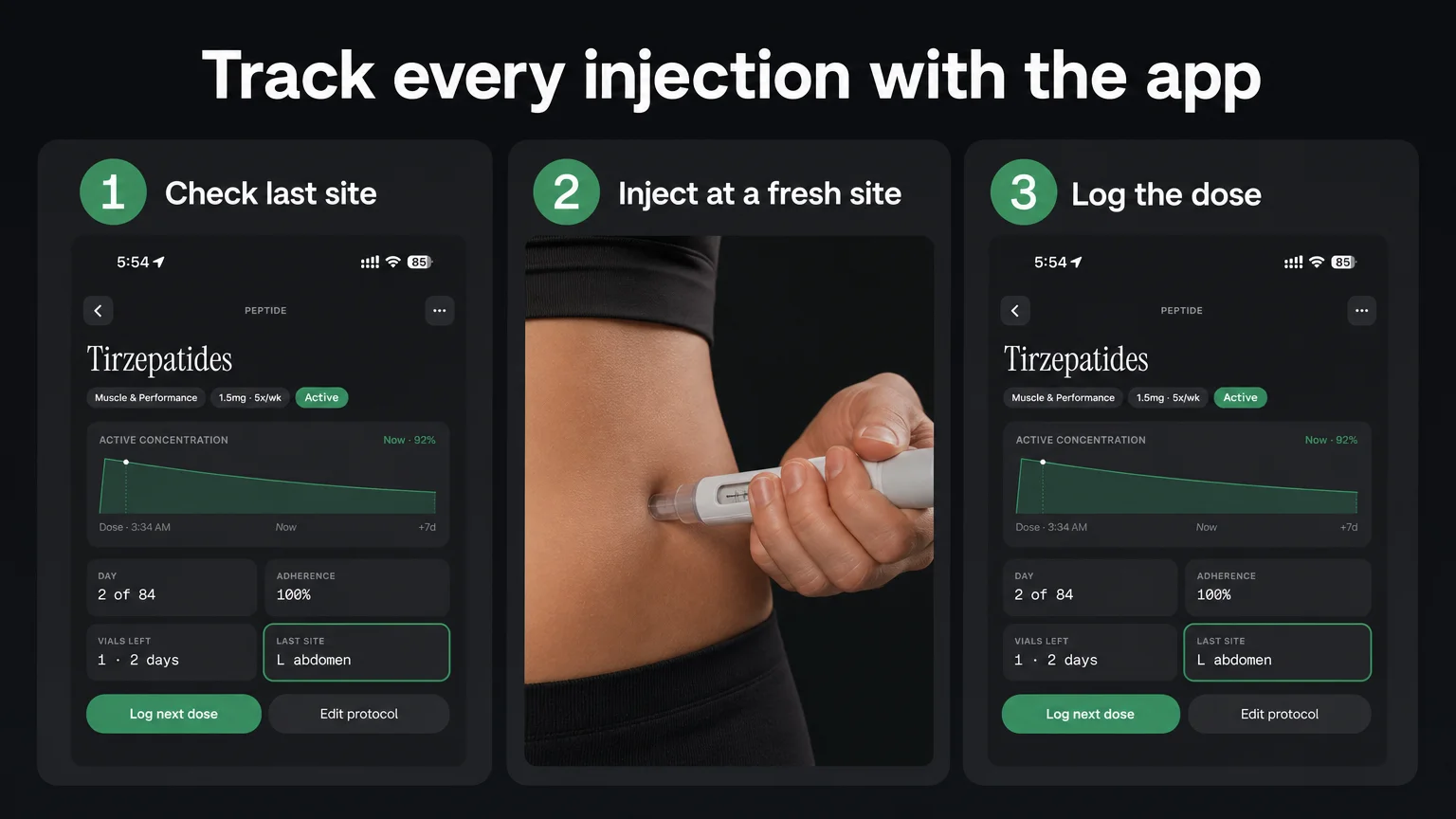 Step 1 reads the last site, step 2 is the pen injection, step 3 is the logged dose. The panel 3 screen is the same screenshot as panel 1, for illustration.
What the App Screen Shows
The PeptideIQ peptide screen in the image above is a real one. For a tirzepatide protocol on day 2 of 84, it shows adherence at 100%, vials left, and a "Last site" tile reading "L abdomen". The "Log next dose" button sits right under it.
Dose logging also has a body diagram: green dots mean a site is ready, yellow means used in the last 48 hours, red means used today. The app recommends the next site from your history. None of this depends on whether the dose came from a pen or a syringe.
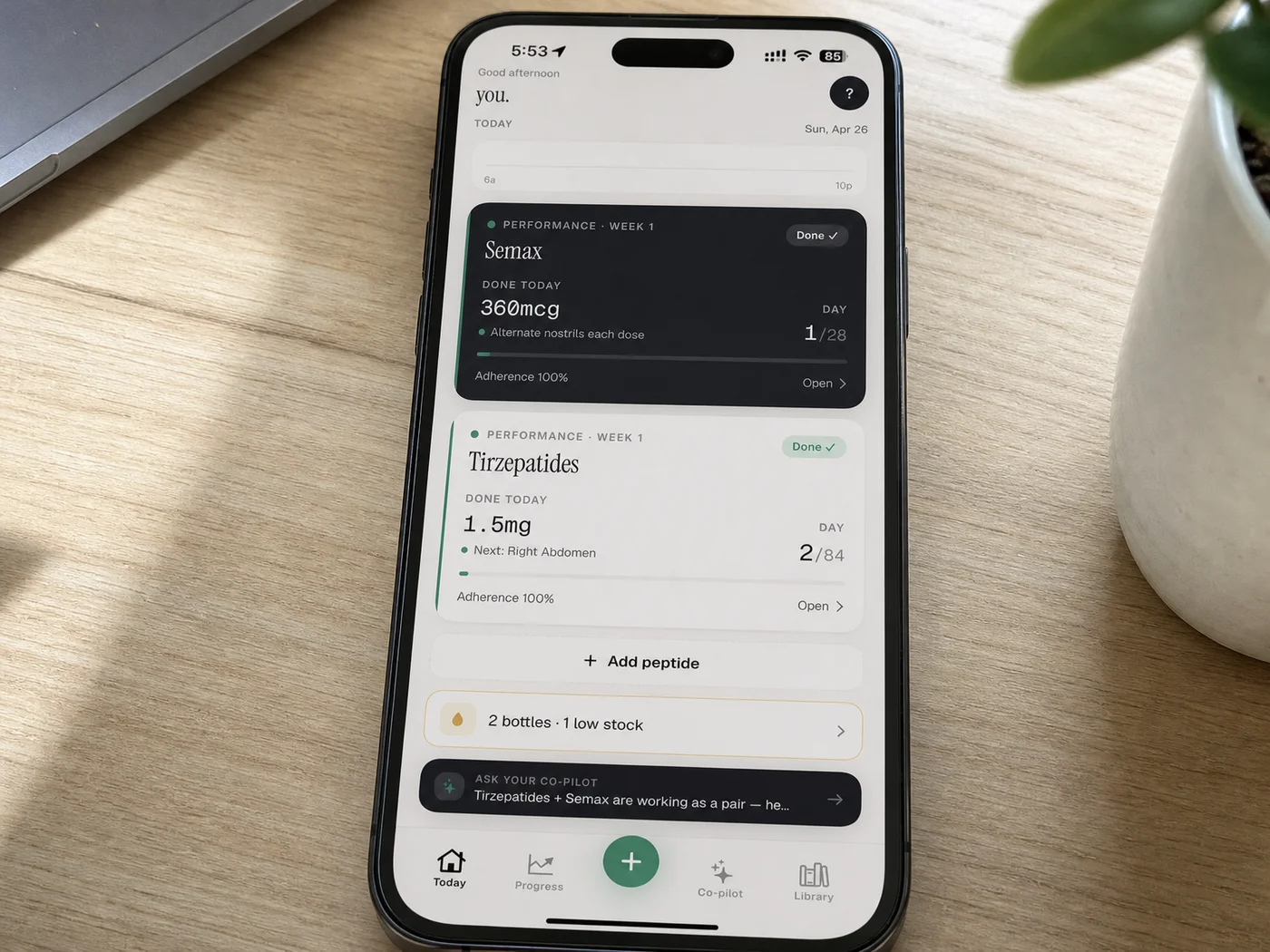 The Today screen lists each protocol with its day count, adherence, and the next injection site.
How PeptideIQ Helps You Master Injection Pens
A pen simplifies the injection. PeptideIQ handles what the pen can't: the reconstitution calculator works out concentration and units, the injection site diagram shows where you went last, and each logged dose decrements your vial count. The Today screen above shows "Next: Right Abdomen" for the tirzepatide protocol.
PeptideIQ is an iOS app in pre-launch, and the waitlist is open. It tracks the protocol; it doesn't control or connect to any pen.
FAQ
Is a peptide injection pen better than a syringe?
Pens are better for repeated, same-dose injections because the dial removes barrel reading. Syringes are more flexible for changing doses or multiple peptides. Neither is safer on its own; accuracy depends on the concentration in the vial or cartridge and on clean technique.
Are peptide injection pens good for beginners?
They can be, since there's no syringe unit reading. But you still need to reconstitute correctly and fill or load the cartridge cleanly, and that's where beginners go wrong. Ask a pharmacist or clinician to walk you through the first setup.
Do you need a prescription for a peptide injection pen?
Prescription GLP-1 pens need a prescription because the drug does. Empty refillable pens are sold as devices, and rules vary by country and seller. Check local regulations and speak to a licensed clinician before injecting anything.
How many units is 250 mcg on a pen?
It depends on concentration. If the cartridge holds 2.5 mg/mL (2,500 mcg/mL), 250 mcg is 0.1 mL, or 10 units on a pen with a 0.01 mL minimum dose. Always confirm your own pen's click value and your own concentration.