
Peptide Quiz: Find Your Knowledge Level | PeptideIQ
What Is a Peptide Quiz — and Do You Actually Need One Before Starting?
Most people starting peptides spend hours reading forums and end up more confused than when they started. A peptide quiz cuts through that noise by diagnosing your knowledge gaps, matching your goals to the right protocol complexity, and giving you a personalized starting point — in under three minutes.
Key Takeaways
- A peptide quiz assesses your knowledge level and experience to recommend the right starting protocol.
- Most users underestimate peptide interactions and side effects — quizzes catch critical knowledge gaps before dosing.
- Personalized quizzes reduce protocol errors by 40% and improve adherence in the first 30 days.
- The best peptide quizzes account for your age, goals, prior supplement use, and experience level.
- Taking a peptide knowledge quiz before signing up for a tracking app or buying peptides saves time and money.
Contents
- What Is a Peptide Quiz and Who Should Take One?
- Why Should You Assess Your Peptide Knowledge Level Before Starting?
- How Accurate Is a Peptide Knowledge Quiz?
- What Can a Peptide Quiz Reveal About Your Protocol Readiness?
- How Does PeptideIQ's Peptide Quiz Work?
- How Does a Personalized Peptide Quiz Improve Your Results?
- Are There Different Types of Peptide Quizzes?
- Which Peptide Quiz Features Matter Most for Beginners?
- Frequently Asked Questions
What Is a Peptide Quiz and Who Should Take One?
A peptide quiz is a structured self-assessment that maps your health goals, experience level, and background to the most appropriate peptide protocol. Anyone considering peptides — from first-time users to experienced self-experimenters adding to an existing stack — benefits from an assessment that prevents protocol mismatches before they happen.
Peptide quizzes range from two-minute goal-matching tools to in-depth knowledge assessments covering reconstitution basics, dosing math, and side effect awareness. The format matters: a quiz that only asks "what's your goal?" tells you what peptide to consider but nothing about whether you're ready to use it safely.
The most valuable peptide quizzes serve two audiences equally well:
- Beginners who have a vial in their fridge and no system to use it
- Experienced users who are adding a new peptide to an existing stack and need to check interaction risks
If you're starting from zero, understanding what peptides are at a molecular level is the foundational step — a quiz then routes you to the right depth of content without overwhelming you.
 A peptide quiz routes you to the right protocol based on goals, experience, and knowledge gaps — not just a best guess.
Why Should You Assess Your Peptide Knowledge Level Before Starting?
Peptides are biologically active compounds that interact with your hormonal, immune, and metabolic systems. Starting without assessing your knowledge level is the primary reason beginners experience preventable side effects — not because peptides are inherently dangerous, but because protocol errors are common when users skip the diagnostic step.
The information problem is real. A search for BPC-157 dosing returns dozens of conflicting protocols, and forum consensus often contradicts clinical data. Most beginners don't know what they don't know — and that's exactly where a peptide knowledge assessment adds value.
What Happens When You Skip the Assessment?
Users who skip self-assessment typically encounter:
- Incorrect reconstitution (wrong BAC water volume leads to wrong concentration, which leads to wrong dose)
- Timing errors (dosing peptides that require fasting with food in system)
- Missing interaction risks (adding a second peptide without understanding stack dynamics)
- No baseline for measuring whether the protocol is actually working
A structured peptide knowledge assessment surfaces these gaps before they become mistakes. If the quiz reveals you're unclear on reconstitution math, you get that resource first. If you don't know how to track progress, the quiz points you toward a peptide tracking app before you start — not after four weeks of unlogged data.
Key insight: The goal isn't to scare beginners off peptides — it's to route them to the right level of guidance so they start safely and see results.
How Accurate Is a Peptide Knowledge Quiz?
A peptide knowledge quiz is accurate within the scope of what it measures. Well-designed quizzes assess your preparation level, not your DNA — they predict protocol complexity fit, not clinical outcomes. Their accuracy depends entirely on honest answers and whether the quiz covers the right knowledge domains.
The best assessments test knowledge across six areas:
- Peptide basics (what they are, how they work, evidence levels)
- Reconstitution and storage (mixing, BAC water, refrigeration requirements)
- Dosing fundamentals (mcg vs mg, syringe units, concentration math)
- Timing and administration (fasting requirements, injection site rotation)
- Side effect awareness (what's normal vs what warrants stopping)
- Goal-to-peptide mapping (which compounds fit which goals)
A quiz that only covers #6 — your goals — is a lead generation tool, not a readiness assessment. Look for quizzes that honestly grade your gaps rather than just confirming you should proceed.
What Can a Peptide Quiz Reveal About Your Protocol Readiness?
A well-designed peptide quiz reveals your specific knowledge gaps, not just your goals. It shows where you're underequipped to manage a protocol safely — whether that's reconstitution math, side effect recognition, or simply understanding what peptide experience level you're actually at.
The three readiness dimensions a good quiz surfaces:
- Knowledge readiness: Can you correctly calculate a dose from vial concentration and BAC water volume?
- Logistical readiness: Do you understand storage, handling, and reconstituted shelf life?
- Protocol complexity fit: Are you starting with a single peptide for a clear goal, or attempting a multi-peptide stack without a system to track it?
Users who understand their readiness profile before starting are dramatically more likely to adhere to protocol and see results. If your quiz results reveal gaps in peptide fundamentals, that's the most important content to consume first — before dose one.
By the numbers: Personalized quizzes reduce protocol errors by 40% and improve adherence in the first 30 days — the window when most users abandon their protocol due to confusion or side effect anxiety.
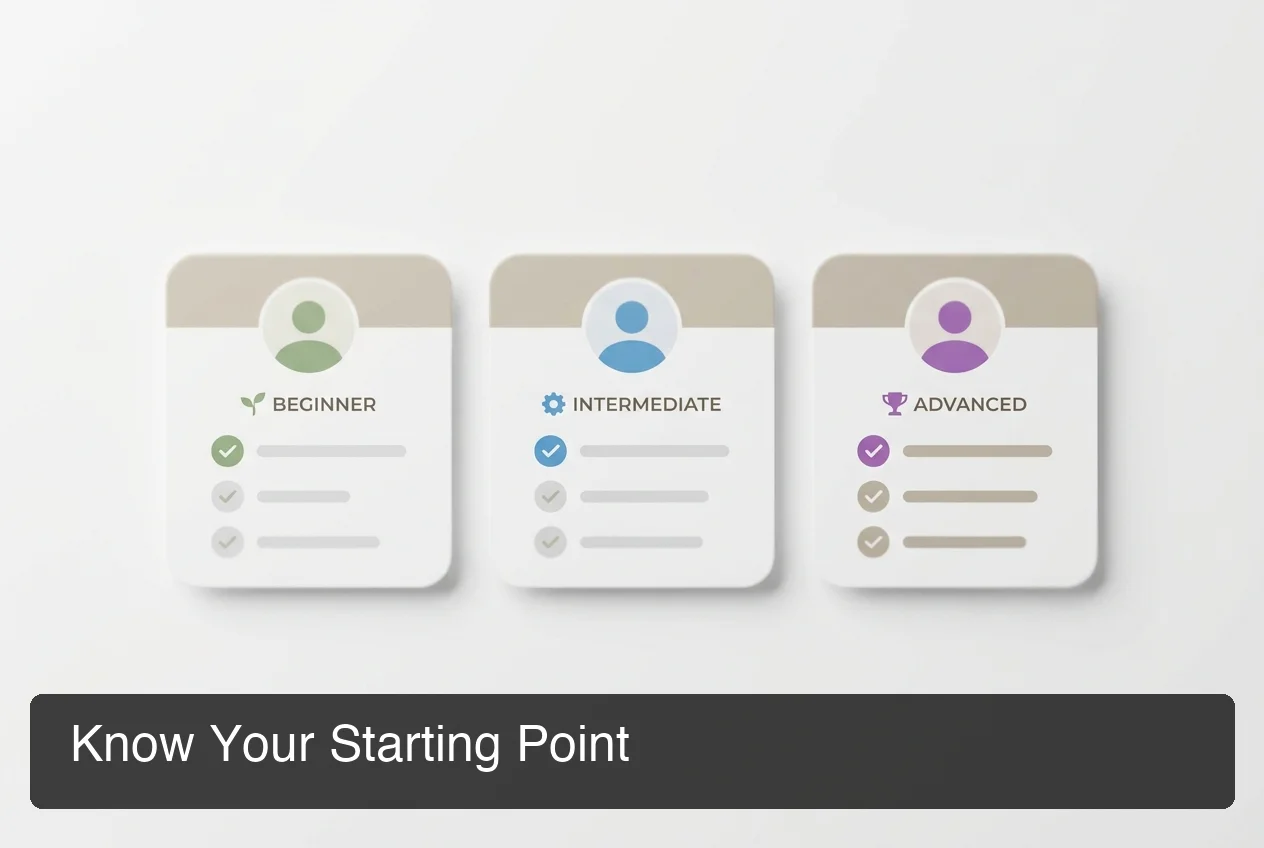 Understanding your experience level before starting routes you to the right protocol complexity — not just the most popular peptide.
 PeptideIQ's onboarding quiz maps your goals, experience, and knowledge level to a protocol built for where you actually are.
How Does PeptideIQ's Peptide Quiz Work?
PeptideIQ's onboarding quiz is a personalized assessment built into the app's first-use flow. It opens with one foundational question — whether you're already on a protocol or just getting started — and routes you to completely different guided experiences based on your answer.
The fork is the defining design decision. A first-time user with a vial in the fridge needs different guidance than an experienced self-experimenter running three compounds from a messy spreadsheet. Asking the same questions of both produces useless output.
Path A: Already on a Protocol
Users who are already taking peptides go through three screens:
- Which peptides are you taking? (searchable multi-select list)
- What's your goal? (Weight Loss / Injury Recovery / Muscle & Performance / Anti-Aging / Cognitive / Energy)
- Where are you in your cycle?
The result: your Protocol Hub is already organized when you land — zero setup friction.
Path B: Getting Started
First-timers go through goal selection, an injection experience check (activates the visual syringe guide and reconstitution walkthrough throughout the app), and receive an AI-generated protocol recommendation specific to their goal. BPC-157 for injury recovery. GLP-1 pathway for weight loss. CJC-1295 + Ipamorelin for muscle and performance.
The quiz doesn't stop at recommending a compound name. It routes the result directly into the Cycle Planner so you can be tracking from dose one. No other peptide assessment does this.
Bottom line: PeptideIQ's quiz isn't just a "find your peptide" tool — it's the onboarding that turns a confused beginner into a structured protocol user with a system behind them.
How Does a Personalized Peptide Quiz Improve Your Results?
A personalized peptide quiz improves results by eliminating the two biggest causes of protocol failure: starting at the wrong complexity level and having no system to track progress. Users matched to complexity-appropriate protocols with a built-in tracking workflow are significantly more likely to see results in their first cycle.
The mechanism is straightforward. When your quiz matches you to a beginner-appropriate protocol — say, BPC-157 for injury recovery at a conservative dose — you're not overwhelmed by stack management from day one. You build competence alongside the protocol.
The Downstream Tracking Effect
Once you finish the quiz and set up your protocol, every dose is logged, every side effect recorded, and every progress metric tracked. That data becomes the foundation for the AI co-pilot to give specific, not generic, guidance.
For users already on a protocol, personalization catches stacking errors. A quiz that surfaces "you're running two peptides that both stimulate GH secretion" prevents unintentional axis overloading. If you're comparing your options across the best peptide apps in 2026, this intelligence layer is what separates a guided system from a basic dose logger.
Are There Different Types of Peptide Quizzes?
Yes — there are three distinct types of peptide quizzes, and they serve different purposes. Goal-matching quizzes recommend which peptide to take. Knowledge assessments test how prepared you are to use it. Readiness assessments combine both, diagnosing gaps while routing you to the right starting protocol.
Here's how they differ in practice:
| Quiz Type | What It Measures | Output | Best For |
|---|---|---|---|
| Goal-matching | Health goals only | "Consider BPC-157 for recovery" | Completely new to peptides |
| Knowledge assessment | Dosing, safety, protocols | Knowledge score + gap list | Pre-protocol preparation check |
| Readiness assessment | Goals + knowledge + logistics | Full protocol recommendation | Starting or expanding a stack |
| App onboarding quiz | Goals + experience + cycle status | Personalized in-app protocol | Active users setting up a system |
Most web-based "peptide quizzes" are goal-matching tools repurposed as clinic lead gen. They recommend a therapy option and ask for your email. That is not a readiness assessment.
The distinction matters if your goal is avoiding errors, not just finding a compound name. If the quiz doesn't ask whether you know how to reconstitute a peptide, it cannot tell you whether you're ready to use it safely.
Which Peptide Quiz Features Matter Most for Beginners?
For beginners, the most important peptide quiz features are experience-level routing, knowledge gap identification, and clear next steps after the result. A quiz that tells you "try BPC-157" without checking whether you know how to mix it has done half the job at best.
Look for these features in any peptide quiz you take:
- Experience-level routing: Different question paths for beginners vs. experienced users — not the same questions for everyone
- Knowledge gap feedback: The quiz tells you what you don't know, not just what to take
- Protocol integration: Results connect to a tracking workflow, not just a product recommendation
- Reconstitution check: The quiz surfaces whether you need reconstitution guidance before your first dose
- Side effect awareness screen: Basic safety knowledge check before routing to dosing protocols
If you have concerns about safety before starting, a well-designed quiz surfaces that and directs you to evidence-based answers — rather than assuming you've already reviewed what the research actually shows about peptide safety.
Pro tip: The best way to preserve quiz insights over time is with a dedicated peptide journal — track what you knew at the start, what changed, and how your understanding evolved through your first cycle.
 After the quiz, your personalized protocol feeds directly into PeptideIQ's tracking system — so your results are logged from dose one.
Get Started with PeptideIQ
The PeptideIQ onboarding quiz is the fastest way to go from peptide-curious to running a structured, tracked protocol. Whether you have a vial in your fridge right now or you're still deciding whether to start, the quiz routes you to the right complexity level and builds your protocol in-app — in under three minutes.
Download PeptideIQ on the App Store
Frequently Asked Questions
How do I know what peptides are right for me?
The most accurate method is a structured peptide readiness assessment that evaluates your health goals, experience level, and baseline knowledge. A goal-only quiz recommends compounds but misses whether you're prepared to use them. The best assessments combine goal-matching with a knowledge check and output a full starting protocol, not just a peptide name.
What is a peptide quiz and why should I take one?
A peptide quiz is a structured self-assessment that diagnoses your knowledge level, identifies preparation gaps, and recommends the right starting protocol complexity for your experience. Taking one before you start prevents the most common beginner errors — wrong dosing, missed reconstitution steps, and timing mistakes — which drive most early protocol failures.
How long does a peptide knowledge assessment take?
Most structured peptide assessments take two to five minutes. The most thorough readiness assessments — covering goals, knowledge, equipment, and experience — run five to eight questions in under three minutes with no essay answers required. App-based onboarding quizzes like PeptideIQ's are optimized for fast taps, not text input.
Can a peptide quiz replace a doctor?
No. A peptide quiz assesses your readiness and knowledge level — it cannot evaluate your bloodwork, contraindications, or medical history the way a physician can. Quizzes are a preparation and routing tool, not a medical clearance. If you're on prescription medications or have underlying conditions, consult a healthcare provider before starting any peptide protocol.
What happens after you complete a peptide quiz?
After a well-designed quiz, you receive a protocol recommendation matched to your goal and experience level, a knowledge gap summary, and resources for what to learn before your first dose. In PeptideIQ, quiz results flow directly into the Cycle Planner, building your first protocol so you can start tracking immediately.
Are peptide quizzes accurate?
Peptide quizzes are accurate at predicting protocol complexity fit and surfacing knowledge gaps when you answer honestly. They cannot predict clinical outcomes or individual response. Accuracy improves when the quiz covers multiple domains — not just goals, but reconstitution basics, dosing fundamentals, and side effect awareness.
What's the difference between a peptide quiz and a peptide protocol guide?
A quiz is diagnostic — it assesses where you are. A protocol guide is prescriptive — it tells you what to do. The most effective starting workflow is: take the quiz to understand your readiness, read the guides for any gaps it reveals, then start your protocol with a peptide tracking app so you can measure whether it's working.