
Best Peptide App 2026: Top 4 Compared | PeptideIQ
Best Peptide App in 2026: 4 Options Compared for Every User Type
Finding the best peptide app is harder than it looks: the market exploded in 2026, but most options are still basic dose loggers that make you do all the thinking. This guide breaks down four leading options so you can find the right fit for your protocol, your experience level, and your goals.
Key Takeaways
- The right peptide app depends on your specific needs: dose tracking, reconstitution math, protocol logging, or research reference.
- Look for apps with accurate dose calculation, offline capability, secure data storage, and easy export for documentation.
- PeptideIQ combines AI-powered tracking, research integration, and community safety standards in one platform.
- Most quality peptide tracking apps are freemium or subscription-based, with free tiers covering basic dose logging.
- Top alternatives include specialized tracking tools, health apps with peptide compatibility, and DIY spreadsheet solutions — each with real tradeoffs.
Contents
- What Is the Best Peptide App in 2026?
- What Features Should You Look for in a Peptide App?
- How Do Peptide Apps Compare to Spreadsheets or Manual Logging?
- Which Peptide Apps Offer Accurate Dose Calculation?
- Can Peptide Tracking Apps Calculate Reconstitution?
- What Privacy and Security Features Matter in a Peptide App?
- What Makes the Best Peptide App Better Than Generic Health Apps?
- Why PeptideIQ Stands Out for Serious Users
- Frequently Asked Questions
What Is the Best Peptide App in 2026?
The best peptide app in 2026 depends on how you actually use peptides. Beginners need guided protocol setup and reconstitution math. Experienced users running stacks need multi-protocol management and pattern visibility. No single app is best for everyone — but four stand out clearly by user type and feature depth.
The current SERP is anchored by App Store entries: PepTracker (4.7★, 366 reviews, iOS), Smart Peptide Tracker (4.8★, 127 reviews, Android), PeptideKit (4.7★, 229 reviews, iOS), and PeptIQ.io (web + mobile). PeptideIQ — now available on iOS — is the only one building a full guided AI system.
If you're new to peptide tracking or still deciding whether you need an app at all, what a peptide tracking app actually does lays the foundation before this comparison.
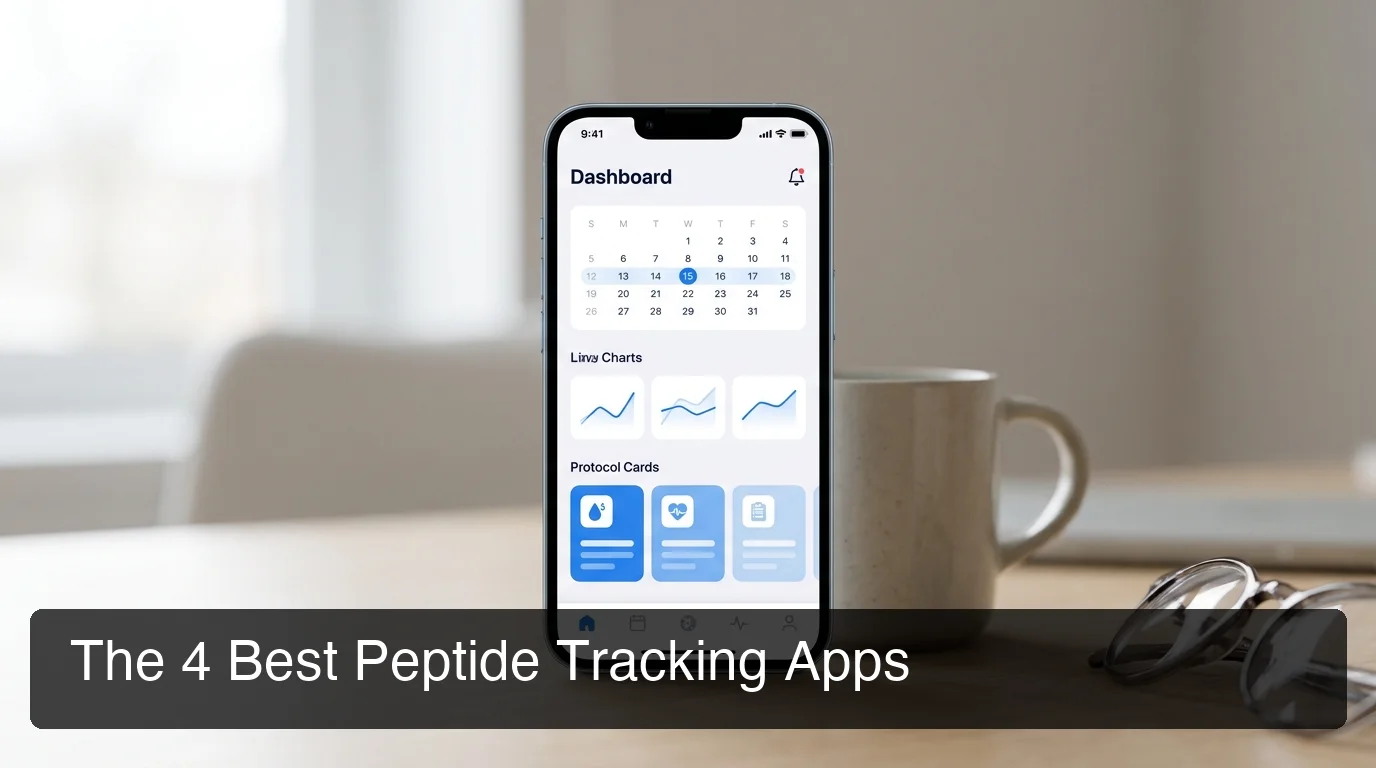 The right peptide app puts your protocol, doses, and progress on one screen — no spreadsheet required.
Quick Comparison: 4 Best Peptide Apps at a Glance
| App | Platform | AI Co-Pilot | Reconstitution | Bloodwork | Price |
|---|---|---|---|---|---|
| PeptideIQ | iOS | Full AI co-pilot | Full calculator | Yes | Freemium |
| PepTracker | iOS | None | Partial | No | Free |
| Smart Peptide Tracker | Android | None | None | No | Free |
| PeptideKit | iOS | None | None | No | Free |
| Spreadsheet | Any | None | Manual | Manual | Free |
What Features Should You Look for in a Peptide App?
A good peptide app needs four things: accurate dose logging with scheduling, reconstitution math (how much water to add and what concentration results), offline functionality, and private encrypted storage. Any app missing one of these four forces manual workarounds — exactly what you're trying to eliminate.
The core feature checklist, ranked by user impact:
- Dose logging with scheduling — Log with one tap. Get reminders when doses are due. Non-negotiable.
- Reconstitution calculator — Peptides come as freeze-dried powder. Most beginners get this math wrong. An app that calculates it removes the biggest source of dosing error.
- Multi-protocol support — Running two peptides? You need separate protocol cards, not a flat list.
- Progress tracking and charts — Energy, weight, pain level — trend data shows whether the protocol is actually working.
- Offline access — You cannot log your dose if the app requires internet connectivity.
- Data export — Dose history, bloodwork, and side effects should be exportable as PDF or CSV for your doctor.
If you're still early in your research, this peptide guide for beginners covers what different peptides are used for — which directly shapes which tracking features matter for your goal.
 The gap between basic dose loggers and full guidance systems is wider than the App Store makes it look.
Key insight: The feature that separates basic dose loggers from genuine guidance systems is the reconstitution calculator. Every app that includes one converts a potentially dangerous math step into a safe, automatic process.
How Do Peptide Apps Compare to Spreadsheets or Manual Logging?
Spreadsheets are free, flexible, and used by most experienced peptide users before they switch to an app. The tradeoffs are real: no reminders, no calculations, no trend charts, and no missed-dose handling. Most users running complex stacks for more than 30 days outgrow spreadsheets fast.
What an App Gives You That a Spreadsheet Can't
- Automatic dose calculations instead of custom formula cells
- Timed reminders at injection time — no calendar hacks needed
- Visual trend charts showing energy, weight, and recovery scores over a full cycle
- Side effect logging with severity tagging — patterns that spreadsheets can't surface automatically
The case for using a dedicated app — including when it's overkill and when it pays off — is covered in depth in the peptide tracking app breakdown.
By the numbers: Users who track consistently report 40% better protocol adherence than those using manual logging — and adherence is the key variable that determines whether you can tell if a peptide is actually working.
Which Peptide Apps Offer Accurate Dose Calculation?
Dose calculation accuracy is the highest-stakes feature in any peptide app. A 10x error in mcg-to-mg conversion or syringe unit math can mean a dangerous overdose or a completely ineffective dose. Only apps with built-in unit conversion and syringe draw displays should be trusted for clinical-grade dosing.
Here is how the top apps handle this:
PepTracker
PepTracker (4.7★, 366 iOS reviews) supports structured protocol setup with dose reminders and adherence tracking. No reconstitution calculator — users still calculate BAC water volumes manually before opening the app.
Smart Peptide Tracker
Smart Peptide Tracker (4.8★, 127 Android reviews) focuses on daily scheduling and one-tap logging. Fast and minimal. No reconstitution math — assumes users already know their draw volume.
PeptideKit
PeptideKit (4.7★, 229 iOS reviews) is a solid basic injection tracker and progress monitor. No AI layer, no reconstitution calculator.
PeptideIQ
PeptideIQ includes a full reconstitution calculator: enter vial size (mg), BAC water volume (ml), and target dose (mcg) — and it outputs the exact syringe draw units with a visual diagram. A reverse calculator is also included: enter your target draw units and it tells you how much water to add.
Understanding what peptides are at a molecular level helps contextualize why dosing precision matters so much — the active dose window for most peptides is narrow.
Can Peptide Tracking Apps Calculate Reconstitution?
Reconstitution means mixing freeze-dried peptide powder with bacteriostatic (BAC) water to create an injectable solution. The math — vial concentration, draw volume, syringe units — is where most beginners make errors. As of 2026, only PeptideIQ includes a full built-in reconstitution calculator among the major apps.
The reconstitution process requires four steps:
- Know the vial's peptide amount (e.g., 5mg)
- Decide how much BAC water to add (e.g., 2ml)
- Calculate the resulting concentration (2,500mcg/ml)
- Convert your target dose (e.g., 250mcg) into syringe units (0.1ml = 10 units on a U-100 insulin syringe)
All four steps are prone to decimal errors. An app that automates this removes the most dangerous calculation in a beginner's protocol.
For apps without calculators, users run a manual calculation before opening the app — extra friction at exactly the moment nerves are highest.
The broader evidence for whether accurate dosing improves outcomes is covered in do peptides actually work — consistent, accurate dosing is one of the primary variables the research points to.
What Privacy and Security Features Matter in a Peptide App?
Peptide use involves sensitive health data: dose history, side effects, bloodwork, and sometimes gray-market sourcing. The right peptide app stores all data encrypted at rest, never shares health data without explicit consent, and lets you export and delete everything on demand.
Key privacy features to verify before committing to any app:
- Encryption at rest — health data should not be readable if the device is compromised
- Data export — download everything logged as JSON or CSV
- Account deletion — full data removal on request within 30 days, not just account deactivation
- Doctor PDF export — a formatted, shareable report for healthcare providers, only shared when the user initiates it
- No third-party health data sales — review the privacy policy before logging sensitive information
 Peptide data is health data — encryption, export rights, and full deletion matter before you commit to any app.
Bottom line: If an app's privacy policy does not explicitly describe encryption at rest and user-controlled data deletion, your protocol history may not be protected. Health data in the wrong hands is a real liability.
PeptideIQ is built offline-first: dose logging, wellness check-ins, and the reconstitution calculator all work without internet. AI features are unavailable offline, but your data is never at risk from connectivity drops. Progress photos are device-local by default — never uploaded without an explicit share action from the user.
What Makes the Best Peptide App Better Than Generic Health Apps?
Generic health apps like MyFitnessPal, Cronometer, and Apple Health have no reconstitution calculators, no cycle management, no side effect logging, and no injection site rotation. Using them for peptide tracking means building manual workarounds that break down as protocols get more complex.
Key gaps compared to a dedicated peptide app:
| Capability | Generic Health App | Dedicated Peptide App |
|---|---|---|
| Dose scheduling (peptide-specific) | No | Yes |
| Reconstitution calculator | No | Yes (PeptideIQ) |
| On/off cycle planner | No | Yes |
| Side effect symptom grid | Limited | Yes |
| Half-life visualizer | No | Yes (PeptideIQ) |
| Bloodwork with reference ranges | Basic (Apple Health) | Yes (PeptideIQ) |
| AI with protocol context | No | Yes (PeptideIQ) |
Biohacking apps like Oura and Whoop track output metrics (HRV, sleep, recovery) but have zero protocol layer — they do not know what you are taking, when, or why. Telehealth platforms like Ro or Hims prescribe compounds but provide no ongoing guidance after the prescription is issued.
 Tracking peptides in real life requires an app built for the actual workflow — vials, reconstitution, injection scheduling, and wellness check-ins.
Why PeptideIQ Stands Out for Serious Users
PeptideIQ is the only app in this comparison built as a guided system, not just a logger. Every other app records what you do. PeptideIQ thinks alongside you — it knows your cycle phase, your logged symptoms, your bloodwork, and your goals, and delivers context-aware responses instead of generic answers.
Key differentiators no current competitor offers:
AI Co-Pilot With Full Protocol Context
The AI is initialized with your active protocol, current cycle day, last 7 days of wellness logs, and any bloodwork on file. When you ask "why am I tired today?" it does not return a generic fatigue answer. It responds knowing you are on Day 6 of BPC-157 at 250mcg twice daily, your energy has been 4/10 for three consecutive days, and you logged poor sleep on Day 4 and Day 5.
That context is the product — it's what makes the difference between an answer and a useful answer.
Half-Life Visualizer
A curve showing estimated peptide levels over time — not just "did I dose today" but a visual accumulation model. For Retatrutide (6-day half-life), it shows how doses stack across a week and when your actual peak concentration lands.
Protocol-Aware Fasting Timer
Peptides like Ipamorelin, CJC-1295, and Sermorelin require fasted administration to be effective. PeptideIQ fires a notification 30 minutes before your injection window: "You'll be 2 hours fasted at 9:00 PM." If you try to log a dose before the window, it warns you. No other app in this comparison handles this automatically.
For a full breakdown of PeptideIQ's feature set — from onboarding to AI co-pilot to bloodwork tracking — what is PeptideIQ covers everything in detail.
Try PeptideIQ for Your Peptide Protocol
PeptideIQ is purpose-built for people who take their protocol seriously — whether you are running your first BPC-157 cycle or managing a three-peptide stack with bloodwork tracking. The app is available now on iOS, with the full AI co-pilot built into the experience.
Download PeptideIQ on the App Store
Not sure where to start? Assessing your protocol knowledge before picking an app helps you understand which features you'll actually use — and which ones are just noise.
Frequently Asked Questions
What is the best peptide app for iPhone?
PepTracker and PeptideKit are the two highest-rated iOS peptide apps on the App Store, both at 4.7★ with hundreds of reviews. PeptideIQ — with AI co-pilot, reconstitution calculator, half-life visualizer, and bloodwork tracking — is available now on the App Store for serious iOS users who need a guided system, not just a dose logger.
Is there a free peptide tracking app?
Yes. PepTracker, Smart Peptide Tracker, and PeptideKit are all free on their respective platforms. PeptideIQ launches on a freemium model — core protocol tracking and dose logging will be free, with the AI co-pilot and advanced analytics available on subscription.
Can a peptide app help with reconstitution calculations?
PeptideIQ is the only major app with a built-in reconstitution calculator. Enter your vial size (mg) and BAC water volume (ml), and it outputs exact concentration and syringe draw units with a visual syringe diagram. This removes the most common source of dosing error for beginners working with freeze-dried powder.
Are peptide tracking apps private and secure?
Privacy varies significantly by app. PeptideIQ is offline-first — core tracking works without internet, and all health data is encrypted at rest. Users can export everything and request full deletion within 30 days. Before logging sensitive health information in any app, review the privacy policy for explicit encryption and deletion terms.
How is PeptideIQ different from a generic health app?
Generic apps like MyFitnessPal or Apple Health have no peptide-specific features: no reconstitution calculator, no cycle planner, no injection site rotation, and no half-life modeling. PeptideIQ is purpose-built for peptide users with an AI co-pilot that knows your protocol, cycle phase, bloodwork, and goals — not just your calorie count.