
What Is PeptideIQ? AI-Powered Peptide App Explained
What Is PeptideIQ? The AI-Powered Peptide Tracking App Explained
What is PeptideIQ? It's the AI-powered peptide tracking app built for people running peptide protocols — a structured guided system that logs every dose, interprets your data, and tells you exactly what's happening.
Key Takeaways
- PeptideIQ is an AI-powered guided system for peptide users — it builds your protocol, tracks every dose, and delivers personalized insights based on your specific cycle and data.
- The app features automatic dosage calculations, injection logging, side-effect tracking, and a reconstitution calculator to eliminate manual math and reduce dosing errors.
- Unlike generic health loggers, PeptideIQ's AI co-pilot knows your active protocol, cycle phase, wellness data, and goals — providing answers specific to your situation, not generic advice.
- Available now on iOS with cloud sync; Android support is planned for a later phase.
- PeptideIQ supports 20+ peptides including BPC-157, semaglutide, tirzepatide, CJC-1295, GHK-Cu, and more, covering the full spectrum from GLP-1 weight loss to longevity protocols.
Contents
- What Is PeptideIQ?
- How Does PeptideIQ Help You Track Peptide Protocols?
- Which Features Make PeptideIQ Stand Out from Other Peptide Apps?
- What Can You Track with PeptideIQ?
- What Is PeptideIQ Pricing? Free Tier vs Subscription
- How Accurate Is PeptideIQ's Dosage Calculator?
- Which Peptides Does PeptideIQ Support?
- Can You Export Your Data from PeptideIQ?
- Get Started with PeptideIQ
- Frequently Asked Questions
What Is PeptideIQ?
PeptideIQ is an AI-powered guided system for peptide users — a mobile app that combines structured protocol management, injection logging, dosage calculations, and a personalized AI co-pilot. The AI knows your specific cycle, dose history, wellness data, and goals. Every answer it gives is grounded in your situation, not generic advice.
Most people running peptide protocols rely on forum posts, spreadsheets, and best guesses. If you're new to this space, the beginner's guide to what peptides are covers the foundational science worth understanding before you start tracking a protocol.
PeptideIQ was built to fill the gap between the explosion of peptide use and the absence of purpose-built guidance tools. The app's core philosophy: the process is the product — a structured, guided system that thinks alongside you, with an intelligent AI co-pilot always one tap away.
 PeptideIQ's Protocol Hub gives you instant visibility into your cycle status, today's dose, and weekly progress at a glance.
Key insight: PeptideIQ is not a chatbot. The AI is a co-pilot within a structured system — not the home screen. If you open the app and see a chat interface, something has gone wrong.
How Does PeptideIQ Help You Track Peptide Protocols?
PeptideIQ structures your peptide protocol from the first day — building a visual cycle planner, sending dose reminders, and logging every injection with wellness check-ins. Its Protocol Hub answers three questions every time you open the app: where am I in my cycle, what do I need to do today, and how is it going?
What Is the Protocol Hub?
The Protocol Hub is your home screen in the app. It shows one card per active peptide with: peptide name and goal, current cycle day and week, a visual progress bar, next dose time and amount, and doses remaining in your vial. For users running multiple peptides, each gets its own color-coded card stacked vertically. A "Today's Action" button shows either "Log Today's Dose" or your next scheduled dose time — no ambiguity.
How Does the AI Co-Pilot Work?
The AI is initialized on every conversation with your full context: active protocols, current cycle day, last seven days of wellness logs, side effects, bloodwork on file, your goal, and experience level. ChatGPT has general peptide knowledge but has no idea what day you're on or what you've logged — that context gap is the entire product.
If your energy slider has been at 4/10 for three consecutive check-ins, the AI surfaces a prompt automatically and answers it knowing exactly where you are in your cycle.
Which Features Make PeptideIQ Stand Out from Other Peptide Apps?
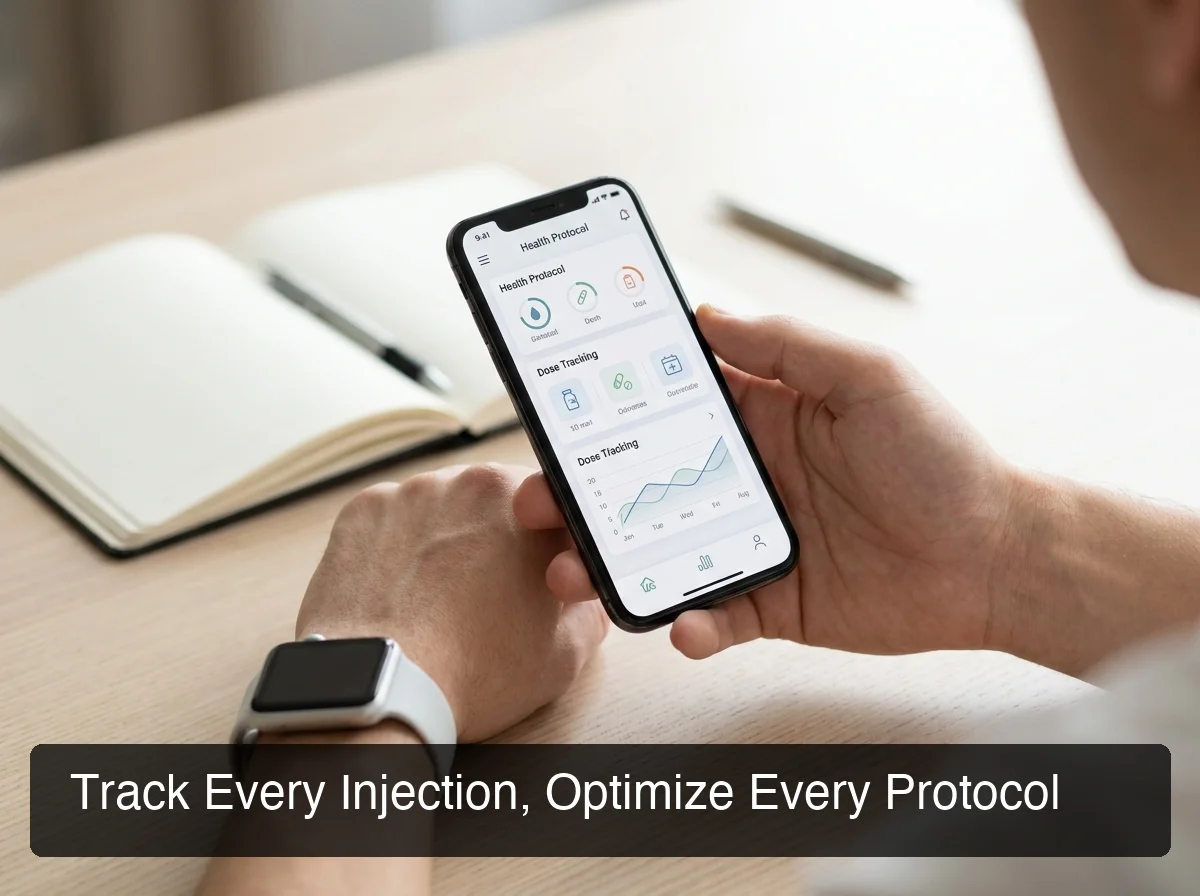 PeptideIQ's core feature set — dose scheduling, injection site rotation, reconstitution calculator, and AI weekly insight cards — replaces the manual tracking systems most users rely on today.
PeptideIQ's differentiation is the combination of a guided structured system with context-aware AI. Every other peptide app is a dumb logger — the user does all the thinking, the app just records. PeptideIQ provides structured process intelligence alongside an AI that knows your specific protocol, not a generic dataset.
Dose Logging That Takes 60 Seconds
Logging a dose is a six-step flow: confirm your pre-filled dose, select your injection site from a rotating body diagram (color-coded: green = ready, yellow = used recently, red = used today), view a syringe illustration showing exactly where to draw, complete four quick wellness sliders, log any side effects from a 15-item tap grid, and add an optional note.
For first-time users, the injection site guidance labels the exact location: "Left abdomen — 2 inches from navel." For experienced users, most steps are skippable.
Cycle Planner with Dose Escalation
Setting up a new protocol is structured like a flight plan. You select your peptide, the app suggests a starting dose with an explanation, and you can plan dose escalation phases visually — for example, Phase 1 at 250mcg for weeks 1–4 and Phase 2 at 500mcg for weeks 5–8. Transitions happen automatically with a confirmation prompt.
For peptides requiring fasted administration — Ipamorelin, CJC-1295, Sermorelin, and Tesamorelin — the fasting window timer enables automatically. A notification fires 30 minutes before your injection window opens.
PeptideIQ vs Generic Trackers
| Feature | PeptideIQ | Generic Health App | Spreadsheet |
|---|---|---|---|
| Peptide-specific protocols | Yes | No | Manual setup |
| Reconstitution calculator | Yes | No | Manual math |
| Context-aware AI co-pilot | Yes | No | No |
| Injection site rotation | Yes | No | No |
| Half-life visualizer | Yes | No | No |
| Doctor-friendly PDF export | Yes | No | No |
| Side effect tracking | Yes | Basic | Manual |
| Bloodwork trend tracking | Yes | Limited | Manual |
Bottom line: If you've been running your protocol in Notes or a spreadsheet, PeptideIQ replaces your fragmented system with an intelligent process that adapts to your cycle and surfaces patterns you'd never catch manually.
What Can You Track with PeptideIQ?
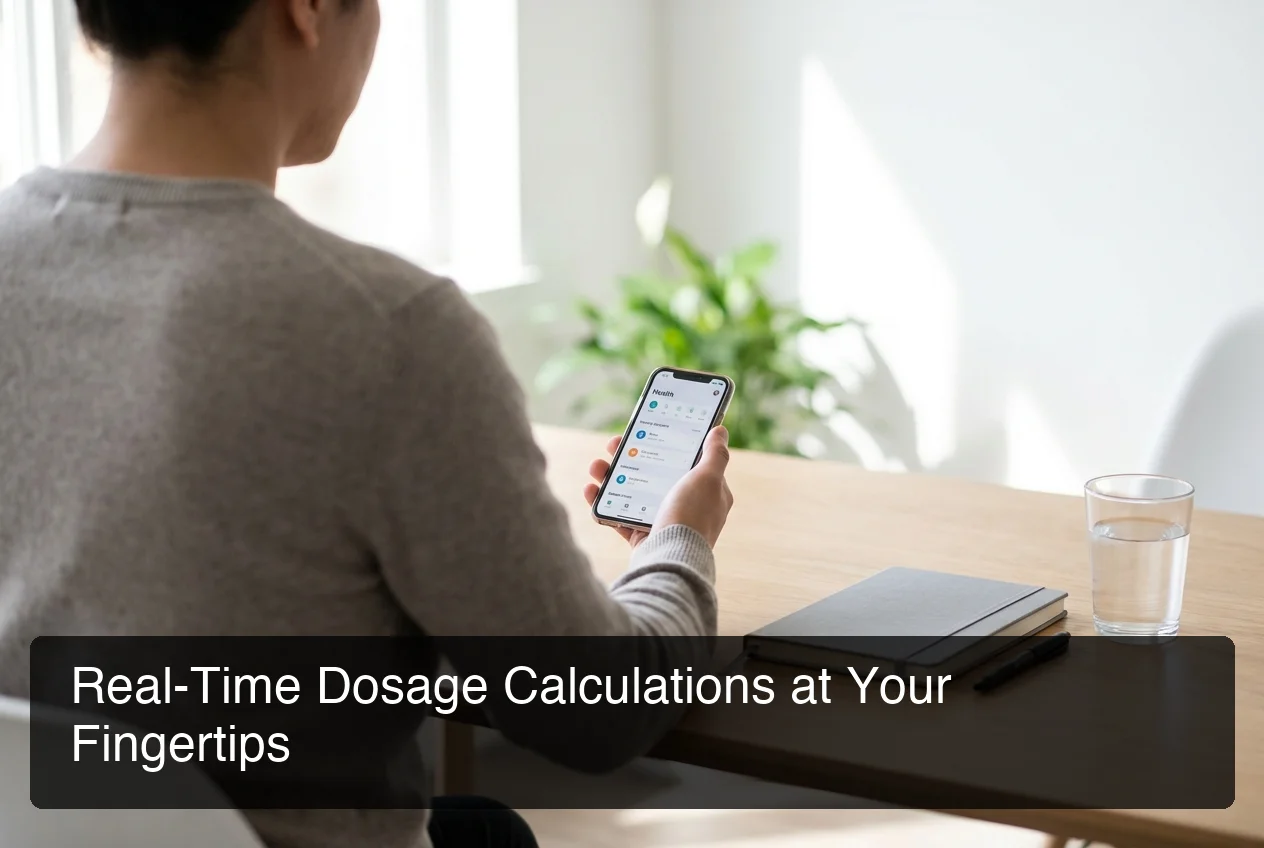 Every dose log in PeptideIQ captures wellness metrics, injection site data, and side effects — building a permanent, searchable record of your entire protocol history.
PeptideIQ tracks dose history, wellness metrics, side effects, bloodwork, body weight, nutrition, hydration, and progress photos — all linked to your protocol timeline. Every data point connects to where you are in your cycle, creating a longitudinal record that reveals patterns no manual log can produce.
Wellness and Side Effect Logging
After every dose you log four wellness sliders: Energy, Mood, Sleep Quality, and a goal-specific metric — Pain Level for injury recovery users, Weight for GLP-1 users, Recovery Score for fitness users. Side effects are logged via a quick-tap grid of 15 common symptoms (Fatigue, Nausea, Headache, Injection Site Soreness, Water Retention, Brain Fog, and more), each tagged as Mild, Moderate, or Severe.
Custom symptoms can be added as free text for anything outside the standard grid.
Bloodwork Tracker
PeptideIQ's bloodwork tracker covers manual entry across all major panels: hormones (Testosterone, Estrogen, IGF-1, TSH, T3/T4), metabolic (Glucose, HbA1c, Insulin), lipids, liver function, kidney function, inflammation markers (CRP, Homocysteine), and custom markers. Each value shows a color-coded status badge against reference ranges.
Bloodwork data feeds directly into the AI co-pilot's context. When you ask "why am I tired this week?", the AI can reference that your last cortisol result was elevated — not just your five-day energy trend.
Progress Photos and Weekly Insights
Progress photos are time-stamped and stored privately in-app, with side-by-side comparison across any two weeks. Every Monday, a Weekly AI Insight Card surfaces based on your prior week's actual data — specific to your numbers, not a generic summary.
If you're still evaluating whether you need a tracking app at all, the case for using a dedicated peptide tracking app breaks down what manual tracking consistently misses at scale.
By the numbers: PeptideIQ tracks 15 side effect categories, 30+ bloodwork markers, 4 wellness sliders per dose, full injection site history, and weekly AI insight cards — creating a data layer that reveals protocol patterns most users never see.
What Is PeptideIQ Pricing? Free Tier vs Subscription
PeptideIQ is available now on iOS. Core protocol tracking is free, while the AI co-pilot and advanced analytics are available through an optional Pro subscription.
The free tier is designed to cover the core tracking loop: building a protocol, logging doses, tracking adherence, and accessing the peptide library. The AI co-pilot, weekly insight cards, wellness correlation views, and bloodwork AI integration are the features planned for the subscription tier.
The app is available now on iOS, with Android planned for a later phase.
How Accurate Is PeptideIQ's Dosage Calculator?
PeptideIQ's reconstitution calculator is precision math, not an estimate. You input your peptide vial amount (mg), the volume of bacteriostatic water you're adding (ml), and your desired dose (mcg). The app outputs the exact syringe units to draw — and shows a visual syringe illustration with the line marked at the correct position.
Reconstitution is where most beginners make errors — unit conversions across mg, mcg, and syringe units are easy to get wrong, and a 10% error compounds across every dose in a cycle. PeptideIQ eliminates the math and shows a visual syringe with the exact draw line marked.
A reverse calculator is also built in: enter your target syringe units and the app outputs how much BAC water to add. Three syringe types supported — U-100, U-50, U-30 — with draw units adjusting dynamically. All calculations save to your vial inventory automatically.
Which Peptides Does PeptideIQ Support?
PeptideIQ's library covers 20+ peptides spanning GLP-1 weight loss, injury recovery, muscle performance, anti-aging, and cognitive enhancement. Every entry includes goal-based use, an honest evidence level badge, typical protocol, common user experiences, and known supplement interactions.
The current library includes: BPC-157, CJC-1295, Ipamorelin, Semaglutide, Tirzepatide, GHK-Cu, Epitalon, TB-500, Selank, Semax, MOTS-c, Sermorelin, Tesamorelin, Retatrutide, LL-37, Thymosin Alpha 1, GHRP-2, GHRP-6, AOD-9604, MK-677, and NAD+. Each peptide is searchable by name and common alias — "Body Protection Compound" and "Pentadecapeptide" both return BPC-157.
Evidence Levels Are Labeled Honestly
Every library entry carries an evidence badge: FDA-Approved, Strong Animal Evidence, Early Human Trials, or Anecdotal Only. PeptideIQ doesn't flatten the distinction between semaglutide (FDA-approved) and BPC-157 (strong animal evidence, limited human trials) — that honesty is a core design decision.
For the safety landscape before starting any protocol, what the research shows about peptide safety and the clinical evidence on peptide therapy are worth reading.
Can You Export Your Data from PeptideIQ?
Yes. PeptideIQ generates a doctor-friendly PDF export on demand — covering dose history, wellness metrics, side effects log, bloodwork results with trend charts, and weight trend over a selectable date range. The PDF is generated client-side and only leaves the device when you explicitly choose to share it.
The export presents everything a clinician needs to understand your protocol history — designed specifically for users who want to share data with a healthcare provider.
All health data in PeptideIQ is encrypted at rest. Users can export their full dataset in JSON or CSV format at any time, and account deletion removes all server data within 30 days.
Core features — dose logging, wellness check-ins, and the reconstitution calculator — work fully offline. Data syncs when connection is restored.
Get Started with PeptideIQ
PeptideIQ ranks among the best peptide apps for users who want more than a basic dose logger — guided protocol management, context-aware AI, and data-linked insights in one place. Whether you're a beginner on Day 1 or managing a complex multi-peptide stack, it gives you the system to track what you're doing and know if it's working.
 PeptideIQ is available now on the App Store for iPhone and iPad.
If you're running any peptide protocol right now — even Day 1 — a structured tracking system makes the difference between guessing and knowing. Download PeptideIQ on the App Store and start with your next dose.
Download PeptideIQ on the App Store
Ready to go deeper? The PeptideIQ app feature breakdown covers every module in detail and explains how it compares to manual tracking methods.
Frequently Asked Questions
What is PeptideIQ?
PeptideIQ is the AI-powered guided system for peptide users — build your protocol, track every dose, and get AI insights that know your data, your cycle, and your specific situation. It is a mobile iOS app that combines structured protocol management with a personalized AI co-pilot initialized with your full protocol context on every conversation.
Is PeptideIQ available on Android?
PeptideIQ is available now on iOS, with Android planned for a later phase.
What peptides does PeptideIQ support?
PeptideIQ supports 20+ peptides — BPC-157, semaglutide, tirzepatide, CJC-1295, Ipamorelin, GHK-Cu, TB-500, Epitalon, Selank, Semax, MOTS-c, Sermorelin, Retatrutide, LL-37, Thymosin Alpha 1, GHRP-2, GHRP-6, AOD-9604, MK-677, NAD+, and more. Searchable by name, alias, or goal.
How is PeptideIQ different from using ChatGPT for peptide guidance?
ChatGPT has general peptide knowledge but no access to your specific protocol, cycle day, wellness logs, or side effects. PeptideIQ's AI co-pilot is initialized with your complete context on every conversation — it knows you're on Day 6 of BPC-157 at 250mcg, that your energy has been low for three days, and what your recovery goal is. That context is the entire product.
Is my health data private in PeptideIQ?
Yes. All health data is encrypted at rest, and progress photos are never uploaded or AI-analyzed without explicit user action. Users can export all data in JSON or CSV at any time, account deletion removes all server data within 30 days, and the doctor-friendly PDF export is generated client-side only.
Does PeptideIQ work offline?
Core features — dose logging, wellness check-ins, and the reconstitution calculator — work fully offline. Data syncs automatically when your connection is restored. The AI co-pilot requires an internet connection and displays an offline indicator when unavailable.
What is PeptideIQ's pricing model?
PeptideIQ is free to download. Core protocol tracking is included, while the AI co-pilot and advanced analytics are available through an optional Pro subscription.