
Peptide Tracker App: What to Look For | PeptideIQ
What Is a Peptide Tracker App — and Why Does One Actually Change Your Results?
You bought the peptides. You started the protocol. But without a peptide tracker app, are you actually tracking it — or just hoping you'll remember when you last injected?
Key Takeaways
- A dedicated peptide tracker ensures precise dosing, safety compliance, and protocol adherence — the foundation of real results.
- Tracking injection dates, doses, and response markers (energy, muscle, side effects) reveals patterns that regular apps completely miss.
- Accurate dose logs let you spot plateaus, adjust protocols confidently, and optimize your next cycle based on data — not guesswork.
- Most generic fitness apps lack peptide-specific features like reconstitution calculators and injection site rotation.
- The best peptide trackers integrate dose calculators, progress markers, and historical records to eliminate guesswork and maximize protocol effectiveness.
Contents
- What Is a Peptide Tracker App and Why Do You Need One?
- Why Should You Track Your Peptide Protocol Religiously?
- What Features Matter Most in a Peptide Tracking App?
- Can You Use a Regular Fitness App to Track Peptides?
- What Data Should Your Peptide Tracker App Capture?
- How Accurate Must Your Dose Records Be for Safety?
- How Peptide Tracking Transforms Your Results
- Frequently Asked Questions
What Is a Peptide Tracker App and Why Do You Need One?
A peptide tracker app is a purpose-built tool for logging injection doses, scheduling protocol cycles, and monitoring wellness markers specific to peptide use. Unlike generic health apps, it understands reconstitution math, injection site rotation, and cycle-aware progress monitoring — all in a single structured workflow.
Peptide protocols involve more variables than most supplements. You may be running multiple compounds simultaneously — each with different half-lives, dosing frequencies, and storage requirements. A notebook or spreadsheet works until it doesn't: you miss a dose, second-guess your reconstitution math, or lose track of whether that fatigue on Day 8 was expected or a warning sign.
A dedicated peptide tracker replaces that chaos with a system. It logs when you injected, where you injected, what you felt, and how that data maps to your goals over time.
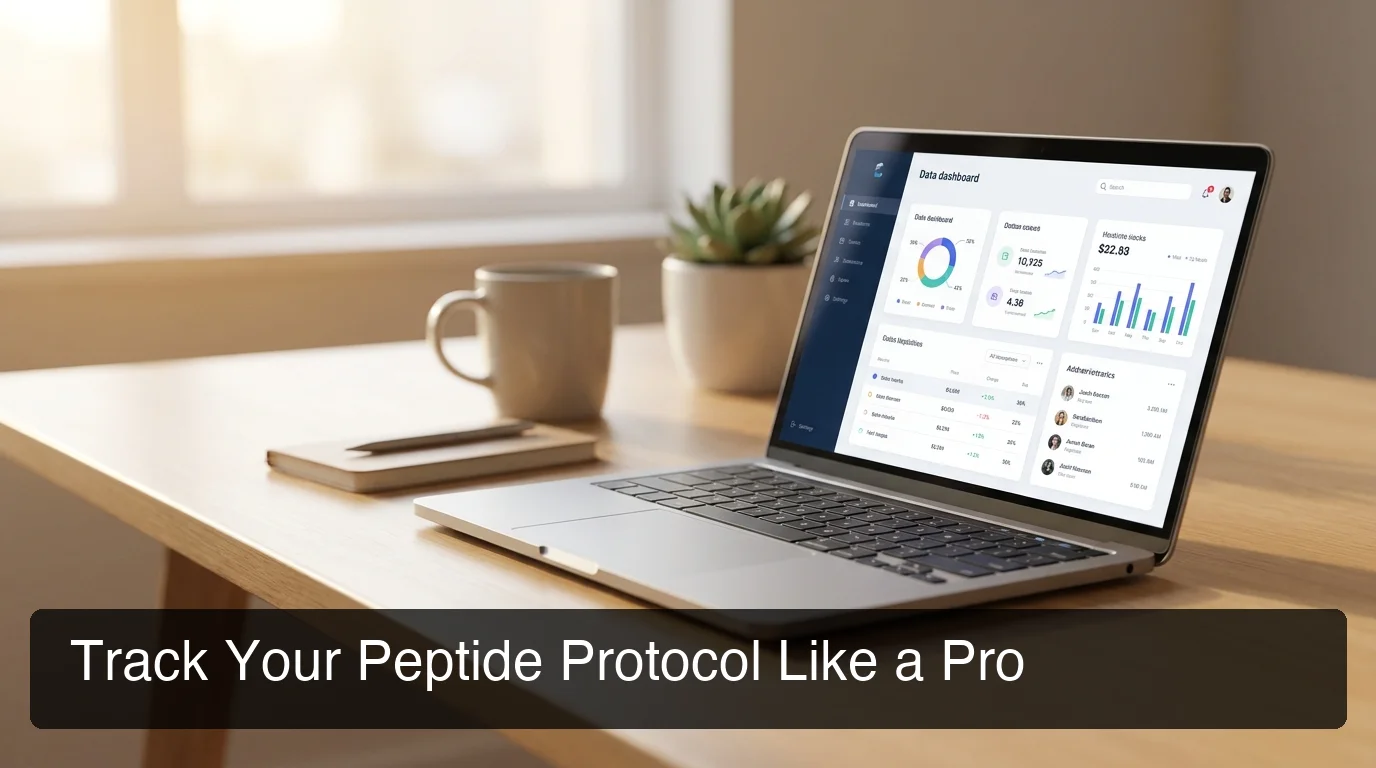 A purpose-built peptide tracker organizes your entire protocol — cycle phase, dose schedule, and progress — in one view.
Why Should You Track Your Peptide Protocol Religiously?
Tracking your peptide protocol creates accountability that casual use cannot. Users who log every dose and wellness marker spot meaningful patterns weeks before those who rely on memory — because trends invisible to the naked eye become obvious on a chart. For peptides like BPC-157 or semaglutide, small dosing inconsistencies compound into missed outcomes.
Most peptide users start strong for two weeks, then drift. They inject Monday and Tuesday, forget Wednesday, and can't remember by Thursday whether they already logged that dose. At the end of a 10-week cycle, they have no data to evaluate whether the protocol actually worked.
Tracking eliminates that uncertainty. But more importantly, it turns your protocol into evidence.
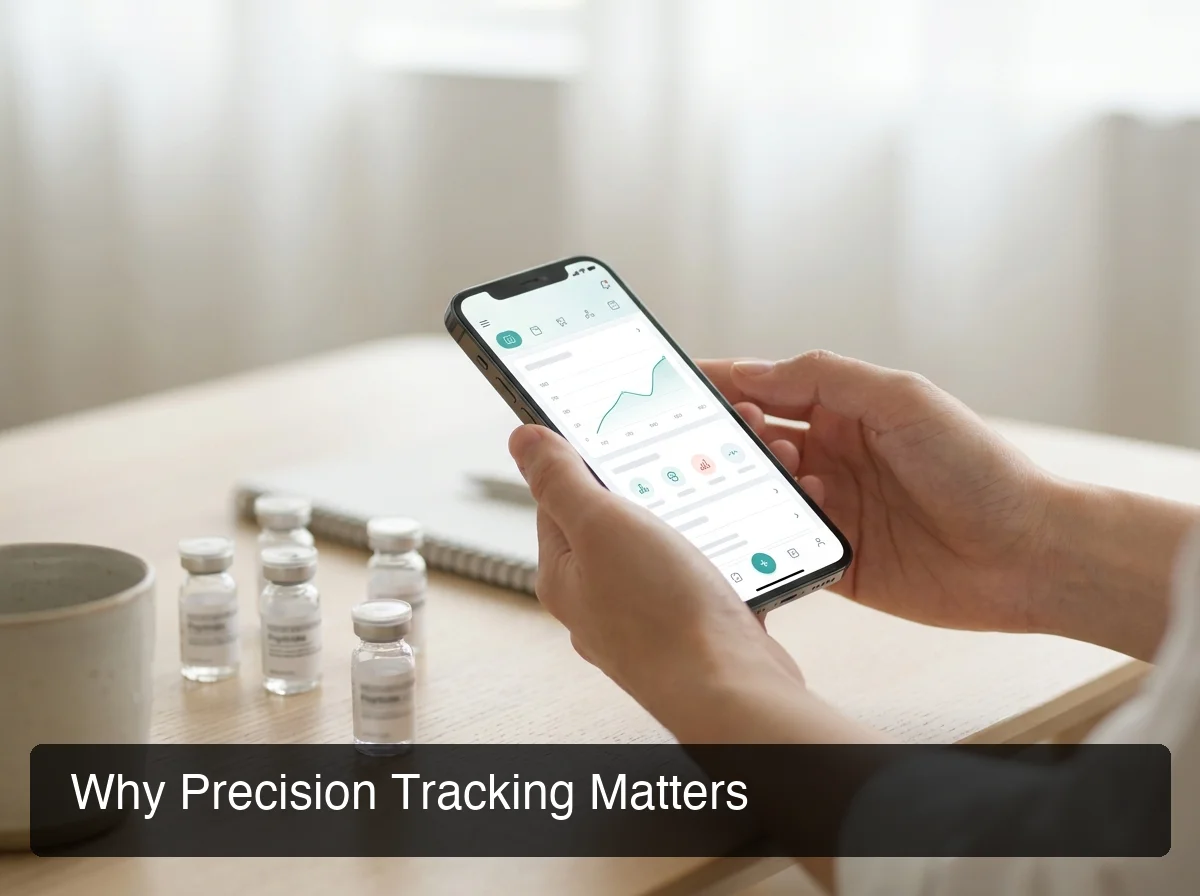 Precision tracking gives you the data to make your next cycle smarter than the last.
What Happens When You Don't Track?
Without logs, you're making protocol decisions based on gut feeling. Did the energy improvement start after dose 5 or dose 12? Was that nausea on Week 2 or Week 3? Did the dose increase help, or were you already improving on your original amount?
These questions are unanswerable without a log. And the inability to answer them is what sends users back to Reddit asking "is this normal?" — getting fifteen conflicting opinions — instead of reading their own data.
If you're new to what peptides actually are and how they work, understanding their mechanism makes the case for tracking even clearer: peptide activity is time-dependent, dose-dependent, and highly individual.
Key insight: Logging your peptide protocol turns a biology experiment into a personal dataset — and your next cycle becomes a hypothesis test, not a repeat of the same guesswork.
What Features Matter Most in a Peptide Tracking App?
The best peptide tracking apps combine dose logging, protocol scheduling, a reconstitution calculator, and progress charting in one place. The features that separate purpose-built trackers from generic apps are reconstitution math, injection site rotation guidance, and cycle-phase awareness that adapts to where you are in your protocol.
Here are the features worth prioritizing:
Dose Logging and Injection Scheduling
The core function. Every log should capture dose amount, injection site, time of day, and wellness markers. Injection site rotation tracking — showing which sites were used recently — is critical for avoiding tissue issues.
Look for apps that send reminders at your scheduled injection time and handle missed doses with peptide-specific guidance. A missed GLP-1 dose requires different handling than a missed BPC-157 dose.
Reconstitution Calculator
This is where most beginners get lost. When you have a 5mg vial and want to dose at 250mcg, how much BAC water do you add, and how many syringe units do you draw?
A good reconstitution calculator solves this in seconds and saves the result to your vial record — so you never redo the math for the same vial. For detailed conversion steps, a peptide dosing calculator covers every unit conversion.
Progress Insights and Analytics
The difference between knowing you took your doses and knowing whether they worked. Look for trend charts that overlay your wellness markers against your cycle timeline. Meaningful correlation — "energy improved three weeks after starting CJC-1295" — requires more than a dose list.
Can You Use a Regular Fitness App to Track Peptides?
No generic fitness app handles peptide-specific requirements. Apps like MyFitnessPal are built around food and exercise logs — they have no concept of injection protocols, reconstitution math, half-life modeling, or cycle-phase tracking. Using one forces workarounds that fail as soon as your protocol gets complex.
The comparison breaks down clearly:
| Feature | Generic Fitness App | Basic Peptide Tracker | AI-Powered Tracker |
|---|---|---|---|
| Dose logging | Workaround only | Yes | Yes |
| Injection site rotation | No | Sometimes | Yes |
| Reconstitution calculator | No | Rare | Yes |
| Multi-peptide stack management | No | Limited | Yes |
| Cycle phase tracking | No | Basic | Yes |
| Wellness correlation charts | No | No | Yes |
| AI-powered protocol insights | No | No | Yes |
| Bloodwork tracking | No | No | Yes |
| Missed dose guidance | No | Generic | Peptide-specific |
Generic apps also lack the vocabulary: no concept of BAC water ratios, half-life accumulation, or phase transitions. You'd spend more time building workarounds than actually tracking.
The same logic applies to Ozempic tracking apps in the GLP-1 space — even those are often built around medication reminders, not the full tracking workflow most peptide users need.
Bottom line: A generic fitness app gives you a place to store data. A peptide tracker app gives you a system that makes sense of it — and tells you what to do next.
What Data Should Your Peptide Tracker App Capture?
A complete peptide tracker should log four categories: protocol data (peptide, dose, time, injection site), wellness markers (energy, mood, sleep, goal metric), side effects (type and severity), and optionally bloodwork results. Together, these four data streams reveal whether a protocol is working — and why.
Beyond the basic dose log, the high-value data most users skip:
Wellness sliders (1–10 scale): Energy, mood, sleep quality, and your primary goal metric — pain level for injury recovery, weight for GLP-1 protocols, recovery score for performance users. Fast to log (30 seconds per session) but compound into the most useful dataset in your tracker.
Side effect log: Not just "nausea" but when it appeared, how severe, and whether it recurred. Side effect patterns — fatigue that resolves after Week 2, nausea that spikes after dose increases — are the most actionable signals for protocol adjustment.
Injection site record: Which site, when, and how the tissue responded. Rotation through at least 6–8 sites prevents lipohypertrophy — the fat deposits that reduce peptide absorption over time.
Bloodwork (optional but high-value): IGF-1, hormones, metabolic markers — logged at cycle start and end, they're the closest thing to objective confirmation that a protocol did what you hoped.
 A structured injection schedule keeps your protocol consistent — the single biggest predictor of outcomes.
How Accurate Must Your Dose Records Be for Safety?
Dose accuracy in peptide tracking matters at the mcg level. A 10% error on a 250mcg BPC-157 dose is minor. A 10% error on a tirzepatide dose changes the therapeutic effect meaningfully. Cumulative inaccuracies across a 12-week cycle can shift your outcomes significantly without any obvious single event causing the drift.
The risk is not dramatic — peptides are not chemotherapy. But the safety case for accuracy is real: FDA testing has found up to 40% of online peptide products contain incorrect dosages or undeclared ingredients. When your starting concentration is already uncertain, your dosing math must be locked in — not estimated.
By the numbers: FDA testing found up to 40% of online peptides had incorrect dosages or undeclared ingredients. When the vial itself is uncertain, your tracking precision is the last line of defense.
Why Injection Site Records Matter for Safety
Repeated injection at the same site without adequate recovery causes lipohypertrophy — fat deposits that form under the skin and reduce peptide absorption. Users on daily protocols (BPC-157, semaglutide) need to rotate through 6–8 sites minimum.
A tracker with site history removes this from memory management. You see which sites were used recently, which are clear, and the app recommends the next site automatically based on rotation history.
How Peptide Tracking Transforms Your Results
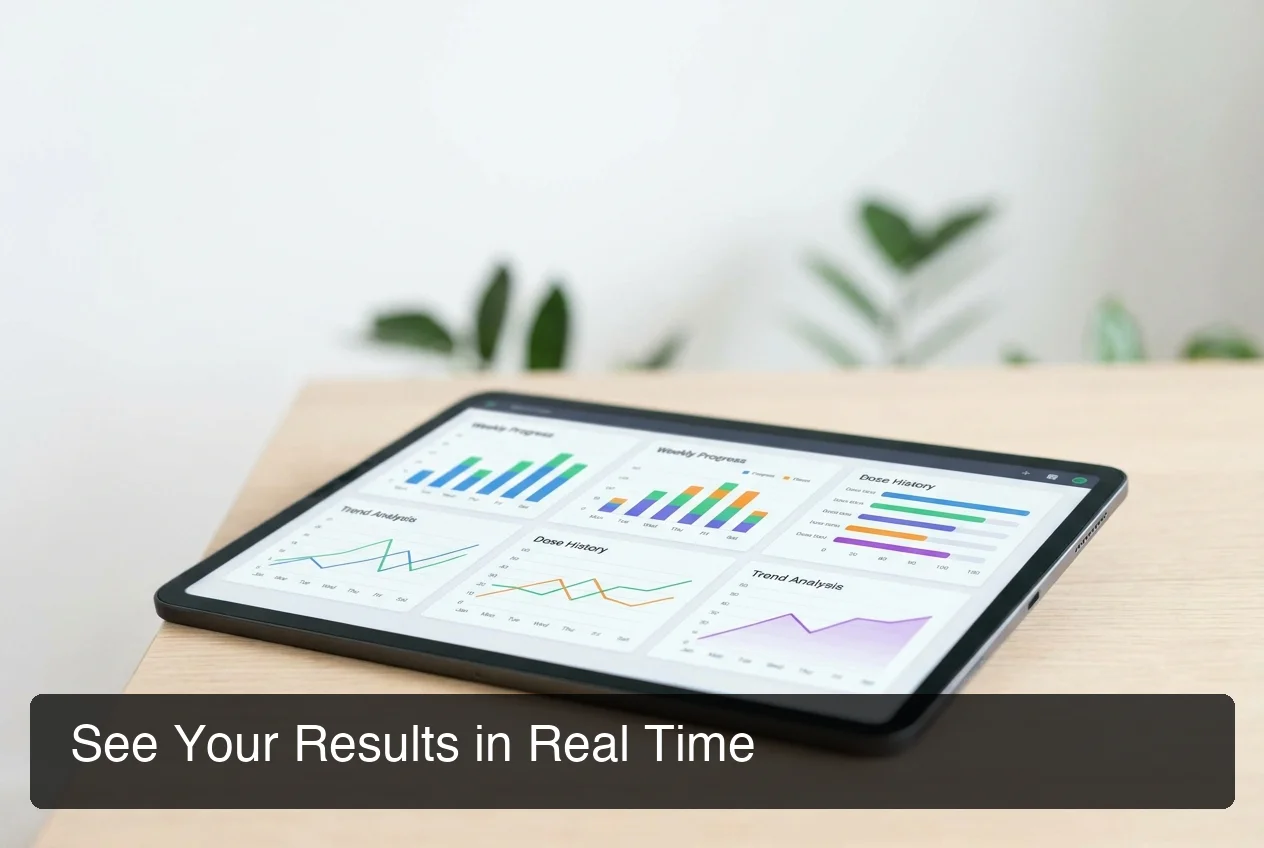 Real-time progress charts reveal patterns — energy trends, side effect timing, goal progression — that prove whether your protocol is working.
The gap between casual peptide use and protocol mastery is consistent, systematic tracking. Users who log every dose, wellness marker, and side effect have the data to answer the only question that matters: is this working? If yes — what's driving it? If no — what needs to change?
Most peptide users run one cycle, notice vague improvement or nothing at all, and restart with the same approach. Systematic trackers run one cycle and emerge with a protocol blueprint: what dose worked, what timing optimized results, what side effects appeared and when.
How PeptideIQ Closes the Gap
PeptideIQ is an AI-powered guided system for peptide users — combining structured protocol management with an AI co-pilot initialized on your specific data. When you ask "why am I feeling tired on Day 6?" — the AI doesn't give a generic answer. It responds knowing you're on Day 6 of BPC-157 at 250mcg twice daily, that your energy slider has been 4/10 for three days, and that you logged poor sleep on Days 4 and 5. That context is everything.
Every other app in the space is a dose logger. PeptideIQ is the system around the data.
Key features that separate it:
- Protocol Hub: One screen showing every active peptide, current cycle day, next dose time, and a three-metric progress snapshot
- AI Co-Pilot: Context-aware intelligence that knows your protocol, your logs, and your goals — not a generic chatbot
- Reconstitution calculator: Calculates exact syringe units, saves to your vial record, includes a reverse calculator
- Bloodwork integration: Logs labs and lets the AI correlate biomarkers with protocol phases
- Half-life visualizer: Shows active peptide levels accumulating over time — not just "did I dose today" but what's actually in your system
- Doctor-friendly PDF export: Shareable protocol summary for healthcare providers
Get Started with PeptideIQ
Your protocol is only as good as your data. PeptideIQ gives you the structured system — and the AI intelligence — to know exactly what's working, why, and what to optimize in your next cycle.
Download PeptideIQ on the App Store
Not ready yet? Download PeptideIQ on the App Store when you're ready to start tracking.
Frequently Asked Questions
What is a peptide tracker app?
A peptide tracker app is a mobile application designed to log injection doses, manage protocol cycles, and monitor wellness data specific to peptide use. Unlike generic health apps, dedicated trackers include reconstitution calculators, injection site rotation, multi-peptide stack management, and progress charts calibrated to cycle phases — not generic fitness metrics.
What is the best peptide tracker app?
The best peptide tracker app depends on protocol complexity. For basic dose logging, apps like PepTracker or Smart Peptide Tracker handle simple schedules well. For users running multi-peptide stacks who want AI-driven insights, bloodwork tracking, and personalized protocol guidance, PeptideIQ offers the most comprehensive system — available now on the App Store.
Can I use MyFitnessPal to track peptides?
No. MyFitnessPal is built for food and exercise logging and has no peptide-specific features. It lacks reconstitution calculators, injection site rotation, half-life tracking, and cycle-phase management. Using it for peptide tracking requires workarounds that break down quickly when managing multi-compound stacks or complex titration schedules.
What data should I log in a peptide tracker?
Log four categories: protocol data (peptide name, dose, time, injection site), wellness markers (energy, mood, sleep, primary goal metric), side effects (type and severity), and optionally bloodwork. These four streams together reveal whether your protocol is working and where to adjust — dose logs alone show adherence, not outcomes.
Is a peptide dose tracker necessary for beginners?
Yes — beginners benefit most from structured tracking. Reconstitution math, injection timing, and dose scheduling are exactly where first-time users make errors. A purpose-built peptide dose tracker guides beginners through each step, provides visual syringe guides, and prevents the common mistake of second-guessing completed doses. Structure matters most when you're starting out.
How does a peptide tracker improve cycle outcomes?
A peptide tracker improves outcomes by creating a feedback loop. You log doses and wellness markers, the app visualizes trends, and you make the next cycle smarter — adjusting timing, dose, or peptide based on actual data rather than memory or guesswork. Users with complete protocol logs can identify exactly what worked and replicate it with precision.
What is PeptideIQ?
PeptideIQ is an AI-powered guided system for peptide users — a mobile iOS app that combines structured protocol management with a personalized AI co-pilot that knows your specific cycle, dose history, wellness data, and goals. Unlike basic loggers where the user does all the thinking, PeptideIQ provides a guided system with intelligent, context-aware AI always one tap away.