

Semaglutide Hair Loss: Timeline & Recovery | PeptideIQ
Semaglutide Hair Loss: What's Actually Happening and When It Stops
Semaglutide hair loss shows up in about 3% of clinical trial patients on the highest dose — barely above the 1% placebo rate. Ask a dermatologist treating weight-loss patients today, and the number they'll quote is closer to 10–15%. That gap isn't a mystery: it's telogen effluvium, a temporary shedding pattern triggered by rapid weight loss, and it behaves nothing like permanent hair loss.
Why Does Semaglutide Cause Hair Loss?
Semaglutide itself doesn't attack hair follicles — the rapid weight loss, calorie deficit, and nutrient shifts it produces push follicles into telogen effluvium, a stress-triggered shedding phase. The same pattern shows up after crash diets, bariatric surgery, or a bad flu. Semaglutide just adds a new, very common trigger to a mechanism that already existed.
Follicles normally cycle through growth (anagen), a short transition, and rest (telogen) on staggered schedules, so shedding stays unnoticeable day to day. A sudden metabolic shock — losing weight faster than the body expects, or running short on protein and iron — can force an unusually large batch of follicles into telogen at once. Weeks later, they all shed together.
Worth knowing: Losing weight faster than roughly 1% of body weight per week is the single biggest driver of this effect. Slower titration schedules consistently show less shedding at the same total weight lost.
How Common Is Semaglutide Hair Loss, Really?
Trial data and real-world reporting tell noticeably different stories, and the reason matters more than either number alone.
| Source | Reported Rate | Why It Differs |
|---|---|---|
| Semaglutide 2.4mg trial arm | ~3% | Short trial duration, structured adverse-event reporting |
| Placebo arm (same trials) | ~1% | Baseline rate unrelated to the drug |
| Higher-dose trial data | 5–6% | Dose-dependent weight loss speed |
| Real-world dermatology reporting | 10–15% | Longer exposure, self-reported shedding, faster real-world weight loss in some users |
Trials run for months, not years, and adverse-event forms don't always capture something as gradual as thinning hair. Real-world numbers climb because people notice shedding on their own timeline — often the same window where they're also losing weight faster than the trial protocol allowed.
Key Takeaways
- Hair loss on semaglutide is telogen effluvium — a temporary shedding response to rapid weight loss, not direct follicle damage.
- Trial data shows roughly 3–6% incidence; real-world dermatology estimates run higher, around 10–15%, likely due to longer exposure and self-reporting.
- Shedding typically starts weeks 8–16, peaks around weeks 5–12 of active loss, and stabilizes as weight loss slows.
- Regrowth usually begins 3–6 months after shedding peaks, with full recovery in 6–12 months.
- Protein, iron, zinc, and biotin support recovery, but the underlying driver is metabolic stress — not something a supplement alone prevents.
When Does Semaglutide Hair Loss Start and When Does It Stop?
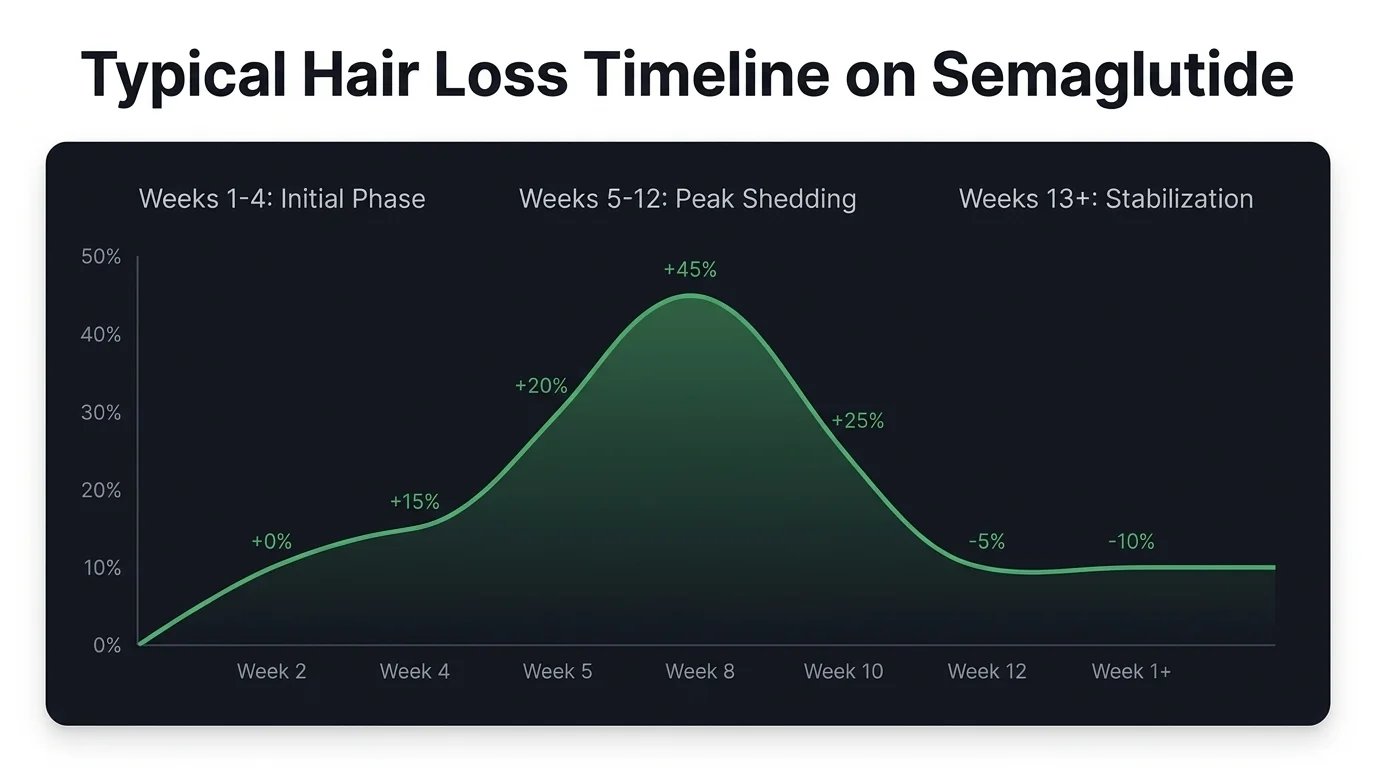
Shedding typically starts 8 to 16 weeks after beginning semaglutide, driven by the two-to-four-month lag built into the hair growth cycle itself. A follicle pushed into its resting phase in week 3 doesn't actually shed until months later — which is why so many people don't connect thinning hair back to a dose increase or a fast-loss stretch from earlier in their protocol.
The rough phases most users report:
- Weeks 1–4: Initial phase — little to no visible change for most people
- Weeks 5–12: Peak shedding window for those affected, matching the fastest stretch of weight loss
- Week 13 onward: Stabilization as weight loss slows and the follicle cycle resets
Shedding that's still accelerating well past month six, rather than tapering, is the pattern worth flagging to a doctor rather than riding out. Week-by-week tracking is what actually lets you spot that window — most users see weeks 5–12 as the critical stretch to watch, not a single day where things suddenly change.
This timeline lines up closely with what's reported under the brand name too — Ozempic hair loss follows the same curve, since semaglutide is the active ingredient in both.
Is Semaglutide Hair Loss Permanent?
No — telogen effluvium from semaglutide is reversible for the large majority of people once weight loss slows or nutrient intake stabilizes. Follicles that shed don't disappear; they re-enter their growth phase once the metabolic stress causing the shedding eases up.
Visible regrowth usually starts 3–6 months after the peak shedding window, with most people seeing close to full density restored by 6–12 months. Recovery speed tracks closely with how quickly protein intake, iron stores, and overall weight-loss pace stabilize — which is also exactly what shows up in semaglutide side effects more broadly, since hair loss rarely arrives alone.
Semaglutide Hair Loss Prevention: What Actually Works
Slowing rapid weight loss, hitting a protein floor, and correcting common deficiencies — iron, zinc, biotin — are the interventions with the most consistent effect on shedding severity, though none of them fully prevent it since the trigger is metabolic, not nutritional alone.
 Correcting real deficiencies moves the needle more than supplementing broadly.
Practical steps that consistently help:
- Ask about a slower titration schedule if weight loss is running ahead of roughly 1% of body weight per week
- Prioritize protein at every meal — not just as a leftover thought after appetite drops
- Get ferritin, zinc, and vitamin D checked once shedding starts, since deficiencies are common and correctable
- Ease up on heat styling and tight hairstyles temporarily to remove mechanical stress on top of biological stress
Nutrition matters enough here that it's worth its own deep dive — proper protein, iron, and zinc intake can reduce hair loss severity, and what to eat (and avoid) while on semaglutide is a natural next read once shedding starts.
How PeptideIQ Helps You Track Hair Loss Through Your Cycle
Tracking hair loss alongside your weight trend and dose history turns "is this normal?" into an answerable question, instead of a guess made from memory weeks after the fact.
 Weekly check-ins turn scattered symptoms into a pattern you can actually see.
PeptideIQ's dose logging includes a dedicated side-effect step — Step 4 of every logged dose — with more than 15 specific symptom options, including hair loss, each rated Mild, Moderate, or Severe. Logged this way, hair loss sits on the same timeline as your weight trend, your dose changes, and your other side effects, instead of living in memory alone.
That structure is exactly what separates normal week 9 shedding from something worth a second look: if severity is climbing sharply or scalp symptoms show up alongside it, the pattern is visible immediately rather than reconstructed from a hazy sense that "it's been a while." A semaglutide tracking app built for this specific purpose — not a generic health logger — is what makes that comparison possible in the first place.
Progress tracking with before-and-after photos helps distinguish normal hair cycling from protocol-related shedding too — many users in the community track this alongside their side-effect log, not as a replacement for it.
Normal Shedding vs. a Problem Worth a Doctor's Visit
Shedding that peaks between weeks 5 and 12 and then tapers is the typical, temporary pattern; shedding that keeps accelerating past month six, or comes with scalp pain, redness, or bald patches, is the pattern that warrants a doctor's attention.
Most people worried about hair loss on semaglutide are also watching other side effects at the same time — many of the same users tracking hair loss also notice changes in muscle mass, and the two often share the same root cause: fast weight loss outpacing protein and recovery capacity. If you're managing both, it's worth understanding semaglutide muscle loss alongside hair shedding rather than treating them as separate problems.
Talk to your doctor if:
- Shedding is severe enough that hair is visibly thinning at the part or crown
- Scalp itching, pain, or redness accompanies the hair loss
- Shedding continues 12+ months after stopping semaglutide with no sign of regrowth
Get Started with PeptideIQ
Guessing whether your shedding is normal wastes the exact weeks when the pattern would still be visible in your data. PeptideIQ logs side effects, dose history, and weight trend together so you can see your own hair loss curve instead of comparing yourself to a generic timeline.
Not ready to try it yet? See what to look for in a semaglutide tracking app before you decide how to log your protocol.
Frequently Asked Questions
Will my hair grow back after semaglutide hair loss?
Yes, for the large majority of people. Once rapid weight loss slows or nutrient intake stabilizes, follicles re-enter their growth phase. Visible regrowth typically starts 3–6 months after shedding peaks, with fuller recovery by 6–12 months depending on how quickly the underlying trigger resolves.
How long does hair loss on semaglutide timeline usually last?
Active shedding commonly runs from around week 8 through week 16, often peaking near weeks 5–12 of the fastest weight loss. Total time from onset to full regrowth is typically 6–12 months, longer if weight loss or nutrient gaps continue.
Does GLP-1 hair loss happen to everyone on semaglutide?
No. Trial data puts the rate around 3–6%, while real-world dermatology reporting suggests 10–15% — still a minority of users. Risk rises with faster weight loss, lower protein intake, and pre-existing nutrient marginal status.
What helps prevent semaglutide hair loss?
Slowing weight loss pace, hitting a protein floor at every meal, and correcting deficiencies in iron, zinc, or biotin have the most consistent evidence. None fully prevent shedding since the trigger is metabolic stress, but they reduce severity and support faster recovery.