

Semaglutide Tracking App: What to Look For
Semaglutide Tracking App: What to Look For and Why It Matters
Most people on semaglutide track one number: the scale. Everything else — whether they actually took last Tuesday's dose, whether the nausea on day 12 was normal, whether three injections in a row went into the same spot — stays invisible. A semaglutide tracking app exists to make that middle layer visible.
Key Takeaways
- Semaglutide adherence directly correlates with results — users who log every dose see more consistent, faster weight loss than those who skip doses or guess at timing.
- A good semaglutide tracking app captures doses, weight progress, wellness metrics (energy, nausea, sleep), and side effect logs in one dashboard — the full picture of your protocol performance.
- Weekly AI-generated insights that connect your adherence, dose timing, and weight trends help you spot patterns and adjust your protocol faster than tracking manually.
- Tracking your semaglutide protocol reveals when side effects are normal for your cycle phase, helping you distinguish between expected reactions and genuine concerns worth discussing with your provider.
- The best semaglutide tracking app integrates injection reminders, progress charts, dose calculations, and protocol guidance — eliminating the need to juggle multiple tools.
Contents
- What Is a Semaglutide Tracking App?
- How Does Tracking Your Semaglutide Dosage Help You Hit Your Weight Loss Goal?
- What Data Should You Log With Every Semaglutide Injection?
- How Does Adherence Tracking Prevent Plateaus and Side Effects?
- What Makes a Great Semaglutide Tracking App?
- How Can Weekly Insights Keep Your Protocol on Track?
- Should You Use an App to Track Semaglutide Use?
- Frequently Asked Questions
What Is a Semaglutide Tracking App?
A semaglutide tracking app is a mobile tool that logs your injections, dose timing, weight trend, and side effects in one place, replacing guesswork with a record you can actually act on. Unlike a generic health app, it's built around the mechanics of a GLP-1 protocol — titration schedules, injection sites, vial expiry — rather than generic calorie counting.
The category exists because semaglutide isn't a one-time decision. It's a months-long protocol with escalating doses, a titration schedule, and side effects that shift as your body adapts. What is a peptide tracking app covers the broader case for tracking any peptide protocol; semaglutide's weekly dosing and multi-month titration curve make the case even stronger.
Most people who search for this are already on a protocol, or about to start one, and want fewer spreadsheets and sticky notes. The app's job is simple: hold the data your brain won't reliably remember three weeks in.
How Does Tracking Your Semaglutide Dosage Help You Hit Your Weight Loss Goal?
Tracking your semaglutide dosage helps you hit your weight loss goal by connecting cause and effect — you can see exactly which weeks you logged every dose and how your weight responded, instead of relying on a vague sense that "it's working" or "it's stalled." That connection is what turns a passive protocol into an active one.
Semaglutide and tirzepatide together generated nearly $30 billion in combined revenue in 2024, and the number of people running these protocols without any structured logging is still enormous. Most track weight weekly and nothing else.
The problem: weight alone is a lagging indicator. It tells you the result, not the cause. If your weight loss stalls in week 5, was it a missed dose in week 4? A dose that needed to increase? Or just a normal weekly fluctuation? Without adherence data next to the weight line, you're guessing at the answer.
Worth knowing: A single missed dose rarely tanks progress on its own — it's a pattern of missed or late doses that correlates with slower results, and you can only spot a pattern if you're logging.
What Data Should You Log With Every Semaglutide Injection?
Every semaglutide injection should be logged with the dose amount, injection site, exact time, and any side effects felt within 24 hours — the four data points that make patterns visible over weeks instead of staying buried in memory. Weight and wellness metrics round out the picture but matter less on a per-dose basis than they do as a weekly trend.
At minimum, a useful log captures:
- Dose amount and unit (mg or mcg, depending on your titration phase)
- Injection site, rotated to avoid repeated tissue irritation
- Time of day, since consistency in timing affects how predictable side effects feel
- Side effects, tagged by severity — nausea, fatigue, headache, injection site soreness
- Wellness sliders — energy, mood, and sleep quality, which often shift before the scale does
- Vial status — how many doses remain and when the current vial expires
Once you know how to track your GLP-1 progress this way, patterns that felt random — "why do I always feel off on Fridays?" — usually turn out to have an obvious explanation once the dose-and-symptom data sits side by side.
How Does Adherence Tracking Prevent Plateaus and Side Effects?
Adherence tracking prevents apparent plateaus by revealing whether a stall is caused by missed doses, inconsistent timing, or genuine biological plateau — three problems with three completely different fixes. It also helps distinguish expected side effects from ones that warrant a call to your provider.
Weight-loss trajectories on semaglutide are rarely a straight line. A dip-and-recovery pattern around week 5 or 6 is common, and it looks alarming if all you're watching is the scale. Overlay adherence data on the same timeline, though, and the story usually resolves itself — a missed dose, a busy travel week, a slower titration step.
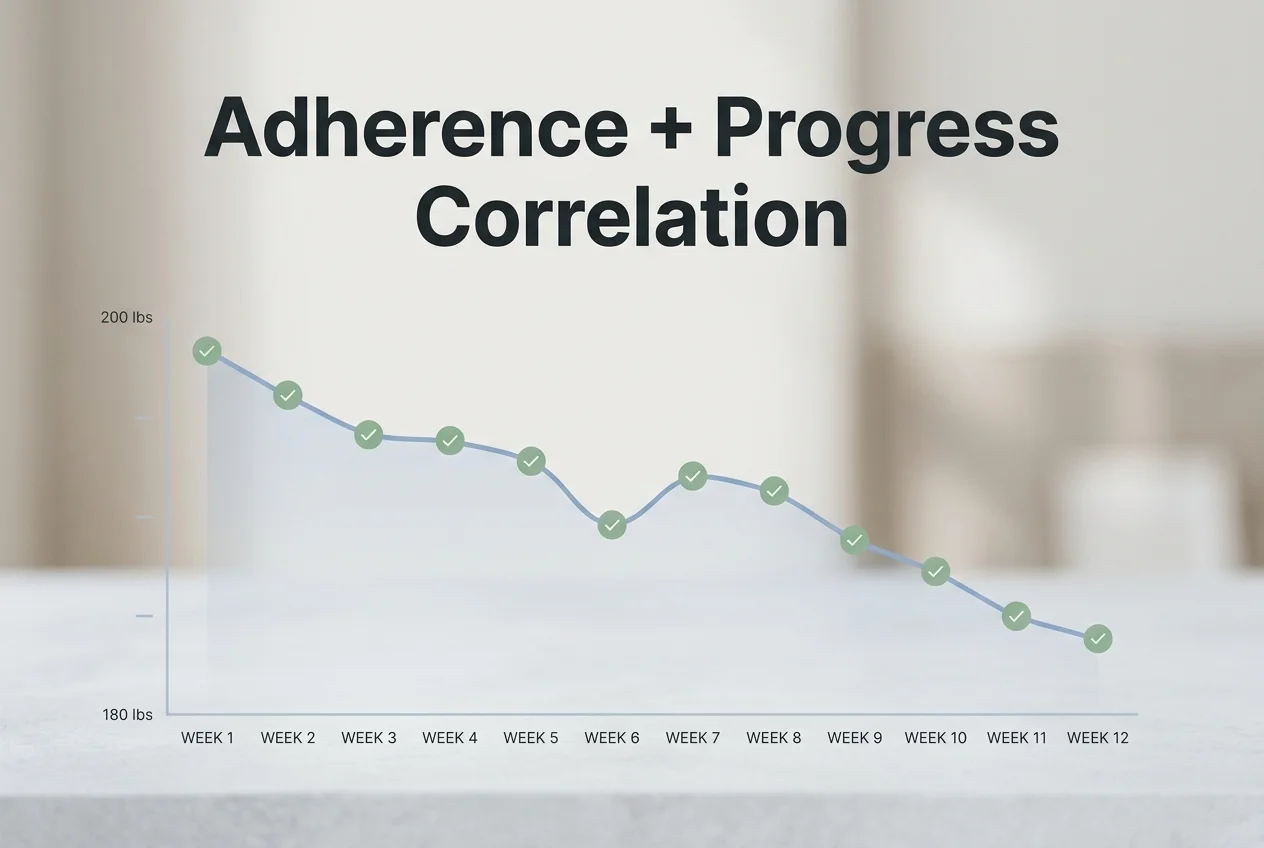 A dip around week 6 looks like a plateau until you see the adherence data sitting right next to it.
By the numbers: Roughly 30-50% of semaglutide users report nausea in the first weeks of a dose increase — a rate high enough that it should be expected, not treated as a red flag every time it appears.
Side effects follow a similar logic. Nausea that shows up two days after a dose increase is a known, time-limited pattern. Nausea that shows up randomly, unconnected to any dose change, deserves a different conversation with your doctor — and you can only tell the difference if the dose and the symptom are both logged against the same calendar.
What Makes a Great Semaglutide Tracking App?
A great semaglutide tracking app combines dose logging, injection site rotation, side effect tracking, and progress charts in a single dashboard — and layers AI insight on top so patterns surface automatically instead of requiring you to spot them yourself. Generic health apps and standalone dose loggers each solve part of the problem; few solve all of it together.
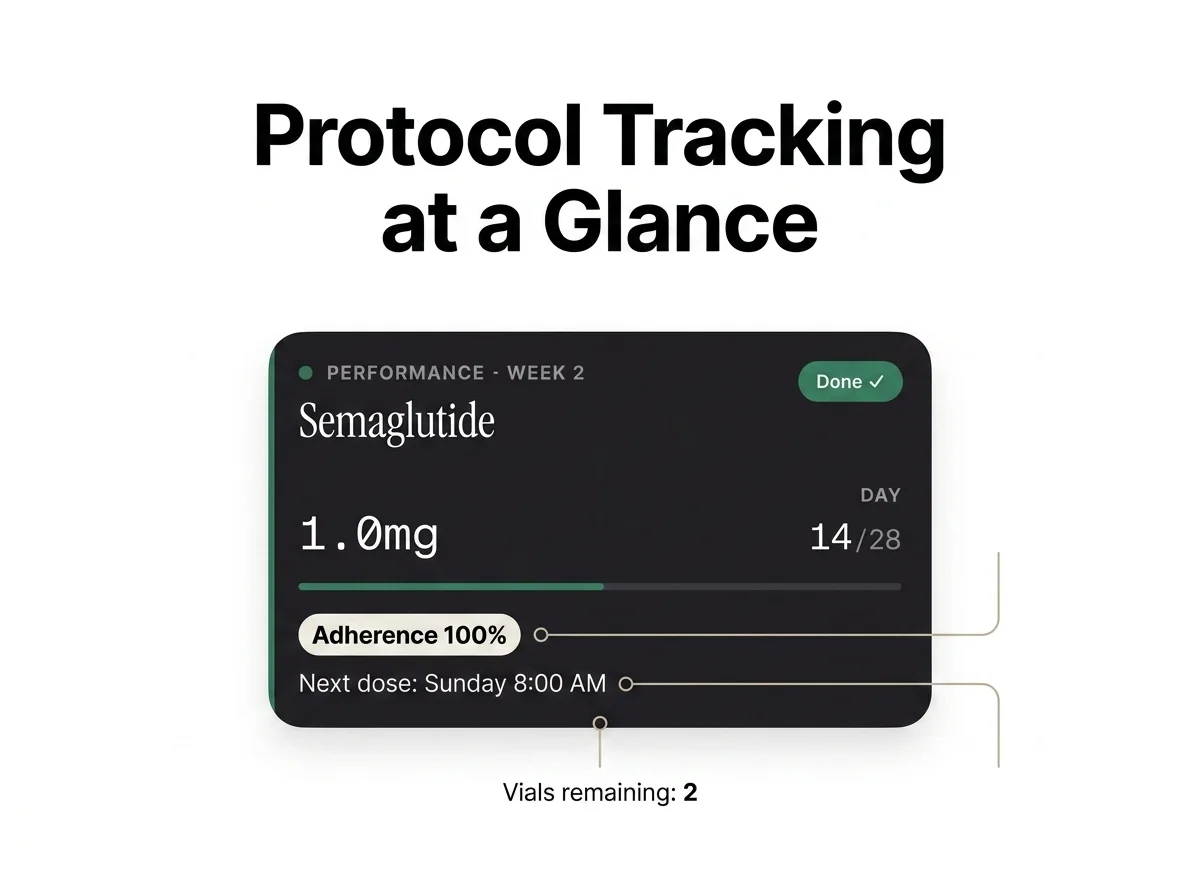 The Today screen answers three questions at a glance: where you are in the cycle, when the next dose is due, and how consistent you've actually been.
This is what PeptideIQ's Today screen shows for an active semaglutide protocol — dose, cycle day, adherence percentage, next dose time, and vials remaining, all on one card. No separate spreadsheet for doses and a separate app for weight.
Semaglutide Tracking Apps Compared
| Feature | Generic GLP-1 dose loggers | PeptideIQ |
|---|---|---|
| Basic dose and shot logging | Yes | Yes |
| Injection site rotation guidance | Rare | Built in, based on 48-hour rotation history |
| AI insights tied to your specific data | No | Weekly, generated from your actual logs |
| Reconstitution / dose calculator | Rare | Built in with reverse calculator |
| Multi-peptide or stack support | No | Yes — semaglutide alongside other protocols |
| Bloodwork tracking alongside doses | No | Yes, with doctor-friendly PDF export |
Most GLP-1 loggers on the app stores do one thing well: they record a shot. Fewer connect that shot to a rotation system, a calculator, or a bloodwork history — and almost none layer AI reasoning on top of your specific cycle rather than generic advice.
How Can Weekly Insights Keep Your Protocol on Track?
Weekly AI-generated insights keep a semaglutide protocol on track by translating raw log data into a plain-language summary — adherence rate, weight change, and flagged side effects — so you don't have to manually cross-reference charts to know if the week went well. The insight is specific to that week's actual numbers, not a generic tip.
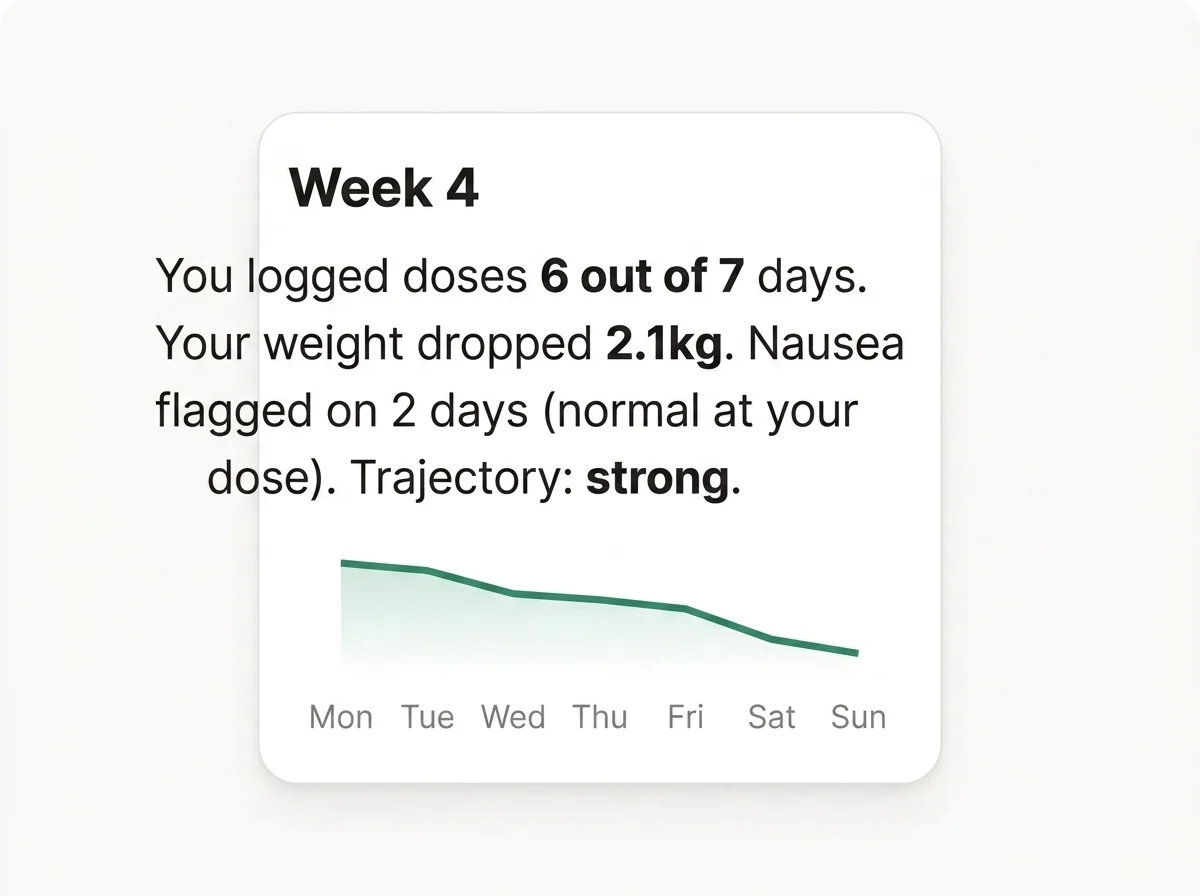 A sample weekly insight — adherence, weight change, and flagged side effects summarized from that week's actual logs.
An example from PeptideIQ's co-pilot: "Week 4 — You logged doses 6 out of 7 days. Your weight dropped 2.1kg. Nausea flagged on 2 days (normal at your dose). Trajectory: strong." That single card replaces ten minutes of manually scrolling back through a week of entries.
The AI co-pilot behind this isn't a generic chatbot bolted onto a logger. Whether you should track your GLP-1 use with an app often comes down to exactly this: does the tool just store your data, or does it actually read it back to you in a way that's useful? Context matters — PeptideIQ's co-pilot is initialized with your current dose, cycle day, and last seven days of logs before it answers anything, so "is this nausea normal?" gets an answer grounded in your actual week, not a disclaimer.
Should You Use an App to Track Semaglutide Use?
If you're already logging doses in a notes app or trying to remember them, the honest answer is yes — a dedicated tracker removes far more friction than it adds. Semaglutide is not a "take it and forget it" medication; it's a multi-month protocol with dose changes, side effect windows, and a titration schedule that shifts every few weeks.
The ozempic tracking app comparison covers the same ground from the Ozempic-branded angle, since semaglutide and Ozempic are the same active compound with different packaging. And if you're weighing tracking tools more broadly, what to look for in a peptide injection tracker breaks down the feature checklist across every peptide category, not just GLP-1s.
The people who benefit least from an app are the ones who never miss a dose, never wonder about a symptom, and never want to see the trend line. Almost nobody actually fits that description three months into a protocol.
Related: Should You Use an App to Track GLP-1 Use? When It Pays Off
Get Started with PeptideIQ
Manually cross-referencing a notes app, a bathroom scale, and your memory of last week's nausea is the exact problem PeptideIQ was built to remove. It logs your semaglutide protocol, rotates your injection sites automatically, and generates a weekly insight card from your actual data — not a generic titration chart.
Join the PeptideIQ waitlist at peptideiq.io
Not ready to try it yet? Track your first week manually using the data points above — dose, site, timing, and side effects — and you'll already see more than the scale alone ever showed you.
Frequently Asked Questions
What is the best GLP-1 tracking app for semaglutide?
The best GLP-1 tracking app for semaglutide is one that logs doses, injection sites, and side effects together, then surfaces patterns instead of just storing entries. Look for injection site rotation, a titration schedule view, and AI insights grounded in your own data rather than generic advice.
How do I track semaglutide doses without an app?
You can track semaglutide doses manually with a notebook or spreadsheet logging date, dose, injection site, and any side effects. It works, but it requires discipline to update consistently and makes spotting patterns — like nausea correlating with dose increases — much harder than an app that charts it automatically.
Is there a free semaglutide tracking app?
Most semaglutide tracking apps, including PeptideIQ, offer a free tier covering core dose and protocol logging, with AI insights and advanced analytics reserved for a paid subscription. Check the specific app's pricing page, since free-tier limits vary by provider.
What's the difference between an Ozempic tracking app and a semaglutide tracking app?
There's no functional difference — Ozempic is a brand name for semaglutide, so an Ozempic tracking app and a semaglutide tracking app track the same compound. Some apps market under the brand name because it's more commonly searched, but the dosing and tracking logic is identical.
How often should I log side effects when tracking semaglutide?
Log side effects within 24 hours of each injection, since that's the window when GI symptoms and fatigue typically appear. Consistent same-day logging makes it far easier to see whether a symptom is tied to a specific dose change or unrelated to your protocol entirely.
Can a semaglutide dose tracker help with plateaus?
A semaglutide dose tracker helps with plateaus by showing whether a weight stall correlates with missed doses, inconsistent timing, or neither — which tells you whether the fix is better adherence or a conversation with your provider about dose adjustment. Without that data, a plateau is just a guess.
Does PeptideIQ track other GLP-1 medications besides semaglutide?
Yes, PeptideIQ tracks tirzepatide and other GLP-1 medications alongside semaglutide, along with dozens of other peptides in its library. Users running a GLP-1 protocol plus a secondary peptide — recovery or longevity-focused — can manage both stacks in the same app instead of switching tools.