
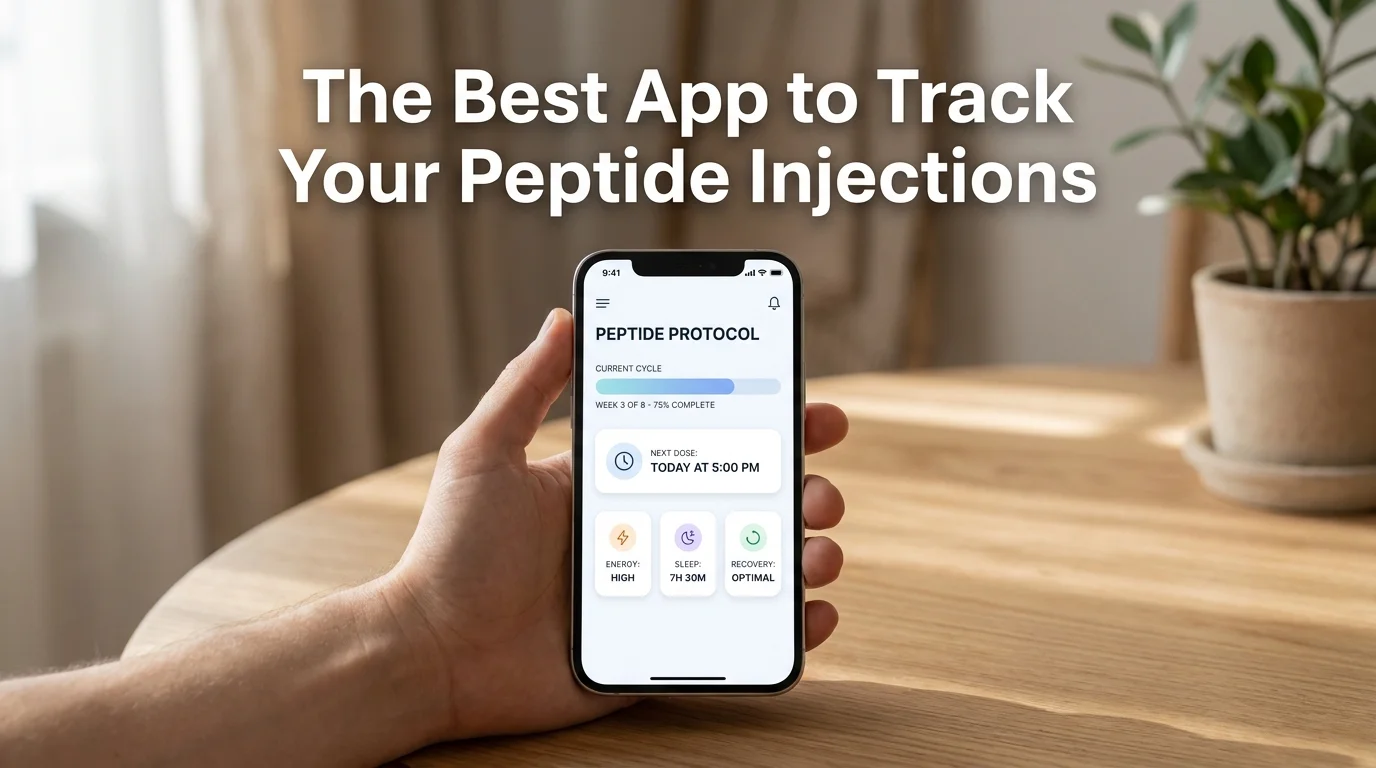
What Is the Best App to Track Peptide Injections | PeptideIQ
What Is the Best App to Track Peptide Injections?
Type "peptide tracker" into the App Store and nine listings load before you've finished reading the first one — PepTracker, Smart Peptide Tracker, PeptideKit, Regimen, Shotlee. The names change; almost every result does the same two things: logs a dose, shows a calendar.
What is the best app to track peptide injections, then? It depends on whether logging the dose was ever the hard part, or just the piece every app already solved while leaving the rest to guesswork.
Key Takeaways
- A dedicated peptide tracking app removes the guesswork from dose logging, injection site rotation, and protocol adherence — transforming raw data into actionable insights.
- The best peptide apps combine dose logging with AI guidance, progress visualization, and safety features like missed-dose alerts and vial expiry tracking.
- Most existing "peptide trackers" are generic loggers that record data but never think — the difference between a guided system and a notebook with buttons is everything.
- Structured tracking enables early detection of side effect patterns, dose timing optimization, and clear evidence of whether your protocol is actually working.
Contents
- What Is the Best App to Track Peptide Injections?
- How Can Tracking Your Peptide Dosages Improve Your Results?
- What Should You Look for in a Peptide Injection Tracker?
- So, What Is the Best App to Track Peptide Injections in 2026?
- Can a Peptide Tracking App Predict Your Side Effects?
- Why PeptideIQ Is Different From Other Peptide Trackers
- Frequently Asked Questions
What Is the Best App to Track Peptide Injections?
The best app to track peptide injections is one that goes beyond a simple log — it should schedule your protocol, calculate your reconstitution math, rotate your injection sites, and turn your wellness data into insight, not just a timestamp. Most apps on the App Store today only handle the first item on that list. The rest gets left to memory, a notebook, or a spreadsheet nobody actually updates.
Three categories currently compete for this search:
- Spreadsheets and notes apps. Free, flexible, and entirely manual — you build the structure and do every calculation yourself.
- Generic peptide loggers. Apps like PepTracker and PeptideKit that give you a dose calendar and not much else beyond it.
- Guided AI systems. A newer category — PeptideIQ among them — that pairs structured protocol logic with an AI co-pilot that already knows your cycle, your history, and your goal.
Whether tracking is worth the effort at all is a fair question to ask before comparing apps — what a peptide tracking app actually does covers that ground first.
How Can Tracking Your Peptide Dosages Improve Your Results?
Tracking your peptide dosages improves results by exposing patterns you can't see in the moment — missed doses, timing drift, and side effects that cluster around specific days of your cycle. A single injection tells you nothing on its own. Thirty logged injections, plotted against how you actually felt, tell you almost everything.
Adherence is the biggest lever here. Someone who logs 6 doses out of 7 each week sees measurably different outcomes than someone estimating "I think I've been pretty consistent." The gap between perceived and actual adherence is usually bigger than people expect.
Worth knowing: Most people underestimate how often they actually miss or delay a dose until they see it logged in a calendar view.
Tracking also turns vague feelings into a timeline. "I've felt tired lately" becomes "energy has averaged 4/10 for six straight days, starting two days after a dose increase" — a sentence you can actually act on, or bring to a doctor.
What Should You Look for in a Peptide Injection Tracker?
A serious peptide injection tracker needs five things: accurate dose logging, a reconstitution calculator, injection site rotation, vial inventory with expiry tracking, and some form of guidance layer that interprets the data you're entering. Anything missing one of these is a partial solution wearing a full-solution name.
Run through this checklist against any app you're considering:
- Dose logging in under a minute — if it takes longer, you'll stop doing it consistently within two weeks.
- Reconstitution math built in — vial concentration, BAC water volume, and syringe units calculated for you, not worked out on a napkin.
- Injection site rotation — a visual map that shows which sites are overused, not just a text field you have to remember to fill in.
- Vial and inventory tracking — doses remaining, expiry dates, and low-stock warnings before you run out mid-cycle.
- A dose logging app for peptide protocol tracking should also flag missed doses within hours, not let a skipped injection vanish silently into the past.
Learn how to calculate your exact dose before logging if the math is where your current process breaks down — this is the step a spreadsheet handles worst.
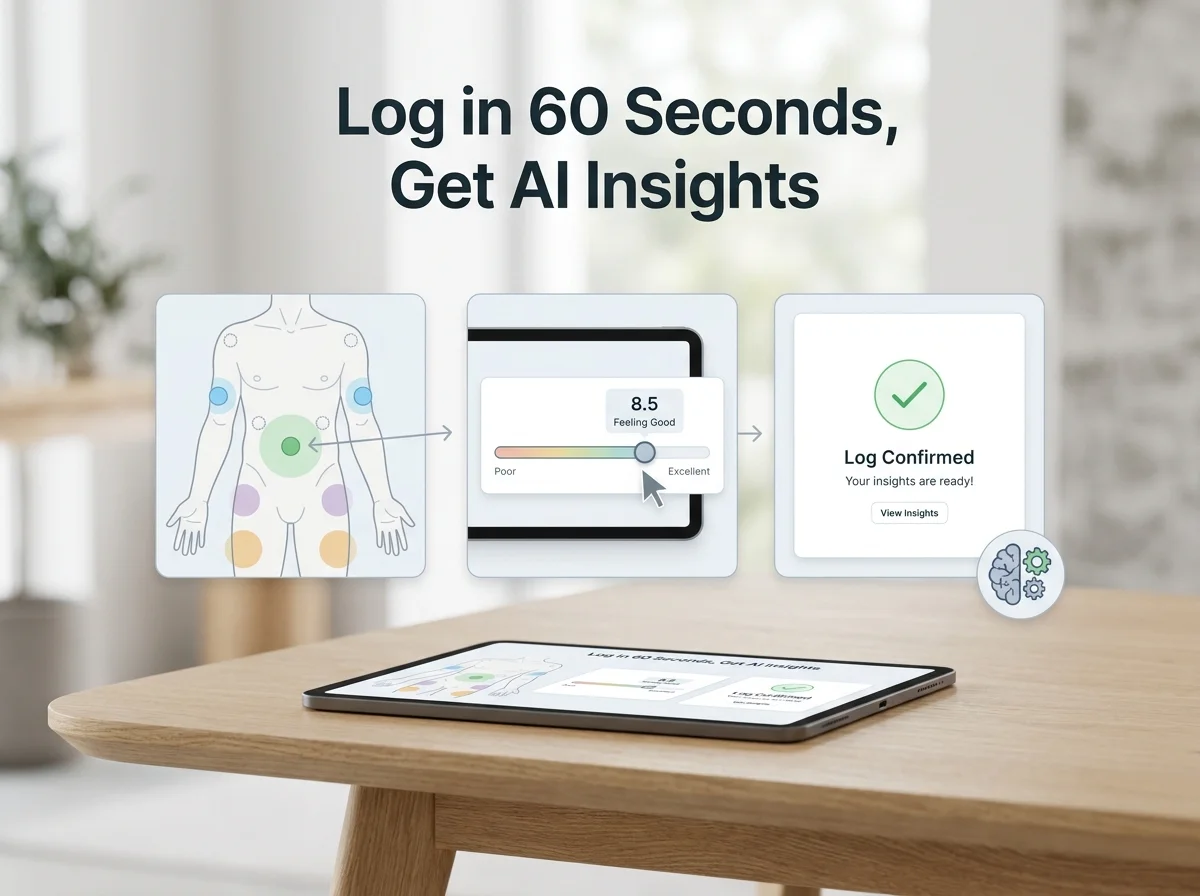 A 60-second logging flow only works if it also feeds something smarter than a spreadsheet cell.
Reconstitution deserves its own mention. It's the step where most beginners freeze — mixing freeze-dried peptide powder with bacteriostatic water, then calculating exactly how many units to draw on a syringe. An app that gets this wrong, or doesn't attempt it at all, is asking you to do the riskiest math in the whole process by hand.
So, What Is the Best App to Track Peptide Injections in 2026?
No single app currently dominates peptide protocol management — the field splits cleanly into spreadsheets, generic dose loggers, and guided AI systems, each solving a different slice of the problem. Picking the right one depends on whether you want a tool that records, or a tool that also reasons.
| Solution Type | Examples | Dose Logging | Reconstitution Calc | Site Rotation | AI Insights |
|---|---|---|---|---|---|
| Spreadsheet / Notes app | Google Sheets, Apple Notes | Manual | Manual | Manual | None |
| Generic peptide logger | PepTracker, PeptideKit, Smart Peptide Tracker | Yes | Basic or none | Rare | None |
| Guided AI system | PeptideIQ | Yes | Full calculator | Visual rotation map | Weekly insight cards |
If you want the fuller version of this comparison, our full peptide app breakdown walks through four leading options feature by feature, and our full ranking of the best peptide trackers in 2026 covers five more by protocol type. If logging methodology specifically is what you're stuck on, the peptide log app guide covers the step-by-step workflow in more depth.
The honest read on the current App Store field: PepTracker and PeptideKit are both solid dose calendars. Neither one interprets what you log — that's the piece a guided system adds.
Can a Peptide Tracking App Predict Your Side Effects?
A peptide tracking app can flag side effect patterns as they emerge — not predict the future, but surface correlations a person scrolling through their own memory would likely miss. If nausea shows up on the same day, three cycles in a row, that's a pattern worth knowing before it happens a fourth time.
This is where a wellness slider and a symptom log stop being busywork. Logged consistently, they build a dataset specific to one person's body — not a generic side-effect list copied from a drug insert.
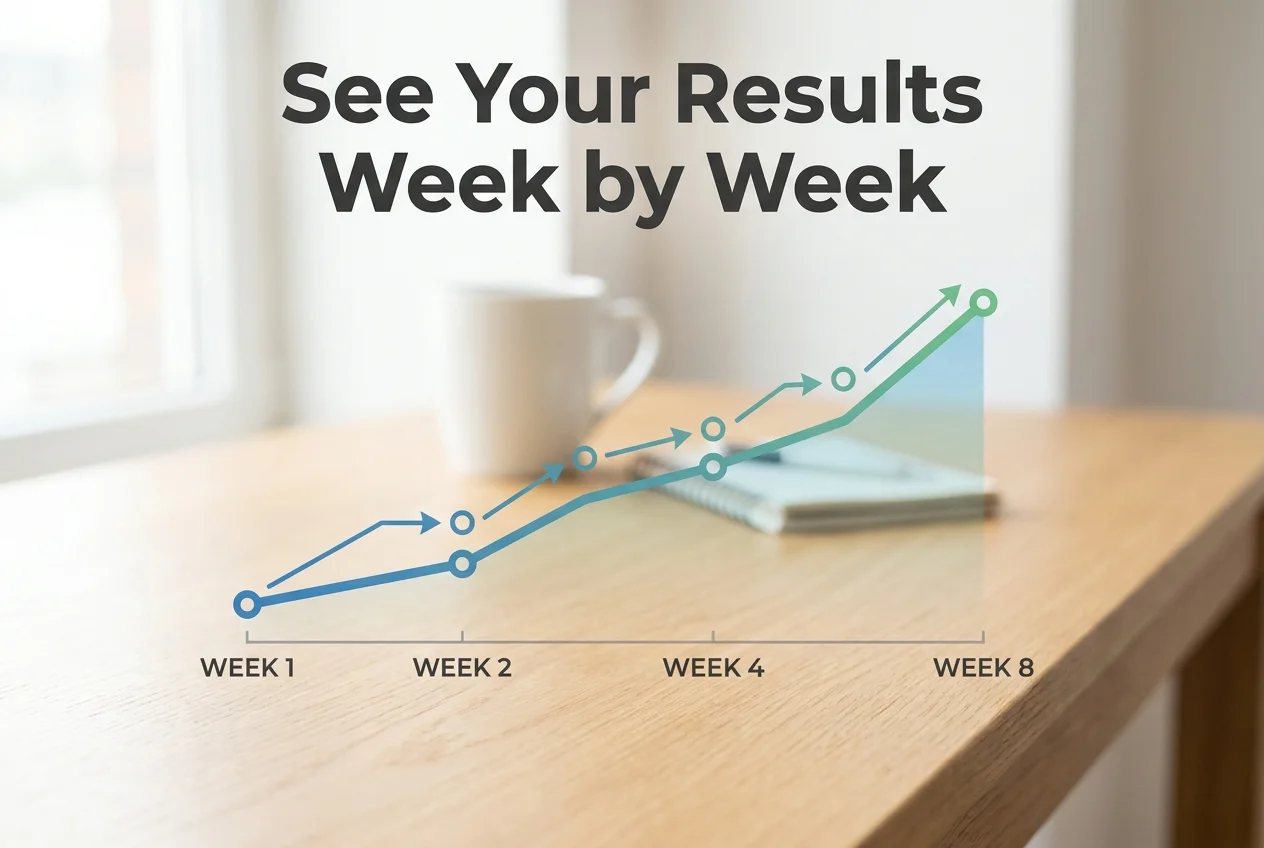 Week-over-week trend lines catch what a single bad day can't.
Reality check: A trend across ten logged days beats a gut feeling about "how this cycle's been going" almost every time — memory smooths over the details that actually matter.
None of this replaces a doctor. It does replace guessing, which is what most people are doing right now with a vial in the fridge and no system underneath it.
Why PeptideIQ Is Different From Other Peptide Trackers
PeptideIQ's Protocol Hub shows cycle day, next dose time, and doses remaining per vial on one card per peptide — plus adherence tracking and AI insights that generic loggers don't attempt. Open PepTracker or PeptideKit and you get a calendar. Open PeptideIQ and the app tells you where you stand and what's next, without you doing the math.
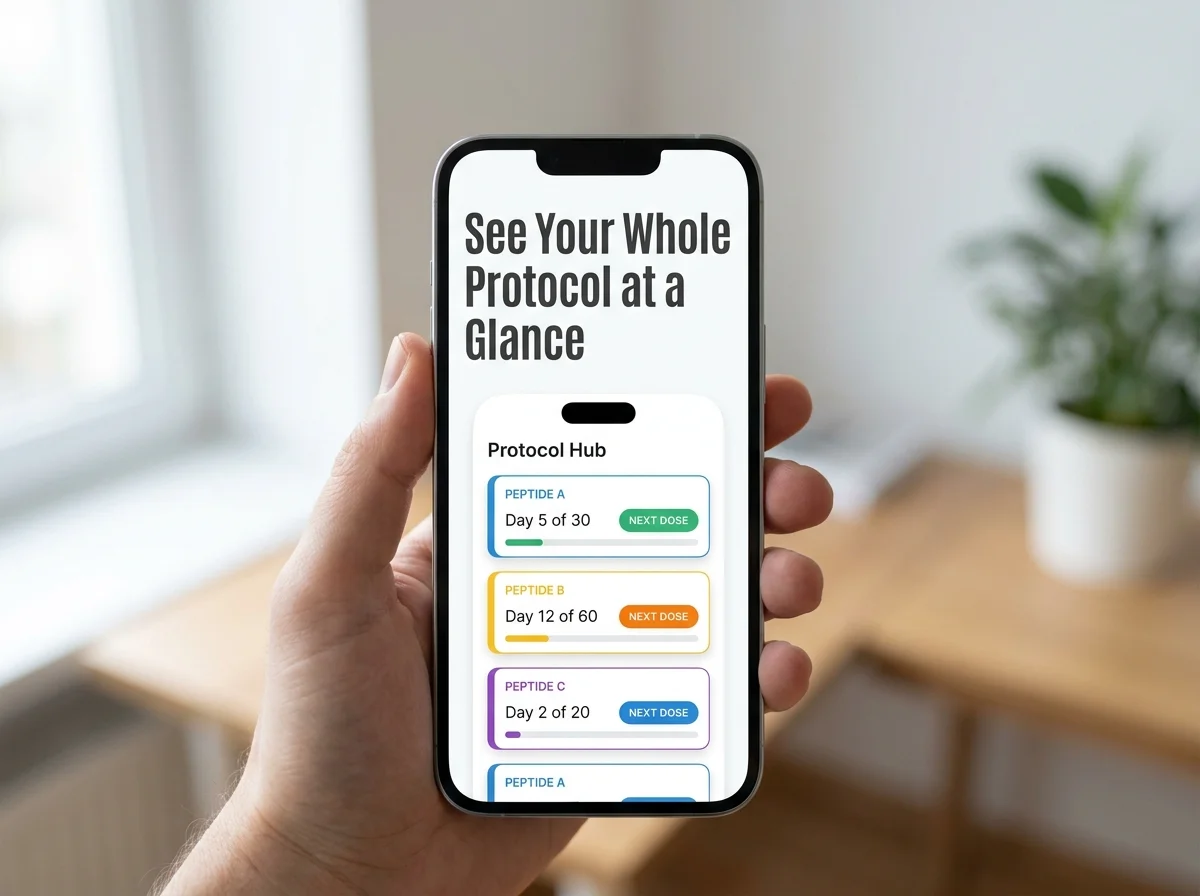 One card per active peptide — cycle day, next dose, and doses remaining, at a glance.
The gap shows up clearest with generic loggers: they record that a dose happened. They don't know the dose was Day 6 of BPC-157 at 250mcg twice daily, that energy scores have sat at 4/10 for three days, or that sleep was logged poor on two of the last three nights. PeptideIQ's AI co-pilot starts every conversation already holding that context — which is the difference between "is this normal?" getting a generic answer and getting one that actually applies to the person asking.
For a longer look at what that means in practice, our PeptideIQ review breaks down the Protocol Hub, the reconstitution calculator, and the AI co-pilot in detail. If you're still deciding what PeptideIQ actually is before going further, start here.
Experienced users — the ones already running three peptides off a chaotic Notes app — tend to want this the most. Not hand-holding, just a system that finally organizes what they already know how to do. Beginners get the reverse benefit: a structure that thinks for them until they don't need it to anymore.
Think of the weekly insight cards as something closer to a peptide journal that reads its own entries back to you, annotated. That framing matters more once you've logged enough days that patterns start to actually show up in the data.
Get Started with PeptideIQ
If you're currently choosing between a spreadsheet and a generic logger, you're choosing between two versions of "you do all the thinking." PeptideIQ is available now on iOS, with the Protocol Hub, reconstitution calculator, and AI co-pilot in one focused system.
Download PeptideIQ on the App Store
Frequently Asked Questions
What is the best peptide tracker?
There isn't one app that's objectively best for everyone — it depends on whether you want basic dose logging or a system that also interprets your data. PepTracker and PeptideKit handle scheduling well. PeptideIQ adds reconstitution math, injection site rotation, and AI insights on top of that logging layer.
What's the best free app to track peptide injections?
Free options exist among the generic loggers, but "free" usually means basic dose reminders with no reconstitution calculator or AI guidance included. A spreadsheet is technically free too — the real cost shows up as manual math and no pattern detection over time.
Is there a peptide calendar or schedule feature in tracking apps?
Most dedicated peptide apps include some form of calendar view showing scheduled and completed doses. The better implementations also track cycle phases and dose escalation automatically, rather than requiring you to manually update the schedule every few weeks.
Where is the best place to inject peptides, and can an app help with rotation?
Common sites include the abdomen, thigh, and upper arm, rotated to avoid overusing one spot. A good tracker shows a visual body map marking recently used sites and recommends the next one automatically, based on your logged history rather than memory.
Is PeptideIQ free to use?
PeptideIQ uses a freemium model — core protocol tracking is free, with the AI co-pilot and advanced analytics available through an optional Pro subscription.
Is PeptideIQ available for Android?
Not yet. PeptideIQ is available on iOS now, with Android planned for a later phase.