
Best Peptide Tracker 2026: Top Apps Compared | PeptideIQ
The Best Peptide Tracker in 2026: 5 Options Compared for Every Protocol
Most people spend weeks researching which peptide to take. They spend 20 minutes finding the best peptide tracker — then wonder why they can't tell if it's working.
Tracking is not a bonus feature. A peptide protocol without a structured system produces noise, not data.
You can't optimize a dose you can't measure. You can't catch a pattern you never logged.
Key Takeaways
- A dedicated peptide tracker removes guesswork from protocol management — you log doses, side effects, and wellness metrics in real-time so you can see what actually works
- The best trackers combine dose logging with progress analytics, showing you week-over-week trends so you can adjust your protocol with confidence
- PeptideIQ's guided system handles the complexity for you: it knows your cycle phase, suggests injection sites, flags potential side effects, and provides AI insights based on YOUR specific data — not generic advice
- Most serious peptide users switch from spreadsheets to dedicated trackers because dose calculations, reminders, and site rotation become impossible to manage manually after week 2
- Structured tracking correlates directly with protocol adherence: users on tracking systems report higher consistency, better side effect management, and measurable progress vs those guessing week-to-week
Contents
- What Is the Best Peptide Tracker for Your Protocol?
- How Do the Top Peptide Trackers Compare?
- What Features Make a Peptide Tracker Worth Using?
- Why Do Serious Peptide Users Need Dedicated Tracking Software?
- Which Peptide Tracking App Is Best for Beginners?
- What Makes the Best Peptide Tracker? The PeptideIQ Advantage
- Can a Peptide Tracker Improve Your Results?
- What Should You Track in Your Peptide Protocol?
- Try PeptideIQ Free
- Frequently Asked Questions
What Is the Best Peptide Tracker for Your Protocol?
The best peptide tracker in 2026 depends on your protocol complexity. For single-peptide GLP-1 users focused on basic dose reminders, PepTracker handles the essentials well. For anyone running a multi-peptide stack, managing dose escalation phases, or wanting AI insights grounded in their specific cycle data — PeptideIQ is the only app built to that standard.
 Choosing the right peptide tracker shapes whether you see results — or just hope for them.
The honest reality of the current market: most "peptide trackers" are dose loggers with reminder notifications. They record that you injected. They don't know what you're injecting, where you are in your cycle, or what your logged data actually means.
PeptideIQ differs because the AI co-pilot is initialized with your specific protocol, cycle day, wellness history, and goals every single session. That distinction matters when you log fatigue on Day 6 and want to know whether it's normal — not a generic answer, but one tied to your BPC-157 dose and the energy trend you've logged over the past week.
If you want a broader comparison of apps beyond tracker-specific functionality, the best peptide app guide covers four options compared across every user type.
How Do the Top Peptide Trackers Compare?
 Feature parity on dose logging is table stakes — the real comparison starts with what happens after you log.
| Feature | PeptideIQ | PepTracker | PeptideKit | Smart Peptide Tracker | Spreadsheet |
|---|---|---|---|---|---|
| Dose logging with timestamps | ✓ | ✓ | ✓ | ✓ | Manual |
| Injection site rotation (auto) | ✓ Body diagram | ✗ | ✓ | ✓ | ✗ |
| Dose escalation phase planner | ✓ Visual timeline | ✗ | ✗ | ✗ | Manual |
| Reconstitution calculator | ✓ With syringe visual | ✗ | ✓ | ✓ | Manual |
| AI insights (protocol-specific) | ✓ Knows your cycle | ✗ | ✗ | ✗ | ✗ |
| Weekly AI insight cards | ✓ Every Monday | ✗ | ✗ | ✗ | ✗ |
| Bloodwork tracker | ✓ | ✗ | ✗ | ✗ | Manual |
| Wellness metric tracking | ✓ (4 sliders per dose) | Basic | ✗ | ✗ | ✗ |
| Multi-peptide stack support | ✓ | ✓ | ✓ | ✓ | Manual |
| Platform | iOS | iOS | iOS | Android | Any |
| No subscription for AI | Freemium (planned) | N/A | N/A | No sub | N/A |
Reality check: Every tracker above does dose logging. The question is what happens after you log. Most apps stop at the record. PeptideIQ feeds every log into an AI co-pilot that references your full context on the next session — cycle phase, energy trend, logged side effects, and goal.
What Features Make a Peptide Tracker Worth Using?
A peptide tracker worth using does five things: logs every dose with a timestamp, guides injection site rotation to prevent tissue buildup, handles reconstitution math automatically, monitors side effects and wellness week-over-week, and connects all of that data into insights that tell you whether the protocol is actually working.
The gap between basic dose loggers and protocol-intelligent trackers is wider than most people realize before they start tracking.
Injection Site Rotation
Repeated injection into the same subcutaneous site causes lipohypertrophy — hardened fatty tissue that absorbs peptides inconsistently. Smart rotation prevents this, but tracking it manually fails within a few weeks.
PeptideIQ uses a front/back body diagram with color-coded sites: green (available), yellow (used in the past 48 hours), red (used today). The app recommends the next site automatically — no mental calculation, no crossed entries in a notebook.
Dose Escalation Phase Planning
GLP-1 protocols always involve titration. Semaglutide typically starts at 0.25mg weekly and escalates over months. Growth hormone peptide stacks often run structured phases with different dose targets per block.
No spreadsheet handles phase transitions automatically. PeptideIQ's cycle planner includes a visual phase builder: Phase 1 at dose X for weeks 1–4, Phase 2 at dose Y for weeks 5–8, with automatic phase transitions and confirmations when the timing arrives.
Wellness Metrics and Correlation
After each dose, PeptideIQ surfaces four quick sliders: Energy (1–10), Mood (1–10), Sleep quality (1–10), and a goal-adapted metric — pain score for recovery, weight trend for GLP-1, recovery score for performance. Under 30 seconds, compounded over 12 weeks into the most actionable data you'll have about your protocol.
For a deeper look at the logging layer specifically, the peptide log app guide covers the core requirements.
Why Do Serious Peptide Users Need Dedicated Tracking Software?
Spreadsheets and notes apps fail peptide protocols for three structural reasons: they don't send fasting reminders, they can't automate dose escalation transitions, and they have no mechanism to surface patterns. Week 6 of a CJC-1295 protocol looks identical to Week 1 in a spreadsheet — no trend, no context, no signal.
Manual trackers capture what you remember to write down. A dedicated app captures what you actually did, at the moment it happened. Retrospective logging is consistently inaccurate — dose amounts drift, side effect notes get skipped, and the precise timing context disappears.
If you're running multiple peptides with different half-lives and fasting requirements, a spreadsheet cannot send the right alert at the right moment. A dedicated peptide tracker app does — and the difference compounds across an 8-week cycle.
Worth knowing: Ipamorelin, CJC-1295, Sermorelin, and Tesamorelin all require fasted administration for optimal effect. PeptideIQ automatically enables the fasting window timer when these peptides are added to a protocol — firing a nudge 30 minutes before the injection window and a confirmation when the fasting threshold is met.
Which Peptide Tracking App Is Best for Beginners?
For beginners, the best peptide tracking app is one that handles the reconstitution math, shows exactly where to inject, and removes the paralysis that comes with a vial in the fridge and no system. PeptideIQ's onboarding detects injection experience at the first screen — first-timers get a visual syringe guide and reconstitution walkthrough built into every step.
Most tracking apps assume you already know what you're doing. They present a form. They don't calculate, and they don't adjust for where you are in the learning curve.
PeptideIQ's syringe illustration shows exactly where to draw — "Draw to the 15 unit mark" — calculated dynamically from your vial concentration and target dose. Within a 6-hour missed-dose window, the app sends a gentle nudge with options that account for late logging, late dosing, or deliberate skip — each with peptide-specific guidance.
What Makes the Best Peptide Tracker? The PeptideIQ Advantage
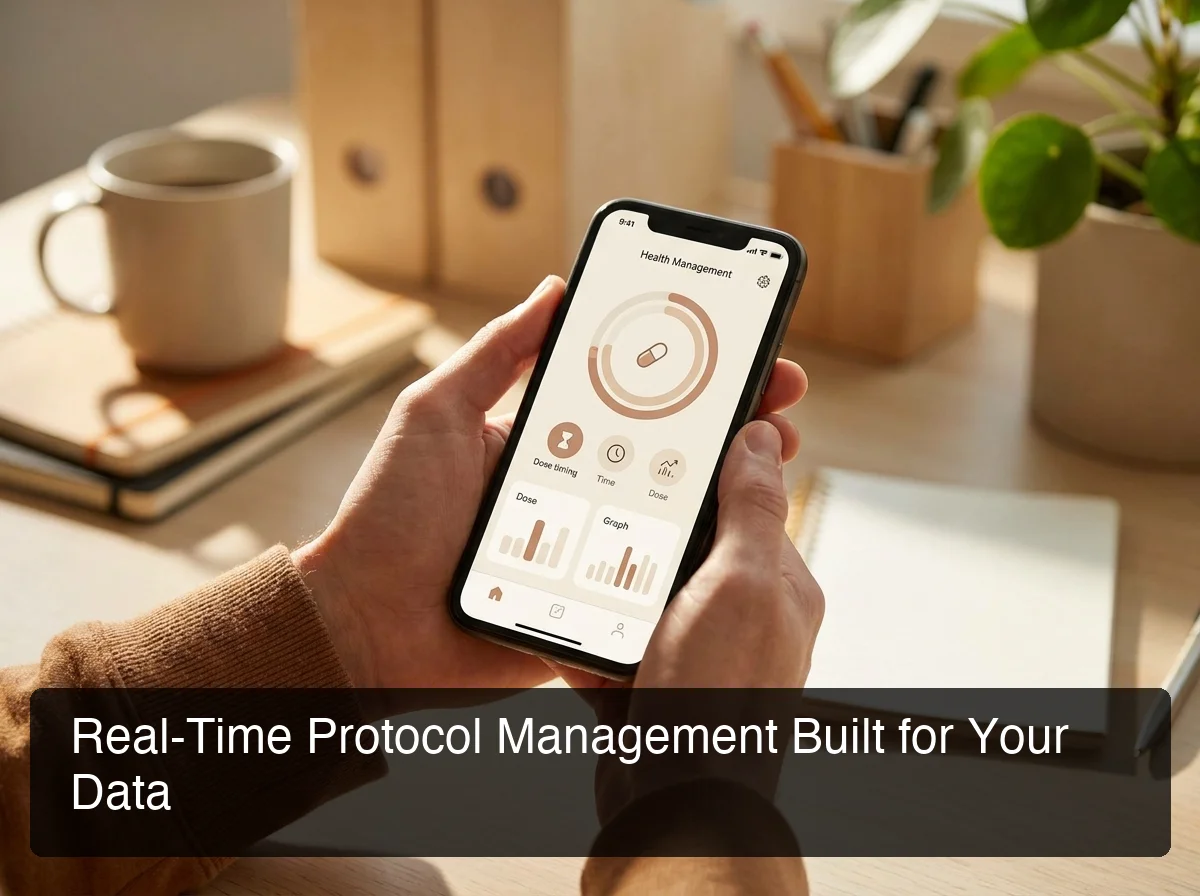 The Protocol Hub answers three questions the moment you open the app: where you are in your cycle, what you need to do today, and how it's going.
Every tracking tool on the market puts the user in charge of the thinking. PeptideIQ inverts that.
The Protocol Hub — the home screen — answers three questions immediately: where am I in my cycle, what do I need to do today, how is it going. One card per active peptide shows cycle day and week (e.g., "Day 14 of 56"), a visual progress bar, next dose time and amount, and doses remaining. Stack users see cards stacked vertically, color-coded per peptide.
Weekly AI Insight Cards
Every Monday, PeptideIQ generates an AI insight card based on that week's actual logged data — specific to your cycle phase, your metrics, and your goal.
Example: "Week 3 — Your average pain score dropped from 7.2 in Week 1 to 4.8 this week. That's a 33% reduction. BPC-157 protocols typically show the most improvement between weeks 3 and 6."
That specificity — tied to your data, not a category average — is what separates a tracking system from a tracking tool.
Protocol Intelligence Per Peptide Type
PeptideIQ knows that growth hormone peptides operate differently than GLP-1s. The fasting timer activates automatically for GHRH peptides like CJC-1295 and Ipamorelin — which lose effectiveness outside a fasting window — but not for GLP-1 compounds that don't require it. That protocol-aware logic is absent from every competitor on this list.
The AI co-pilot holds full stack context. Ask "should I add BPC-157 this cycle?" and the response knows your current cycle day, energy trend, and active stack — not a generic compound answer.
Can a Peptide Tracker Improve Your Results?
A peptide tracker improves results by improving adherence, surfacing patterns you'd miss in manual logs, and catching side effects early enough to act on. A single missed injection on a GLP-1 titration timeline can delay the escalation phase by an entire week — and distort the data you'd use to evaluate whether the protocol is working.
The adherence math alone makes the case. One week with 85% adherence — two missed days — looks like a compound underperforming. Consistent tracking data shows you it wasn't the peptide.
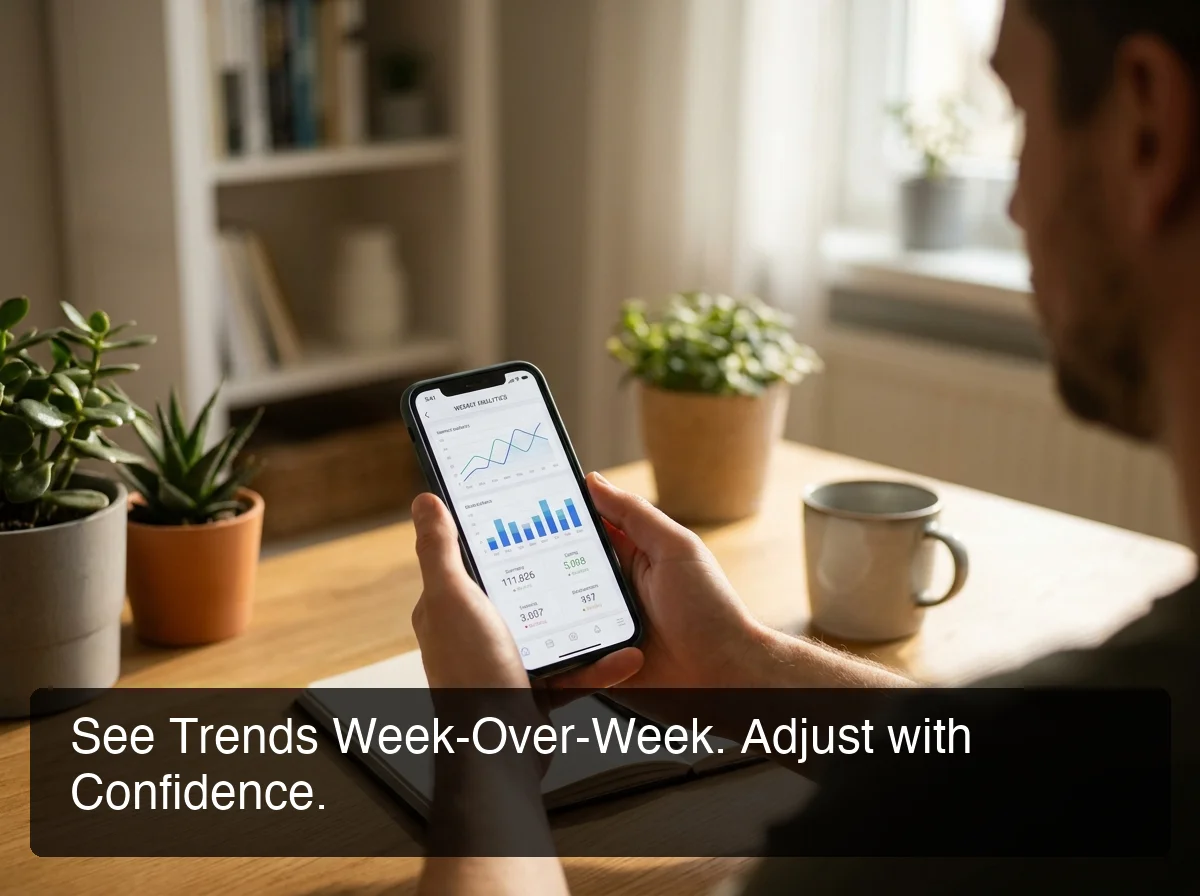 Week-over-week insight cards translate your logged data into protocol adjustments — specific to your cycle, not generic advice.
PeptideIQ surfaces patterns explicitly. If energy sliders drop for three consecutive check-ins, the AI automatically prompts: "You've logged lower energy for 3 days in a row. Tap to understand why." That prompt is tied to your dose timing, cycle phase, and recent side effect log — not a generic fatigue response.
Correlation Is What Manual Systems Miss
Side effects don't exist in isolation. Headache plus hydration below 50% of daily goal is a different signal than headache with full hydration.
Fatigue on Day 6 of BPC-157 means something different from fatigue on Week 2 of semaglutide. Only structured logging creates the context that separates signal from noise.
GLP-1 users tracking semaglutide or tirzepatide have specialized tracking needs — nausea pattern logging, weight trend correlation, and titration milestone tracking — areas that upcoming semaglutide-specific tracking guides will cover in depth.
What Should You Track in Your Peptide Protocol?
Effective peptide tracking covers seven data streams:
- Dose and timing — exact amount, administration time, days elapsed in cycle
- Injection site — which site, rotation history, local reactions
- Wellness metrics — energy, mood, sleep quality, goal-specific metric
- Side effects — symptoms with severity (mild/moderate/severe), timestamped
- Vial inventory — doses remaining, reconstitution date, expiry
- Body weight and measurements — for weight loss or composition protocols
- Bloodwork — hormone panels and metabolic markers over the cycle
Most people track 1 and 3, loosely. Items 2, 4, 5, and 6 are what let you analyze a protocol with confidence — and they're where manual systems break down first. If you're evaluating whether PeptideIQ fits your situation, the what is PeptideIQ article covers the system's full design philosophy.
Try PeptideIQ Free
If you're running a peptide protocol — whether it's Day 1 of BPC-157 or Week 8 of semaglutide — a system that thinks alongside your data beats any spreadsheet or notes app.
PeptideIQ is the only peptide tracker with Protocol Hub intelligence, automated injection site rotation, dose escalation phase planning, and weekly AI insights grounded in your specific cycle. PeptideIQ is available to download now on the App Store.
Download PeptideIQ on the App Store
Frequently Asked Questions
What is the best app to track peptide injections?
PepTracker handles basic dose logging and reminders on iOS. For protocol-intelligent tracking — injection site rotation, dose escalation planning, and AI insights grounded in your specific cycle — PeptideIQ is the most complete option. It's the only tracker that simultaneously knows your cycle day, wellness trend, and current dose phase.
Is there a free peptide tracker?
PepTracker, PeptideKit, and Smart Peptide Tracker all offer free core functionality. PeptideIQ uses a freemium model: core protocol tracking and dose logging are free, with the AI co-pilot and advanced analytics on an optional paid tier.
What features should I look for in a peptide tracking app?
Look for: dose logging with timestamps, injection site rotation guidance, a reconstitution calculator, side effect tracking with severity levels, and week-over-week progress charts. AI insights personalized to your cycle are the top-end differentiator. Dose escalation planning matters for any titrated compound — GLP-1s and GHRPs both require it.
Do peptide trackers work for beginners with no injection experience?
Yes, but only well-designed ones. PeptideIQ detects injection experience at onboarding and activates the visual syringe guide and reconstitution walkthrough for first-timers — each dose log shows which site to use next, labeled anatomically, and the calculator handles BAC water volume, concentration, and syringe units automatically.
Can I track multiple peptides in one app?
Yes. PeptideIQ supports multi-peptide stacks with separate protocol cards per compound — color-coded, with individual cycle timelines and fasting timers where required. The AI co-pilot holds context for all active protocols simultaneously, so questions like "does NAD+ interact with my current stack?" get answered with your full stack in view.
What is the difference between a peptide log app and a peptide tracker?
A peptide log app records what you did. A peptide tracker adds structure, reminders, and analysis — turning raw entries into protocol intelligence with cycle planners, injection site guidance, reconstitution calculators, and trend charts. For the full breakdown, the peptide log app guide covers the logging layer specifically.